The Question Beneath All Questions
The field of Kurukshetra lay empty. Where two worlds of men had stood in arms, there was now only wind, and the wind carried a fine grey dust across ground that had drunk more blood than it had ever drunk rain. In the midst of that emptiness, on a bed that no hand had made, lay Bhishma. The arrows of his own grandson held him a hand's breadth above the earth, and he would not consent to die until the sun turned northward.
The sons of Pandu came to him each morning, and Krishna came with them, and the great sages sat in a ring at a little distance, listening.
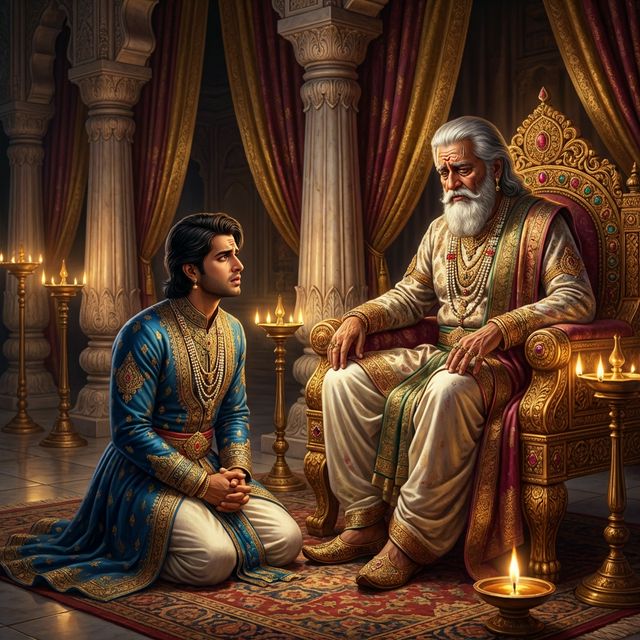
Yudhishthira sat down at the old man's feet. He had been crowned; the anointing water had dried in his hair; and he had the look of a man who has been handed a lamp and told to carry it through a house that he himself set alight.
"Grandfather," he said, "they tell me I am king. They tell me the earth is mine, and since they told me so I have not been able to eat. I have heard the duties of kings recited since I was a boy. I know how a king should sit, and how he should walk, and whom he should set to guard his granaries. I do not want to hear those things again."
"What do you want to hear?" said Bhishma.
"The question that lies underneath them," said Yudhishthira. "Why should a good man rule at all? Rule is killing. Rule is the spy, the tax and the executioner. A man who wishes to keep his hands clean goes to the forest and lives on roots. Tell me why he should not."
The sages said nothing. Krishna, sitting a little behind Yudhishthira, said nothing either.
Bhishma turned his head upon the arrows, and for a moment something that was almost pleasure moved across the ruin of his face.
"You have asked the last question first," he said. "That is well. Then I shall answer you from the beginning of the world."
The Law of the Fishes
"There was a time," said Bhishma, "when there was no king upon the earth, and no punishment, and no man whose office was to punish. There was no need of any of them. Men guarded one another by dharma alone. Each knew his duty as he knew his own hand, and did it, and the doing of it was itself his protection.
"Then dharma grew thin. Greed came first, and after greed delusion, and after delusion desire, and after desire the loss of shame. Men who had known their duty forgot it, and men who still remembered it saw no reason to keep it while their neighbours did not. The Vedas went unstudied. The sacrifices stopped. The gods received nothing, and the earth received everything.
"And then, Yudhishthira, there began upon this earth what the wise call matsya-nyaya, the law of the fishes. You have seen it in any pond. The great fish eats the small fish, and no wrong is done in the pond, because there is nobody in the pond to say that a wrong has been done. So it was among men. The strong took and the weak were taken. A man kept his daughter until a stronger man saw her. Nothing belonged to anyone. Nothing could be built, because nothing could be kept. And even the strong could not rest, for there is always someone stronger, and he too must sleep at night.
"The gods went in fear to Brahma, for a world without dharma feeds nobody, neither man nor god; and out of that fear came the science of rule, and out of the science of rule came the king.
"Men went to Manu and said, be our king. And Manu refused them. He said, the work of a king is full of sin; men are crooked, and one who governs the crooked must handle crookedness. Then they promised him a fiftieth part of their cattle and their gold, and a tenth of their grain; and they said, of every merit we earn a fourth shall be yours, and of the sin you take on in guarding us, that also we shall carry with you. So Manu consented, and walked out among them, and the strong left off eating the weak.
"That is where kings come from. Not out of heaven. Out of the fear of the pond."
The Rod That Sleeps
"Of all the duties of a king," Bhishma went on, "one is the root and the others are branches. Protection.
"The brahmin at his recitation, the merchant over his tallies, the farmer with the seed in his fist, the widow with her small hoard buried under the floor, the child asleep in an open doorway - each of these is a shape that a life takes only where life is safe. Charity, truth, penance, hospitality: name me any virtue you please and it is a plant, and protection is the ground it stands in. A hunted man gives no alms. A woman who expects to be carried off does not sit teaching her son the Veda. Where men sleep unafraid, dharma grows of itself, and the king who gave them that sleep takes a fourth part of the merit of every good act done in his realm. Where they sleep afraid, he takes a fourth part of the sin."
"And the instrument?" said Yudhishthira.
"Danda," said Bhishma. "The rod. Punishment. Do not flinch from the word, for the word is the whole of your office. Danda is dharma lying asleep. While men keep dharma awake in themselves the rod lies still and nobody sees it. When they let it sleep, the rod wakes up in the king's hand; and it is terrible, and it is dharma even so. The rod is awake while the city sleeps. The wise say that the rod is not the servant of dharma but dharma itself, wearing iron.
"And it must fall where it has been earned, Yudhishthira. Not upon the poor because they are near at hand, and not away from the great because they are dear. When you spare a friend you have not been merciful; you have taken the price of his crime out of a stranger. There will come a day when you must raise the rod against a man who called you brother across the marriage fire. If your hand shakes on that day, every subject you have will know within a week that the rod is only a rumour, and the pond will begin to fill again."
"And if it falls too heavily?" said Yudhishthira.
"Then you are no king. You are the calamity that men hire kings to keep away. Hear now how a king may take from his people without eating them."
The Bee and the Flower
"A king lives on what other men have grown," said Bhishma. "There is no help for it. He does not plough, and yet he eats; he does not weave, and yet he is clothed; and the armies that keep the roads open are fed out of other men's granaries. So the question is never whether a king takes. The question is only how he takes.
"Take as the bee takes. The bee comes down upon the flower, drinks what it needs, and goes; and the flower is not torn, and the bee may come again tomorrow, and the year after there are more flowers than before. Take as the calf takes from the cow, drawing what it needs and leaving the udder something for the evening. Take as the gardener takes, who plucks the ripe fruit and comes back to the same tree every season of his life.
"Do not take as the charcoal-burner takes. He also wants something of the tree, and he gets it in a single day: he fells it, and burns it, and carries off one basket of coals, and next year he must go looking for another forest. A king who empties his kingdom in one season has made a charcoal-burner of himself, and there is no second kingdom waiting for him beyond the hill.
"Milk your realm as a wise man milks a cow, gently and in season, and it will be milked all your life long. Wring it, and it will kick you, and go dry, and hate you while it does so. And remember that grain is not the only thing you take from them. You take their sons for your wars and their years for your roads.
"But the best likeness is this one, Yudhishthira, and I would have you keep it. Be as a woman who is carrying a child. She wants what she wants: the food she likes, the bed she likes, the hour of sleep she likes. She sets them all aside for the sake of the thing she carries, and she does not call it a sacrifice. She calls it plain sense. Your kingdom is what you carry. Your own pleasure weighs nothing against it. From today your food is medicine, your sleep is duty, and your anger is a public act."
The King Is the Age
"There is an old question among the wise," said Bhishma. "Is the age the cause of the king, or the king the cause of the age? Do not argue it. The king is the cause.
"When a king rules in whole dharma, when he protects without partiality and lets no man devour another, then that age is the Krita, the golden age, and men will say that they were fortunate in their times. When he rules by three parts dharma and one part appetite, the age is the Treta. When he halves it, it is the Dvapara. And when he abandons dharma altogether, when he hunts while petitions rot at his gate and lets the strong eat the weak in his own market place, then that age is the Kali, and he made it. His people will say that the times are evil, and they will not know that the times are a man. The age does not come down out of the sky, Yudhishthira. It walks out of the palace gate every morning."
Yudhishthira sat a long while without speaking. The wind moved over the field, turning up the feather of a broken arrow. Krishna did not speak, but he was watching Yudhishthira's hands, which had stopped shaking.
"I came here," said Yudhishthira at last, "meaning to ask your leave to go into the forest. I see now what I was really asking. I was asking to be allowed to keep my hands clean while other men were eaten. The forest would have been easier. Fasting is easier. Silence is easier. There is no austerity as hard as sitting in a hall from dawn to dusk and being just to men one does not like."
"Now you are a king," said Bhishma.
"And my grief?" said Yudhishthira. "It is the last thing I own that is only mine."
"It is a luxury," said Bhishma, "and a king cannot afford it. Grieve as a private man for one hour before the sun comes up. When that hour is over, the day belongs to the people who are still alive."
The sun was going down over the field. Krishna rose and helped Yudhishthira to his feet, and said only, "Come again tomorrow." And they came again the next day, and for many days after that, until the old man on the arrows had emptied himself of everything he knew.
Dharma Lesson
Protection is the root of every other virtue, because no virtue grows where people cannot sleep unafraid. The rod of punishment is dharma asleep, and it must fall on friend and kinsman exactly as it falls on strangers, or it stops meaning anything at all. A king takes from his people as a bee takes from a flower, never as the charcoal-burner takes from the tree; and because he makes the age his people live in, his private grief is an indulgence he no longer owns.