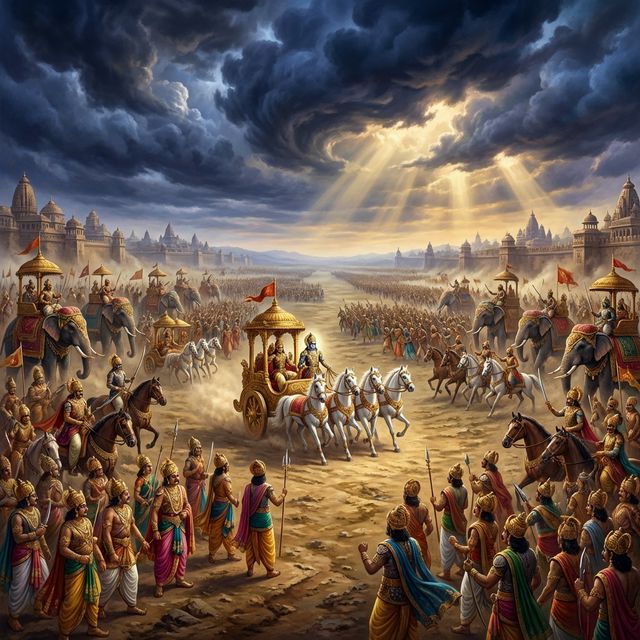
The Rewards of the Eighteen Parvas
Vaishampayana prices each stage of hearing the Bharata against a sacrifice, from the Agnishtoma to twenty-one thousand years with Indra
The Question After the Story
Janamejaya had heard the whole of it by then. The snake sacrifice at Takshasila was finished, the fires had been let down, and the king who had begun the rite in order to burn a race of serpents had sat through eighteen books of a history instead. He had asked who the dead of Kurukshetra had turned out to be, and he had been told. Bhishma had gone back into the Vasus. Drona had entered Brihaspati. Karna had gone into the sun.
What he asked next was not about the story. It was about the hearing of it.
"O holy one," Janamejaya said, "according to what rites should the learned listen to the Bharata? What are the fruits acquirable by hearing it? What deities are to be worshipped during the several paranas? What should be the gifts that one should make, O holy one, at every parva or sacred day during the continuance of the recitation? What should be the qualification of the reciter to be engaged? Tell me all this."
A recitation of the Bharata is not the work of an afternoon. It is taken in stages, over days, and a parana is the end of one of those stages: the pause in which the listener breaks his fast, the day's portion is closed off, the brahmanas are fed and the gifts are made. Ten paranas carry a man from the first line of the history to the last. Janamejaya was asking what a man who sat through all ten of them had bought.
Vaishampayana, the disciple of Vyasa, who had been the mouth of the whole recitation from its beginning, answered him.
"Hear, O king, what the procedure is, and what the fruits are that will spring from one's listening. Even this, O king of kings, is what thou askest me. The deities of Heaven, O ruler of Earth, came to this world for sport. Having achieved their task, they ascended once more to Heaven."
That was the first thing he said about the reward, and it was the whole of the reward in one sentence. The gods had come down, played out their business on the plain, and gone home. What they left behind was the account of it. A man could still follow them up by sitting still and listening.
Everything in One Place
"Listen to what I shall tell thee in brief," Vaishampayana said, and then gave the inventory of what is in the book.
In the Mahabharata are to be found the births of Rishis and deities on the Earth. In this treatise are to be seen in one place the eternal Rudras, the Sadhyas and the Viswedevas, the Adityas, the two deities named the Ashvins, the regents of the World, the great Rishis, the Guhyakas, the Gandharvas, the Nagas, the Vidyadharas, the Siddhas, the diverse deities, and the Self-born visible in a body with many ascetics about him. In it are the Hills and Mountains, the Oceans and Seas and Rivers, the diverse tribes of Apsaras. In it are the Planets, the Years, the Half-years and the Seasons, and the whole universe of mobile and immobile entities, with all the gods and the Asuras.
That is the claim on which everything that follows rests. The Bharata is not a chronicle of one family that happens to be long. It is the register of everything there is, gathered in one place, and a man who hears it hears the roll called.
"Hearing their celebrity," said Vaishampayana, "and in consequence of a recitation of their names and achievements, a man that has committed even terrible sins will be cleansed."
Then the practical part. Having with a concentrated soul and a cleansed body heard the history duly from the beginning, and having reached its end, one should make Sraddha offerings unto those foremost of persons who have been mentioned in it. The dead of the story are treated as one's own dead, and fed.
And unto the Brahmanas, with due devotion and according to one's power, large gifts should be made: diverse kinds of gems, and kine, and vessels of white brass for milking kine, and maidens decked with every ornament and possessed of every accomplishment suited to enjoyment, as also diverse kinds of conveyances, beautiful mansions, plots of land, and cloths. Animals also should be given, such as horses, and elephants in rage, and beds, and covered conveyances borne on the shoulders of men, and well-decked cars. Whatever objects occur in the house of the foremost kind, whatever wealth of great value occurs in it, should be given away.
Then the line that ends the list and refuses to stop where a list should stop.
"Indeed, one should give away one's own self, wives, and children."
And one condition on the listener, set down before any reward is named. He should hear it without a doubting heart, with cheerfulness and joy, and as he proceeds listening to its recitation he should, according to the extent of his power, make gifts with great devotion.
The Man Who Reads It Aloud
Before the fruits, the two men who have to be right for the fruits to come.
The listener first. Vaishampayana described the man who succeeds in the matter of a recitation of the Bharata as one devoted to truth and sincerity, self-restrained, pure in mind, observant of those acts which lead to purity of body, endued with faith, and having subjugated wrath. Six things, and not one of them is wealth.
Then the reciter, who is described at greater length than anyone else in the whole section, because the king had asked about him by name.
He should be pure of body and endued with good and pious conduct. He should be robed in white. He should have a complete mastery over his passions and be cleansed of all offences. He should be conversant with every branch of learning, endued with faith, free from malice, possessed of handsome features, blessed, self-restrained, truthful, with his passions under control, and beloved of all for the gifts he makes and the honours of which he is the possessor. A man is not to be engaged for this because he has a good memory. He is to be engaged because he is the kind of man whose mouth the history can pass through without being spoiled.
Then the manner of the reciting, which is set down as exactly as a rule of ritual, because it is one.
He should be seated at his ease, free from all bodily complaints, and with rapt attention. He should recite the text without too much slowness and without a labouring voice, without being fast or quick, quietly, with sufficient energy, without confusing the letters and words together, in a sweet intonation, and with such accent and emphasis as would indicate the sense. He should give full utterance to the three and sixty letters of the alphabet from the eight places of their formation.
Everything in that paragraph is a warning against a particular way of ruining it. Dragging. Straining. Racing. Slurring one word into the next until nobody can hear where a sentence breaks. The instruction is not that the reciter should be moving; it is that he should be audible, and that the sense should be carried on the sound.
And then the opening itself. Bowing unto Narayana, and unto Nara, that foremost of men, as also to the goddess Sarasvati, the word Jaya should be uttered.
Not the name of a king. Not a line of the story. One word, victory, which is the oldest name the history has for itself, said aloud before the first verse.
The First Three Paranas
"Listening to the Bharata, O king, when recited by a reader of this kind," said Vaishampayana, "the listener, observant of vows all the while and cleansed by purificatory rites, acquires valuable fruits."
Then he counted them out, one parana at a time, and he priced each stage of the hearing against a sacrifice, because a sacrifice was the only currency his listener would understand.
When the first Parana is reached, the hearer should gratify Brahmanas with presents of all desirable objects. By doing this, one obtains the fruits of the Agnishtoma sacrifice.
The Agnishtoma is the smallest of the great soma rites, a day's work with a season's preparation behind it, and it is already beyond the reach of most men who ever lived. That is the bottom rung. And the reward is described in the same breath: he acquires a large celestial car teeming with diverse orders of Apsaras who wait upon him, and with a glad heart, and with the deities in his company, he proceeds to Heaven, his heart rapt in felicity.
When the second Parana is reached, the hearer acquires the fruits of the Atiratra vow, the rite that runs through the night without a break in it. Indeed, he ascends a celestial car made entirely of precious gems. Wearing celestial garlands and robes, decked with celestial unguents, and always shedding a celestial fragrance around him, he receives high honours in Heaven.
When the third Parana is reached, he acquires the fruits of the Dwadasaha vow, the sacrifice of twelve days. Indeed, he resides in Heaven for myriads of years, like a god.
Read those three together and the shape of the thing becomes visible. The first gives him a car and a journey. The second gives him a better car and a standing when he arrives. The third stops describing the vehicle altogether and gives him time, and the time is already counted in myriads of years, and there are seven paranas still to come.
Nobody in that sacrificial enclosure could have performed an Agnishtoma, an Atiratra and a Dwadasaha in one lifetime. Three days of sitting still and listening had just been declared to be worth all three.
The Car That Moves at the Will of the Rider
"At the fourth Parana he acquires the fruits of the Vajapeya sacrifice."
The Vajapeya is the drink of strength, the rite a king performs when he wants pre-eminence among kings, and it has a chariot race in the middle of it that the sacrificer is required to win. That is what the fourth day of listening is now worth, and Vaishampayana spends one line on it and moves on.
At the fifth, twice those fruits are his. Ascending a celestial car that resembles the rising sun or a blazing fire, and with the deities for his companions, he goes to Heaven and sports in felicity for myriads of years in the abode of Indra.
At the sixth Parana, twice again, and at the seventh, thrice those fruits become his. And here the account slows down and looks at the car, because by the seventh parana the reward has stopped being a quantity and has become a place.
He ascends a celestial car that resembles the summit of the Kailasa mountains in beauty. It is equipped with an altar made of stones of lapis lazuli and other precious gems. It is surrounded by beautiful objects of diverse kinds and decked with gems and corals. It moves at the will of the rider. It teems with waiting Apsaras. On it he roves through all the regions of felicity, like a second deity of the Sun.
Notice what has been put on board. Not a throne. An altar. The man who sat and listened is given a car with a place of sacrifice built into it, so that whatever else he does up there he can go on doing the one thing that got him there. And it goes where he wants it to go without being driven, which is the oldest description in the language of what it is to be free.
Four days of hearing bought a king's rite. Seven bought a mountain that flies.
Rajasuya, and Then the Horse
"At the eighth Parana," said Vaishampayana, "he acquires the fruits of the Rajasuya sacrifice."
The Rajasuya is the imperial consecration, the rite that Yudhishthira performed at Indraprastha with the kings of the earth carrying his water and his sandals, and it took years of war to make it possible. Eight days of listening are held to be its equal.
He ascends a car as beautiful as the rising moon, and unto it are yoked steeds white as the rays of the moon and endued with the speed of thought. He is served by women of the foremost beauty, whose faces are more charming than the moon. He hears the music of the garlands that encircle their waists and of the Nupuras encircling their ankles. Sleeping with his head resting on the laps of women of transcendent beauty, he awakes greatly refreshed.
That last clause is the most human line in the entire catalogue. Everything else in this heaven blazes and tinkles and flies. This one is about waking up rested.
"At the ninth Parana, he acquires, O Bharata, the fruits of that foremost of sacrifices, the Horse-sacrifice."
The Asvamedha is the rite Yudhishthira performed after the war to be cleansed of the war, and there is nothing above it. A horse is loosed for a year, and wherever it walks a king must submit or fight, and the sacrificer must be able to hold the whole of that.
The car that comes with it is described piece by piece. It is equipped with a chamber whose top is supported by columns of gold. It has a seat made of stones of lapis lazuli, and windows on all sides made of pure gold. It teems with waiting Apsaras and Gandharvas and other celestials. On it he blazes forth in splendour. Wearing celestial garlands and robes and decked with celestial unguents, he sports in bliss, with deities for his companions, in Heaven, like a second deity himself.
The ladder has now run out of sacrifices. There is no rite left in the books that is worth more than the horse. And there is still one parana to go.
Twenty-One Thousand Years
"Reaching the tenth Parana and gratifying Brahmanas," said Vaishampayana, "he acquires a car."
It tinkles with innumerable bells. It is decked with flags and banners. It is equipped with a seat made of precious gems and has many arches made of lapis lazuli, a network of gold all round, and turrets made of corals. It is adorned with Gandharvas and Apsaras well-skilled in singing. And it is fit for the residence of the Righteous, which is the only line in the description that is not about ornament.
The man himself is described last, and he is described as a king. Crowned with a diadem of the complexion of fire, decked with ornaments of gold, his person smeared with celestial sandalpaste, garnished with celestial wreaths, he roves through all celestial regions, enjoying all celestial objects of enjoyment, endued with great splendour, through the grace of the deities.
Then the number.
Thus accoutred, he receives high honours in Heaven for many long years. With Gandharvas in his company, for full twenty-one thousand years, he sports in bliss with Indra himself in the abode of Indra. He roves at pleasure every day through the diverse regions of the gods, riding on celestial cars and conveyances, and surrounded by celestial damsels of transcendent beauty. He is able to go to the abode of the solar deity, of the lunar deity, and of Shiva. Indeed, he succeeds in living in the same region with Vishnu himself.
"It is even so, O monarch. There is no doubt in this. A person listening with faith becomes even so. My preceptor has said this."
That is Vaishampayana putting his teacher's name behind the claim, the way a man does when he knows how large a thing he has just said.
And then, immediately, the bill.
"Unto the reciter should be given all such objects as he may wish. Elephants and steeds and cars and conveyances, especially animals and the vehicles they draw, a bracelet of gold, a pair of ear-rings, sacred threads, beautiful robes, and perfumes in especial. By worshipping him as a deity one attains to the regions of Vishnu."
Twenty-one thousand years with Indra, and the man who reads it out to you is to be treated as a god while he does it.
What Is Owed at Each Parva
After the fruits, the housekeeping. Vaishampayana went through the eighteen books one by one, naming what should be set before the brahmanas as each was reached. The list is a second telling of the epic in food.
During the Astika-parva, fruits and roots, frumenty, honey, clarified butter, and rice boiled with raw sugar. During the Sabha-parva, havisya with apupas and pupas and modakas. During the Aranyaka-parva, when the Pandavas are in the woods, fruits and roots and nothing else. At the Arani-parva, water-pots full of water. During the Virata-parva, diverse kinds of robes. During the Udyoga-parva, perfumes and garlands and food of every agreeable quality.
Then the war books, where the gifts arm the guests. During the Bhishma-parva, excellent cars and conveyances, then pure well-cooked food. During the Drona-parva, food of a very superior kind, and beds, and bows and good swords. During the Karna-parva, food of the foremost kind, presented with a rapt mind. During the Shalya-parva, confectionery and rice boiled with raw sugar, cakes of wheat, and soothing drinks. During the Gada-parva, food mixed with mudga.
Then the books of grief. During the Stri-parva, gems and precious stones. During the Aishika-parva, rice boiled in ghee. During the Shanti-parva, havisya. At the Asvamedhika, food of every agreeable quality. At the Asramvasika, havisya. At the Mausala, scents and garlands, and during the Mahaprasthanika the same. At the Svarga-parva, havisya again. Upon the conclusion of the Harivansa, a thousand brahmanas are fed, each presented with a cow and a piece of gold.
At the end, the book itself is worshipped. One versed in the scriptures, robed in white and purified, should place a copy of the Mahabharata on an auspicious spot, cover it with silken cloth, and worship it with scents and garlands, offering each at a time. Then the names of all the deities should be taken, and of Nara and Narayana. Unto the reciter should be given a copy, a piece of gold, and land, for there is no gift like the gift of land.
"He that listens with devotion to this Bharata from the beginning becomes cleansed of every sin, even if he be guilty of Brahmanicide, or of the violation of his preceptor's bed, or a drinker of alcohol, or a robber of other people's wares, or born in the Chandala order. Destroying all his sins like the maker of day destroying darkness, such a man, without doubt, sports in felicity in the region of Vishnu, like Vishnu himself."
That is the last thing said in the eighteenth book, and it is not about the Pandavas. The history ends by telling the man who has just finished hearing it how to hear it again.
Dharma Lesson
The epic ends by putting a price on itself, and the price is not devotion in the abstract but a fed brahmana, a gift made at the end of each day's hearing, and a reciter treated as a god while he reads. The rewards climb through every sacrifice a king could perform and then past them, which is the text's way of saying that attention given to the whole of this history is worth more than anything wealth can buy. Note what is asked of the listener before any reward is named: hear it without a doubting heart, with cheerfulness and joy. The fruit is promised to the man who was not calculating the fruit.