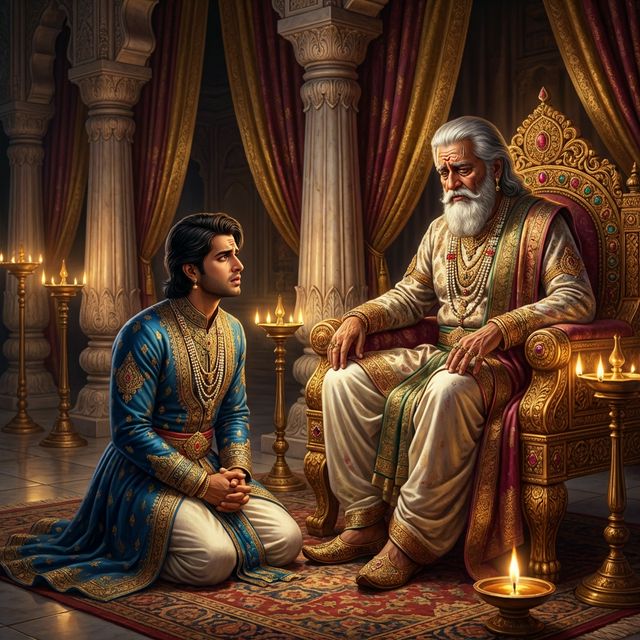
The Quiet Man Who Prayed at Dawn and Dusk
Bhishma turned next to a story smaller in its setting than the ones before it, though he warned Yudhishthira not to mistake its scale for its weight.
There lived, in a village whose name the story does not trouble to keep, a brahmin of perfect discipline whose entire life had folded itself into a single practice. Each morning before the sun cleared the treeline, and each evening as it sank again, he sat in japa - the quiet, unhurried recitation of the sacred Gayatri mantra, syllable following syllable in a rhythm so worn into him that it had ceased, long ago, to feel like effort at all. He performed no great public rites. He gathered no disciples, sought no patronage from kings, and built no reputation beyond the small circle of neighbors who knew him mainly as the quiet man who prayed at dawn and dusk and asked nothing of anyone in between.
He had not begun his recitation with ambition, and he did not continue it with ambition either. He did not recite to be seen reciting, nor to accumulate merit the way a merchant accumulates coin, weighing each day's practice against some ledger of heavenly reward. He recited because the recitation itself had become, over the slow accumulation of years, the shape his devotion took - as natural to him as breathing, and no more calculated than breathing is.
It is said that such purity of practice does not go unnoticed, even by those who dwell far above the modest village where it is performed. Heaven itself, Bhishma said, took notice of this brahmin - not because he had asked it to, but because his recitation had become, without his intending it, a thing bright enough to be seen from very far away.
I Did Not Recite for Wages
In time, the gods resolved to reward what they had witnessed, and word came to the brahmin - by what messenger the story does not specify, only that the offer was unmistakably genuine - that the fruit of his lifetime's discipline stood ready for him: entry into the blessed worlds, the reward reserved for those whose merit has been weighed and found to overflow the scale.
To any other man, the offer might have seemed the completion of a bargain quietly kept for decades. The brahmin, hearing it, did not rise to accept. He considered the offer with the same unhurried attention he gave his recitation, and then he declined it.
'I did not recite for wages,' he said, and the story insists he said it without bitterness or false modesty, simply as a fact requiring correction. 'If heaven is being held out to me now as payment for what I have done, then I must decline the payment, because I never understood myself to be owed one. A laborer who works for a wage may rightly claim it when the work is finished. But I did not sit each dawn and dusk as a laborer sits at his task, counting the hours until the wage came due. I sat because the sitting itself was what I wanted from my life, complete in the moment I performed it, needing nothing added afterward to make it whole. If you offer heaven as the price of my recitation, you misunderstand what my recitation was. Keep it. It was never what I was reciting for.'
The messengers of heaven, unused to having their gifts declined, carried the answer back with something between confusion and awe, for they had offered this reward to countless souls before and none had ever handed it back.
A Contest to Give the Gift Away
The gods, the story says, found themselves in genuine consternation, for their entire economy of reward rested on the assumption that every soul, however disciplined, was still bargaining somewhere beneath its piety - that enough merit, offered plainly enough, would always find a taker. Here was a man beyond their usual currency, and they did not quite know what to do with an offer nobody wanted.
Their confusion deepened further when the story of the reciter became tangled with that of a king - Ikshvaku, ancestor of a great line of rulers, whose own long reign of just governance had likewise accumulated merit beyond the ordinary measure. By some working of cause and consequence that the story treats as simply how such things happen, the king's merit and the brahmin's merit came to touch one another, each man's store of good somehow bound up with the other's, until neither could quite say which portion of the reward belonged to whom.
Rather than quarrel over the division the way two merchants might quarrel over a disputed inheritance, king and brahmin fell instead into a contest of an entirely different kind. Ikshvaku insisted the greater share of merit, and so the greater claim to heaven, belonged to the reciter, whose lifetime of quiet discipline the king professed himself unworthy to match. The brahmin insisted just as firmly that the king's decades of just rule, protecting his subjects and upholding dharma across an entire realm, outweighed the private recitation of one unremarkable man in one unremarkable village. Each pressed the reward toward the other. Neither would keep it.
It was, Bhishma observed to Yudhishthira, a strange sight even by the standards of these old stories - two men competing not for a prize but to give it away, each convinced the other had earned it more, and heaven's messengers standing between them with a gift that, for once, nobody on earth would consent to take.
Communion, Not Wages
The contest resolved itself, in the end, not by one side yielding to the other but by both discovering they had misunderstood the nature of the gift from the start.
What the brahmin wanted, it became clear, was never heaven weighed out as a wage - so many years of recitation exchanged for so many seasons of bliss above. What he wanted, and what he had in fact been receiving all along without naming it, was communion: the felt nearness of the divine that his recitation had been quietly cultivating every dawn and dusk of his life, syllable by syllable, long before any messenger arrived to offer him a reward for it. Heaven granted him that presence directly, unmeasured by any ledger, and he accepted it not as payment but as the recognition of something that had already been true.
The king, for his part, was shown that his own just rule needed no separate reward laid alongside it, for the governance itself, performed rightly and without grasping, had already carried its own completion within it the same way the brahmin's recitation had.
What the reciter had practiced all his life, the story concludes, had never truly been a means to some later end. It had only looked like a means, to onlookers keeping score from outside it. From within, syllable following syllable through every ordinary dawn, it had already been the end - complete in each repetition, asking nothing further of the future to justify what the present moment had already given him.
Let Your Rule Be a Recitation
Bhishma let the tale close before he turned, as he had each time, to the king seated near him on the field.
'Draw the lesson carefully, Yudhishthira, for it is easy to hear this story and think it praises poverty over kingship, or recitation over rule. It does neither. It draws a line, instead, between two ways of performing any act at all, whether that act is a brahmin's mantra or a king's judgment from the throne. Acts done for their fruit - performed with one eye always on the wage they will purchase - buy exactly the fruit they were done for, and no more, and once that fruit is spent, the act itself is spent along with it, gone as completely as a coin handed across a counter. But acts done as devotion, entered into completely for their own sake without a ledger running beside them, are never spent at all. They do not wait on some later heaven to become whole. They are already whole in the doing, and what they yield afterward - if anything is yielded - comes as a recognition of what was true all along, not as a payment for what was owed.
You are about to take up the burden of rule that Ikshvaku once carried, and you will be tempted, as every king is tempted, to measure your reign by what it will purchase for you - the loyalty it secures, the legacy it leaves, the heaven it might one day earn. Set that ledger down. Let your rule be performed the way the reciter performed his mantra - each judgment, each act of protection, each small mercy complete in itself, asked for nothing beyond itself, and you will find that a reign performed that way was never spent, because it was never a transaction to begin with.'
Dharma Lesson
Actions performed for their fruit purchase only that fruit and are exhausted once it is spent, but actions performed as devotion, complete in themselves, are never spent at all. A ruler who performs his duties without grasping at their reward turns even a throne into an offering rather than a transaction.