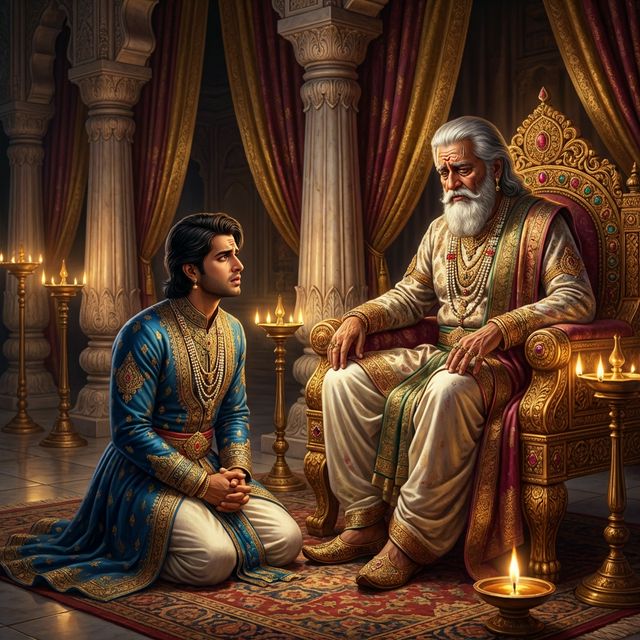
The King Who Could Not Be Shaken
"There was a king in Videha named Janaka," said Bhishma from the bed of arrows, "who once asked the question you have been carrying up and down this field all morning without ever finding words for it. I will give you his question, and I will give you the answer he received, and I ask you to notice that the answer contains no comfort in it anywhere."
Janaka ruled at Mithila, and he ruled it well. He was learned. He kept sages at his court and argued with them and did not always win, which is rarer in a king than victory. The city said of him that he was a man who could not be shaken, and the city said it the way people always say such things, from a distance, in fine weather.
Then a hard season came to him, as one comes to every man who lives long enough. Wealth went out of the treasury and did not come back; there had been drought, and then a war on the border that had to be paid for whether it was wanted or not. Kinsmen died. Some of them died in the order that is bearable and some of them did not. And in the middle of it Janaka noticed one morning, climbing the steps he had climbed for forty years, that he was climbing them slowly, and that he had begun climbing them slowly some time ago without marking the day.
He sent for a brahmin named Ashman, who had a reputation for going straight to the bone of a thing.
"I have counsellors enough for consolation," said the king. "They are very good at it. By the third hour after they leave me it has all worn off and I am sitting here again. So I do not want comfort from you. I want the reasoning.
"My wealth has deserted me. My kinsmen have deserted me. My youth is deserting me while I speak, and life itself will follow the others out of the door. Tell me by what reasoning a man of understanding does not burn when these go. Not how he hides the burning. How he stops it."
"You shall have the reasoning," said Ashman. "It is not pleasant, and it does not wear off."
What Ripens, Falls
"Name them again," said Ashman. "The things that have deserted you. Say them slowly, and after each one tell me when it became yours."
The king began. The treasury. The lands. The strength in his arms. His father. His brother. The two sons of his brother. His own dark hair. He got no further than the third before he stopped, because he had heard what he was saying.
"Every one of them arrived," he said.
"Every one of them arrived," Ashman agreed. "There was a morning before each, when you did not have it and were not the poorer for not having it. Then it came. You did not make it out of yourself. It came to you the way weather comes to a field, and while it stayed you called it yours, and the calling was a habit and not a fact.
"Look at what happens to a fruit. It sits on the branch, green and hard and perfectly attached, and nothing is being done to it by anybody. Time works inside it quietly. The green goes, the sweetness comes, the stem thins, and one afternoon with no wind at all it falls. No thief took it. The tree did not withdraw its love. What ripens, falls. That is not an accident that befell the fruit. That is what a fruit is.
"Your wealth was a fruit and it has fallen. Your youth is a fruit and it is falling now, this month, while we sit here. Your kinsmen were fruit, and so are you. Everything that belongs to the body ripens and drops by time, and the gathering of a thing is only the first half of its scattering."
"You are telling me my losses were inevitable," said Janaka, "and that is exactly what I cannot bear. If a thief had taken my treasury I could hunt the thief. If a man had killed my brother I would know what to do with my hands."
"There it is," said Ashman. "That is your whole suffering, and it is not the losses. You want an enemy, because an enemy can be answered, and you have looked everywhere for one and found nothing but time. And time is not your enemy, king. An enemy attends to you. Time is not attending to you at all."
Day and Night, and the River
"Then teach me to bear it," said Janaka.
"First stop believing that this is a permanent condition," said Ashman. "You are grieving as though grief were the true weather and your good years were a mistake. Sit at the third watch of the night, when everything is black and cold and the lamps have gone out, and try to believe in noon. You cannot. The night persuades you that it is the whole of things. And a man at noon, with the sun on his shoulders, cannot believe in the dark either, which is why he builds so carelessly.
"Joy and sorrow go round in a man the way day and night go round the world. Neither is a visitor. Both are stations on the same wheel, and no man has ever been given one without the other. You have had many turns of it already. You have simply never counted the pleasant ones as turns, because a man notices the wheel only when it puts him underneath.
"Now, what does a fool do in a flood? He faces upstream. He sets himself square against the current and puts out all his strength, because the river is going the wrong way and it has no right to. And he is a strong man, so he holds his place for a while, and then he tires, and the river which was never straining at all takes him and drowns him within sight of the bank he started from.
"The wise man enters the same river and does not fight it once. He turns his shoulder to the current and lets it carry him while he swims across it, and he comes out far downstream from where he meant to, and alive, and on the other side.
"Do not mistake this for lying down. The wise man is not less active than the fool; he is a great deal more, because none of his strength has been spent on the one thing in the world that cannot be moved. Grief is strength spent pushing at the current. Nothing comes back for it. It does not restore one coin of your treasury or one hour of your brother, and it takes from you the very force you would need to do the next right thing."
The Two Wolves
"You have a fortress," said Ashman. "Describe it to me."
Janaka described it, because a king can always describe his fortress. The outer wall, a bowshot thick at the base. The moat, and what lived in the moat. The gate of iron-bound timber that took twenty men to swing. The watch changed four times a night. Tasters at the table. Physicians in the next room. A tunnel out of the inner court that three living men knew of.
"Good," said Ashman. "Now name me the wall that keeps out old age."
The king said nothing.
"Name me the gate that death has not walked through. Name me the sentry who has ever challenged it, or the taster who has ever caught it in the dish. You have built against men, and you have built well; no man will come at you unannounced. But there are two wolves hunting you that have been hunting you since the hour you were born, and they came in with you, past every wall, inside the gate.
"Old age is the first. It does not rush. It takes a little each year and takes it so gently that you sign for the loss without reading it, and then one morning you notice the stairs.
"Death is the second, and it runs behind the first, and it never needs to hurry either, because it knows the one thing that settles the hunt: sooner or later the quarry must stand still.
"They do not tire. They do not sleep. They are not bribed, and they are not deceived by the tunnel that three men know of. And they are not a punishment sent to you in particular. They are running at exactly this speed after every creature in your kingdom, after the ploughman and the ox and the sages at your court and the brahmin sitting in front of you, and none of us is faster than the others by so much as a step."
"You have taken away my last comfort," said Janaka.
"I have taken away your last excuse," said Ashman. "They are easy to confuse. A man who believes he has time is not really living in a fortress. He is living in a story about a fortress, and the story is what has kept him from beginning."
The One Thing Time Cannot Take
"Then what is left?" said the king. "You have shown me that everything I hold ripens and drops, that joy and sorrow are one wheel turning, and that two hunters are closing on me whom no wall stops. What is there that is not taken?"
"One thing," said Ashman. "Conduct already done.
"Time lends and time repossesses. It will have the treasury back, and the strength of your arms, and finally your breath. But the deed you performed last year has gone out beyond its reach, because it is finished. Nothing can unmake it. The judgment you gave honestly when it would have paid to give it otherwise is permanently a judgment given honestly. The man you fed in the famine was fed. Death cannot go back and unfeed him.
"That is the whole of it, king. Not one hour that you already spent well can be taken from you by anything that comes. And every hour spent grieving what is already gone is another hour surrendered for nothing.
"So the conclusion is not to sit still and be wise about impermanence. Fools also sit still. The conclusion is to act, rightly, now, in the hour you are actually holding, because the hour is the only property you have that is not already promised to somebody else."
Janaka rose. Whatever had been sitting on him since that bad season began was not on him when he stood. He went out and gave the day's judgments, and he gave them well, and afterwards he did not speak of what he had lost, because it had stopped being an argument he was having.
"That is the teaching, son of Kunti," said Bhishma. "And I will say the hard part myself, since Ashman is not here to say it to you. You have lost far more than Janaka ever did. Sons, brothers by law and by blood, teachers, friends, and a whole generation of the people you were raised among. Nobody will give them back, and no amount of sitting in this dust moves the river by a finger's width.
"Go up to the city and rule. Do it now. What you do well in the next twenty years is the one possession that will still be yours when the two wolves reach you, and they will reach you, and I would like them to find you busy."
Dharma Lesson
Everything that belongs to the body ripens and falls by time, the way a fruit drops from a branch with nobody to blame for it, and joy and sorrow circle a man as day and night circle the world. The fool spends his whole strength facing upstream against a current that is not even straining, while the wise man turns his shoulder to it and crosses. Old age and death are two hunters that no wall, gate or watch has ever stopped. Therefore act rightly in the hour you are holding, because conduct already done is the one thing time cannot take back.