The Courtesan of Videha
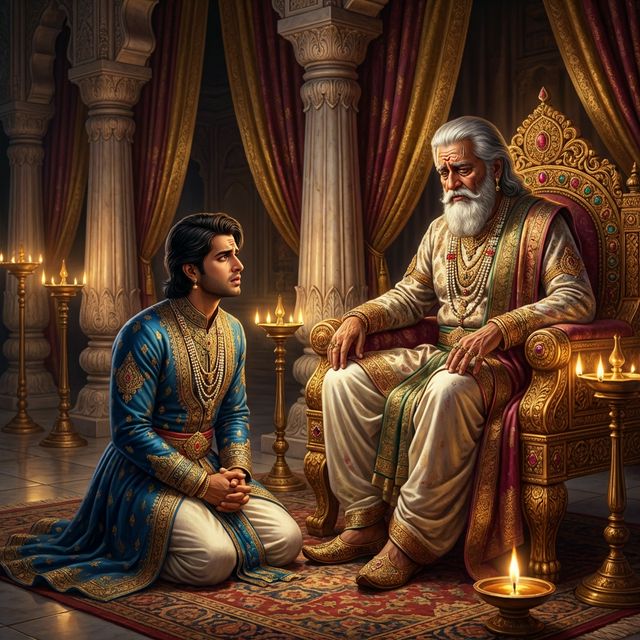
"I shall give you the same teaching in another voice," said Bhishma from the bed of arrows, "because a king does not believe a thing until he has heard it twice, and the second teacher of the moksha-dharma is a courtesan."
Yudhishthira lifted his head, and Bhishma saw the small movement and answered it before it could become a question.
"Wisdom does not inspect the house it is born in. Learn where the lesson is found, or go without the lesson. Her name was Pingala, and she lived in Mithila, in the country of Videha."
She was very good at her trade, which is to say that her whole art was the art of being wanted. She knew what to wear and what to leave off, which lamp to light and how low to set it, when to speak and how long to wait before answering. Men came away from her house believing that they had been the ones doing the choosing. She had put by a little money and she meant to put by a great deal more, and she had settled in her own mind on the manner in which it was going to arrive.
There was a rich man of the city, a merchant with ships on two rivers, who had been coming to her all that season, and who had said, in the loose warm way that such men say things, that he would come to her tonight, and that he would not come empty-handed.
So Pingala prepared. She bathed and oiled her hair and bound it up in the fashion he had once praised. She painted her eyes and reddened the soles of her feet. She put on the good cloth, the one she kept folded away, and the ornaments, and she trimmed the wick and set the lamp in the niche by the door so that its light would fall on her and not on the room.
Then she went and stood in the doorway of her house, in the street of the courtesans in Mithila, and began to wait; and the whole of the teaching is contained in what happened to her while she waited.
The Street of Footsteps
The first watch of the night went by.
Understand that she was not idle. Hope is work, and it is heavy work, and it goes on all night without a rest. There would be a footstep at the far end of the street, and everything in her would rise up and stand at attention; and the footstep would come nearer, and she would learn from the sound of it that the man was walking too quickly, or too lightly, or with the hard heel of a soldier; and the footstep would pass the door and go on and turn the corner, and everything in her would sit down again in the dark.
Then she would go inside and look at herself and find the hair not perfectly right, and take it down and bind it again. Then she would come back to the door. She moved the lamp a little and moved it back. She told herself that a man with ships does not leave his accounts at sunset, that he would come at the second watch, that he was very likely already in the street. Twice she went out barefoot to the corner to look, and came back quickly so as not to be away if he arrived.
There were footsteps enough. Mithila is a large city and its nights are long. Every one of them lifted her and every one of them dropped her, and the lifting was involuntary and the dropping was a small precise injury, and there were a hundred of them between dusk and midnight.
"See what is being done to her," said Bhishma, "and see that nothing whatever is being done to her. No one strikes her. No one robs her. She stands in her own doorway in a rich city in a season of peace, wearing her best cloth, in no danger at all, and she is being tortured for six hours, and the whole engine of it is inside her skull. She is not waiting for a man. She is waiting for the picture of a man that she made herself and hung up in front of her own eyes, and every real footstep in that street is being measured against the picture and found wanting.
"That is hope, Yudhishthira. It is not a comfort that helps a person through a hard night. It is the hard night."
What Am I Doing?
The second watch went. The street emptied in the way streets do, so gradually that there is no moment when it can be said to have happened; and then it was very late, and the lamps in the other houses had gone out one by one, and there were no more footsteps to be ruined by.
Pingala stood in the doorway with her painted eyes and her good cloth and her hair bound in the fashion he had once praised, and she was suddenly and entirely awake.
She looked at the street. She looked at the lamp she had trimmed for a man who was at that moment asleep somewhere with his accounts done and his shoes off, having forgotten by noon a thing he had said the evening before. She looked at her own feet, reddened for him. And she saw the whole shape of it at once, the way a person sees the shape of an illness only when the fever breaks.
"What am I doing?" she said aloud, in an empty street, to nobody. "Look at me. Look what I have sold, and look what I was paid.
"I have sold this night. I shall not be given another one. I sold my sleep, which is the one wealth that a poor woman still owns, and I sold my peace, which is worth more, and I sold them both to a man who is not coming. And he has not wronged me. He has done nothing at all. That is the whole horror of it. There is nobody in this street to be angry with. I built the rack and I climbed onto it and I have been turning the wheel myself since sunset.
"And all this while. All this while there is One who is always here, who does not have to be waited for, who is not detained by his ships, who never sent word and failed to come, who is nearer to me in this doorway than my own breath. I have kept my door open all night for a man who forgot my name at midday, and I have kept it shut against the Lord who has been standing inside the house the whole time.
"I am a fool. But I am a fool who has just this moment stopped."
Hope Is the Highest Misery
And standing there in the doorway, Pingala sang the verses that men have repeated ever since, though she was not a sage, and had composed nothing in her life before that night.
"Hope is the highest misery. Hopelessness is the highest bliss. Pingala has cut off hope, and Pingala sleeps happily tonight.
"Hope is thin and long and very hard to cut, and it does not die of old age. It is the last thing in a man to fail. A dying man in his last hour is still arranging the season after next, and it is that arranging, and not the sickness, that makes his dying bitter.
"I was burning all night and I did not know that I was burning, because the fire had my own wanting for its fuel and my own eyes for its light, and a thing that is inside a person is not felt as heat. It is felt as living. Only when the fire went out did I find out that it had been a fire.
"I have been the property of a man who does not know my name. Now I belong to myself, and being my own is so cheap that I could have had it at any hour of any of these years, and I never once put out my hand for it, because it costs nothing and I was trained to want expensive things.
"Let no one pity me for what I have lost tonight. I have lost a merchant who was not coming. Weigh that against what I have got, which is the whole remainder of my life without a doorway in it."
"Mark the verse," said Bhishma. "Hope is the highest misery, hopelessness the highest bliss. It sounds like the counsel of despair, and it is the exact opposite. The despairing man has not given up hope; he is full of it, and is being scalded by it, and calls the scalding despair. The woman in that doorway is not without hope in the way a beaten man is without hope. She has simply taken her happiness off a hook that another person was holding, and hung it where nobody can reach it but herself."
Pingala Sleeps
Then Pingala went into her own house and did a plain and unremarkable set of things.
She took the ornaments off and put them in the box. She unbound her hair. She washed the paint from her eyes with cold water and washed the red from her feet, and folded the good cloth and put it away, and she did all of this without hurry and without any of the violence of a woman making a gesture, because there was nobody watching and nothing to prove. Then she put out the lamp she had trimmed at dusk, and lay down on her own mat, and slept.
"She slept the sleep of a person who has nothing outstanding," said Bhishma. "You are a king and you have never had it. I am a grandfather of kings and I had it exactly once, and I am having it now, on this bed, because there is nothing left that I am waiting to be given.
"Now take it, Yudhishthira, since it was told for you.
"Your grief is Pingala's vigil. You are standing in a doorway that you have trimmed a lamp for, listening to the street. Every night you hear the footsteps of the thing you are waiting for, in a dream, in a turn of some man's head in the hall that is nearly Abhimanyu's, in the hour before waking when the dead are not yet dead. And every night the footstep passes the door and goes on around the corner, and you are dropped, and you get up in the morning and trim the lamp again.
"They are not late. Understand the sentence and do not soften it. They are not delayed, they are not on the road, they are not coming. Grief for what will not return is the vigil of a woman waiting for a man who has forgotten her, and it can be ended in the same way. Not by being persuaded. Not by being comforted. By being seen, once, clearly, in the middle of the night.
"Take off the ornaments. Put out the lamp. You may put it down tonight, and sleep, and be a king in the morning."
Dharma Lesson
Hope is the highest misery and hopelessness the highest bliss, because hope hangs a person's peace on a hook that somebody else is holding. Pingala was tortured all night in a safe street by an engine entirely inside her own mind. Grief works the same way: it is a vigil kept for those who are not delayed but simply not coming, and it ends not by comfort but by being seen clearly, once.