Who Falls From Heaven First
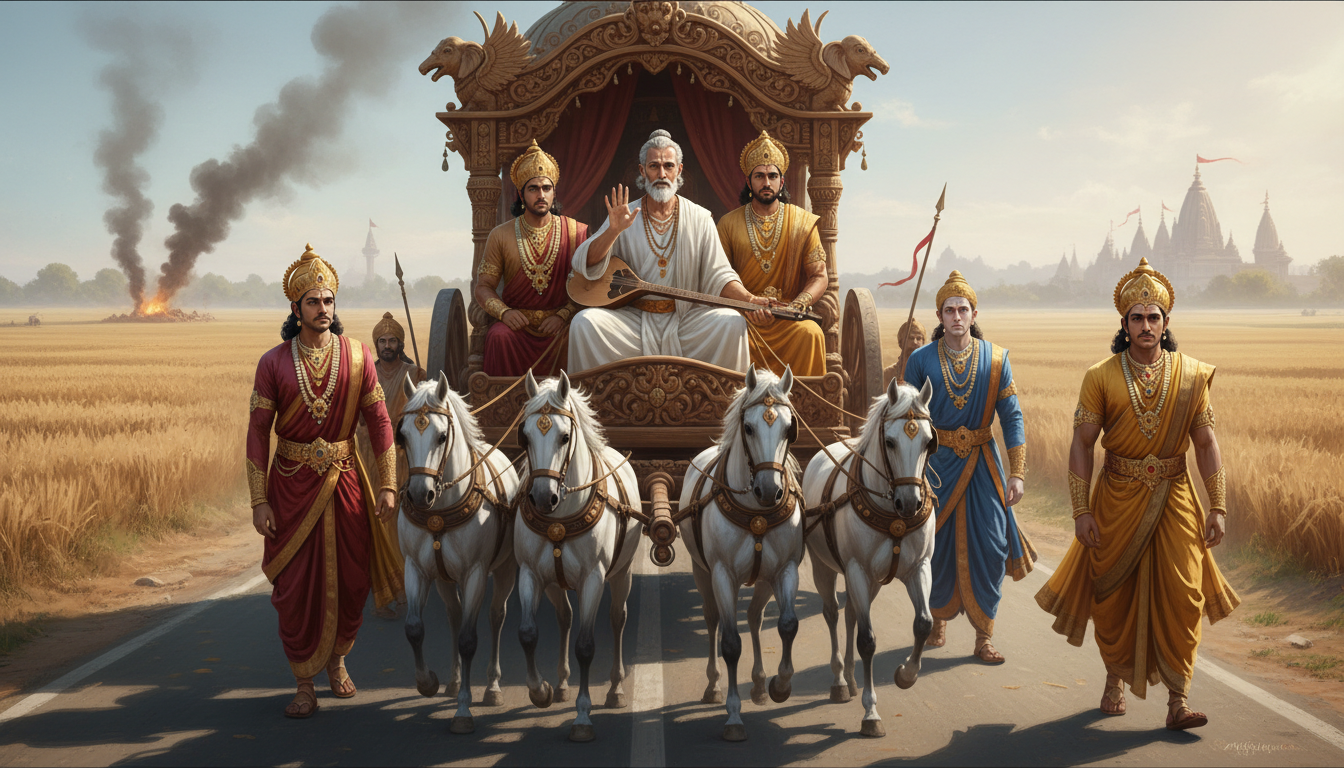
Narada rides with four kings and ranks their generosity
Tell Us Again of Kings
The fire in the Kamyaka clearing had burned down to a red bed, and the brothers had stopped talking about Hastinapura, which was how Yudhishthira knew the hour was right for asking something.
"Holy one," he said to Markandeya, "tell us again of the great good fortune of kings."
The sage who had watched the world dissolve and re-form more times than he cared to count sat with his hands on his knees and did not answer at once. Draupadi was mending a garment by the last of the light. Bhima had stretched himself out along the ground the way a man does when he has walked all day and intends to be comfortable about it. Dhaumya was banking the coals.
"Good fortune," Markandeya said at last. "Very well. But I will not tell you of a king who was fortunate. I will tell you of four of them who were, and who wanted to know how long it would last, and who asked the one person in the three worlds tactless enough to answer."
"Narada," said Arjuna, without looking up.
"Narada," the sage agreed. "Understand what these four men were. They were not ordinary kings. They were brothers, all four of them long-lived, all four of them without a vice anyone could name, all four of them certain of heaven and not wrong to be certain of it. Ashtaka of Viswamitra's race was the eldest. With him were Pratardana, and Vasumanas, and Sivi the son of Usinara. Ashtaka had just completed a horse sacrifice, and the kings of the earth had come to it, and when the rites were finished and the guests were dispersing, the four brothers rode out together on one car in the good humour of men who have done a great thing correctly.
"That is where the story begins. On a road, in a good mood, with everything already won."
A Seat in the Car
They saw the rishi coming along the road toward them, alone, with nothing in his hands, walking as though the distance between one world and the next were a matter of no particular interest to him.
The four kings got down and saluted him. Then one of them said what any host would say. "Ride with us. There is room on the car."
"So be it," said Narada, and mounted.
They drove on. The brothers took turns gratifying him as men do who have a celestial rishi in their chariot and are aware of the opportunity: they praised his learning, they asked after the worlds he had lately walked through, they were careful and warm and entirely sincere. And when the sage was pleased, one of the four leaned toward him.
"Holy One, I desire to ask thee something."
"Ask," said Narada.
The king chose his words the way a man does when he already knows the shape of the answer he wants. "All four of us are blessed with long lives, and we have every virtue. We shall therefore be permitted to go to a certain heaven, and to dwell there for a long period. That much we do not doubt. But nothing in heaven is forever, and one of us must be the first to use up what he has stored. Who amongst us, then, shall fall down first?"
It was asked lightly. It was the kind of question four men who are pleased with themselves ask a holy man on a pleasant road, expecting to be told that the question is unanswerable, or that the difference between them is too small to measure.
Narada did not pause even for the length of one turn of the wheel.
"This Ashtaka," he said, "shall first come down."
The chariot went on. Nobody said anything for a while. Then Ashtaka himself, to his credit, asked the next question in a steady voice.
"For what cause?"
The Kine of Many Colours
"I lived for a few days in thy abode," said Narada. "Thou wilt remember it. Thou carried me one day on thy car out of the town, and we came to open ground, and there I beheld kine standing in their thousands, distinguished one from another by difference of hue. Red cattle and white, dun and brindled and black, in herds that ran to the edge of what a man could see.
"I asked thee whose they were."
Ashtaka waited.
"And thou said: 'I have given away these kine.'"
"That was true," Ashtaka said. "I had given them. Every one of them was given, to brahmanas, at the proper season, with water poured on the hand. I said nothing that was not so."
"Thou said nothing that was not so," Narada agreed. "By that answer thou gave expression to thine own praise. It is for that answer of thine that thou shalt have to come down."
The road went past under the wheels. Ashtaka turned the thing over and could find no place to take hold of it. He had not boasted in an assembly. He had not asked for a herald to proclaim it. A guest had asked a simple question and he had given a simple answer, and the answer had happened to contain himself.
"The gift stands," he said finally. "Does it not? The cattle went where they went. The brahmanas have them still."
"The cattle went where they went," said Narada. "That is why thou hast heaven at all. But a gift is a thing a man puts out of his own hands, and thou took those herds back into thy hands with one sentence, in order to be a certain kind of man in the eyes of a guest who had not asked to be told. There is no sin in it. There is only weight. Heaven does not keep what is heavy."
And because the brothers were kings, and because kings are practical even when they are frightened, one of them asked the obvious thing next.
"Three of us, then, will stay in heaven. Amongst us three, who shall fall down first?"
"Pratardana," said Narada.
The Horses Given One by One
"For what reason?" asked the enquirer, and Pratardana sat very still.
"I lived for some days in thy abode also," said Narada, "and thou too carried me one day on thy car. Hear what happened on that road, since thou wert driving and may not have counted it as I did.
"A brahmana came to thee and said, 'Give me a horse.' And thou said, 'After returning, I will give thee one.' And he said, 'Let it be given to me soon.' And thou did not argue with him. Thou stopped the car and unyoked the steed that was harnessed at the right-hand wheel and put the rein in his hand, and we went on with three.
"And another brahmana came, desirous of obtaining a steed. And thou spoke to him in the same way, and gave him the horse of the left wheel, and we went on with two.
"And a third came. And thou unyoked the horse on the left front of the car and gave him that, and we went on with one.
"And then a fourth came, desirous of obtaining a horse. And thou said, 'Returning, I will give thee a horse.' And he said, 'Let the steed be given to me soon.' And thou gave him the only horse thou had."
Pratardana said, "I remember the road."
"Then thou wilt remember what thou did next," said Narada, "for I have never seen a king do it before or since. Thou got down. Thou took the yoke of the car in thine own hands, with a rishi still sitting in it, and thou began to draw. A crowned man between the shafts, hauling his own chariot along a public road because he would not send a brahmana away empty. In all my wandering I have not been carried by anything I honoured more."
Pratardana let out a breath.
"And as thou drew," said Narada, "thou said: 'There is now nothing for the brahmanas.'"
Nothing Left for the Brahmanas
"I said it to myself," said Pratardana.
"Thou said it aloud, and I was behind thee, and the road was empty enough to carry a whisper. Consider what the sentence is. It is not a lie. There was indeed nothing left. Four horses had gone and the car stood on the ground and a man cannot give away what he has not got. Every word of it is accurate."
"Then where is the fault?"
"In the direction it faces," said Narada. "A man who says 'there is nothing left for the brahmanas' is not counting his stable. He is counting his own generosity, and inviting the sky to count it with him. Thou had given, it is true. But thou had given with detraction. The four gifts were clean and the sentence after them was not, and it is for that speech of thine that thou shalt have to fall down from heaven."
The car went on. The two who had not yet been named sat with their hands in their laps like men at a court hearing waiting to learn whether the matter concerns them.
"Of the two that remain," one of them said, "who shall fall down?"
"Vasumanas."
"For what reason?"
"In the course of my wanderings I arrived at thy abode," said Narada, "and at that time the brahmanas were performing the ceremony of Swastivachana for the sake of a flowery car. I came into thy presence while it was going forward. When the brahmanas had completed the ceremony the flowery car became visible to them, and it was a beautiful thing, and I said so. I praised it as any man would praise it.
"And thou said, 'Holy one, by thee hath this car been praised. Let this car, therefore, be thine.' And it was mine, and I was glad of it."
"That is how I remember it also," said Vasumanas.
"So do I," said Narada. "Now hear the second time."
The Car Praised Three Times
"After some while I came to thee again, being once more in need of such a car," said Narada. "And I admired it. And thou said, 'It is thine.' Twice, then, thou gave the same thing, and twice thou gave it without a pause and without a face.
"And I went to thee a third time, and admired the car again."
Vasumanas said nothing.
"And even then," said Narada, "thou exhibited the flowery car to the brahmanas, and thou cast thine eyes on me, and thou said: 'O holy one, thou hast praised the flowery car sufficiently.'
"And the king only said these words, without making me a gift of that car. For this he will fall down from heaven."
The brothers heard it, and each of them heard something slightly different in it, and the thing they all heard was how small it was. Not a refusal. Not an insult. A pleasantry, delivered in front of company, by a man who had already given the same object away twice and might reasonably feel he had earned one dry remark.
"Holy one," said Vasumanas, "I had given it to thee twice."
"Thou had."
"Was I to keep nothing?"
"Thou wert to keep whatever thou wished," said Narada. "Say 'I will not give it,' and no one in the three worlds could reproach thee, and thy heaven would stand. But thou did not refuse the car. Thou refused it and told me that my praise had reached its limit, which is to say thou grudged the asking while pretending to grudge nothing, and thou did it where the brahmanas could hear. Two clean gifts, and one sentence, and it is the sentence that has weight."
And now there was one brother left who had not been named, and one passenger who had done all the naming, and the fourth question asked itself.
"Of the one who is to go with thee," said the enquirer, "who will go and who will fall down?"
The One Who Falls Is Myself
"Sivi will go," said Narada, "but I will fall down."
It took a moment for the car to understand what it had been told. Ashtaka turned around. Pratardana said, "Thou?"
"For what reason?" asked the enquirer.
"Because I am not the equal of Sivi," said Narada, "and I will tell you how I came to know it, since I was standing there and saw the whole of it and did nothing but watch.
"One day a brahmana came to Sivi and said, 'O Sivi, I came to thee for food.'
"And Sivi answered him as he answers everyone. 'What shall I do? Let me have thy orders.'
"And the brahmana said: 'This thy son, known by the name of Vrihadgarbha, should be killed. And, O king, cook him for my food.'"
The wheels turned. Nobody in the car breathed.
"I have heard men asked for their wealth," said Narada, "and for their kingdoms, and for their wives, and for their own flesh. I had not before heard a guest name a child by name at his father's door and ask to have him served up in a dish. And I did what I am telling you I did. I waited to see what would follow. That is the whole of my part in it. I waited, as a man waits at a spectacle.
"And Sivi did not argue, and did not send for his counsellors, and did not ask the brahmana to consider what he was saying. He went inside. He killed his son. He cooked him duly, as the rite requires, and he placed that food in a vessel, and he took the vessel up onto his own head, and he went out into the streets of his city carrying it, looking for the man who had ordered it, because the guest had wandered off and the food was getting cold."
"Stop," said Vasumanas.
"Thou asked who falls first," said Narada. "This is the answer to the question thou asked."
The Dish Carried Through the Burning City
"While Sivi was thus seeking for the brahmana," Narada said, "someone came running to him with news, in the way that news is brought to kings.
"'The brahmana thou seekest, having entered thy city, is setting fire to thy abode. He is also setting fire, in wrath, to thy treasury, and thy arsenal, and the apartments of the women, and thy stables for horses and elephants.'
"Consider the position of the man hearing this. He has his dead son on his head in a covered vessel. He is standing in his own street. And he is being told that the guest for whom the dish was made is at that moment burning the four things a king cannot lose and remain a king: his money, his weapons, his household, and his cavalry.
"Sivi heard all of it without change of colour.
"I was watching his face. I have made a study of faces for a very long time and there was nothing in it. Not patience held down over anger. Not the stillness of a man who has decided to be calm and is working at it. There was simply no anger there to be held down, which is a different thing altogether and much rarer.
"He went on through the smoke with the vessel steady on his head, into his own city, past his own burning stables, and he found the brahmana standing in the middle of what he had made of the place, and Sivi bowed to him.
"And he said: 'O holy one, the food has been cooked.'"
The chariot rolled through the ordinary afternoon.
"And the brahmana," said Narada, "hearing this, spoke not a word. From surprise he stood with downcast looks. He had come with an instrument for breaking a man and he had used every part of it and the man was standing in front of him offering him dinner."
Eat It Thyself
"Then Sivi, with a view to gratifying his guest, said: 'O holy one, eat thou this.'
"And the brahmana looked at Sivi for a moment. Only a moment. Then he said: 'Eat it thyself.'"
Pratardana made a small sound.
"And thereupon Sivi said, 'Let it be so.'"
Narada let the words stand in the moving air.
"Cheerfully. That is the part I cannot get past, and I have gone over it many times since. Not grimly. Not as a man swallowing the last humiliation because he has already swallowed the rest. He took the vessel down from his head with the same steadiness he had carried it, and he uncovered it, and he was going to eat.
"And the brahmana caught hold of his hand.
"'Thou hast conquered wrath,' he said. 'There is nothing that thou canst not give unto the brahmanas.' And that brahmana adored Sivi where he stood.
"And as Sivi cast his eyes before him, he beheld his son standing there, alive, like a child of the gods, decked in ornaments, and a fragrance came from his body. Nothing was burning. The treasury was not burning. The stables were not burning. There had never been anything in the vessel.
"And then the brahmana made himself visible as he was, and it was Vidhatri, the ordainer, who had come in that guise to try that royal sage."
"A god," said Ashtaka.
"A god," said Narada, "who wanted to know one thing, and who could think of no cheaper way to find it out. And when he had disappeared, the counsellors came to Sivi. They had been standing at the edge of it the whole time, as counsellors do, and they asked the question that had been in every mouth in that city.
"'Thou knowest everything,' they said. 'For what didst thou do all this?'"
The Path Trodden by the Virtuous
"And Sivi answered them," said Narada, "and I have carried the answer with me ever since, because it is shorter than the deed and harder.
"'It was not for fame,' he said, 'nor for wealth, nor from desire of acquiring objects of enjoyment that I did all this. This course is not sinful. It is for this that I do all this: the path which is trodden by the virtuous is laudable. My heart always inclineth towards such a course.'
"That is all. He did not say that he had known the brahmana was a god. He did not say that he had trusted a good end. He gave no reason at all except that this was the road men of that kind walk on, and his heart went that way, and he had followed it.
"So Sivi goes, and stays. And I fall. Because I stood in that street with my hands empty and watched a man do it, and the watching was the whole of what I was fit for."
The four kings came to the end of their road, and Narada got down, and the story Markandeya told stopped there, because there is nothing after it.
He turned to Yudhishthira in the Kamyaka firelight.
"Three men lost heaven, son of Kunti, and not one of them lost it for a thing he kept back. Ashtaka gave thousands of cattle. Pratardana gave four horses and then pulled his own chariot. Vasumanas gave the same car away twice. They were undone by a sentence apiece, spoken afterwards, in which each of them stepped back into his own gift to be seen standing in it.
"That is the whole difficulty with generosity. The giving is the easy half. The silence afterwards is the half that costs, and the only gift that survives being looked at closely is the one the giver never mentions again."
Yudhishthira, who had given away a kingdom and had heard himself called righteous for it more times than he liked, sat with that a long while, and did not say anything at all, which was perhaps the point.
Dharma Lesson
Generosity is undone not by the size of what is withheld but by the sentence spoken after the giving. Ashtaka named his own cattle, Pratardana announced that nothing was left, Vasumanas told a guest his praise had gone far enough, and each stepped back into his own gift to be seen standing in it. The only gift that survives scrutiny is the one the giver never mentions again.