A Guest Who Did Not Look at the Hall
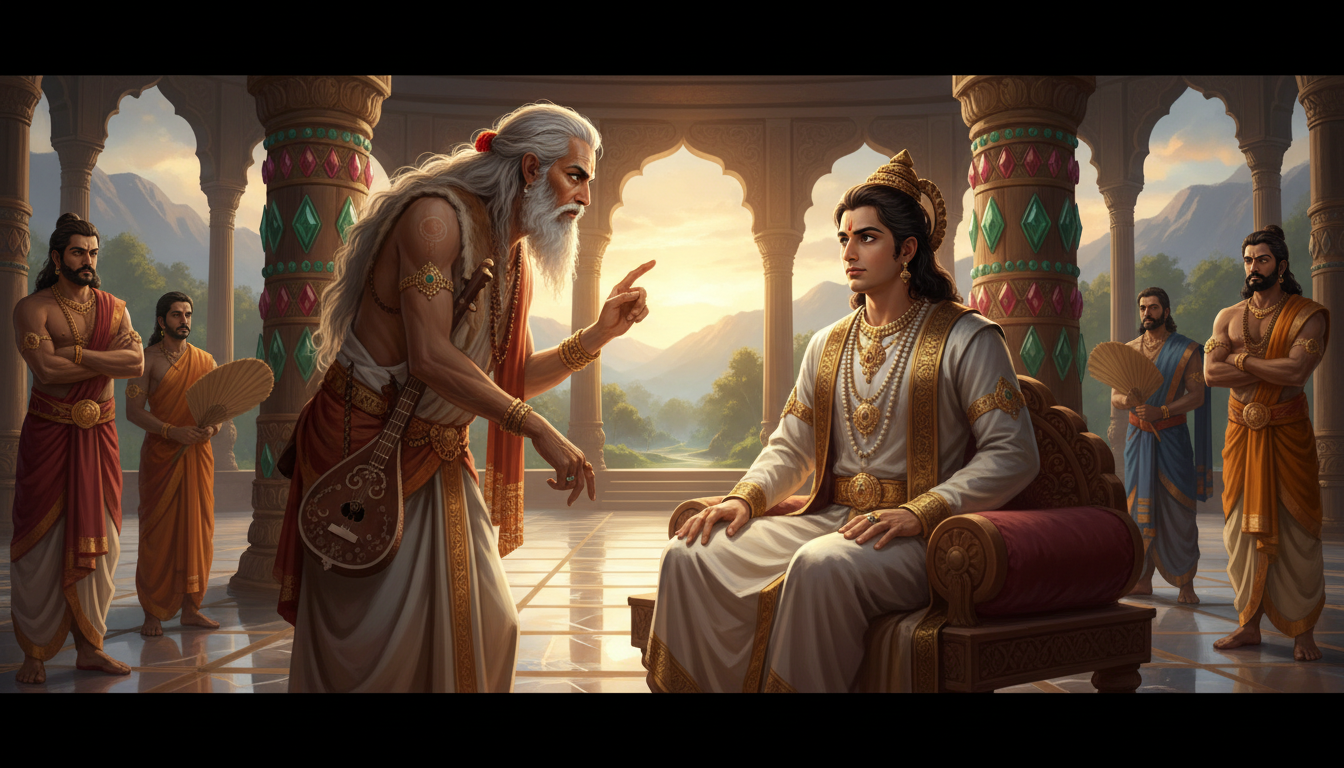
The Pandavas were sitting in the new assembly hall among the chief of the Gandharvas, said Vaishampayana, when the doorway filled and the celestial Rishi Narada came in out of the air.
He had Parijata with him, and the intelligent Raivata, and Saumya and Sumukha. He travelled at the speed of mind, so no herald had been able to run ahead of him. There was no one alive who had read more. He knew the Vedas and the Upanishads, the histories and the Puranas, all six of the Angas down to prosody and astronomy, and logic, and the truth of moral science. He could reconcile two texts that contradicted each other, apply a general rule to a particular case, and tell you which of the five propositions in an argument was the rotten one. He was master of both Sankhya and Yoga. He knew treaty and war, the marching of armies, the maintaining of posts against an enemy, ambush and reserve. It was said that he could answer Vrihaspati himself, point for point, on religion, wealth, pleasure and salvation, and that he was fond of setting the gods and the Asuras quarrelling for the interest of seeing how it came out.
Yudhishthira saw who it was and rose at once, and his four brothers rose with him. He bowed low and gave the sage a seat worthy of him, and brought him kine and the arghya with honey and the rest of the offerings, and worshipped him with gems and jewels, whole-heartedly, as the rule requires.
Narada took all of it and was gratified. Then he settled himself, looked at the young emperor across the polished floor of the most costly hall that had ever been built by men, and said nothing at all about the hall.
"Is the wealth you are earning," he said, "being spent on proper objects?"
Religion, Wealth, Pleasure, and the Hours of the Day
Nobody in the hall moved. The Gandharvas stopped their music. Yudhishthira folded his hands and waited, and the questions came on in a steady voice, one after another, like a man walking the boundary of an estate and putting his stick into every fence post.
"Does your mind take pleasure in virtue? Are you enjoying the pleasures of life, or does your mind sink under their weight? Do you keep to the conduct your ancestors practised towards the three classes of subjects, the good, the indifferent and the bad? Do you never injure religion for the sake of wealth, or injure both religion and wealth for the sake of pleasure, which seduces so easily? You know the timeliness of things. Do you divide your day judiciously between religion, wealth, pleasure and salvation, or has one of them eaten the others?"
He did not wait for answers. That was the shape of it. Each question carried its own answer inside it for a man who was honest, and Narada was leaving the emperor alone with them.
"With the six attributes of a king," he went on, "cleverness of speech, readiness in providing means, intelligence in dealing with a foe, memory, and knowledge of morals and of politics, do you attend to the seven means? Sowing dissension, chastisement, conciliation, gifts, incantations, medicine, magic. Have you surveyed your own strength and your own weakness, and then examined the fourteen possessions of your enemies: their country, their forts, their cars, their elephants, their cavalry, their foot, the principal officials of their state, the zenana, the food supply, the count of the army and the income, the religious treatises in force among them, the accounts of state, the revenue, and the wine-shops and the other secret enemies?"
Bhima, who had conquered the east, sat forward. He had not known that the wine-shops were on the list.
The Seven Officers and the Fourth Watch of the Night
"Your seven principal officers of state," said Narada. "The governor of the citadel, the commander of forces, the chief judge, the general in interior command, the chief priest, the chief physician, the chief astrologer. I hope none of them has succumbed to the influence of your foes. I hope none of them has grown idle on the wealth he has already earned. They are all obedient to you?
"Your counsels are never divulged, not by your spies in disguise, not by your ministers, not by yourself? You know at all times what your friends, your foes and the strangers are about? You make peace and make war at the proper times, and stay neutral towards those who are neutral towards you? And have you made your ministers out of men like yourself, men who are old, continent in behaviour, able to see what should be done and what should not, pure in birth and blood, and attached to you? The victories of kings, child, are to be credited to good counsel and to nothing else.
"You have not become the slave of sleep? You wake at the proper hour? In the small hours of the night, do you think through what you must do the next day and what you must leave undone? You settle nothing alone, and you do not take counsel with a crowd either? What you have resolved on does not become known all over the kingdom before it is done? You begin at once on measures of great usefulness that are easy to accomplish, and nothing obstructs them?
"And the men who dig and plough, do you keep them within your sight? Are they afraid to come near you?"
Yudhishthira answered that one without meaning to, because it was the first that touched a face he could see. "They are not afraid," he said.
"Good," said Narada, and went on.
One Learned Man for a Thousand
"People should know the measures you have already accomplished," said the sage, "and those that are half accomplished and waiting on completion. They should not know the ones that are still only in your head and not begun. Is that how it stands?
"Have you appointed experienced teachers, men who can explain the causes of things and who are learned in the science of morals and in every branch of learning, to instruct the princes and the chiefs of the army? And this above all. Would you buy a single learned man by giving in exchange a thousand ignorant ones? Do it. The learned man confers his greatest benefit in the season of distress, and the thousand will be of no use to you at all on that day.
"Are your forts always full? Not of soldiers only. Treasure, food, weapons, water, engines and instruments, and the engineers who work them, and bowmen. A fort with a granary and no engineer is a pen for your own people.
"One minister who is intelligent and brave, whose passions are under complete control, who has wisdom and judgment, is enough to confer the highest prosperity on a king or a king's son. I am asking you whether there is even one such man with you."
Arjuna glanced at his brother. Yudhishthira did not look away from the sage.
"Do you honour a priest who is humble, of pure blood, of good name, and free of jealousy and of meanness? Has some well-behaved, intelligent, guileless Brahmana, well up in the ordinance, been given charge of your daily rites before the sacred fire, and does he remind you in proper time when your homa is due? Is your astrologer skilled in reading a face, able to interpret an omen, and competent to neutralise the disturbances of nature?"
Three and Three, Unacquainted With One Another
"Now the eighteen tirthas of your enemy," said Narada, "and the fifteen of your own. Do you seek to know everything about them by means of three and three spies who are unacquainted with one another?"
Sahadeva, who had conquered the south and knew what a bought messenger costs, lifted his head at that.
"Three," the sage repeated, "and not one, because one man may be turned, and if he is turned you will never learn it from him. And unacquainted, because three who know each other are one man with three mouths. O slayer of foes, do you watch all your enemies with care and attention, and unknown to them?
"Have respectable servants been put into respectable offices, indifferent men into indifferent ones, and low men into the low? Have you given the high offices to ministers who are guileless, of good conduct for generations, and above the common run? Do you oppress your people with cruel and severe punishment? Do your ministers rule the kingdom under your orders, or under their own? Do they ever slight you, as sacrificial priests slight the man who is fallen and can pay for no more sacrifices, or as wives slight a husband who is proud and incontinent?"
He let that one hang a moment. It was the sharpest thing he had said yet, and everyone in the hall had heard it land.
"Are you free of the fourteen vices of kings? Atheism, untruthfulness, anger, incautiousness, procrastination, failure to visit the wise, idleness, restlessness of mind, taking counsel with only one man, consulting men who do not know the science of profit, abandoning a settled plan, divulging your counsels, leaving beneficial projects unaccomplished, and undertaking everything without reflection. By these, monarchs firmly seated on their thrones have been ruined, and they were seated more firmly than you are."
Arrears of Pay
"Is the commander of your forces confident, brave, intelligent, patient, well conducted, of good birth, devoted to you, and competent? Do you treat with consideration and regard the chief officers of your army, the ones who are skilled in every kind of warfare, who are forward and well behaved and full of prowess?
"Do you give your troops their sanctioned rations and their pay at the appointed time? You do not oppress them by withholding these?" Narada leaned forward. "Understand what I am asking. The misery caused by arrears of pay, and by irregularity in the distribution of rations, drives troops to mutiny, and the learned call that one of the greatest of all mischiefs. Not the enemy's cavalry. The pay chest.
"Are all the principal high-born men devoted to you, and ready cheerfully to lay down their lives in battle for your sake? I hope you never permit one man of uncontrolled passions to run a number of concerns in the army at the same time as he likes. And when a servant of yours has accomplished a particular business by some special ability of his own, is he disappointed of a little more regard from you, and of an increase in his food and pay? Do you reward learning and humility and skill with gifts and honour in proportion to what the man is worth?
"Do you support the wives and the children of the men who have given their lives for you and have been ruined on your account?"
Nakula, who kept the accounts of the horse, said quietly, "They are on the rolls, holy one. They are paid first."
"Then the house stands," said Narada. "And the enemy you have already weakened, and the man who came to you for shelter after being beaten in battle, do you cherish them with a father's affection? Are you equal to all men, so that anyone may come to you without fear, as to a mother and a father?"
Seed for the Tillers, Water for the Fields
"Are the agriculturists in your kingdom contented?" said the sage, and now his voice changed a little, and the questions came slower.
"Are large tanks and lakes built all over your kingdom at proper distances, so that agriculture in your realm is not left entirely dependent on the showers of heaven? Are your agriculturists short of either seed or food? Do you grant them loans of seed grain with kindness, taking back only a fourth in excess of every measure by the hundred, and not more?
"Are the four professions of agriculture, trade, cattle-rearing, and lending at interest carried on by honest men? On these, monarch, the happiness of your people depends, and not on your hall.
"Do the five brave and wise men employed in the five offices, the protection of the city, of the citadel, of the merchants, of the agriculturists, and the punishment of criminals, benefit your kingdom by working in union with one another, or does each of them work to spite the other four? For the protection of your city, have the villages been made like towns, and the hamlets and the outskirts of villages like villages? Are thieves and robbers who sack your town pursued by your police over the even and the uneven parts of your kingdom alike, or only over the roads that are pleasant to ride?
"Do the officers who are paid out of the taxes take only their just dues from the merchants who come to your territories from distant lands, impelled by the desire of gain? Are those merchants treated with consideration in your capital, and able to bring their goods here without being cheated by false pretexts, whether the pretexts come from the buyers or from your own men?
"And your artisans and your artists. Do you give them the materials of their work, and their wages, regularly, for periods not longer than four months?"
The Accountants in the Forenoon
"Do your servants speak to you in the forenoon," said Narada, "about your extravagant expenditure on your drinks, your sports and your women? Do they dare? Is your expenditure always covered by a fourth of your income, or a third, or at the very worst a half?
"Do the accountants and clerks employed to look after your income and your expenditure lay both before you every day in the forenoon? Every day, monarch. Not at the turn of the season, when the theft has had a season to grow in.
"Do you dismiss without fault a servant who is accomplished in business, popular, and devoted to your welfare? Do you employ in your business men who are thievish, or open to temptation, or hostile, or minors? Do you persecute your kingdom with the help of thievish or covetous men, or minors, or women?
"Does it ever happen, out of covetousness or folly or pride, that you fail to decide between a plaintiff and a defendant who have come to you? Do you deprive of their pensions the proteges who sought your shelter out of trust or out of love? I hope no well-behaved, pure-souled, respectable man is ever ruined and put to death on a false charge of theft by ministers of yours who do not know the Sastras and act out of greed. I hope your ministers never let a real thief go from covetousness, knowing him to be a thief and having taken him with the goods on him. I hope they are never won over by bribes, and never decide wrongly between the rich man and the poor one.
"Do you seek to cure the diseases of the body with medicines and fasts, and the illnesses of the mind with the advice of the aged? Are the physicians who look after your health conversant with the eight kinds of treatment, and are they attached to you?"
Have Your Vedas Borne Fruit?
"Do you cherish, as a father would, the blind, the dumb, the lame, the deformed, the friendless, and the ascetics who have no home? Do you bow to your relatives and your superiors, to the aged, to the gods, to the ascetics, to the Brahmanas, and to the tall banian trees of the villages, which are of so much benefit to the people? Sinless one, do you ever cause grief or anger in anyone?
"Have you banished the six evils, sleep, idleness, fear, anger, weakness of mind, and procrastination?
"And this last. Has your study of the Vedas borne fruit? Has your wealth borne fruit? Your wife? Your knowledge of the Sastras?"
Here Yudhishthira spoke, because it was a question he could not answer without first being told the terms of it. "How, holy one," he asked, "do the Vedas and wealth and a wife and the knowledge of the Sastras bear fruit?"
"The Vedas bear fruit," said Narada, "when the man who has studied them performs the Agnihotra and the other sacrifices. Wealth bears fruit when the man who has it enjoys it himself and gives it away in charity. A wife bears fruit when she is useful and when she bears children. And knowledge of the Sastras bears fruit when it results in humility and good behaviour, and in nothing else. A learned man who is not humble has a granary full of seed that he has never once put into the ground."
The hall was very quiet. Somewhere above them the lamps of the great chamber burned in their brackets of gold, and nobody had looked up at them for a long time.
Then the King Asked His Own Question
Yudhishthira got up and bowed to the ground and worshipped the sage's feet.
"I shall do all that you have directed," he said. "My knowledge has expanded under your advice. The truths of religion and morality that you have set out one after another are just and proper, and I observe those ordinances to the best of my power. What the monarchs of old performed properly bore proper fruit, and was undertaken for solid reasons and for proper objects. We wish to walk in the virtuous path of those rulers, who had, besides everything else, their own souls under complete control."
And Vaishampayana said that from that day the king acted conformably to that advice, and in time gained the whole earth to her belt of seas.
"The king who is thus employed in the protection of the four orders," said Narada, "Brahmanas, Kshatriyas, Vaishyas and Sudras, passes his days here happily, and afterwards attains the region of Sakra."
Only then, when the audit was over and the sage was sitting at his ease, did Yudhishthira allow himself the thing he had been holding since Narada walked in. He waited for the proper moment, and then he asked it in front of the whole assembly of kings.
"You have the speed of mind, and you wander over the many worlds that Brahma created in the days of old, and you see everything. Tell me. Have you ever beheld anywhere before an assembly room like this of mine, or one superior to it?"
Narada smiled.
"Child," he said, "among men I have never seen nor heard of an assembly room built of gems and precious stones like this of yours. Among men. I shall describe to you instead the hall of the king of the departed, and the hall of Varuna, and of Indra, and of him who has his home on Kailasa, and the celestial Sabha of Brahma that dispels every kind of uneasiness. Listen, and then ask me again."
Dharma Lesson
A ruler is measured not by the hall he has built but by whether the men who dig his tanks, guard his forts and carry his messages are fed, paid and heard. Narada asks about arrears of pay and seed loans before he asks about anything else, because a kingdom fails at the pay chest long before it fails at the border. Knowledge of the sacred books bears fruit only when it turns into humility and good behaviour.