The King Made of Two Halves
A mango, two queens, and the demoness who put a child together
Why Was He Not Burnt?
They were still arguing about Magadha in the hall at Indraprastha. Arjuna had said what a man born in the Bharata race ought to say, and Krishna had agreed with him.
"We do not know when death will overtake us, in the night or in the day," Krishna said. "Nor have we ever heard that immortality was achieved by declining to fight. It is not wise to fight openly with a foe who is exceedingly powerful and standing at the head of his well-arrayed forces. But if we accomplish our purpose by entering the abode of our foe secretly and attacking his person, we shall earn no obloquy for it. That bull among men Jarasandha alone enjoys unfaded glory. But I see his destruction in front of me. Either we shall slay him, or being slain by him we shall ascend to heaven."
Yudhishthira had been listening with his chin down. He asked the question that had been sitting under the whole discussion.
"Krishna. Who is this Jarasandha? What is his energy and what is his prowess, that having touched you, he was not burnt up like an insect at the touch of fire?"
It was fairly asked, and Krishna did not pretend otherwise. Whole tribes, the Kukkuras and the Andhakas and the Vrishnis, had looked at the king of Magadha and decided, as a matter of policy, not to fight him. There was a reason for that, and the reason began before Jarasandha was born.
"Hear, monarch," said Krishna, "who Jarasandha is, and what his energy is, and why he has been spared by us though he has offended us again and again."
Brihadratha of Magadha
There was a mighty king of the name of Vrihadratha, lord of the Magadhas, proud in battle, who kept three akshauhinis of troops. He was handsome and full of energy, wealthy beyond measure, and he carried on his body the marks that show a man has been installed at the sacrifices. He was like a second Indra. In glory he was like Surya, in forgiveness like the Earth, in wrath like the destroyer Yama, and in wealth like Vaisravana. The whole earth was covered by his qualities, which had come down to him from a long line of ancestors, as the rays come out of the sun.
He married the twin daughters of the king of Kashi. Both of them had the whole wealth of beauty, and they had been born on the same day and could not be told apart by anyone who did not know them well, and he could not have said himself which of the two he loved more.
So he made an engagement with them in secret, the three of them alone, that he would love them equally and would never show a preference for either. It was a private promise between a husband and two wives, and nobody outside that room ever heard of it, and it was going to decide everything.
He passed his days in the company of those two dearly loved wives, both of whom suited him well, like a mighty elephant between two cow-elephants, or like the ocean in his own person standing between Ganga and Yamuna in theirs.
And his youth passed away in the enjoyment of his possessions, and no son was born to him to continue his line. He tried the auspicious rites. He tried the homas. He performed sacrifice after sacrifice with the desire of offspring, and the best of monarchs failed at the one thing every householder in his kingdom managed without effort.
The Ascetic Under the Mango Tree
One day the king heard that the high-souled Chandakausika, son of Kakshivat of the illustrious Gautama race, had come wandering into the capital, having laid aside his ascetic penances for a season, and had sat down in the shade of a mango tree.
The king went out to him with his two wives, and worshipped him with jewels and with valuable presents, and gratified him greatly. Chandakausika was truthful in speech and firmly attached to truth, which is a dangerous quality in a man who is about to make an offer.
"O king of kings," he said, "I have been pleased with you. Solicit a boon, you of excellent vows."
And Vrihadratha bent low with both his wives beside him, and the words came out of him choked with tears, because he had long since given up expecting anything.
"Holy one, I am about to forsake my kingdom and go into the woods to practise ascetic penances. I am very unfortunate. I have no son. What then shall I do with my kingdom, or with a boon?"
The Muni heard that. He said nothing, and controlled his outer senses, and entered into meditation sitting exactly where he was, in the shade of that same mango tree, with the king and the two queens of Kashi standing in front of him waiting.
The Fruit That Fell Into His Lap
While he sat there, a mango fell out of the tree and landed in the lap of the seated Muni.
It was juicy, and it was untouched. No parrot had been at it, and no other bird. That was the whole of the sign, and Chandakausika did not look for a better one. He took up the fruit and pronounced certain mantras over it in his mind, and gave it to the king as the means of obtaining an incomparable offspring.
"Return, king," he said. "Your wish is fulfilled. Desist from going into the woods."
The monarch heard the words, and worshipped the feet that had held the fruit, and went back to his own house with one mango in his hands and two queens walking beside him.
And then, in his own apartments, he remembered his former promise.
He had sworn to love them equally and never to show a preference for either. There was one fruit. There was no way to give one fruit to two women that was not a preference, except one.
So he gave that single fruit to both of his wives. And his beautiful queens divided it into two parts and ate it up between them, and neither of them had more than the other by a single mouthful.
Because of the certainty of the realisation of the Muni's words, and because the Muni had never in his life spoken an untruth, both of them conceived, as the effect of having eaten that fruit. And the king beholding them in that state was filled with great joy, and had the fact proclaimed, and made gifts, and waited.
What the Midwives Carried Out the Back Door
In time, when the time came, each of the queens brought forth a fragmentary body.
Each fragment had one eye. One arm. One leg. Half a stomach, half a face, and half of everything else that a body has one of. They were alive. That was the part that neither sister could bear to look at, and the part that the story never lets anyone forget.
Both mothers trembled at the sight of them. The two helpless sisters, who had shared a womb themselves, consulted anxiously with each other, alone, with the doors shut, and there was nobody in the world they could ask. And sorrowfully they abandoned those fragments that were endued with life.
The two midwives who waited upon the queens wrapped up the pieces carefully, which is a strange word for what they were doing and the only word the story uses. They went out of the inner apartments by the back door, and threw the bodies away at a crossing of the roads, and came back in haste to the palace, and told nobody.
And the palace was quiet, and the two queens lay in their separate rooms with their milk coming in, and the king of Magadha, who had gone into the woods and come back for this, had a boon from a truthful Rishi and no son.
Jara at the Crossing of the Roads
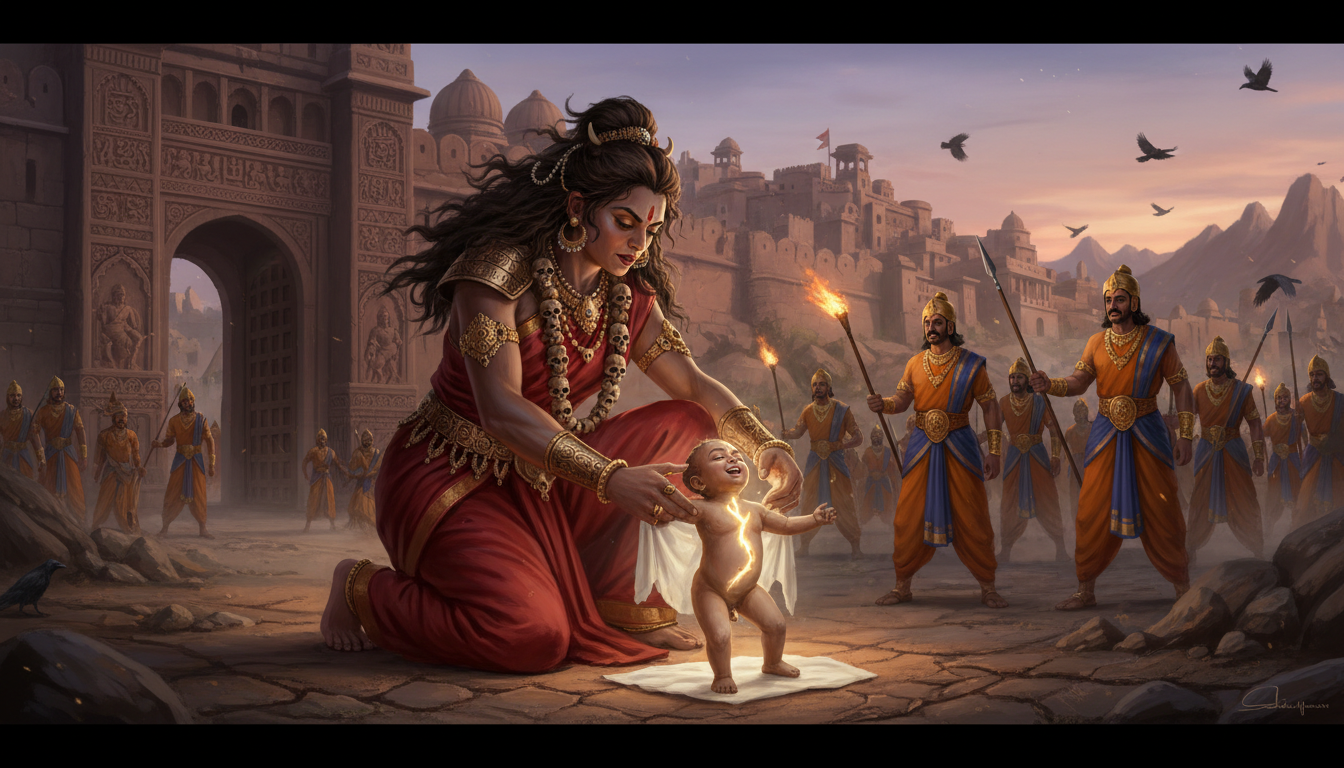
A little while after, a Rakshasa woman of the name of Jara, who lived upon flesh and blood, came to that crossing and took up the fragments that were lying there.
She meant to carry them off and eat them, and there were two pieces and she had her hands full. So, impelled by the force of fate and by nothing more elevated than convenience, the female cannibal put the two halves together so that they would be easier to carry.
As soon as the fragments were joined they formed one sturdy child, with a single body, and life in it.
Jara stood at the crossroads with her eyes wide open in wonder and found that she could not lift him. The body was as hard and as strong as the thunderbolt. And the infant closed his fists, red as copper, and put them into his mouth, and began to roar, and the sound of it was like rain-charged clouds coming over a plain.
The noise brought the palace out. The inmates came running with the king at the head of them, and behind them, sudden and disordered, came the two helpless disappointed queens with their breasts full of milk, to recover the child that had cried.
The Rakshasa woman looked at the queens in that condition, and at the king who was so desperate for offspring, and at the strength that was in the child in her arms, and she thought it out.
I live within the dominions of this king, she said to herself, and he is desirous of an offspring. It does not behove me to kill the infant child of such an illustrious and virtuous monarch.
So she took a human form, and came forward holding the child in her arms as clouds hold the sun.
"Vrihadratha, this is your child. Given to you by me. Take it. It was born of both your wives by virtue of the command of the great Brahmana. The midwives cast it away, and I have protected it."
The Goddess Painted on the Wall
The handsome daughters of the king of Kashi took the child and drenched him at once with their milk. The king got the whole story out of them, piece by piece, and then turned to the woman of the golden complexion standing in his courtyard.
"O you of the complexion of the filament of the lotus, who are you, that give me this child? You seem to me a goddess roaming at her pleasure."
"Blessed be you, king of kings," she answered. "I can assume any form at will. I am a Rakshasa woman called Jara. I am living happily in your house, worshipped by everyone in it. Every day I wander from the house of one man to the house of another. I was created of old by the Self-create, and I was named Grihadevi, the household goddess. I am of celestial beauty and I was placed in the world for the destruction of the Danavas.
"He who paints on the walls of his house a likeness of me, youthful and in the midst of children, must have prosperity in his home. Otherwise a household sustains decay and destruction. On the walls of your house, lord, my likeness is painted, surrounded by numerous children. Stationed there I am worshipped daily with scents and flowers, with incense and edibles and various objects of enjoyment. Being so worshipped in your house I think every day of doing you some good in return.
"It chanced that I beheld the fragmentary bodies of your son. When they happened to be united by me, a living child was formed of them. Great king, it has been so through your good fortune alone. I have been only the instrument. I am capable of swallowing the mountain of Meru itself. What shall I say of a child? But I have been gratified by the worship I receive in your house, and therefore I have bestowed this child on you."
And having spoken, Jara disappeared from the courtyard where she stood.
The king carried the boy inside. He had all the rites of infancy performed on him, and ordered a festival to be kept by his people in honour of that Rakshasa woman. Then he named the child, and the name he chose was a plain description of what had happened: because he had been united by Jara, he was called Jarasandha. And the son of the king of Magadha began to grow in bulk and in strength like a fire into which clarified butter has been poured, and to increase day by day like the moon in the bright fortnight.
Chandakausika Names the Future
Some time after this the great ascetic Chandakausika came again into the country of the Magadhas, and Vrihadratha went out to receive him, filled with joy, with his ministers and his priest and his wives and his son.
He worshipped the Rishi with water for his feet and his face and with the offering of arghya, and then offered him his whole kingdom, and his son with it.
The Rishi accepted the worship and declined the rest.
"King, I knew all of this by spiritual insight," he said. "But hear what this son of yours will be, and what his beauty and his excellence and his strength and his valour will be.
"As other birds can never imitate the speed of Vinata's son, so the other monarchs of the earth will not be able to equal this son of yours in energy. All those who stand in his way will certainly be destroyed. As the force of a current can never make the slightest impression on the rocky breast of a mountain, so weapons hurled at him, even by the celestials, will fail to produce the least pain in him. He will blaze forth above the heads of all who wear crowns on their brows. As the sun dims the lustre of all luminous bodies, this son of yours will rob every monarch of his splendour. Kings who are powerful, who own large armies and numberless vehicles and animals, will approach him and perish like insects upon a fire. He will seize the growing prosperity of all kings as the ocean receives the rivers swollen in the rains. As the huge earth bears every kind of produce and supports things both good and evil, this child will support all the four orders of men, and all the kings of the earth will live in obedience to his commands as every creature with a body lives in dependence upon Vayu. And this prince of Magadha, the mightiest of all men in the world, will behold with his physical eyes the god of gods, Rudra, the slayer of Tripura."
Having said it, the Rishi thought of his own business and dismissed the king.
Vrihadratha went back into his capital, called together his friends and his relations, and installed Jarasandha on the throne. Then a great distaste for the pleasures of the world came over him, and he went into an asylum in the woods with his two wives, and lived there practising penances, and ascended to heaven at last with them both. And after his father and his mothers had gone, Jarasandha by his valour began bringing the kings of the earth under his sway.
Ninety-Nine Yojanas
"He ruled his kingdom like a father," said Krishna, "having received all those boons, exactly as Kausika had uttered them.
"Then Kansa was slain by Vasudeva, and an enmity arose between the king of Magadha and me. His sister's husband was dead by my hand and there was no arguing it away.
"So the mighty king, from his city of Girivraja, whirled a mace about his head ninety-nine times, and hurled it towards Mathura, where I was living then. The mace fell near Mathura, at a distance of ninety-nine yojanas from Girivraja. The citizens saw it come down and went and told me. The place where it fell is next to Mathura and is called Gadavasan to this day, and men go and look at it."
He let that sit in the hall for a moment. Nobody in the room had a mace that would carry a bowshot beyond a bowshot.
"Jarasandha had two supporters, called Hansa and Dimvaka, and neither of them could be slain by weapons. Both were well versed in the science of politics and morality, and in council they were the foremost of all intelligent men. I have already told you everything about that pair. Those two and Jarasandha together, I believe, are more than a match for the three worlds.
"That, brave king, is why the powerful Kukkura and Andhaka and Vrishni tribes, acting from motives of policy, did not deem it proper to fight with him. It was not fear only. It was arithmetic."
A Man Who Was Never Whole
The hall at Indraprastha was silent when Krishna finished.
Bhima had understood something before the others, and he sat with his forearms on his knees looking at his own hands. A blessing had been given whole. It had been cut in half out of fairness, by a man keeping a promise to two women who had never asked him to break it. It had been thrown away at a crossroads by frightened servants. And it had been put back together by a flesh-eating woman who only wanted a convenient load to carry, and who spared the child in the end because a king had kept her likeness painted on his wall among children and set food in front of it every day for years.
No weapon would hurt him. That had been promised in front of witnesses, by a Rishi who had never lied in his life, and the promise had held through a lifetime of war.
Nothing had been said about hands.
"Then we do not go against Magadha with an army," Yudhishthira said at last.
"No," said Krishna. "Three men on foot, dressed as Brahmanas, by the back way through the hills. And when we are inside, we ask him for what he cannot refuse a guest, and let him choose which of us he fights."
Dharma Lesson
A blessing granted whole and divided out of fairness can still come back joined, and the thing that saves a life is not always the thing that was asked for. Brihadratha's promise to his two wives is what breaks the fruit, and a household goddess honoured for years on a painted wall is what repairs the child. Small faithfulness kept in private decides what walks out of a story.