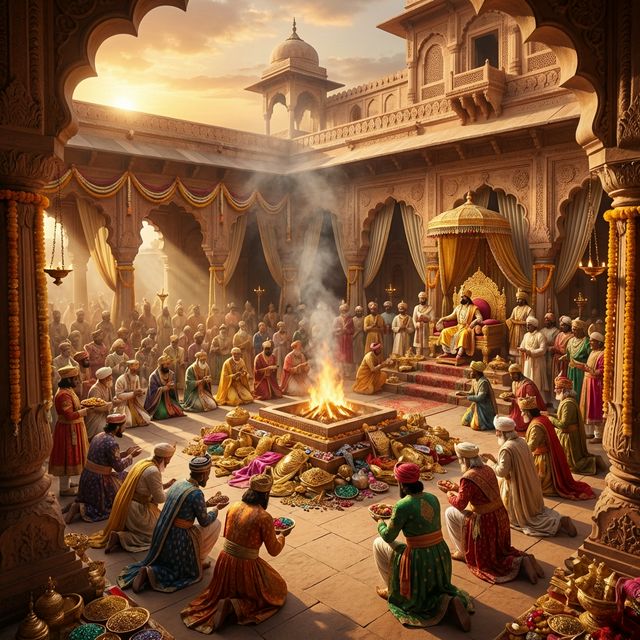
The Fortress of Five Hills
East of where the Ganga bends, in the country where the plain begins to buckle up into low stone, five hills stand in a rough ring, and the ground they enclose is a valley wide enough to quarter an army in. The hills are Vaibhara, Varaha, Vrishabha, Rishigiri and Chaityaka, and the men of old had built walls in the gaps between them, so that the ring was closed and the valley became a city. This was Girivraja, which means the pen of hills, and it was the seat of Magadha.
No place in Bharatavarsha was harder to take. An enemy who marched against it did not besiege a wall; he besieged geology. The passes were few and every one of them was watched. The flanks of the hills were sheer where they had not been fortified. Inside the ring were tanks of sweet water and granaries and smiths at their forges and elephants standing in their lines, and a city that could feed itself for years without opening a gate. Kings looked at Girivraja, and thought, and went home.
The line that held it was old. Brihadratha had founded it, a king of the Chedi stock who had taken Magadha and made a power out of it, and the city carried an inheritance of prosperity that had never once been interrupted by a defeat. Its people were proud in the particular way of those who have never been humbled. In the streets they said that Girivraja had never been entered by an enemy, and they said it as a plain fact rather than a boast, because it was one.
Into that city, and into that line, a son was born whose coming had been strange, and whose strength would make Magadha for a generation the terror of every kingdom between the sea and the mountains.
Born in Two Halves
Brihadratha had two queens who were sisters, and he had sworn to favor neither above the other, and for years neither of them gave him a child. Grieving, he went into the forest and served an ascetic named Chandakaushika, and the sage, having nothing else at hand, gave him a mango that had fallen into his lap and told him it would give him a son.
The king, keeping his oath of even-handedness to the letter, cut the fruit in two and gave half to each queen.
Each queen bore half a child. Not a weak child, and not a deformed one: half, divided cleanly down the middle, one eye and one arm and one leg apiece, and both halves breathing. The horror in the palace was complete. The two pieces were carried out after dark and left at a crossroads outside the walls for whatever would come and take them.
What came was a rakshasi named Jara, who ate flesh and haunted that quarter of the city. She gathered the two halves up to make them easier to carry and set them side by side, and the instant the cut faces touched, they knit. The joined child drew breath and screamed, and the scream was loud enough to bring the guard running with torches. Jara, who was a household spirit as much as a demon, and who had been worshipped in Magadha for generations with lamps and painted figures on the doorposts, found that she could not eat what she had just made. She carried the boy back to the palace herself and put him into his father's hands.
Brihadratha named him for her: Jarasandha, joined by Jara. She told the king that the child would be unbreakable, and that men would not be able to kill him by any ordinary means. She did not say that he could not be torn apart again along the seam where she had joined him.
The Pen of Kings
Jarasandha grew into the strongest man alive, and he used the strength the way a man uses a tool he trusts absolutely. He gave two of his daughters in marriage to Kamsa of Mathura, and when Krishna killed Kamsa, Magadha's private grievance became a campaign that lasted years.
Seventeen times the armies of Girivraja came west against Mathura. Seventeen times the Yadavas met them and held, and each time the holding cost a city that could not replace what it spent. Jarasandha could lose an army and raise another before the next season; Mathura could not. In the end Krishna took a decision that looked to the world like defeat and was not, and moved the whole people west to the sea, to Dwaraka, where Magadha's chariots could not reach them, and that flight has its own telling.
With the west quiet, Jarasandha turned to collecting. He did not merely defeat kings. He took them. Beaten monarchs were brought back to Girivraja and shut into a cave in the flank of one of the hills: alive, fed, guarded, and left there. When Krishna spoke of it afterwards he did not soften the words. The emperor was penning kings the way a herdsman pens goats, and when he had a hundred of them he meant to sacrifice them all to Rudra and be consecrated by the slaughter. It had never been done. It had never seriously been proposed by a man in his right mind.
By the time Yudhishthira at Indraprastha began to consider the Rajasuya, there were eighty-six kings in that cave. Fourteen more, and the fire would be lit. Every crowned head in Bharatavarsha knew the number, and knew equally well that no army on earth could get into Girivraja to stop it.
Three Snatakas at the Gate
So they did not bring an army.
Three men came east on foot, dressed as snatakas, brahmins who have completed their studies, in the plain cloth and garlands proper to that order. They did not use the road to the gate. They went up the flank of Chaityaka, the hill the city held sacred, where the peak had been shaped into a landmark and three ancient drums stood covered in hide, and they broke the peak and beat the drums, which was an insult nobody could mistake, and came down into the streets of Girivraja through the gap they had made. On the way to the hall they took garlands from a shop without paying for them.
Jarasandha received them as the law required a king to receive brahmanas. Then he looked at them and said what everyone in the room was already thinking. "Brahmanas do not enter a city over its wall. Brahmanas do not take what has not been given. And no brahmana ever born carried the marks I see on those shoulders. Bowstrings have worn those. Who are you?"
Krishna answered him. "We are your enemies, and we have come to you for single combat. This is Bhima, and this is Arjuna, and I am Krishna, son of Vasudeva. Choose one of us and fight."
Jarasandha did not call his guard, which he could have done, and which would have finished the matter in a minute. He said that he would not fight Krishna, who had run away to the sea, nor Arjuna, who was a boy and slight; and he chose Bhima, who was his own size. Then he took off his crown, named his son heir in front of the whole court, and went down into the arena.
They wrestled for fourteen days without weapons and without sleep, and the sound of it carried out of the valley. On the fourteenth night Bhima felt the emperor tire at last. He lifted him, whirled him, threw him down, set a foot on one leg and took the other in both hands, and tore him apart along the line where Jara had joined him. Then, being warned, he flung the two halves in opposite directions so that they could not find each other.
After the Emperor
The city woke to the sound of women wailing and did not at first understand what it had lost. Krishna did not sack it. He had come for one man and had killed one man, and he now did the thing that turned Magadha into an ally instead of an open wound: he found Jarasandha's son Sahadeva, whom his father had named heir the day before with his own mouth, set him on his father's seat, and took his friendship.
Then they went down under the hill and opened the cave. Eighty-six kings came out into the light, filthy and thin and blinking, men who had been crowned and anointed and had learned in that darkness precisely what a crown is worth. Krishna told them they were free, that they should go home and rule, and that if the eldest son of Pandu celebrated the Rajasuya at Indraprastha they might come and stand with him if they wished. They wished. That imperial sacrifice, and everything it eventually cost, belongs to another telling.
Jarasandha's own chariot was taken out of Girivraja and driven away west. The drums of Chaityaka lay broken on the hill. Magadha stopped being the terror of the earth and went back to being a great kingdom, which is what it had been before.
It kept its pride. Long afterwards, when the war had emptied the world and Yudhishthira sent the horse of the ashvamedha wandering with Arjuna following behind it, the animal came into Magadha, and the young king there, Meghasandhi, grandson of Jarasandha, rode out and stopped it. He said that a horse loose in another man's country is either a gift or a challenge, and he did not intend to be given anything. He fought hard, and he lost, and Arjuna would not kill him. The boy surrendered the horse, made his gifts, and let it pass. The pen of hills had learned something. It had not yet learned to stand aside before being asked.
Dharma Lesson
Jarasandha's power was real, and his fortress could not be taken by any army in the world, and neither fact saved him. What undid him was the thing he was proudest of: a code that would not let him refuse a challenge, or set guards on men who had come into his hall and asked for single combat. Adharma built at that scale is usually broken at its one point of honor.