The Southern Column
Yudhishthira dismissed his youngest brother with affection, as he had dismissed the other three, and Sahadeva went south out of Indraprastha with a mighty host behind him and a list in his head.
The Rajasuya cannot be performed by a king whom other kings do not acknowledge. That was the whole errand. Four brothers went out to the four quarters to collect acknowledgement, by conciliation where conciliation would serve and by war where it would not, and the southern quarter fell to the son of Madri, who was the quietest of the five and the most exact.
He vanquished the Surasenas at the outset and brought the king of Matsya under his sway. He defeated Dantavakra, the mighty king of the Adhirajas, made him pay tribute, and then put him back on his own throne, which was the pattern of the whole march: the object was a name on a list, not a ruin. He brought Sukumara under his sway, and then king Sumitra, and then the other Matsyas, and then the Patacharas. He conquered the country of the Nishadas and the high hill called Gosringa and the lord of earth called Srenimat, and subjugated Navarashtra.
Then he came to Kuntibhoja, who was his own grandmother's house by adoption, and Kuntibhoja accepted the sway of the conquering hero with great willingness and no fighting at all.
Marching from there to the banks of the Charmanwati, he met the son of king Jamvaka, who had been defeated once before by Vasudeva on account of an old hostility and had not forgiven anybody for it. That prince gave him battle. Sahadeva defeated him and turned south again, and the column went on toward the country of the great river.
Down to the Narmada
On the banks of the Narmada he came against the two heroic kings of Avanti, Vinda and Anuvinda, who were supported by a mighty host and who fought him properly. He beat them and exacted much wealth.
He marched then upon the town of Bhojakata, and there the fighting lasted two whole days before the invincible Bhishmaka was vanquished. After that came the king of Kosala, and the ruler of the lands along the Venwa, and the Kantarakas, and the kings of the eastern Kosalas. He defeated the Natakeyas and the Heramvakas, subjugated the country of Marudha, and reduced Munjagrama by sheer strength. He vanquished the monarchs of the Nachinas and the Arvukas and the various forest kings of that region, and reduced king Vatadhipa, and defeated the Pulindas, and went further south.
He fought the king of Pandrya for one whole day and won, and marched on. And then he came to the celebrated caves of Kishkindhya, and in that region he fought for seven days with the monkey-kings Mainda and Dwivida.
Seven days, and neither side tired. At the end of it those illustrious kings were not beaten. They were gratified. They came to him joyfully and said, "O tiger among the sons of Pandu, go hence, and take the tribute from us all. Let the mission of king Yudhishthira the just be accomplished without hindrance."
He took their jewels and their gems and thanked them, and that was the last easy thing that happened to him in the south. From Kishkindhya the road ran back north and west to the river, to the city that stands on the Narmada, and Sahadeva marched to Mahishmati and did battle there with king Nila.
The Army That Caught Fire
The battle between king Nila and Sahadeva was fierce and terrible and exceedingly bloody, and the life of the hero himself was exposed to great risk in it, because the god Agni was fighting on the other side.
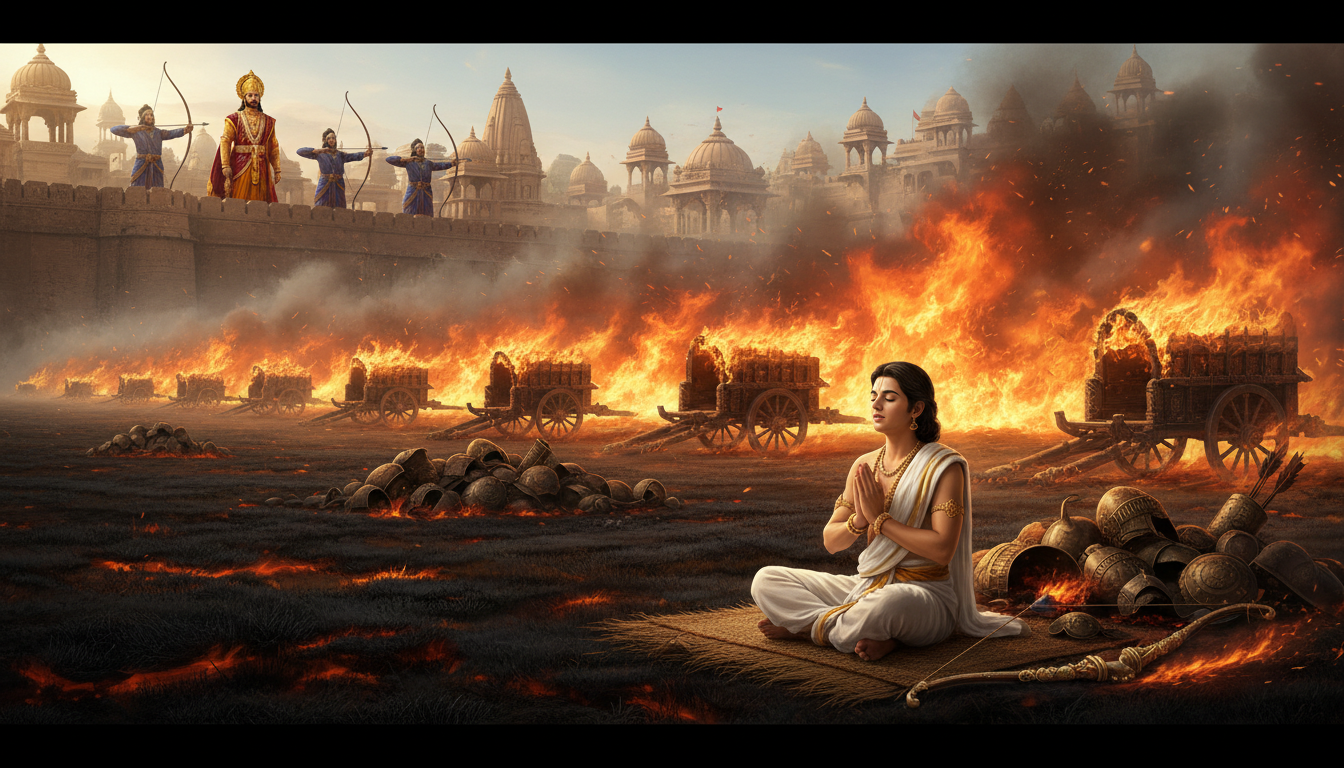
It did not begin as anything strange. It began as a hard field against a well-handled defence. Then the cars began to burn. Not struck by fire arrows, not lit from anything: the cars, and the men in them, and the elephants, and the soldiers standing in their coats of mail, all appeared to be on fire at once, out in the open, with nothing near them that could have done it.
Sahadeva sat in his chariot in the middle of an army that was catching alight and became exceedingly anxious, and could not resolve upon what he should do. There is no formation against that. There is no counter-charge. He had been given a quarter of the world to bring in and he had brought in every kingdom on the way, and here at the Narmada the thing standing in the road was not a king.
Janamejaya said, "O regenerate one, why was it that the god Agni became hostile in battle to Sahadeva, who was fighting simply for the accomplishment of a sacrifice, and therefore for the gratification of Agni himself?"
Vaishampayana said: For a reason that had nothing to do with Sahadeva at all, O Janamejaya, and everything to do with a girl who used to blow on her father's altar fire.
The Breath That Made It Burn
It is said that the god Agni, while residing in Mahishmati, earned there the reputation of a lover.
King Nila had a daughter who was exceedingly beautiful. She used always to stay near the sacred fire of her father, causing it to blaze up with vigour, and this was not a figure of speech. The thing had been noticed by everyone in that house. King Nila's fire, even when it was fanned in the proper manner by men whose whole office was the fanning of it, would not blaze up at all until it had been agitated by the gentle breath of that girl's lips.
So she came to the altar every day, because the rite could not go forward without her, and she bent over the coals and breathed, and the flame came up to meet her, every time, at once.
It was said in king Nila's palace, and it was said in the house of every one of his subjects, from the priests down to the men who cut the wood, that the god Agni desired that girl for his bride. They said it as a marvel and they said it as a joke and after a while they said it simply as a piece of local information, the way people will speak of a thing that is happening in a great house in front of them.
They were correct. And there was a part of it they did not know, which is that she had accepted him.
A Brahmana, Caught
One day the deity, having assumed the form of a Brahmana, was happily enjoying the society of the fair one, and was discovered by the king.
That is the whole of what the story says about the discovery, and it is enough. A father walks into a room in his own palace and finds his daughter with a man; and the man is a brahmana, a stranger, in the inner apartments of the king of Mahishmati, where he has no business at all.
And king Nila was a virtuous king. That is the hinge of the entire episode, and it is worth stopping on, because it would have been so easy for him to be something else. He was the master of a city on the Narmada with an army at his back and a law in his hand, and the man in front of him had no name he could produce and no family in the town. Nila could have had him killed in the courtyard in the time it takes to say it, and no one would have asked a question.
Instead the virtuous king ordered that the brahmana be punished according to law. According to law. He convened the thing properly, and the sentence came down as the sentence comes down on any man who has done what this man had done, and the officers went to carry it out.
At this the illustrious deity flamed up in wrath.
The Boon and the Stranger Gift
The room filled with a light that no lamp in it was making. The stranger who had been standing there under sentence was standing there still, and was the fire itself, and every man present understood at the same instant what had been going on at the altar and who had been bending over it every morning to make it live.
Beholding this, the king wondered much, and bent his head low to the ground.
And then, after some time, the king bowing low bestowed his daughter upon the god Agni, who was disguised as a Brahmana. Not upon the god in his glory. Upon the brahmana. He gave her away in the form the man had come to his house in, which is a fine and stubborn thing for a frightened king to insist upon, and Vibhavasu accepted that fair-browed daughter of king Nila and became gracious unto that monarch.
Then Agni, the gratifier of all desires, asked the king to beg a boon of him.
Nila did not ask for wealth, or for the extension of his borders, or for long life. He asked one thing: that his troops might never be struck with panic while engaged in battle. Not that they might never be defeated. Only that they might never break.
And from that time, O king, those monarchs who out of ignorance of this history desire to subjugate king Nila's city are consumed by Hutasana. That is the answer to your question. The fire that came up in Sahadeva's lines that morning was a father-in-law's wedding gift, still being delivered generations later.
There was another consequence, and it is stranger. From that time the girls of the city of Mahishmati became rather unacceptable to others as wives, for a family that marries a daughter to a god does not easily marry the next one to a neighbour. And Agni by his boon granted them liberty, so that the women of that town roam about at will, each unbound to a particular husband. And from that time, for both reasons together, the monarchs of other countries have left that city alone.
The Hymn of the Many Names
Sahadeva, beholding his troops afflicted with fear and surrounded by flames of fire, stood there immovable as a mountain.
He did not order a charge and he did not order a retreat. He got down. He purified himself and touched water, in the middle of a burning field, with his army watching him do it, and then he addressed the god who sanctifies everything.
"I bow to you, O you whose track is always marked with smoke. These my exertions are all for you. O sanctifier of all, you are the mouth of the gods, and you are Sacrifice itself. You are called Pavaka, because you sanctify everything. You are Havyavahana, because you carry the clarified butter that is poured upon you. The Vedas sprang for the ministering unto you, and therefore you are called Jataveda.
"Chief of the gods, you are called Chitrabhanu, Anala, Vibhavasu, Hutasana, Jvalana, Sikhi, Vaiswanara, Pingesa, Plavanga, Bhuritejah. You are he from whom Kumara had his origin. You are holy. You are called Rudragarva and Hiranyakrit.
"Let you, O Agni, grant me energy. Let Vayu grant me life. Let Earth grant me nourishment and strength, and let Water grant me prosperity. O you who are the first cause of the waters, you who are of great purity, you for the ministering unto whom the Vedas have sprung, you who are the foremost of the deities and their mouth: purify me by your truth. Rishis and Brahmanas, Deities and Asuras pour clarified butter into you every day, according to the ordinance, during sacrifices. Let the rays of truth emanating from you, while you exhibit yourself in those sacrifices, purify me.
"Smoke-bannered and possessed of flames, great purifier from all sins, born of Vayu and ever present in all creatures, purify me by the rays of your truth. Having cleansed myself thus, cheerfully, O exalted one, do I pray to you. Grant me now contentment and prosperity, and knowledge, and gladness."
He that will pour clarified butter into Agni reciting these mantras, O Janamejaya, will ever be blessed with prosperity, and having his soul under complete control will be cleansed of all his sins. The words Sahadeva found in a burning field became a prayer that householders have used ever since.
The Kusa Grass
Then Sahadeva said one thing more, and it was not praise. It was an argument, and it was the shortest speech of his life.
"O carrier of the sacrificial libations, it does not behove you to obstruct a sacrifice."
Having said that, the son of Madri spread some kusa grass upon the earth and sat down on it, in front of those terrified and anxious troops of his, and waited for the fire to reach him.
He did not sit behind them. He sat in front. Every man in that host could see their commander sitting on a handful of grass with his back to a wall of flame and his weapons on the ground beside him, and the fire came on across the field toward him.
And Agni, like the ocean that never transgresses its continents, did not pass over his head.
The flame came up to him and stopped, and then the god approached quietly, and addressed that prince of the Kuru race, and gave him every assurance.
"O you of the Kuru race, rise up from this posture. Rise up. I was only trying you. I know all your purpose, and those of the son of Dharma as well. But, O best of the Bharata race, so long as there is a descendant of king Nila's line, so long must this town be protected by me. I will, however, O son of Pandu, gratify the desires of your heart."
So the terms were plain, and they were honourable on both sides. The city would not fall, because a promise made at a wedding does not lapse. But the sacrifice would not be obstructed either, because the man who had come for it had put down his weapons and asked properly.
At these words the son of Madri rose up with a cheerful heart, and joining his hands and bending his head he worshipped that god of fire, the sanctifier of all beings.
The Road Went On South
After Agni had disappeared, king Nila came out to them, and at the command of that deity he worshipped Sahadeva with due rites, as a host worships a guest. Sahadeva accepted the worship, and then made him pay tribute, and the name went onto the list. Neither man had been beaten and both had got what he came for.
Then the victorious son of Madri went further south, because the quarter was not finished.
He brought the king of Tripura of immeasurable energy under his sway, and turned his forces against the Paurava kingdom and reduced its monarch, and with great effort brought Akriti, king of Saurashtra and preceptor of the Kausikas, under his sway. From Saurashtra he sent an ambassador rather than an army to king Rukmin within the territories of Bhojakata, who was rich in possessions and in intelligence and was the friend of Indra himself; and Rukmin, remembering with his son their relationship with Krishna, cheerfully accepted the sway of the son of Pandu, and gave up jewels and wealth without a battle.
He reduced Surparaka and Talakata and the Dandakas. He brought under subjection numberless kings of the Mlechchha tribes living on the sea coast, and the Nishadas, and the cannibals, and the Karnapravarnas, and those called the Kalamukhas who are a cross between men and Rakshasas, and the whole of the Cole mountains, and Surabhipatna, and the island called the Copper island, and the mountain called Ramaka. He subdued king Timingila, and conquered the wild tribe called the Kerakas, who are men with one leg. He took the town of Sanjayanti and the country of the Pashandas and the Karahatakas by means of his messengers alone, and made all of them pay tribute. He exacted tribute from the Paundrayas and the Dravidas, the Udrakeralas and the Andhras and the Talavanas, the Kalingas and the Ushtrakarnikas, and the delightful city of Atavi, and that of the Yavanas.
And having arrived at the sea shore at the end of the world, he sent messengers across the water to the illustrious Vibhishana, the grandson of Pulastya, who had been king in Lanka since Rama's day. That exalted monarch willingly accepted the sway of the son of Pandu, for he regarded it all as the act of Time; and he sent back diverse jewels and gems, and sandal, and much wood, and celestial ornaments, and costly apparel, and many valuable pearls.
The intelligent Sahadeva accepted them all and came home. He had vanquished numberless kings by conciliation and by war, and had made them pay tribute, and he presented the whole of that wealth to king Yudhishthira the just, and regarded himself as crowned with success, and continued to live happily.
Of the whole southern campaign, the day he is remembered for is the day he sat down on the grass.
Dharma Lesson
There are gates that open only to reverence, and no formation exists that will force one. A commander who can set his weapons down in front of such a gate, in view of his own frightened army, is worth more to a king than one who cannot.