The Youngest, and the Wisest
Sahadeva was the youngest of the five brothers, born last and treated, in most households, as the one whose opinions carried least weight simply by accident of order. The Pandavas' household did not treat him so. Yudhishthira, asked more than once which of his brothers he trusted most in matters of judgment, gave the same answer every time, to the visible surprise of courtiers who expected him to name Arjuna's cunning or his own patience: Sahadeva, he said, was the wisest of them all.
It was not flattery between brothers. Sahadeva had a gift for pattern that the others lacked, a mind that tracked the turning of stars and seasons, read omens correctly where priests hedged their interpretations, and calculated consequences several moves beyond where anyone else in the family thought to look. He was consulted quietly, in doorways and before councils rather than during them, and he answered quietly too, in the fewest words that would serve.
"You could speak more," Nakula told his twin once, half joking. "People would listen."
"People listen to what is right whether or not it is said loudly," Sahadeva answered. "I would rather be right once than be heard twice."
It was a habit that would carry him through a southern campaign that armies alone could not win, through a vow sworn in a humiliated hall and kept in total silence for thirteen years, and finally through a war whose very hour of beginning would be set by his own calculations. None of it would make him famous the way his brothers were famous. All of it would prove, to anyone paying close attention, that Yudhishthira's private verdict had never been mistaken.
The Gate at Mahishmati
His road for the Rajasuya's conquests ran south, and it ended, more memorably than anywhere else along the way, at the gates of Mahishmati. The sacrifice those conquests would eventually feed belongs to another account entirely; what happened at Mahishmati belonged only to Sahadeva.
King Nila's city was no ordinary fortress. When Sahadeva's forces advanced to take it by the methods that had worked everywhere else, arrows loosed, formations pressed forward, the plain grammar of siege, the fire god Agni himself rose in the city's defense, and weapons that came within reach of Mahishmati's walls caught flame in the archers' own hands before they could be loosed. Soldiers who had marched confidently through kingdom after kingdom found themselves, for the first time on the whole campaign, facing a defender that arrows could not touch.
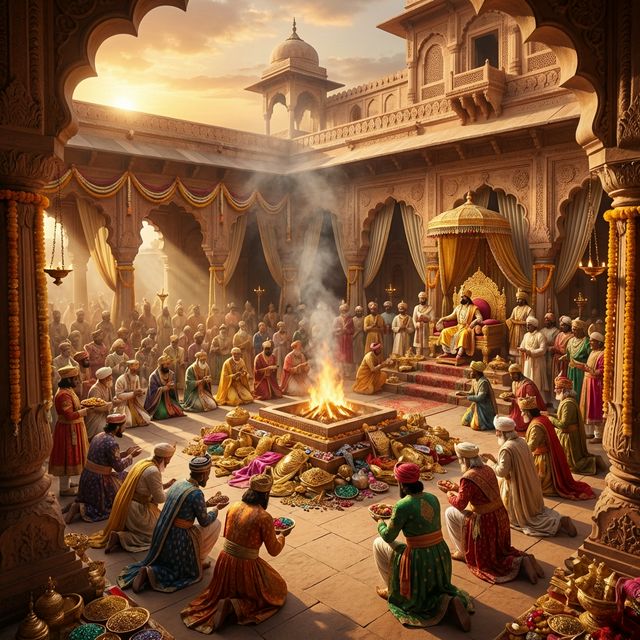
Sahadeva did not order a second assault. He watched the flames die back from the walls and understood, faster than any general trained only in tactics could have, that this was not a battle to be won by force at all. Mahishmati's protection was a god's favor, earned by King Nila's own devotion, and a god's favor could not be burned or broken through, it could only be approached the way it had been earned.
He laid down his weapons at the city's edge and turned to prayer instead, honoring Agni with the same care Nila's own priests would have shown, until the fire that had guarded the gates settled, and the gates themselves opened without another arrow spent. King Nila came out to meet him not as a defeated king dragged before a conqueror, but as one ruler acknowledging another who had known, in the end, when strength should yield to reverence.
"You did not come to burn my city," Nila said. "So my city does not burn you."
Sahadeva took his tribute, his alliance, and a lesson he would carry for the rest of his life: that the sharpest kind of victory was often the one that never drew a weapon at all.
A Vow Sworn in Silence
In the dicing hall at Hastinapura, when Draupadi was dragged before the assembly and every law of the court failed to protect her, each brother swore something in the aftermath, promises shouted or grimly stated, vengeance named against the men most responsible. One brother swore against Duryodhana's thigh and Dushasana's chest. Another swore against Karna, who had mocked her openly while she stood humiliated.
Sahadeva swore too, though almost no one who was not listening closely caught the words, or thought to repeat them afterward the way his brothers' oaths were repeated in awed and horrified whispers for years. His vow was against Shakuni, the uncle whose loaded dice had made the whole catastrophe possible, not the loudest villain of that hall, but in Sahadeva's private accounting, the architect who had made every other cruelty in it possible.
He did not raise his voice to swear it, and he did not raise the subject again for thirteen years. While his brothers spoke often of the debts they intended to collect, and those vows became something like public facts of the war everyone anticipated, Sahadeva's oath against Shakuni stayed exactly where he had first placed it: inside himself, unrepeated, undiscussed, carried through exile and disguise and the long approach to war without ever once being used to draw attention to his own grievance.
"You never speak of it," Nakula said to him once, in the quiet years of exile.
"Speaking of it would not kill him any faster," Sahadeva said. "I will speak of it once, when it is finished."
He kept the promise in exactly that shape: private preparation instead of public threat, patience instead of proclamation, for thirteen years that would have worn a louder man's resolve thin long before the armies ever met at Kurukshetra.
Tantipala, and the Hour of War
The year of hidden exile found Sahadeva in Virata's court as Tantipala, a herdsman set to watch over the kingdom's cattle, a role that asked nothing of the mind that had read Mahishmati's defenses and calculated a kingdom's fortunes, and asked everything of his patience instead, another year folded into the larger account of that disguise and remembered chiefly for how little it demanded of the gifts he actually carried.
When the year ended and war finally became unavoidable, those gifts were needed in full. It fell to Sahadeva, keeper of calendars and reader of omens since boyhood, to determine the hour at which the Pandava host should march onto the field at Kurukshetra, a calculation weighed against planetary position, season, and the countless smaller omens that a lifetime of quiet study had trained him to read correctly where others only guessed. The brothers who had once teased him gently for saying too little now waited on his word for something as large as when to begin a war that would end an age.
He gave it without ceremony, the same plain economy of speech he had always used, and the army moved when he said it should move.
On the eighteenth day, with the war nearly spent and most of its named villains already fallen, Sahadeva found Shakuni at last on the field where the vow sworn thirteen years earlier in the dicing hall could finally be paid. He did not announce the moment or call for witnesses to see it settled. He simply fought his way to the man who had loaded the dice that broke his family's fortunes, and finished what he had promised, in the same silence he had carried the promise in for over a decade.
It was, of every act attributed to him across the whole war, the one that most matched the shape of the man: a debt collected without a speech, because the paying of it had never needed an audience to be real.
The Fall, and the Weight of Knowing
On the final climb into the mountains, after Draupadi and three of his brothers had already fallen along the path and Yudhishthira had answered, without flinching, why each of them had, Sahadeva was the next to go down. The brother still walking beside him asked, as he had asked each time before, what fault had finally caught up with the one who had seemed, of all of them, the least burdened by fault.
Pride, Yudhishthira said, not pride in strength or beauty or skill at arms, the failings that had already claimed the others, but pride in wisdom itself. Sahadeva had believed, quietly and without ever saying so aloud, that no one matched him in understanding, and had allowed that private certainty to settle into something the journey's harsh accounting still called vanity, however differently it wore compared to his brothers' more visible sins.
It was, in its way, the cruelest of the mountain's verdicts, because it fell on the one gift Sahadeva had spent a lifetime using without ever demanding recognition for it. He had read the god's terms at Mahishmati and chosen prayer over arrows. He had carried a vow in total silence for thirteen years and closed it without ceremony. He had fixed the very hour a world-ending war began, and told almost no one what that responsibility had cost him to calculate correctly. If wisdom itself could still be a vanity, then no gift, however quietly held, was safe from becoming one.
He fell where he fell, and the climb went on without him, the same patient silence that had defined his whole life closing over him one final time. What he left behind was not a legend of loud deeds, the kind his brothers had earned at Kurukshetra in full view of two armies, but a harder lesson for anyone willing to sit with it: that foresight bound to silence is still a kind of valor, that the wisest counsel is sometimes the one never spoken aloud, and that even the man who is right most often must still, in the end, answer for believing it too completely.
Dharma Lesson
Sahadeva's dharma is patience without proclamation: he swears an oath and simply keeps it, reads the omens and simply reports them, without ever demanding recognition for either. His story asks whether wisdom that never announces itself is worth more, not less, than wisdom that must be praised to feel complete, and answers, gently, that even quiet gifts can become a private vanity.