Fourth-Named, First in the Saddle
Nakula was, by the unanimous verdict of Hastinapura's court and every kingdom it exchanged envoys with, the handsomest man of his generation, a beauty striking enough that poets reached for it as a matter of course whenever they needed an ideal, then moved on quickly to praise something they considered more substantial. He was also, though it was mentioned second and sometimes not at all, the finest swordsman among the five brothers and the surest hand with a horse that the Kuru line had produced in memory, able to break and train a mount that other riders had given up on.
None of it moved him up the order. In the formal genealogies, in the address of ministers and the recitation of priests, he came fourth: after Yudhishthira, whose birth made him king; after Bhima, whose strength made him feared; after Arjuna, whose skill made him sung about in every court from Panchala to Dwaraka; and ahead only of Sahadeva, his twin, who seemed no more troubled by fourth and fifth place than Nakula pretended to be.
"There is no shame in being named after your brothers," Kunti told him once, sensing what he did not say aloud. "There would be shame only in believing the order of naming is the order of worth."
He carried the words the way he carried most things that mattered to him, quietly, and without complaint that any court chronicler thought worth recording. It was a discipline that would be tested more than once: in a western kingdom that was also his mother's people, in a lake that decided which of two mothers would keep which son, and on a battlefield where an enemy's mercy would matter more than his own skill. But that discipline began here, in the plain fact of being fourth-named and refusing to let it curdle into something smaller than himself.
The Delicate Conquest of Madra
When Yudhishthira prepared for the Rajasuya, the great sacrifice that would proclaim him emperor, each brother rode out in a different direction to bring the kingdoms of Bharatavarsha under his authority, a series of campaigns whose culmination, the sacrifice itself, belongs to another telling. Nakula's road ran west, through Sindhu and Sauvira and the river kingdoms beyond, campaigns fought and won with the same unhesitating skill he brought to everything, tribute gathered and allegiances secured without any court needing to be reminded twice of the cost of refusal.
Then his road reached Madra, and the campaign changed shape entirely.
Madra was his mother's kingdom, ruled by his uncle Shalya, Madri's brother, the man who had given his sister in marriage to Pandu and had watched Nakula and his twin grow from a respectful distance ever since. Conquest, in the ordinary sense, was not a word Nakula could use here without souring something that mattered more than tribute.
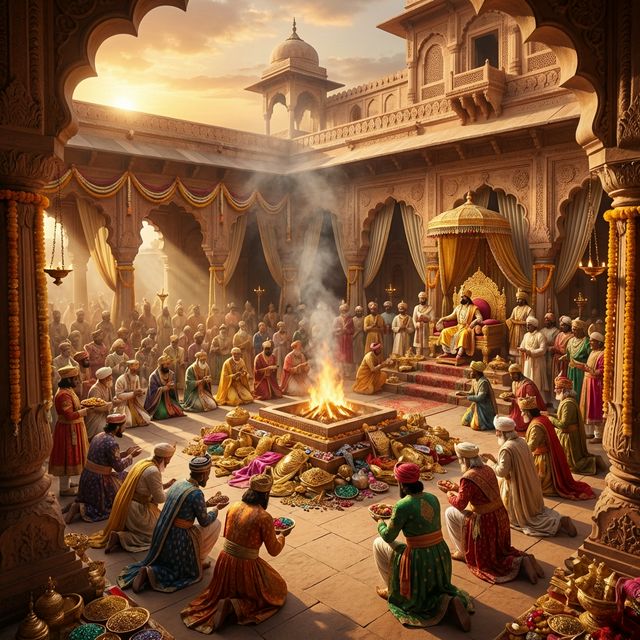
He rode into Madra not as an invader announcing terms but as a nephew arriving with an army he hoped never to need. He met Shalya's ministers first, then Shalya himself, and spoke of the Rajasuya not as a demand but as an honor his uncle's house could share in by choosing, of its own will, to stand with Yudhishthira before the sacrifice began.
Shalya was no fool, and he understood exactly what was being offered him: the chance to submit without the humiliation of having been made to. He took it, gave his tribute freely, and embraced his nephew as kin rather than as a conquered king receiving a conqueror's mercy.
"You could have taken this kingdom by force," Shalya told him privately. "Your brothers would have."
"My brothers are not your sister's sons," Nakula said. "I did not come here to prove I could break you. I came to ask you to stand with us, because you are family, and because I believed you would say yes if I asked rather than commanded."
It was the same discipline Kunti had named years before, the fourth-named brother's gift for achieving completely without needing the achievement to look like a conquest at all.
The Lake and the Choice
Years later, deep in the forest exile, a lake guarded by a yaksha took each of Nakula's brothers in turn, Bhima, Arjuna, Nakula himself, and finally Sahadeva, each drinking from the water before answering the questions the guardian demanded and each falling lifeless for the failure. Only Yudhishthira, arriving last and answering every riddle with patient and exact truth, satisfied the yaksha enough to be offered a reward beyond his own survival: one brother restored to life, his choice which.
Nakula, hearing the story afterward exactly as everyone else heard it, from Yudhishthira's own retelling, felt something he had rarely let himself feel about his place among the five: a fierce and grateful astonishment. His eldest brother had not chosen Bhima's strength or Arjuna's skill, the two arms that most obviously kept the family safe. He had chosen Nakula, and had given the yaksha a reason so plain it needed no defending, that he himself, Kunti's son, already lived, and it was only right that Madri, his father's second wife, should keep at least one son of her own among the living as well.
"You did not choose me for anything I had done," Nakula said to him later, unable to keep the wonder fully out of his voice.
"I chose you for what was fair," Yudhishthira answered. "Your mother deserved a living son as much as mine did. That was reason enough."
Nakula never forgot it. It was, of all the honors his beauty and his swordsmanship had earned him across a lifetime of being named fourth, the one he prized most: not a victory he had won, but a fairness someone else had insisted on when it would have been easier not to.
Granthika, and the Day Karna Spared Him
The thirteenth year of exile demanded disguise, and Nakula spent it in Virata's court as Granthika, a keeper and trainer of horses whose true name and lineage nobody in the stables thought to ask after, a year folded quietly into the larger account of that disguise, remembered mostly for how completely he vanished into a role far beneath the station poets had spent his whole life praising.
By the seventeenth day of the war that came after, there was no more vanishing to be done. Nakula met Karna in open battle, and the encounter went the way most of Karna's encounters went that day: swiftly, and to Karna's advantage. Blow answered blow only until Karna's superior strength told, and Nakula's bow was broken, his chariot wrecked, his sword struck from his hand, until he stood disarmed before a man who could have ended the war's most storied twin with a single further stroke.
Karna did not deliver it. He lowered his weapon instead, close enough that only Nakula could hear him.
"Go, child," Karna said. "Fight Arjuna if you must find someone to lose to. I will not be the one to make your mother a liar."
Nakula did not understand the reference until much later, when the whole truth of Karna's birth and his private promise to Kunti, that she would keep five sons regardless of how the war ended, and that his blade was reserved for Arjuna alone, became common knowledge among the brothers who survived him. In the moment he understood only that he had been beaten and spared in the same breath, by an enemy whose mercy asked for no thanks and expected none.
He rode back to his own lines disarmed but alive, and said little about it to anyone, which was, by then, exactly the kind of silence his brothers had come to expect of him.
The Last Steps, and the Weight of Being Beautiful
Years afterward, when Yudhishthira led his brothers and Draupadi on the long final climb into the mountains, each of them fell in turn along the path, and each fall was answered when the next brother still walking asked why. Draupadi's love had not been equal among her five husbands, Yudhishthira said. One brother's own appetite had outrun his restraint. Another's boast that he could destroy every enemy in a single day had been a lie even the gods would not forgive.
When Nakula fell, the answer came without cruelty but without softening either: he had believed, more than was proper for any mortal man, that there was no one as beautiful as himself. It was not a fault of vanity performed for others to see, Nakula had never demanded praise for his face the way lesser men demand it, but a private conviction he had never fully released, carried quietly the same way he carried everything, and it was enough, in the accounting that governed that mountain road, to cost him the rest of the climb.
There was a kind of justice in it that fit the whole shape of his life. He had spent his years excelling without insisting on first place, conquering without humiliating, achieving in silence what louder brothers achieved with acclaim, and the one indulgence he had allowed himself, the quiet certainty of his own beauty, was the single thing that finally slowed him down. It was a small vanity beside his brothers' more visible sins, and the mountain did not weigh it as small.
What remained of him afterward was not the beauty the poets had reached for so easily, but the discipline underneath it: a man who had learned, across a lifetime spent fourth in every listing, that being overshadowed was not the same as being lesser, and that the truest humility was not in refusing praise but in never having needed it in the first place.
Dharma Lesson
Nakula's dharma is the discipline of the middle: excelling without insisting on first place, conquering an uncle's kingdom without humiliating him, and serving wherever he was needed rather than wherever he might be praised. His story teaches that vanity, even in someone whose gifts are entirely real, is still a debt the self must eventually pay.