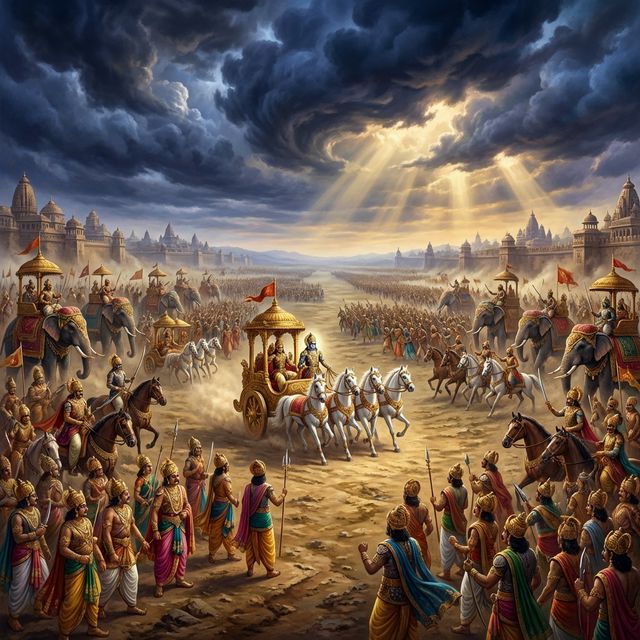
Krishna Takes Leave of Indraprastha
The farewell on the road to Dwaraka, and the promise to return
The Visit That Ended
Vaisampayana was telling king Janamejaya about the days after the burning of the Khandava forest, when the city on the river was still called Khandavaprastha by the old men and Indraprastha by the young ones, and the ground for the great hall had only just been measured out.
Janardana had been living there a long while. He had been treated all that time with respectful love and affection by the sons of Pritha, and he had been happy, and there is nothing in the account to suggest that anybody in that household expected the happiness to end. Then one day the thing happened that happens in every long visit. He became desirous of leaving Khandavaprastha to behold his father.
That is the whole of the reason given. Not an errand, not a summons, not a danger at Dwaraka. He wanted to see Vasudeva, who was an old man now in a city by the sea, and so he began to take his leave.
He went first to the two who had to be asked. He saluted Yudhishthira, and then he went to Kunti, his father's sister, and made obeisance with his head unto her feet.
Consider who was bending. This was the possessor of large eyes, unto whom the obeisance of the universe is due, deserving of the worship of all, and he put his head down on the floor at the feet of his aunt because she was his aunt and that is what a sister's son does.
Pritha did not treat him as anything else. She raised him and smelt his head, in the old gesture that a mother makes over a child, and she embraced him.
There was no speech recorded between them. The woman who had been given away to Kuntibhoja, whose brother's son this was, and who had spent a life since then losing husbands and kingdoms and going into forests with five boys, stood in the doorway of a house that was finally hers and held Krishna's head against her and let him go.
Messages for the Paternal Side
From Kunti he went to his own sister.
Hrishikesa approached Subhadra affectionately, and his eyes filled with tears. That detail is given plainly and it is the only time in the whole passage that anybody weeps. He had brought her here himself. It was his chariot she had driven away from Raivataka with Arjuna beside her, and it was his voice that had settled the Vrishnis afterwards when they wanted a war about it, and now he was going home to the city she came from and she was staying.
He spoke unto her words of excellent import and truth, terse and proper and unanswerable, and fraught with good. Vaisampayana does not give them. What he gives instead is the shape of them, and the shape is a brother telling a married sister the things she needs to hear said aloud once before he leaves, in as few words as they can be put, with nothing in them that she can argue against.
The sweet-speeched Subhadra saluted him in return and worshipped him repeatedly with bent head, and then she told him all that she wished to be conveyed to her relatives on the paternal side. Messages for Dwaraka. For her father, for her mother, for Balarama who had wanted her married elsewhere. She was sending her voice back along the road she could not travel, and her brother was the road.
He bade her farewell and uttered benedictions on his handsome sister, and then he of the Vrishni race went to find Draupadi and Dhaumya.
Dhaumya was the family priest, the Brahmana who had walked out of the forest to serve five landless princes and had stayed with them into their kingdom. Krishna duly made obeisance unto him, as a man does to a priest, and then he turned to Draupadi.
The text says he consoled her, and then obtained leave from her. Both halves matter. She had to be comforted, because he was going. And she had to give permission, because in that house she was the queen, and a guest does not simply walk out of a queen's door.
The Rites Before a Road
Then the learned and mighty Krishna, with Partha at his side, went to his cousins, and the five of them stood together, and Vaisampayana says that surrounded by the brothers Krishna shone like Sakra in the midst of the celestials.
Before a journey there are rites, and he performed them all.
He whose banner bore the figure of Garuda purified himself with a bath. He adorned his person with ornaments. The bull of the Yadu race then worshipped the gods and the Brahmanas with floral wreaths, with mantras, with bows of the head, and with excellent perfumes.
Having finished all these, that foremost of steady and virtuous persons thought of setting out.
The chief of the Yadu race came out of the inner apartments into the outer, and issuing thence he made offerings to the Brahmanas who deserved worship: vessels full of curd, and fruits, and parched grain. He caused them to pronounce benedictions upon him. He made them presents also of wealth. Then he went round them, keeping them on his right, the way a man circles a fire or a temple or anything else he is asking to bless him.
None of this is hurried in the telling, and none of it is decoration. A departure in that world is a thing with parts, like a sacrifice, and a man who is leaving well leaves in order: he washes, he dresses, he honours the gods, he feeds the Brahmanas, he pays them, he walks around them, and only then does he look at the road. Krishna, who had built the hall by asking Maya for it and had burned a forest with Arjuna and would one day drive a chariot through the worst battle in the world, stood in a courtyard at Indraprastha and did the whole of it, item by item, like anyone else.
Then his car was brought.
The Car with the Garuda Banner
It was an excellent car of gold, endued with great speed, and on its staff was the banner bearing the figure of Tarkhya, which is Garuda. It carried his mace and his discus and his sword and his bow Sharnga and his other weapons, all of them stowed as though he were going to a war and not to his father's house. To it were yoked his horses Saivya and Sugriva.
He of eyes like lotuses set out at an excellent moment of a lunar day of auspicious stellar conjunction, which is to say that even the hour of it had been chosen properly.
And then the departure came apart in the most affectionate way possible, because nobody would let him go alone.
Yudhishthira, king of the Kurus, from pure affection ascended the chariot after Krishna. Daruka was the finest charioteer alive and he was standing at the reins where he belonged, and the king of Indraprastha caused him to stand aside and took the reins himself. Arjuna of long arms rode on that same car and walked round Krishna and fanned him with a white chamara furnished with a handle of gold. Behind them came the mighty Bhimasena, and with him the twins Nakula and Sahadeva, and behind the twins the priests, and behind the priests the citizens.
Kesava, that slayer of hostile heroes, followed by all the brothers, shone like a preceptor followed by his favourite pupils.
There is a small comedy in the picture and the poet knows it. A guest is leaving, and to see him off the emperor has demoted his driver, the greatest bowman on earth has made himself a fan-bearer, and the whole city has come out on the road. Nobody is behaving with any dignity at all.
On the way Govinda spoke unto Arjuna and clasped him firmly. He worshipped Yudhishthira and Bhima. He embraced the twins, and was embraced in return by the three elder Pandavas, and reverentially saluted by the two younger ones.
And the road went on, and the city fell behind, and none of them stopped.
Half a Yojana
After they had gone about half a Yojana, which is two miles, Krishna, that subjugator of hostile towns, addressed Yudhishthira respectfully and requested him to stop following him further.
They had come two miles. He had to ask.
And when he asked, Govinda, who was conversant with every duty, did not ask as a man asks a friend. He saluted Yudhishthira reverentially and took hold of his feet.
That is the second time in this episode that Krishna has gone down, and both times he has gone down to a Pandava, and both times the person he honours is one who would say, if asked, that the honour runs entirely the other way. Yudhishthira did not let it stand. He soon raised Kesava up, and having raised him, that son of Pandu smelt his head, exactly as Kunti had done in the house, and gave him leave.
"Good bye," said the king.
Then the slayer of Madhu made an appointment with them about his return, in words that were proper. He was not saying farewell. He was naming a time, and the naming of it is the reason the parting could be borne, and everything that happens in that city afterwards, the great hall and the rajasuya and the dice, happens in the space between his going and his coming back.
Even then they would not turn round. He had to prevent the Pandavas with difficulty from following him further on foot, and only when he had done it did he gladly proceed towards his own city, like Indra going towards Amravati.
Out of the love and affection they bore him, the Pandavas gazed on Krishna as long as he was within sight. When he got out of sight their minds still followed him. Kesava of agreeable person soon disappeared from their view, unsatiated though their minds were with looking at him.
Then those bulls among men, the sons of Pritha, with their minds fixed on Govinda, desisted at last, and unwillingly returned to their own city in haste.
Two Homecomings
The car went west with Satyaki riding behind it, and Sauri, the son of Devaki, with his charioteer Daruka beside him, reached Dwaraka with the speed of Garuda.
Both houses closed their doors that evening, and Vaisampayana sets the two homecomings side by side.
At Indraprastha, king Yudhishthira of unfading glory, accompanied by his brothers and surrounded by friends, entered his excellent capital. That tiger among men then dismissed all of them, his relatives and his brothers and his sons, and sought to make himself happy in the company of Draupadi. The public part of the day was over. He had walked two miles out and two miles back for a man who was no longer there, and what he wanted afterwards was his wife and no audience.
At Dwaraka the same thing happened in a different order. Kesava was worshipped by the principal Yadavas, Ugrasena among them, and entered his own excellent city with a happy heart. He worshipped his old father Vasudeva, whom he had come all this way to see, and his illustrious mother Devaki. He saluted his brother Valadeva. Then he of eyes like lotus-petals took his seat.
Then the sons came, and they are named one after another as they came to be embraced: Pradyumna, Shamva, Nishatha, Charudeshna, Gada, Aniruddha, Bhanu.
And having obtained the leave of all the elderly men, Janardana entered the apartments of Rukmini.
That is where the episode leaves him, and it is worth noticing what it is: an ordinary evening. A man arrives home from a long stay with cousins, greets his parents, salutes his brother, embraces the children, waits until the old men say he may go, and goes in to his wife.
Two miles east of Indraprastha the road was empty. In fourteen months Maya would finish the hall of gems and send word to Yudhishthira, and after that would come the sacrifice, and after the sacrifice the game of dice, and every one of those days would be shaped by the promise Krishna made on the road before he let go of Yudhishthira's feet: that he would come back.
Dharma Lesson
The parting is made entirely of small courtesies, and the courtesies run downhill in the wrong direction on purpose. The one to whom the obeisance of the universe is due puts his head at his aunt's feet and takes hold of his cousin's; the emperor pushes aside a charioteer to drive; the greatest bowman on earth carries a fan. Affection in this house is shown by who is willing to be the lesser person in the room. And what makes the leaving bearable is not the farewell but the appointment: Krishna does not say goodbye, he names a time, and the Pandavas are able to turn round and go home because of it.