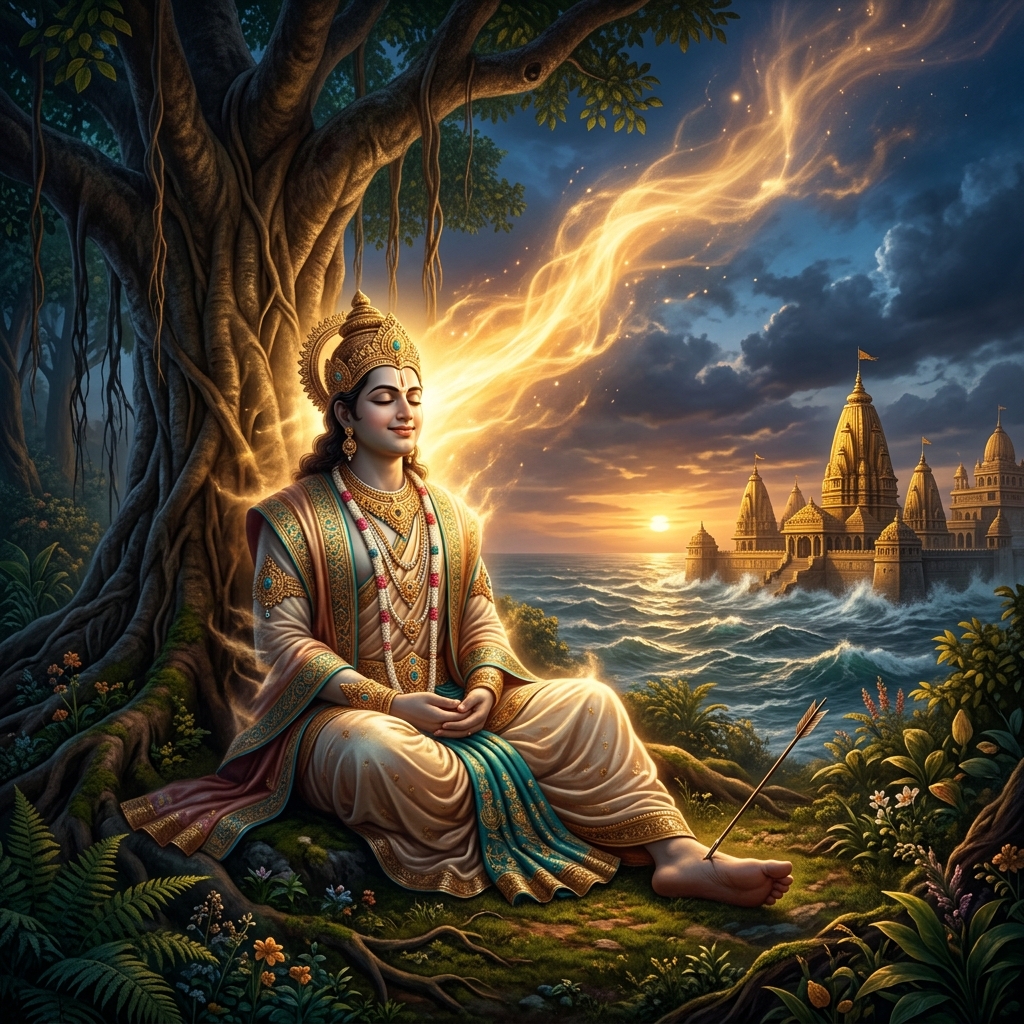
The City Seen From the Water
Travelers who came to Dwaraka by sea always told the story the same way afterward: that the city announced itself before the coastline did. Long before a sailor could make out the line where water met land, the flag of Garuda, gold thread on deep cloth, stood visible above the horizon, catching wind and sun both, so that ships still a half day out could steer for it as surely as for any star.
Then the ramparts rose. They were built to be seen from exactly this distance, walls the color of struck gold in the morning light, curving with the shore in a long unbroken sweep that made the whole city look, from the water, like something the sea itself had cast up rather than something men had built upon it. Towers stood along the wall at intervals, catching the light a beat before the wall beneath them did, so that the approach felt like watching a slow sunrise happen sideways, over stone instead of sky.
The city had been raised, the tradition says in a single clause worth remembering and not lingering on, in one night, by craft neither wholly human nor wholly divine, after Krishna and the Yadavas fled Mathura before Jarasandha's armies and needed a home the sea itself would help defend. What had begun as a refuge had become, in the years since, something that made refuges of every place a traveler had known before seeing it. Fishermen leaving before dawn watched it catch the first light; merchants returning after long absence found their eyes drawn to the wall before their feet found the gangplank; and more than one visitor, the old accounts insist, simply stood at the rail a long while before going ashore, unwilling yet to trade the sight of the whole city for the narrower view any single street would give him.
The Plan of the Many-Doored City
Once past the ramparts, a visitor discovered that Dwaraka's beauty was not an accident of gold and light but a matter of design, laid out with the same deliberate care a scholar brings to a mandala drawn for worship. The city was quartered by two broad avenues that crossed at its heart, each quarter given its own character and its own trades, so that a stranger who learned the pattern once could find his way through the whole city without asking a single direction twice.
Between the great avenues ran smaller streets lined with step-wells, their stone stairs descending in neat tiers to water that stayed cool even in the hottest months, and gardens broke up the built stone at regular intervals, planted with flowering trees that scented whole neighborhoods when the wind was right. The wealthy kept private gardens behind their courtyard walls, but the step-wells and the larger public gardens belonged to everyone, and it was common in the evenings to find porters and princes drawing water from the same stone steps, trading news of the day's trade or the day's gossip as equals at the water's edge.
It was the gates, though, that gave the city its very name. Dwaraka means the many-doored, and the city earned the title honestly: gates opened from every quarter, toward the sea for the fishing fleets and the merchant ships, toward the inland roads for the caravans that brought grain and timber and news from the wider Yadava country, toward the pastures where the herds were kept, each gate carved and painted with its own guardian figures and each one manned day and night by watchmen who knew every regular face that passed through it. A city with one door can be starved by a single siege. A city with many can never quite be closed, and the Yadavas, who had once fled a closing city, had built themselves one that could not be shut against them.
The Hall Brought From Heaven
At the center of the city's crossing avenues stood the Sudharma, the assembly hall the gods themselves were said to have surrendered to the Yadavas, a hall so finely built that no earthly craftsman could account for its proportions, its pillars catching light in ways that seemed to change with the hour rather than merely reflect it. Here the Yadava council sat to settle disputes, to weigh matters of trade and war and marriage, and to hear, on the days he chose to attend in person rather than send word through his ministers, Krishna's own counsel on whatever question the city had brought before it.
Below the hall's high dignity, the ordinary city carried on its extraordinary daily round. The harbor markets were the loudest of Dwaraka's quarters by mid-morning, ships from a dozen coasts unloading pepper and cloth and worked ivory, their crews trading in tongues the local merchants had learned just well enough to bargain in, a running comedy of gesture and mispronunciation that everyone involved seemed to enjoy as much as the trade itself. Nearer the pastures, the cattle-yards kept the wealth the Yadavas had always measured themselves by before they measured themselves by gold, herds lowing in the cool of the yards while boys not yet old enough for weapons practice learned the herding trade from grandfathers who still remembered Mathura.
The wrestling grounds drew crowds every evening, young Yadava men testing their strength against each other under instructors who had trained under Balarama himself, and not far off the schools of archery and music ran their lessons side by side, so that the twang of a bowstring and the notes of a flute often carried across the same open ground at the same hour, the city apparently seeing no contradiction between the two arts. Festivals, when they came, spilled out of every quarter at once and ran all the way down to the tide line, where the sea itself seemed, on those nights, to join the dancing.
Ten Thousand Households
The tradition counts the great houses of Dwaraka in the tens of thousands, Vrishnis and Andhakas and Bhojas together, and the number matters less for its arithmetic than for what it says about the city's character: here were kings without crowns, living among each other as equals in a council of equals, an entire aristocracy that had agreed, in the founding of this city, to share a single throne room rather than compete for a single throne. Ugrasena presided as elder among them, but the Yadava way of rule had always leaned toward the council table more than the solitary crown, and Dwaraka was built, quarter by quarter, to hold that arrangement comfortably rather than merely tolerate it.
Among these households Krishna kept a routine that visitors often found more remarkable than his miracles, precisely because it was so ordinary. He rose before the heat of the day, attended to the small devotions and the correspondence any head of a great house must attend to, and walked to the Sudharma most mornings to sit with the council on whatever business the city had brought. His several households, each of his queens keeping her own residence within the wider palace grounds, received him in turn across the days of the week, and the tradition is fond of noting that no queen was made to feel the least among the others, that he arranged his own hours the way a careful steward arranges accounts, so that every ledger came out even.
He was, in the accounts that remember this period, as much citizen as god: a man who kept appointments, who sat through long council arguments over water rights and marriage settlements with the same patience he brought to larger matters, who could be found some evenings simply walking the harbor quarter, unescorted, trading a word with a fisherman mending nets as easily as he had spoken that morning with the elders of the city he had built for them.
A City Kept Under the Tongue
For all its order and its brightness, the tradition never quite lets a listener forget, in one clause held apart from the rest of the telling, that Dwaraka stood on land the sea itself had lent rather than given outright, ground that would in time, in the stories the city's own end is told through, be asked for back. That shadow is not dwelt on here. It belongs to another telling, and this one is content to let it fall, briefly, across the noon of the city's life before passing on.
What the tradition keeps instead, more insistently than any warning, is the plain wonder of the place while it stood: the golden ramparts that made every arriving ship slow its approach without meaning to, the crossing avenues and their step-wells, the Sudharma catching light no earthly hall should have been able to catch, ten thousand households living as equals under gates that could never all be closed at once, and at the center of it, a god who kept a citizen's hours among them, dividing his mornings and his evenings the way any careful householder must.
Those who saw Dwaraka in its noon, the old accounts insist, carried the sight the rest of their lives the way a person carries the memory of a particular light on a particular day, never quite able to describe it so that someone who had not seen it themselves could believe it fully. The city outlived, in memory, every gate and every wall it had actually been built of. And the sea that had lent Dwaraka its land keeps the city now, the tradition says, the way a person keeps a word they have promised not to speak aloud: held close, held whole, held under the tongue, brought out only when the telling of it is asked for by someone patient enough to listen all the way to a morning by the water, a flag catching the first light, and a city rising gold out of the tide.
Dharma Lesson
A city, like a life, is a shape held together by the people who keep faith with its daily rounds - its markets, its schools, its assembly halls - and by nothing more permanent than that faith. Splendor without discipline is only a bigger ruin waiting to happen, which is why the tradition remembers Dwaraka's order and generosity in the same breath as its gold. What is truly borrowed, even a city built on the sea's own goodwill, must one day be returned.