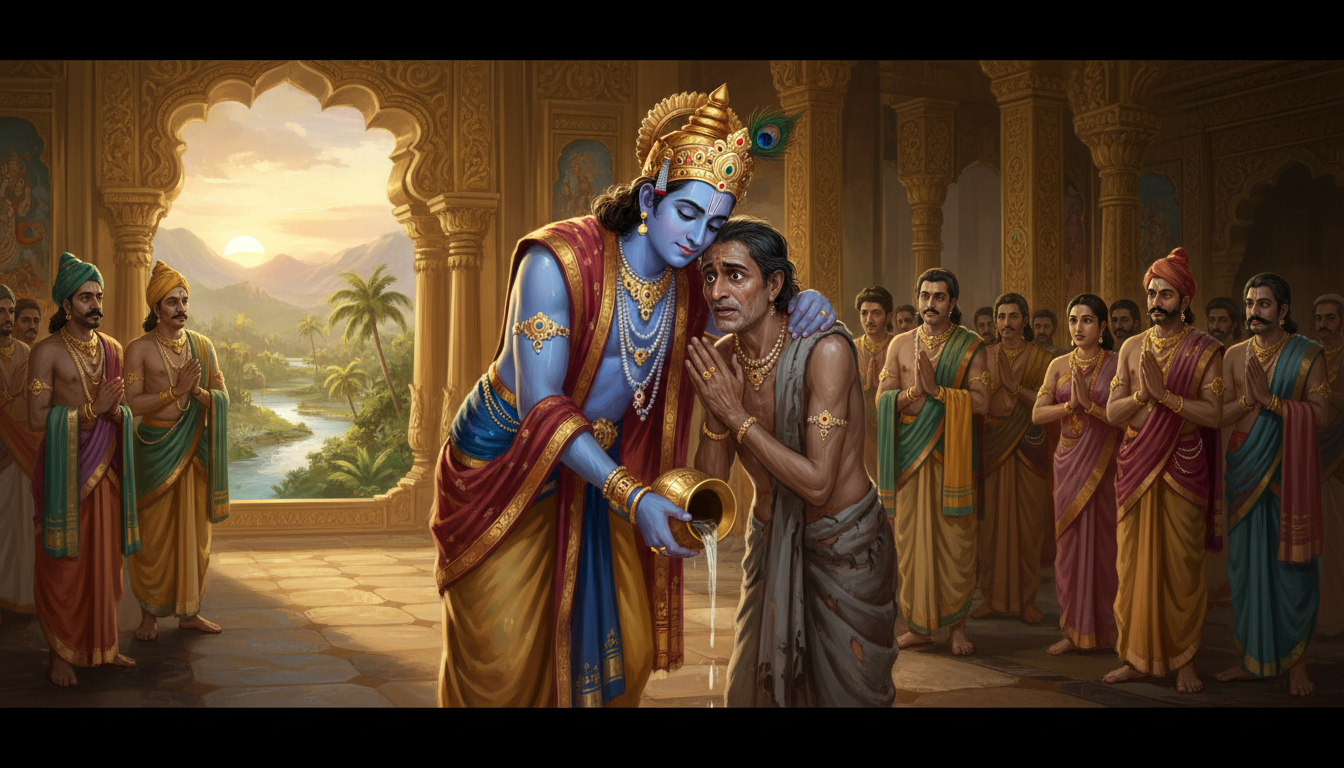
The Two Who Held the Line
In the years when Jarasandha came at Mathura the way weather comes at a coast, again and again, with a patience that wore at the defenders worse than any single assault, the emperor of Magadha did not fight alone. He brought kings with him. Most of them were what kings usually are, brave enough and beatable. Two of them were neither.
Hamsa and Dimbhaka were brothers, and the Yadavas on the walls learned to pick them out of a moving army at half a day's distance, because where those two rode the line did not bend. They were masters of every weapon that has a name and of several that have none, trained by teachers whose own names had gone out of use, and they had done more than train. In their youth they had gone up into the hills and stood through the summers ringed with fire and through the winters waist deep in snowmelt, and had given Shiva such austerity as few men have the constitution to survive, and Shiva, who does not haggle, gave them what they asked for: that no weapon in battle would ever kill them.
It was not a figure of speech. Yadava archers of forty years' experience put shafts into their chests and watched the arrows turn as though the men were cut out of oiled stone. Maces broke on them. A spear thrown by Satyaki, who did not miss, opened nothing at all.
And they knew it, which was the worst of it. Men who cannot be killed grow a particular insolence, an ease in danger that reads to ordinary soldiers as contempt for them personally. Hamsa fought without a helmet so that his face could be seen from the wall. Dimbhaka, the younger, laughed while he worked. When the two of them rode out from the Magadhan lines the drums behind them changed their rhythm, and the men on Mathura's rampart who heard that change felt their arms go heavy before a single arrow had been loosed.
They were, in the plainest terms, the reason the sieges kept coming back.
The Question in the Council
Balarama fought them both in one afternoon and came back at dusk with the plough over his shoulder and an expression his brother had not seen on him before.
"I hit the elder one," he said. "Squarely. I have felled elephants with less. He came up off his knee and asked whether I would care to try it again."
The council that night went badly, as councils do when brave men are being asked to admit that courage is not the missing ingredient. Ugrasena spoke about ditches and a higher wall. Somebody proposed an alliance that nobody in the room believed in. Somebody else, more quietly, said what all of them were thinking: that Mathura could not hold forever against an enemy who was incapable of losing his two best men.
Krishna listened to the whole of it and then asked a single question that seemed, at the time, beside the point.
"When Hamsa rides out," he said, "where is Dimbhaka?"
They worked back through the seasons, and the answer never varied. On his brother's right, or on his brother's left, or coming up behind him when the line got ragged. Never in another quarter of the field. Never given a separate command, not once in all the years of the sieges. Jarasandha had tried to split them early and had given it up. The brothers were not merely allies. Each of them plainly regarded the other as the greater part of himself.
"That is where they are strong," Balarama said. "Two men who never leave a gap between them."
"Yes," said Krishna. "And it is the one gate in them that Shiva's boon does not cover."
The room was slow to follow him, and then it was not slow any more, and then it was very quiet.
"No weapon in battle," Krishna said. "So there is no arrow for these two, and no mace, and no discus, and no plough. What cannot be pierced can still be deceived. Their armor is on the outside of them. What they love is not."
Nobody in that council asked him what he intended to do about it, and afterwards several of them wished very much that they had.
The Fog of a Long Day
The fighting that season shifted down to the flats along the Yamuna, where the ground runs good for chariots and the river is wide and slow at the edges and deep in the channel.
Krishna took the field against Hamsa himself, and it was a long day. He could not kill the man and did not attempt it. What he did instead was drive him, hour after hour, the way a herdsman turns a bull: refusing him ground, cutting his chariot away from the Magadhan center, working at his horses until the elder brother, unwounded and unwoundable, found himself alone on the river side of a battle that had drifted away from him, with dust between him and his own army and no road back before dark. He turned north along the bank to come round by the upper fords. It was the sensible thing to do. It was also the last that anyone on that field saw of him for two days.
What happened afterwards is the part that the tellers of this story do not hurry past.
Word went through the Magadhan camp that night the way word goes through any camp: from a driver who had seen a chariot go down toward the water and not come up again, to a wounded man who had heard shouting near the bank, to a captain who put the two together and said the thing plainly, because plain things travel fastest. Hamsa is dead. Hamsa fell at the river. By midnight it was in every fire-circle in that army.
It was not a lie that anybody had told. It was the ordinary fog of a long day's fighting, the kind of mistake armies have made about their own men in every war that has ever been fought.
But it reached Krishna's ears before it reached Dimbhaka's, and there was a moment - the tellers place it exactly here, and leave it lying in the open - when a rider could have gone across under a truce flag with the correction, as commanders sometimes do send. Krishna heard the report, and understood precisely what it would do when it arrived where it was going, and sent nobody.
Into the Water in His Armor
Dimbhaka was at the southern end of the camp when they brought it to him, and he made them say it three times.
He did not shout. The men who watched him afterwards said that this was the frightening part: that he stood up, and asked for the name of the man who had seen it happen, and listened all the way through the answer, and then simply stopped speaking. Someone offered him a horse so that he could go and search the bank himself. He looked at the horse as though he could not work out what it was for.
The two of them had come out of the same womb within a year of each other and had never, so far as either could remember, spent a whole day apart. Everything Dimbhaka knew how to do he had learned standing beside his brother. The austerity in the hills had been done together, two boys upright in the snowmelt keeping each other awake through the nights by counting the stars aloud. Shiva had granted them one boon in one voice. Now, trying to imagine the world going on from tomorrow morning with Hamsa not in it, he found that he could not assemble the picture at all. There was nothing there. There was a blankness where the rest of his life was supposed to be.
He walked out of the camp before first light, down the slope and across the flats, and he did not take off his armor.
The Yamuna at that place is lazy at the edges and quick in the middle and deeper than a tall man twice over. He went in at a steady walk, past his knees, past his waist, past his chest, with the plates still buckled and the sword still on him and no weapon anywhere within a mile of him that could have done him the smallest harm. The cold took his breath somewhere near the channel. The current took the rest.
Shiva's boon held to the letter, which is how boons hold. No weapon killed Dimbhaka. He was not killed in battle. He walked into a river in the dark because he had been told his brother was gone, and the water, which is not a weapon, closed over him.
The Door No Boon Covers
Hamsa came back the following evening, dusty and whole and in a reasonably good temper, having crossed at the upper ford and ridden all day with the sun on his left.
He knew before anybody spoke to him. He could read it in the camp: in the sentries who did not call his name, in the way three men turned toward him and then did not come. Someone finally told him where his brother was, and what had been said the night before, and what Dimbhaka had done with it.
The tellers give him no speech. He stood a while. Then he asked one question, whether the body had been recovered, and was told that it had not, and he nodded as though that settled a matter he had been turning over.
He went down to the flats at dusk and into the Yamuna at the same place, and he did not take off his armor either.
So the two invincibles died within a day of one another without a wound between them. Jarasandha, when the news reached him, is said to have wept first and then gone into a rage that lasted the better part of a week, and the campaign broke off, and the siege that had been building all that season came apart before it ever reached Mathura's walls. The long war between Magadha and the Yadavas tilted from that night in a direction it never entirely tilted back from.
Nobody in Mathura celebrated very loudly. Balarama, who had wanted to beat Hamsa in the open field with the plough in his hands and had been cheated of it, would not discuss the matter for years afterwards. And the question that hangs over this story hangs there still, left unresolved by the tellers on purpose: that Krishna spoke no falsehood, and let one stand; that he did not push the brothers into the river, and did not put out a hand either.
What the tellers do say is this. Two men had asked heaven to seal every door a weapon might come through, and heaven had sealed them, faithfully, every one. Neither brother thought to mention the door he had left standing open his whole life. No austerity has ever barred the heart, and no boon has ever been written that covers what a man will do for love of his brother.
Dharma Lesson
Austerity can seal every gate that a weapon might come through, and these brothers sealed them all, but neither thought to guard the one door he had left open since childhood. What made them unbeatable together was also the single place where each could be destroyed through the other. The story refuses to let Krishna off lightly: he tells no lie, and he corrects none either, and the tellers leave that silence standing exactly where a reader is obliged to look at it.