The Half That Was Wilderness
When the Pandavas came back from the wax house alive and married to Draupadi, Hastinapura could no longer pretend they were dead, and Dhritarashtra, pressed by Bhishma and Vidura, divided the kingdom. The Kauravas kept the old capital and the cleared and settled country around it. The sons of Pandu were given Khandavaprastha: a tract of scrub and ruin on the Yamuna, half swallowed by an ancient forest, with an old broken settlement in the middle of it that no one had lived in for generations.
It was a poor gift and everyone present knew it. Yudhishthira took it without a word of complaint, and the brothers went west with Krishna beside them and looked at what they had been handed.
'This ground is better than it looks,' Krishna said. 'Let us make a city here that no one will call a village.'
Vyasa came and measured out the site and consecrated it, walking the line of the future rampart while the priests sang. Then, tradition says, Indra's own architect was set to the work, and what rose on that riverbank over the following seasons was not a fortified camp but a planned capital: a moat wide enough to swallow a chariot and deep enough to hide a boat, walls white as a bank of cloud and high as the shoulder of a hill, gates like the wings of a bird, watchtowers, arsenals, straight roads, tanks and orchards and flowering trees, and houses laid out for brahmanas, merchants and craftsmen who came from every direction when they heard where the land was free.
They called it Indraprastha, the plain of Indra, and men who saw it said it looked like the city of the gods brought down and set on the Yamuna. It was the only place in this entire history that the Pandavas made with their own hands rather than inherited or won or lost. That is worth holding on to, because of what happens to it later.
The Fire That Cleared the Ground
The forest had to go first, and the manner of its going is told at length elsewhere. What matters here is what it left behind.
Arjuna and Krishna were resting on the Yamuna bank in the hot season when a brahmana came to them, gaunt and burning-eyed, and asked to be fed. He was Agni, and the food he wanted was the Khandava forest itself, which he had tried eleven times to consume and eleven times been driven off, because Indra protected it for the sake of the naga king who lived under its trees and put out every fire with rain. Agni asked the two of them to hold the sky off him while he ate.
They agreed. Varuna gave Arjuna the Gandiva and two inexhaustible quivers and a chariot with white horses; Krishna took up his discus. Then the fire went into the trees on every side at once, and the two of them rode the burning circuit and turned back everything that tried to escape, and turned back Indra's rain, and turned back the gods who came down to help him, until the forest was ash.
Out of that ash came the ground the city stood on, and one other thing. Among the creatures fleeing the flames was Maya, the great architect of the asuras, running with the fire behind him and Krishna's discus in front. He ran straight to Arjuna and asked for his life, and Arjuna gave it, and Agni let that one guest go unburned.
Maya was not a man who took a debt lightly. 'You have saved me,' he said to Arjuna. 'Tell me what to make for you. There is nothing built by any craftsman of the three worlds that I cannot build better.'
Arjuna would take nothing for himself. 'Then make something for him,' he said, and looked at his eldest brother.
So a forest was burned to clear a site, and the burning delivered, as if it had been planned, the one workman in the worlds who could crown it.
The Hall of Illusions
Maya went north to a lake in the mountains that he knew of, and came back with materials no quarry in the Kuru country could have supplied: crystal and gem-stone, and a club and a conch out of an old asura hoard. Then he worked for more than a year on the flat ground inside Indraprastha's wall, and when he was done the Pandavas had a sabha that had no equal anywhere. The full account of that hall belongs to its own telling; what is needed here is only the shape of it.
It stood on a thousand pillars and covered ground you could not cross quickly. Its floor was polished until stone became water and water became stone. There were pools inside it whose surfaces were so still and so clear that a man would walk onto them thinking he was walking on marble, and doors of crystal set in walls of crystal that seemed to be open when they were shut. Trees grew inside it that flowered out of season. Yudhishthira sat there among the sages and heard the news of the world brought in from every direction, and Draupadi was queen of that hall, and for a time there was nothing in it but good fortune.
The illusions were not a trap. They were a craftsman's joke, and every guest was warned. But when Duryodhana came to Indraprastha for the great sacrifice and walked through that hall, he mistook the crystal for water and lifted his hem, and mistook the water for crystal and went into it to his neck, and walked into a shut door hard enough to stagger. The young men of the household laughed, and the servants laughed, and Bhima laughed longest and loudest of anyone.
Duryodhana said nothing at the time. He went home to Hastinapura and could not eat and could not sleep, and told Shakuni that he would rather die than live in a world where his cousins owned a house like that and he owned only a kingdom. Out of that sleeplessness came the invitation to a game of dice.
Imperial Capital, and Then Empty
Before the dice there was the crown. Narada came to the new hall and asked Yudhishthira whether he intended to be a king or an emperor, and Krishna advised that the rajasuya could not be performed while Jarasandha of Magadha held eighty-six kings in a pen waiting to be sacrificed. So Jarasandha was dealt with, and the four brothers rode out to the four directions and brought back the submission of the earth, and the tribute came into Indraprastha in such quantity that there was no room to store it.
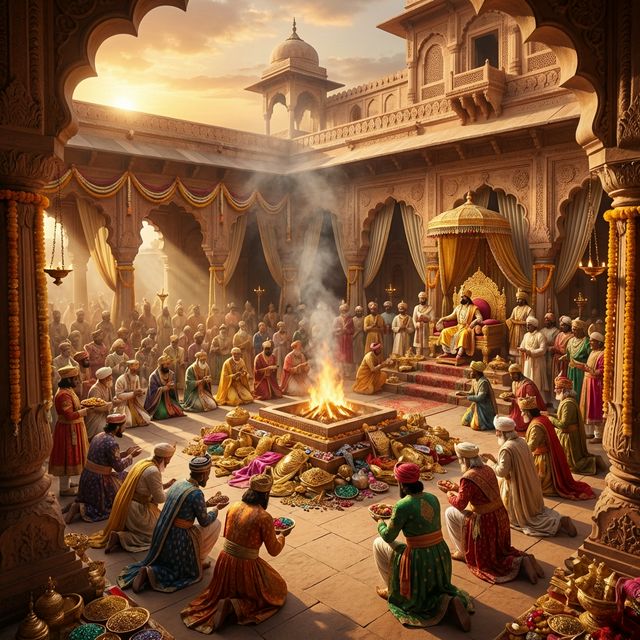
The sacrifice itself is told elsewhere. What the city saw was every crowned head in the world walking its streets at once, the priests of the age at its fires, Krishna honoured first among the guests, and Yudhishthira consecrated as emperor in a hall built by an asura on ground cleared by a god of fire. That week was the summit of the whole Pandava fortune. Nothing afterward was ever as good.
The fall took a single day and it did not even happen here. Yudhishthira was summoned to Hastinapura for a friendly game, and dharma required a kshatriya to accept a challenge, and by evening he had staked and lost the tribute of the earth, the hall of a thousand pillars, the white city on the Yamuna, his brothers, himself and Draupadi.
Messengers came back to Indraprastha ahead of the exiles with the news, and the city that had been an empire's capital eight days earlier had nothing left to be. When the Pandavas came for their clothes of bark, the citizens filled the road out to the gate and would not stop following them, and Yudhishthira had to turn and send them back to their houses and their new master.
Draupadi walked out of the city she had been queen of with her hair loose and unbound, and she did not bind it again for thirteen years.
Five Villages, and a Mound
Thirteen years later, in Dhritarashtra's assembly at Hastinapura, Krishna reduced the claim of the sons of Pandu to almost nothing. Not the empire, not the tribute of the four directions, not even a province. Five villages, he said, and let there be no war; and the tradition remembers Indraprastha as one of the five he asked for, a city the Pandavas had built out of scrub with their own hands, requested back as a gift.
Duryodhana refused it in a sentence: not so much land as the point of a needle would cover, not without a fight. So the white city on the Yamuna, which had been won by work and lost by dice and offered up in exchange for peace, became instead one more reason for eighteen days at Kurukshetra.
After the war Yudhishthira ruled from Hastinapura, and Indraprastha did not become his second capital or his summer court or a monument to the best years of his life. When the Yadavas destroyed themselves at Prabhasa and Dwaraka went under the sea, Arjuna brought the survivors, the women and the old men and the children, up out of the west, and Yudhishthira gave Indraprastha and its territory to Vajra, Krishna's great-grandson and the last heir of that house, and had him consecrated there. The city the Pandavas built with Krishna's counsel ended as the refuge of Krishna's descendants. There is a kind of justice in that arrangement, though nobody involved was in a state to enjoy it.
Then the Pandavas went north to the mountain and did not come back, and the record of Indraprastha stops. Tradition keeps the place, if not the city: a long mound above the Yamuna in the country that is now Delhi, where the old name survives in a village called Indarpat and the ground under the fort walls gives up potsherds far older than any fort.
A burned forest, a white capital, an empire, an empty hall, five villages refused, a mound. That is the whole life of the one city these brothers ever made.
Dharma Lesson
The Pandavas were given the worst land in the kingdom and made it the finest city in the world, which proves what work can do; then they lost it in an afternoon over dice, which proves what work cannot protect you from. Building is slow and losing is fast, and nothing you construct is safe from a single bad hour of your own choosing. What a man makes belongs to him only as long as he does not gamble it.