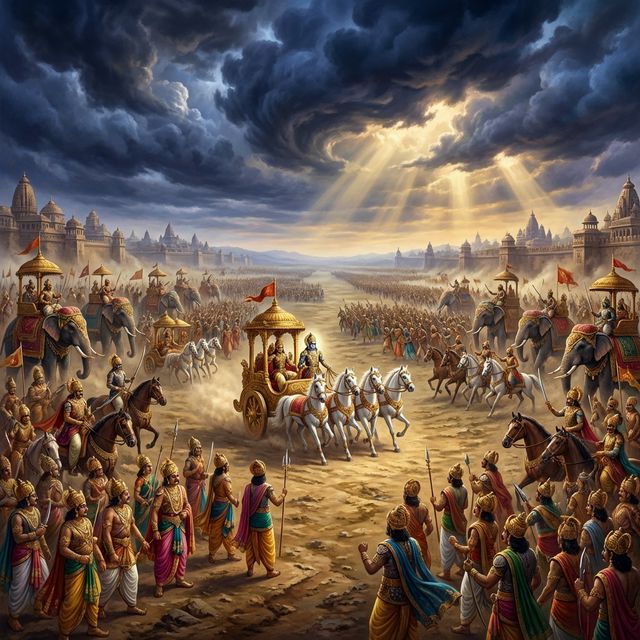
The Vows Sworn Before Exile
Four brothers name their killings on the way out of the dice hall
Deer-Skins in the Hall
Vaisampayana was telling it to Janamejaya, and he had come to the part that everyone waits for and nobody enjoys.
Shakuni had cast the dice one last time and said, "Lo, I have won," and the stake that time had not been cattle or gold or brothers. It had been twelve years in the woods and a thirteenth year lived unrecognised among men, and if they were recognised in that year, another twelve.
So the vanquished sons of Pritha prepared for their exile into the woods. They did it in front of the whole assembly, because the assembly is where it had been lost. One after another, in due order, they cast off their royal robes, and each of them put on the skin of a deer, which is the dress of a man who has no house and no fire and no claim on anything. Bhishma was there, and Drona, and Kripa, and every king who had come to see the Kurus play. Not one of them had stopped the game. Now they sat and watched five men change their clothes.
Dushasana could not keep still. He had been the one who dragged Draupadi into that hall by the hair a short while before, and nothing had happened to him for it, and a man who has done such a thing and gone unpunished acquires a certain confidence. He got to his feet while the Pandavas were still dressing.
"The absolute sovereignty of the illustrious king Duryodhana hath commenced. The sons of Pritha have all been plunged by us into everlasting hell. Let them put off their variegated mail, their resplendent robes of celestial make, and attire themselves in deer-skins according to the stake they accepted of the son of Suvala. They who always used to boast that they had no equals in all the world will now regard themselves in this their calamity as grains of sesame without the kernel."
Then he turned to the woman standing at the edge of the hall in a single piece of cloth stained with blood, with her hair still hanging loose where his hand had left it.
"O Yajnaseni, what joy will be thine upon beholding in the woods these thy husbands dressed in skins and thread-bare rags? Elect thou a husband, whomsoever thou likest, from among all these present here. These Kurus assembled are all forbearing and self-controlled, and possessed of great wealth. Why shouldst thou longer wait upon the fallen sons of Pandu? Vain is the labour used upon pressing the sesame grain devoid of the kernel."
He said all of it in the hearing of the Pandavas. That was the point of saying it.
The Lion and the Jackal
Bhima was not a forbearing man, and he had been forbearing all afternoon, which is a different thing and costs more.
He came at Dushasana the way a Himalayan lion comes at a jackal, and Vaisampayana uses exactly that comparison, and the hall saw a man in a deer-skin cross the floor with nothing in his hands.
"Wicked-minded villain," Bhima said, "ravest thou so in words that are uttered alone by the sinful? Boastest thou thus in the midst of kings, advanced as thou art by the skill of the king of Gandhara? As thou piercest our hearts here with these thy arrowy words, so shall I pierce thy heart in battle, recalling all this to thy mind. And they also who from anger or covetousness are walking behind thee as thy protectors, them also shall I send to the abode of Yama with their descendants and relatives."
He did nothing else. He could not. He was bound by a stake his eldest brother had accepted, and to lay a hand on Dushasana in that hall would have been to break the terms in front of the men who had set them, and Bhima, who is usually described as the brother without patience, would not deviate from the path of virtue.
Dushasana understood that perfectly. He abandoned all sense of shame and began to dance.
He danced around the assembled Kurus, in front of Bhishma and Drona and the kings, in front of Draupadi, and while he danced he called out one word at Bhima again and again.
"O cow! O cow!"
Bhima stood where he was and let him do it.
"Wretch," he said when the noise stopped. "Darest thou, O Dushasana, use harsh words as these? Whom doth it behove to boast, thus having won wealth by foul means? I tell thee that if Vrikodara, the son of Pritha, drinketh not thy life-blood, piercing open thy breast in battle, let him not attain to regions of blessedness. I tell thee truly that by slaying the sons of Dhritarashtra in battle, before the very eyes of all the warriors, I shall pacify this wrath of mine soon enough."
Thirteen years later, on a field at Kurukshetra, men who had been in that hall would remember that he had named the place, the wound and the drink, and had left nothing out.
The King Who Walked Like Bhima
They began to leave, five men in deer-skins going down the length of a hall they had walked into as an emperor and his brothers. And Duryodhana, from excess of joy, got up and walked behind Bhima, mimicking with his own steps the playful leonine tread of the man in front of him.
It is a boy's trick, and Duryodhana was not a boy but a king who had just won the world, and he did it in front of the court with his father's counsellors watching.
Bhima half turned. "Think not, ye fool, that by this thou gainest any ascendency over me. Slay thee shall I soon with all thy followers, and answer thee, recalling all this to thy mind."
Then he suppressed his rising rage, because Yudhishthira was still walking and Bhima's whole discipline that day consisted of following his brother's steps, and as he went out of the Kaurava court he made the vow aloud, in the assembly, so that it would be witnessed.
"I will slay Duryodhana, and Dhananjaya will slay Karna, and Sahadeva will slay Shakuni, that gambler with dice. I also repeat in this assembly these proud words, which the gods will assuredly make good. If ever we engage in battle with the Kurus, I will slay this wretched Duryodhana in battle with my mace, and prostrating him on the ground I will place my foot on his head. And as regards this other wicked person, Dushasana, who is audacious in speech, I will drink his blood like a lion."
He had assigned three deaths, and two of them were not his to assign, and neither of the men he named contradicted him.
Arjuna had not spoken since he put on the deer-skin. When he did speak it was to correct his brother's manner and not his purpose. "O Bhima, the resolutions of superior men are not known in words only. On the fourteenth year from this day, they shall see what happeneth."
Bhima was in no mood to be edited. He said it again, shorter, and this time he put a fourth name in it. "The earth shall drink the blood of Duryodhana, and Karna, and the wicked Shakuni, and Dushasana that maketh the fourth."
The mace, the foot set on the head, the blood. Everything Bhima ever did afterwards that shocked the world was announced in that hall, in advance, in front of the elders who were letting it happen.
On the Fourteenth Year From This Day
Arjuna, having asked for silence and been refused, gave his own word next, as a service to his brother rather than as a claim of his own.
"O Bhima, I will, as thou directest, slay in battle this Karna, so malicious and jealous and harsh-speeched and vain. For doing what is agreeable to Bhima, Arjuna voweth that he will slay in battle with his arrows this Karna with all his followers. And I will send unto the regions of Yama also all those other kings that will from foolishness fight against me."
Then the three impossibilities.
"The mountains of Himavat might be removed from where they are, the maker of the day lose his brightness, the moon his coldness, but this vow of mine will ever be cherished."
He was a careful man even in fury, and he closed with the one condition that could still cancel everything.
"And all this shall assuredly happen if, on the fourteenth year from this, Duryodhana doth not, with proper respect, return us our kingdom."
That clause hung in the air of the hall and was heard by Duryodhana and by Karna and by Bhishma and by the blind king's counsellors, and it stayed open for thirteen years and one year more. Krishna himself would come to Hastinapura at the end of that time to ask for it to be honoured, and would be refused, and everything Arjuna had just promised would then become obligatory.
The twins are the brothers the epic usually lets pass without a speech. Not here.
Sahadeva, the handsome son of Madri, endued with great energy, wanted Shakuni. He waved his mighty arms and sighed like a snake, and his eyes were red with anger, and he spoke past Duryodhana entirely to the man from Gandhara who had thrown the dice.
"Thou disgrace of the Gandhara kings, those whom thou thinkest as defeated are not really so. Those are even sharp-pointed arrows from whose wounds thou hast run the risk in battle. I shall certainly accomplish all which Bhima hath said adverting to thee with all thy followers. If therefore thou hast anything to do, do it before that day cometh. I shall assuredly slay thee in battle with all thy followers soon enough, if thou, O son of Suvala, stayest in the fight pursuant to the kshatriya usage."
That last clause is the sharpest thing in it. The Pandavas had not been beaten by arrows but by ivory cubes on a floor, and Sahadeva was telling the winner that the account was still open in the only currency a kshatriya recognises, and that he was not sure the winner would stand and settle it.
The Vow Nakula Made for Somebody Else
Then Nakula, the handsomest of men, who had been dressed in a deer-skin for less than an hour, made the fourth vow, and his was the only one made entirely on behalf of another person.
"I shall certainly send unto the abode of Yama all those wicked sons of Dhritarashtra who, desirous of death and impelled by Fate, and moved also by the wish of doing what is agreeable to Duryodhana, have used harsh and insulting speeches towards this daughter of Yajnasena at the gambling match. Soon enough shall I, at the command of Yudhishthira and remembering the wrongs to Draupadi, make the earth destitute of the sons of Dhritarashtra."
Nothing in it is about Nakula. Bhima had named his own enemy, Arjuna had named his, Sahadeva had named the man who threw the dice. Nakula named a hundred men and gave one reason for all of them, which was what had been said in that hall to his brothers' wife while she stood in a single stained cloth with her hair down.
And even in that sentence he asked permission first. At the command of Yudhishthira: the twin who intended to empty a dynasty put his eldest brother's authority in front of his own anger, and would in fact wait thirteen years for the order.
Four brothers had now pledged themselves. The fifth, the one who had staked them all and lost them all, said nothing whatever about killing anybody, and nobody in the hall seems to have expected him to.
Dushasana had been dancing a few moments before, calling out "O cow" at a man who had just described how he would open his chest. Duryodhana had been walking like a lion behind a man who had just described the mace and the foot on the head. Shakuni had heard his own death named twice, by two different brothers, with the manner and the condition attached. Karna had been named by Arjuna in front of every king on earth.
Not one of the four of them answered a word.
And those tigers among men, all endued with long arms, having thus pledged themselves to virtuous promises, turned away from the men they had promised and walked up to the throne where the blind king was sitting, to take their leave of him properly, because that is what the order of a departure requires.
What Vidura Asked to Keep
Yudhishthira took his leave of every man in that hall by name, and nobody answered him, and that silence belongs to another telling. What happened next was that one man in the room found something practical to say.
Vidura was the son of a serving woman, half-brother to the blind king and to Pandu, called Kshatta by the court, the counsellor who had told Dhritarashtra the truth at every stage of the game and been ignored at every stage. He did not offer sympathy. He asked for custody of an old woman.
"The reverend Pritha is a princess by birth. It behoveth her not to go into the woods. Delicate and old and ever known to happiness, the blessed one will live, respected by me, in my abode. Know this, ye sons of Pandu. And let safety be always yours."
Kunti was to stay in Hastinapura, in the house of the one Kuru who could be trusted with her, and the Pandavas agreed at once. "Thou art our uncle, and therefore like as our father. Order thou whatever else there is that remaineth to be done."
So he ordered the rest of it, and it turned out to be a blessing shaped like an inventory. One that is vanquished by sinful means, he said, need not be pained by such defeat. Then he went round the party and named what each of them was still worth. Yudhishthira knew every rule of morality. Dhananjaya was ever victorious in battle. Bhimasena was the slayer of foes. Nakula was the gatherer of wealth. Sahadeva had administrative talents. Dhaumya, their priest, was foremost of all conversant with the vedas. The well-behaved Draupadi was conversant with virtue and economy.
"Ye are attached to one another and feel delight at one another's sight, and enemies cannot separate you from one another, and ye are contented. Therefore, who is there that will not envy ye? This patient abstraction from the possession of the world will be of great benefit to thee. No foe, even if he were equal to Sakra himself, will be able to stand it."
That is the argument in one line. They had not been robbed of anything that made them dangerous.
Take These From the Elements
Then Vidura did the thing that shows what kind of man was talking. He reminded a king going into exile of every teacher he had ever had, in order, with the place of instruction attached to each: Meru Savarni on the mountains of Himavat, Krishna Dwaipayana in the town of Varanavata, Rama on the cliff of Bhrigu, Sambhu himself on the banks of the Dhrishadwati, the great rishi Asita on the hills of Anjana, and Bhrigu on the banks of the Kalmashi, whose disciple he had become.
"Narada and this thy priest Dhaumya will now become thy instructors. In the matter of the next world, abandon not these excellent lessons thou hast obtained from the rishis, O son of Pandu. Thou surpassest in intelligence even Pururavas, the son of Ila; in strength, all other monarchs; and in virtue, even the rishis."
A man walking into twelve years of forest was being handed his own history, because Vidura knew that what a man is likeliest to lose in the woods is not his kingdom but his sense of who he was before he lost it.
And then the last part, which reads like a list of provisions.
"Therefore resolve thou earnestly to win victory, which belongeth to Indra; to control thy wrath, which belongeth to Yama; to give in charity, which belongeth to Kuvera; and to control all passions, which belongeth to Varuna. And obtain thou the power of gladdening from the moon, the power of sustaining all from water, forbearance from the earth, energy from the entire solar disc, strength from the winds, and affluence from the other elements."
He was sending a man out with nothing, and so he told him where the rest of it was kept. Nine things, and every one of them available in a forest to a man who has just been stripped of a treasury.
"Welfare and immunity from ailment be thine. I hope to see thee return. And O Yudhishthira, act properly and duly in all seasons, in those of distress, in those of difficulty, indeed in respect of everything. O son of Kunti, with our leave go hence. Blessing be thine. No one can say that ye have done anything sinful before."
Thus addressed, Yudhishthira the son of Pandu, of prowess incapable of being baffled, said, "So be it." He bowed low unto Bhishma and Drona, and went away.
Keep Thy Eye on Sahadeva
Inside the women's apartments, Draupadi was taking her leave. She went first to Pritha, who is Kunti, and asked her permission to go, and then asked leave of the other ladies of the household, all of whom had been plunged into grief. And there arose within the inner apartments of the Pandavas a loud wail of woe.
Kunti was terribly afflicted at the sight of her, and what she said came out in a voice choked with grief, and it is not what anyone would expect a mother-in-law to say at such a moment.
"O child, grieve not that this great calamity hath overtaken thee. Thou art well conversant with the duties of the female sex, and thy behaviour and conduct also are as they should be. It behoveth me not, O thou of sweet smiles, to instruct thee as to thy duties towards thy lords."
She refused, in other words, to give the standard speech. Then she said the sentence the Kurus should have written on their walls.
"Thou art chaste and accomplished, and thy qualities have adorned the race of thy birth as also the race into which thou hast been admitted by marriage. Fortunate are the Kauravas that they have not been burnt by thy wrath."
That is Kunti's verdict on the day. Not that Draupadi had been wronged, which everyone knew, but that Draupadi had been wronged and had not yet destroyed them, and that this was luck, and that the luck would not hold.
"O child, safely go thou, blest by my prayers. Good women never suffer their hearts to be stung at what is inevitable. Protected by virtue that is superior to everything, soon shalt thou obtain good fortune."
And then, at the end, the real charge. Kunti had five sons walking into a forest and she asked for one of them.
"While living in the woods, keep thy eye on my child Sahadeva. See that his heart sinketh not under this great calamity."
Sahadeva was the youngest, and he was not her own son but Madri's, and Madri was dead, and Kunti had raised him. Of all the men going out that gate, the four with vows in their mouths and the one with his face covered, the mother worried about the quiet one.
"So be it," said Draupadi.
Then the princess of Panchala, bathed in tears, clad in one piece of cloth stained with blood, her hair dishevelled, left her mother-in-law and walked out weeping. And Pritha, in grief, followed her.
Fie on My Desire of Life
She had not gone far when she saw her sons.
They were shorn of their ornaments and their robes, their bodies clad in deer-skins, their heads down with shame, and they were surrounded by rejoicing foes and pitied by friends. Kunti embraced them all, and in accents choked by woe she said the longest speech she is given anywhere in the epic.
"Ye are virtuous and good-mannered, and adorned with all excellent qualities. Ye are all high-minded, and engaged in the service of your superiors, and devoted to the gods. Why, then, hath this calamity overtaken you? I do not see by whose wickedness this sin hath overtaken you. Alas, I have brought you forth. All this must be due to my ill fortune."
She went back over her own choices and found the one she thought had done it.
"If I had known before that ye were destined to live in the woods, I would not have on Pandu's death come from the mountains of Satasringa to Hastinapore. Fortunate was your father, for he truly reaped the fruit of his asceticism, and he entertained the wish of ascending heaven without having to feel any pain on account of his sons. Fortunate also was the virtuous Madri, who had a fore-knowledge of what would happen. Oh, fie on my desire of life, owing to which I suffer all this woe."
Then she called on the one person she could think of who was not in that city.
"O Krishna, O thou who dwellest in Dwaraka, where art thou? Why dost thou not deliver me and these best of men also from such woe? They say that thou who art without beginning and without end deliverest those that think of thee. Why doth this saying become untrue?"
And then the elders, by name, because they were standing within earshot.
"Alas, when there are such elders amongst our race as Bhishma and Drona and Kripa, all conversant with morality, how could such calamity at all come? O Pandu, O king, where art thou? Why sufferest thou quietly thy good children to be thus sent into exile, defeated at dice?"
Last of all she asked for the boy.
"O Sahadeva, desist from going. Thou art my dearest child, dearer, O son of Madri, than my body itself. Forsake me not. Bound by the ties of virtue, let these thy brothers go. But then, earn thou that virtue which springeth from waiting upon me."
He went with his brothers. They consoled their weeping mother, and with hearts plunged in grief they set out for the woods. And Vidura, himself much afflicted, consoled the distressed Kunti with reasons, and led her slowly to his house.
The Rishi Who Came Down Into the Hall
In the city the women wept and censured the Kurus. Dhritarashtra sent for Vidura and asked how the Pandavas had left the city, and Vidura read their departure back to him sign by sign. That reading belongs to its own telling. What concerns this one is what happened in the hall while they talked.
There appeared in that assembly, the best of the celestial rishis. He stood in front of the men who had won the game and uttered these terrible words.
"On the fourteenth year hence, the Kauravas, in consequence of Duryodhana's fault, will all be destroyed by the might of Bhima and Arjuna."
And having said this, that rishi, adorned with surpassing Vedic grace, passed through the skies and disappeared.
Bhima had said the same thing an hour earlier and had been danced at. Now the sky had said it, and the room believed it.
Duryodhana and Karna and Shakuni turned to the one man they thought could stand between them and that sentence, and offered the kingdom to Drona. Drona took the duty and refused the comfort.
"The sons of Dhritarashtra have sought my protection, and I shall look after them to the best of my power. Destiny is supreme. I cannot abandon them. But the sons of Pandu go into exile in pursuance of their promise, and practising the brahmacharya mode of life they will return in anger and, to our great grief, take the amplest vengeance on their foes."
Then he spoke about his own death, in public, to his own students. He had once deprived Drupada of his kingdom, and Drupada had gone home and performed a sacrifice for a son who would kill him, and out of that fire had risen Dhrishtadyumna, and with him his sister Krishna, who is Draupadi.
"I am a being that is mortal. That he hath been born for slaying me is widely known in the world. What grief can be greater to me than this? For thy sake, O Duryodhana, that terrible season of destruction is almost come. Think not that everything hath been accomplished by sending the Pandavas into exile. This thy happiness will last but a moment, even as in winter the shadow of the top of the palm tree resteth for a short time at its base. On the fourteenth year hence, a great calamity will overwhelm thee."
Dhritarashtra heard him out, and said the words that had been available to him all day.
"O Kshatta, the preceptor hath uttered what is true. Go thou and bring back the Pandavas. If they do not come back, let them go treated with respect and affection."
They were already on the road. Nobody went after them.
Dharma Lesson
A vow made in public is a debt the world collects. The four brothers say exactly what they will do, and thirteen years later they do all of it, down to the mace, the foot on the head and the blood, so that the war is less a decision than a payment falling due. Vidura's answer to the same hour is the harder one: he does not curse anybody, he takes an old woman into his house and reminds a ruined king of the teachers he studied under and the qualities his brothers still have. Both responses are faithful, and only one of them leaves the man who makes it free.