A Medicine Nobody Wants
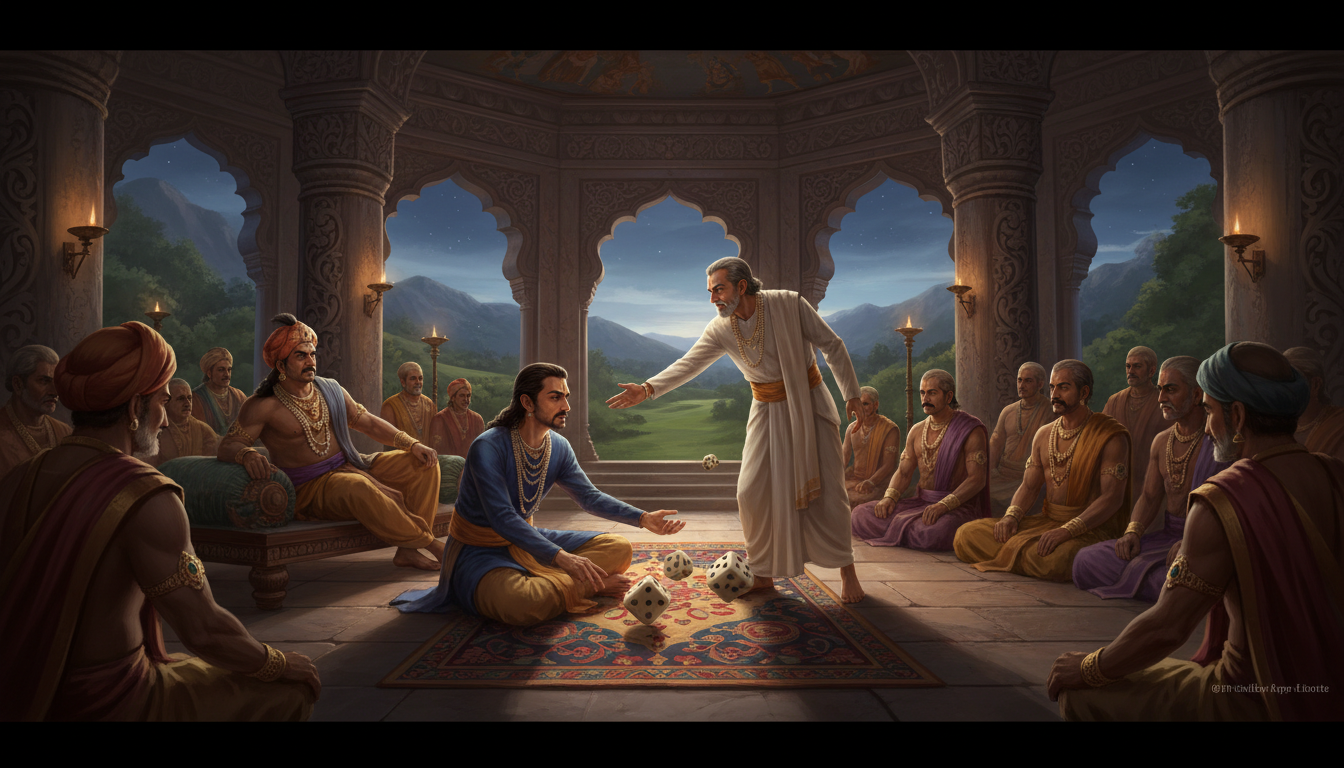
The dice were still falling. That is the thing to hold on to about this scene. Vaishampayana says plainly that it happened during the course of the gambling, not after it, so everything Vidura said was said over the noise of Shakuni's throws and the counting of what had just changed hands.
Yudhishthira sat on one side of the cloth with his jaw set. Shakuni sat on the other, picking up the dice, rolling them, and announcing the number in the same pleasant voice each time. Duryodhana stood behind his uncle's shoulder. Dhritarashtra sat where he always sat, listening with his head slightly turned, and every so often he could not stop himself asking who had won, and when he was told he could not stop his face.
The hall was full. Bhishma was there, and Drona, and Kripa, and Karna, and Dussasana, and all the kings who had come to see the new gaming house that had been built for exactly this. The stakes had already gone a long way. The pearls had gone, and the gold, and the chariots, and the horses of the four quarters, and the elephants, and the herds, and the treasury of Indraprastha, and the servants, and none of it had bought a single throw back.
And Vidura, the dispeller of all doubts, stood up in the middle of it and addressed the king.
"Great king, of the Bharata race, attend to what I say, although my words may not be agreeable to you." He paused there so that everyone had to hear the comparison. "They will be like medicine to a man who is ill and about to breathe his last."
Nobody stopped throwing. The point of the sentence was that he already knew nobody would.
The Jackal in Your House
"When this Duryodhana of sinful mind had, immediately after his birth, cried discordantly like a jackal," said Vidura, "it was well known that he had been ordained to bring about the destruction of the Bharata race."
He was not raising anything new. Everyone in that hall over forty years old had been alive on the day it happened, and had heard what the Brahmanas advised at the time, and had watched the father decline the advice.
"Know, king, that he will be the cause of the death of all of you. A jackal is living in your house in the form of Duryodhana, and you do not know it, in consequence of your folly."
Duryodhana did not answer. He was not yet ready to, and there was a stake on the table.
Vidura was the king's brother, and the king's minister, and by the reckoning that certain men in that hall preferred, the king's servant. He was the only person present entitled to say that sentence and the only person present who would say it. Bhishma had known the same thing as long as he had. Drona had. Kripa had. What none of them ever produced was the sentence itself, said aloud, in the hall, while there was still something on the cloth left to lose.
Dhritarashtra said nothing either. The blind king had a great deal of practice at receiving a sentence like that and letting it go past him, and one of the reasons the epic keeps returning to this hour is that his silence here is the same silence he will produce again, later, when the stake is a woman and not a herd of elephants.
"Listen now," said Vidura, "to the words of the Poet, which I will quote to you."
The Honey-Gatherers
"They that collect honey in the mountains," said Vidura, "having received what they seek, do not notice that they are about to fall. Ascending dangerous heights, wholly abstracted in the pursuit of what they seek, they fall down and meet with destruction."
It was an image every man in the room had seen with his own eyes on some journey or other. The cliffs above the rivers, the great grey combs hanging out from the rock face, the men on their ropes of twisted creeper, smoked and stung and climbing higher because the comb above is always fuller than the comb in the hand. What kills them is not the bees. What kills them is that at the last moment they are looking up at the comb and not down at their own feet.
"This Duryodhana also, maddened with the play at dice, like the collector of honey, abstracted in what he seeks, marks not the consequences. Making enemies of these great warriors, he does not behold the fall that is in front of him."
It was a careful choice of picture. Vidura did not say that his nephew was wicked in that sentence, though he had said so a moment before. He said that his nephew was concentrating. The honey-gatherer is not a thief and not a fool. He is a working man doing a skilled and profitable thing with great attention, and the attention itself is what takes his weight off the rock.
Behind him, at the cloth, Shakuni said a number, and there was a small sound from the Kaurava side of the hall, the sound men make when a thing they wanted has come to them.
Vidura did not turn round. He was talking to the only person in the room who could have stopped it.
A Crow for These Peacocks
"You know, great king, that among the Bhojas they abandoned, for the good of the citizens, a son who was unworthy of his race," said Vidura. "The Andhakas and the Yadavas and the Bhojas united together and abandoned Kansa. And afterwards, when at the command of the whole tribe that same Kansa was slain by Krishna, all the men of the tribe were exceedingly happy for a hundred years.
"So at your command, let Arjuna slay this Suyodhana. And in consequence of the slaying of this wretch, let the Kurus be glad and pass their days in happiness."
He had said it. He had stood in the assembly of the Kurus and asked the king to have his eldest son killed by his nephew, and the men who had been pretending to watch the dice were now openly watching Vidura instead.
"In exchange for a crow, great king, buy these peacocks, the Pandavas. In exchange for a jackal, buy these tigers. For the sake of a family a member may be sacrificed. For the sake of a village a family may be sacrificed. For the sake of a province a village may be sacrificed. And for the sake of one's own soul, the whole earth may be sacrificed.
"This was what the omniscient Kavya himself said to the great Asuras, to persuade them to abandon Jambha at the very moment of his birth. He knew the thoughts of every creature. He was a terror to all foes. And he told them that the child in front of them should be given up now, while giving him up cost only grief."
The Birds That Vomited Gold
"A certain king," said Vidura, "caused a number of wild birds that vomited gold to take up their quarters in his own house. And afterwards he killed them, out of temptation.
"Blinded by temptation and by the desire of enjoyment, for the sake of the gold that was in them, he destroyed at one stroke both his present gains and all his future ones. Do not prosecute the Pandavas from a desire of profit, king, like that king in the story. Blinded by folly you will have to repent afterwards, exactly like the person who killed the birds."
The Pandavas were the birds. Vidura did not have to say so and did not say so. Everyone in the room knew what the Rajasuya had brought in, because most of them had carried some of it up the road themselves: the tribute of the four quarters, the kings queueing at the gate with what their countries produced, so much of it that the counting had gone on for days after the sacrifice ended. That had been an annual thing. That had been a thing that would have kept happening, to a house that shared a grandfather with the house it was happening to.
What was on the cloth today was the stock of it. One stock, once. And the arrangement that had produced it would not survive the taking.
The Flower-Seller and the Burnt Tree
"Like a flower-seller who plucks his flowers in the garden, day after day, from trees that he cherishes with affection," said Vidura, "continue, Bharata, to pluck flowers day by day from the Pandavas. Do not scorch them to their roots like a fire-producing breeze that reduces everything to black charcoal.
"Go not, king, to the region of Yama with your sons and your troops. For who is there that is capable of fighting with the sons of Pritha together? Not to speak of others, is the chief of the celestials, at the head of the celestials themselves, capable of doing it?"
That was the whole of the counsel, and it had been the same counsel three times over. Take the honey and do not climb higher. Keep the birds and take the gold they give. Pluck the flowers and do not burn the tree.
Three pictures of one idea: that a source of good is worth more than the whole of it seized at once, and that the seizing destroys the source. It is not a moral appeal. There is nothing in any of the three about kindness, or kinship, or the rights of the sons of Pandu. It is an argument from profit, addressed to a man who had shown for fifty years that profit was the only language he would take instruction in, and it still did not work.
Win the Pandavas Themselves
"Gambling is the root of dissensions," said Vidura. "It brings about disunion. Its consequences are frightful. And having recourse to this, your son Duryodhana creates for himself a fierce enmity.
"The descendants of Pratipa and of Santanu, with their fierce troops and their allies the Vahlikas, will meet with destruction for the sins of Duryodhana. In this intoxication he forcibly drives luck and prosperity out of his own kingdom, like an infuriated bull breaking his own horns himself. The brave and learned man who disregards his own foresight and follows the bent of another man's heart sinks in terrible affliction, like one who goes to sea in a boat steered by a child.
"Duryodhana is gambling with the son of Pandu, and you are in raptures that he is winning. It is such success that begets war, and war ends in the destruction of men.
"Listen, you sons of Santanu, you descendants of Pratipa, all of you sitting in this assembly of the Kauravas. Do not enter the terrible fire that has blazed up following this wretch. When Ajatasatru, intoxicated with dice, gives way to his wrath, and Vrikodara and Arjuna and the twins do the same, who among you, in that hour of confusion, will prove your refuge?"
Then he turned back to the throne and put it as plainly as it can be put.
"Great king, you are yourself a mine of wealth. You can earn by other means as much wealth as you are trying to earn by gambling. What do you gain by winning from the Pandavas their vast wealth? Win the Pandavas themselves. They will be worth more to you than everything they own.
"We all know the skill of Suvala's son in play. This hill-king knows many nefarious methods in gambling. Let Sakuni return whence he came. War not with the sons of Pandu."
The Serpent Cherished on Our Lap
Duryodhana had heard enough. He came round from behind Shakuni's shoulder and answered, and he answered the man and not one word of the argument.
"Kshatta, you are always boasting of the fame of our enemies and deprecating the sons of Dhritarashtra. We know whom you are really fond of. You always disregard us as children. That man stands confessed who wishes success to those who are near to him and defeat to those who are not his favourites. His praise and his blame are handed out accordingly. Your tongue and your mind betray your heart, and the hostility you show in speech is greater even than what is in your heart.
"You have been cherished by us like a serpent on our lap. Like a cat you wish evil to the one who feeds you. The wise have said that there is no sin graver than injuring one's master. How is it, Kshatta, that you do not fear this sin?
"Having vanquished our enemies we have obtained great advantages. Do not use harsh words about us. You are always willing to make peace with our foes, and that is why you hate us. A man becomes a foe by speaking words that are unpardonable. And in praising the enemy, the secrets of one's own party should not be divulged, which you have just done. Why then, parasite, do you obstruct us?
"There is only one Controller and no second. He controls even the child in its mother's womb. I am controlled by Him. Like water that always flows downward, I am acting precisely in the way in which He directs me. Go, therefore, Vidura, wheresoever you please. A wife who is unchaste, however well treated, forsakes her husband in the end."
And nobody in that hall told him to be quiet. Not the grandsire. Not the preceptor. Not his father.
Bitter, Pungent, Burning
Vidura did not answer the prince. He turned to the throne and asked the king for a ruling, which was the last piece of procedure left to him.
"Monarch, tell us impartially, like a witness, what you think of the conduct of those who abandon their serving-men for giving them instruction. The hearts of kings are indeed very fickle. Granting protection at first, they strike with clubs at last.
"Prince, you regard yourself as mature in intellect, and you regard me as a child. But consider who is the child. He is a child who first accepts a man for a friend and afterwards finds fault with him. An evil-hearted man can never be brought to the path of rectitude, any more than an unchaste wife in the house of a well-born man. Assuredly instruction is not agreeable to this bull of the Bharata race, as a husband of sixty years is not agreeable to a young damsel.
"After this, king, if you wish to hear words that are agreeable to you in respect of all acts, good and bad, ask women, and idiots, and cripples, or persons of that description. A sinful man who speaks agreeable words may be found anywhere in this world. But a speaker of words that are disagreeable and yet sound as medicine, or a hearer of the same, is very rare.
"Great king, drink that which the honest drink and the dishonest shun. Drink humility, which is like a medicine that is bitter, pungent, burning, unintoxicating, disagreeable and revolting. Drink it, king, and regain your sobriety.
"I always wish Dhritarashtra and his sons affluence and fame. Happen what may to you, here I bow to you and take my leave. Let the Brahmanas wish me well. Son of Kuru, this is the lesson I carefully inculcate: that the wise should never enrage such adders as have venom in their very glances."
And the Dice Went On
He bowed. He was not banished that day; that came later, after the game was over and the hall had done everything it was going to do. He simply stopped speaking, and sat down, and was one more elder in a room full of elders who were not stopping it.
Dhritarashtra never answered the question that had been put to him as a witness. He had been asked to judge, impartially, the conduct of a master who cherishes a servant and then strikes him for giving good advice, and he could have said one sentence and ended the whole afternoon. He said nothing. It was the third or fourth time in an hour that saying nothing had been available to him, and each time it had cost less than the alternative and been worth less.
Shakuni picked up the dice.
He said, as he had been saying all afternoon, that he had won, and Yudhishthira staked the next thing, and after the elephants and the horses and the treasury there were still the servants, and after the servants there were still the brothers, and after the brothers there was still himself, and after himself there was one stake left in the world that a man could put on a cloth.
Duryodhana had told Vidura to go wherever he pleased. Vidura went nowhere. He stayed in the hall for the whole of it, and was there when the messenger was sent to the inner apartments, and was there for the question about whether a man who has already lost himself still owns a wife to stake, and he never got an answer to that question either. His banishment came later, in its own season, and by then there was nothing left in the house worth being banished from.
The honey-gatherer was still climbing. The comb was directly above him now and looked, from where he hung, close enough to reach.
Dharma Lesson
The counselor's duty ends at speaking plainly and being disbelieved; the guilt for what follows belongs to the man who chose the pleasant voice over the true one. Vidura argues from profit rather than from pity, because profit was the only language the throne would take instruction in, and even that fails. Bitter medicine is rarely welcome, and the rarest thing in a court is not a man willing to say it but a man willing to hear it.