Nobody Could Answer Him
The dice were put away and the stakes were settled and there was nothing left to do in that hall except leave it. Yudhishthira went round the room and said goodbye to every man in it by name.
"I bid farewell to all the Bharatas," he said. "To my old grandsire. To king Somadatta. To the great king Vahlika. To Drona. To Kripa. To all the other kings. To Aswatthaman. To Vidura. To Dhritarashtra. To all the sons of Dhritarashtra. To Yuyutsu. To Sanjaya. To all the courtiers. I bid farewell to every one of you, and returning again I shall see you."
And Vaishampayana said that not one of them could tell him anything in reply. They were overcome with shame. Bhishma looked at the floor. Drona, who had taught him to hold a bow, said nothing. Kripa said nothing. In their hearts they prayed for the welfare of that intelligent prince, and with their mouths they said nothing at all, and the silence went round the hall behind him as he walked, the way water closes behind a boat.
Then Vidura spoke, and he spoke about someone who was not going.
"The reverend Pritha is a princess by birth," he said. "It does not befit her to go into the woods. She is delicate, and she is old, and she has never known anything but happiness. The blessed one will live in my house, respected by me. Know this, you sons of Pandu, and let safety be always yours."
"Let it be as you say, sinless one," the Pandavas answered. "You are our uncle, and therefore you are as our father. We are obedient to you. You are our most respected superior, and we should always obey what you choose to command. Order us whatever else remains to be done."
What Vidura Gave Them Instead of Money
"Know this to be my opinion," said Vidura. "A man who has been vanquished by sinful means need not be pained by the defeat.
"You know every rule of morality. Dhananjaya is ever victorious in battle. Bhimasena is the slayer of foes. Nakula is the gatherer of wealth. Sahadeva has administrative talents. Dhaumya is the foremost of all men conversant with the Vedas. And the well-behaved Draupadi is conversant with virtue and with economy both. You are attached to one another, you take delight in the sight of one another, no enemy can separate you, and you are contented. Who then is there that will not envy you? This patient abstinence from the possession of the world will be of great benefit to you, and no foe, even if he were the equal of Sakra, will be able to stand against it.
"You were instructed on the mountains of Himavat by Meru Savarni, and in the town of Varanavata by Krishna Dwaipayana, and on the cliff of Bhrigu by Rama, and on the banks of the Dhrishadwati by Sambhu himself. You listened to the great Rishi Asita on the hills of Anjana, and you became a disciple of Bhrigu on the banks of the Kalmashi. Narada and this your priest Dhaumya will be your instructors now. Do not abandon those excellent lessons.
"Resolve to win victory, which belongs to Indra. To control your wrath, which belongs to Yama. To give in charity, which belongs to Kuvera. To master all your passions, which belongs to Varuna. Take the power of gladdening from the moon, the power of sustaining all from water, forbearance from the earth, energy from the whole disc of the sun, strength from the winds, and affluence from the other elements. No one can say that you have ever done anything sinful. Go hence with our leave. I hope to see you return."
"So be it," said Yudhishthira. He bowed low to Bhishma and to Drona, and went out.
Kunti Sends Draupadi Away
In the inner apartments Draupadi went to Pritha to ask her leave, and to the other ladies of the household, who were all plunged in grief, and she saluted each of them and embraced each of them as each deserved, and then she stood ready to go. And a loud wail of woe went up in the women's rooms of the Pandavas.
Kunti was terribly afflicted at the sight of her on the eve of that journey, and her voice was choked when she found it.
"Child, do not grieve that this great calamity has come upon you. You are well conversant with the duties of your sex, and your behaviour and your conduct are as they should be. It does not befit me, O you of sweet smiles, to instruct you in your duties towards your lords. You are chaste and accomplished, and your qualities have adorned the race you were born into and the race you were married into. Fortunate are the Kauravas that they have not been burnt up by your wrath."
She took the young woman's face in her hands.
"Go safely, blessed by my prayers. Good women never let their hearts be stung by what is inevitable. Protected by virtue, which is superior to everything, you will soon obtain good fortune. And while you are living in the woods, keep your eye on my child Sahadeva. See that his heart does not sink under this great calamity."
"So be it," said Draupadi.
She was bathed in tears. She was wearing one piece of cloth, stained with blood, and her hair was still down her back as it had been left in the hall, and in that state she left her mother-in-law and walked out weeping through the corridors of the house she would not see again for thirteen years. And Pritha, in grief, got up and followed her.
The Mother in the Courtyard
She had not gone far when she saw her sons.
They had been stripped of their ornaments and their robes. Their bodies were clad in deerskins. Their heads were down with shame. They stood surrounded by enemies who were enjoying it and by friends who could do nothing but pity them, and Kunti went to them with the whole of a mother's excess of love and put her arms round them all, and her voice broke.
"You are virtuous and well mannered and adorned with every excellent quality. You are high-minded. You serve your superiors. You are devoted to the gods and to the performance of sacrifices. Why then has this calamity overtaken you? Where is this reverse of fortune from? I do not see through whose wickedness this sin has come upon you. Alas, I brought you forth. All of this must be my own ill fortune. It is for that you are overtaken, though you want for nothing in energy or prowess or strength or firmness or might. How will you live now, poor, in the pathless woods, having lost your wealth and your possessions?
"If I had known you were destined to live in the woods I would never have come down from the mountains of Satasringa to Hastinapura when Pandu died. Fortunate was your father. He truly reaped the fruit of his asceticism, and he had foresight, for he wished to ascend to heaven without ever having to feel pain on account of his sons. Fortunate also was the virtuous Madri, who seems to me to have had foreknowledge of all this, and who obtained the high path of release and every blessing with it. Fie on my desire of life, that I suffer all this.
"Where is Krishna, who dwells in Dwaraka? Why does he not deliver me and these best of men from such woe? They say that he who is without beginning and without end delivers those who think of him. Why has that saying become untrue?
"Sahadeva. Desist from going. You are my dearest child. Let your brothers go, bound by the ties of virtue, and you earn the virtue that springs from waiting upon me."
Vidura Leads Her Home
They consoled their weeping mother as well as men can who have nothing to offer, and then, with their hearts plunged in grief, they set out for the woods.
Vidura himself was much afflicted. He stayed behind with Kunti and reasoned with her, and gave her the arguments that men give at such times, and led her slowly away to his own house. She went where he took her. She did not look back at the gate more than once.
In the apartments of Dhritarashtra the ladies had by now heard everything as it happened, the exile, and the dragging of Krishna into the assembly where the princes had gambled, and they wept aloud and censured the Kauravas. Afterwards the women of the royal household sat silent for a long time with their lotus faces covered by their fair hands, and nobody in that part of the palace spoke at all.
And king Dhritarashtra, thinking of the dangers that now threatened his sons, became a prey to anxiety and could not find peace of mind. He sat turning it over, and the more he turned it the less his mind kept its balance, until at last he sent a messenger running.
"Let Kshatta come to me," he said. "Without a moment's delay."
Vidura came quickly to the palace. And as soon as he came, before he had been given a seat, the blind king asked him, with great anxiety, how the Pandavas had left Hastinapura.
How Did They Go?
"How does Yudhishthira the son of Dharma proceed along?" said Dhritarashtra. "And how Arjuna? And how the twin sons of Madri? And how, Kshatta, does Dhaumya proceed along? And how the illustrious Draupadi? I desire to hear everything. Describe to me all their acts."
Vidura told him, and he told it flatly, without any comment at all, the way a man reads out an inventory.
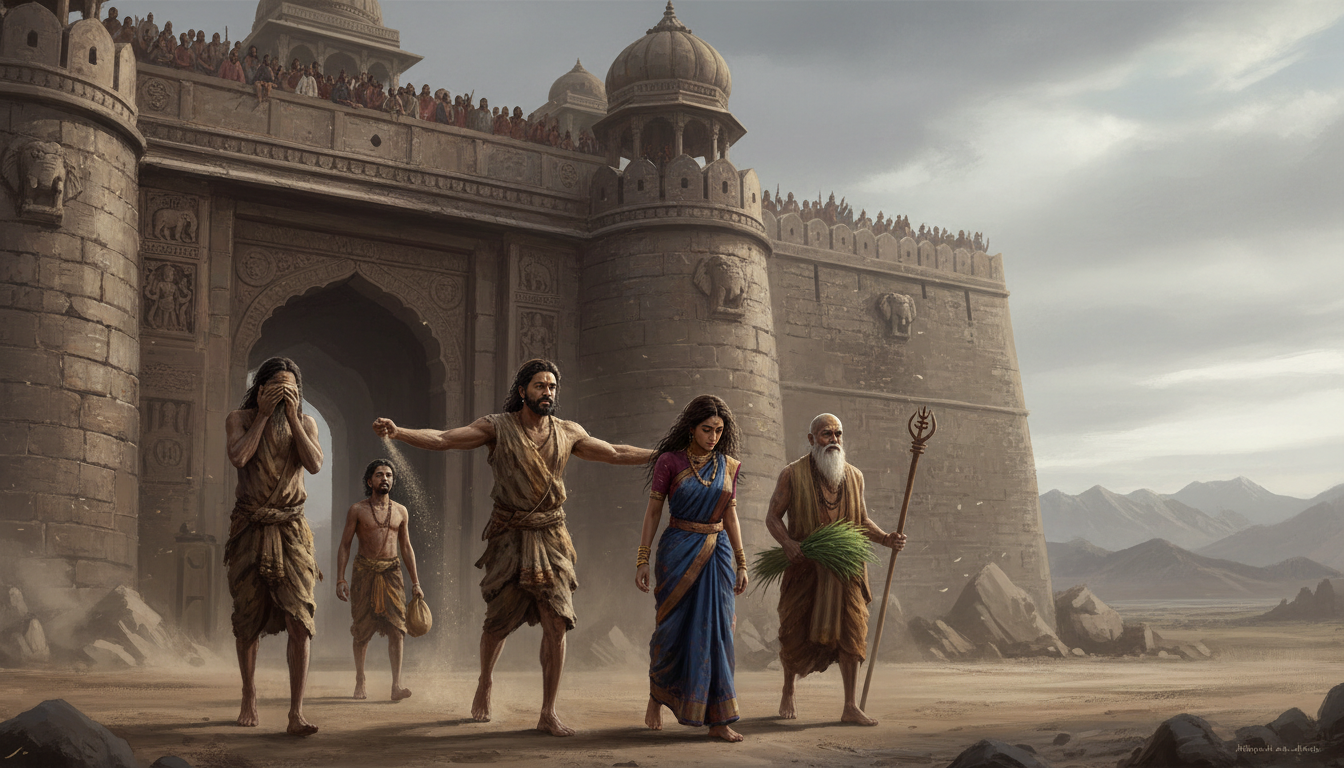
"Yudhishthira the son of Kunti has gone away covering his face with his cloth.
"Bhima has gone away looking at his own mighty arms.
"Jishnu has gone away following the king, spreading sand-grains around him as he walks.
"Sahadeva the son of Madri has gone away besmearing his face.
"Nakula, the handsomest of men, has gone away staining himself with dust, and his heart in great affliction.
"The large-eyed and beautiful Krishna has gone away covering her face with her dishevelled hair, following in the wake of the king, weeping and in tears.
"And Dhaumya goes along the road with kusa grass in his hand, uttering the awful mantras of the Sama Veda that relate to Yama."
There was a pause. The blind king had listened to all of it with his head turned slightly, as he did.
"Tell me, Vidura," he said. "Why are the Pandavas leaving Hastinapura in such varied guise?"
The Reading of the Seven
"Though he has been persecuted by your sons and robbed of his kingdom and his wealth," said Vidura, "the mind of the wise king Yudhishthira has not yet deviated from the path of virtue. He is always kind to your children. He was deprived by foul means, and he is filled with wrath, and still he does not open his eyes. 'I should not burn the people by looking at them with angry eyes.' Thinking so, the royal son of Pandu goes covering his face.
"Now hear why Bhima goes so. 'There is none equal to me in strength of arms.' Thinking so, Bhima goes stretching out those arms again and again, proud of them, exhibiting them, desiring to do with them deeds worthy of them.
"And Arjuna, who can draw the Gandiva with either hand, follows in the footsteps of Yudhishthira scattering sand-grains, and the sand-grains stand for arrows. He is saying that as easily as he scatters these, so easily will he rain those.
"And Sahadeva goes besmearing his face, thinking, 'Let none recognise me on this day of trouble.'
"And Nakula goes staining himself with dust, thinking, 'Lest otherwise I steal the hearts of the ladies who look at me.'
"And Draupadi goes attired in one piece of stained cloth, her hair dishevelled, weeping, and what she signifies is this. That the wives of the men for whom she has been reduced to such a plight shall, in the fourteenth year from now, be deprived of husbands and sons and relatives and everyone dear to them, and shall enter Hastinapura smeared all over with blood, with their hair dishevelled and all of them in their seasons, having offered the water oblations to their dead.
"And the learned Dhaumya, with his passions under full control, walks in front holding the kusa grass and pointing it towards the south-west, singing the mantras of the Sama Veda that belong to Yama. He too is signifying something. That when the Bharatas have been slain in battle, the priests of the Kurus will sing these same mantras over them."
The Sky Over the City
"And the citizens," said Vidura, "afflicted with great grief, are crying out over and over in the streets behind them. 'Alas, alas, behold our masters are going away. Fie on the Kuru elders, who have acted like foolish children in banishing the heirs of Pandu out of covetousness and nothing else. Separated from the sons of Pandu we shall all be masterless. What love can we bear to the wicked and avaricious Kurus?'
"Thus, king, have the sons of Kunti gone away from Hastinapura, indicating by manner and by sign the resolutions that are in their hearts."
He stopped there. Then he told the rest, because it had to be told.
"And as those foremost of men went out from the city, flashes of lightning appeared in a sky that had no cloud in it, and the earth itself began to tremble. Rahu came to devour the sun, though it was not the day of conjunction. Meteors fell, keeping the city to their right. And jackals and vultures and ravens and the other carnivorous beasts and birds began to shriek and cry aloud from the temples of the gods, and from the tops of the sacred trees, and from the walls, and from the roofs of houses.
"These extraordinary and calamitous portents were seen and heard, king, and what they indicate is the destruction of the Bharatas, as a consequence of your counsels."
Dhritarashtra did not answer that. Outside, somewhere over the roofs, the birds were still going.
Fourteen Years, Said the Rishi
While the king and the wise Vidura were talking with each other, there appeared in that assembly of the Kauravas, before the eyes of all of them, the best of the celestial Rishis.
Narada did not sit down and he did not accept any offering. He stood in the middle of the hall where the dice had been thrown and said one sentence.
"On the fourteenth year hence, the Kauravas, in consequence of Duryodhana's fault, will all be destroyed by the might of Bhima and Arjuna."
Then he passed through the skies and was gone, and the assembly was left holding it.
Duryodhana and Karna and Shakuni the son of Suvala looked round for a wall to put their backs against, and the wall they chose was Drona. They went to him together and offered him the kingdom.
Drona heard them out. Then he addressed Duryodhana, and Dussasana, and Karna, and all the Bharatas.
"The Brahmanas have said that the Pandavas are of celestial origin and cannot be slain. Still, the sons of Dhritarashtra have with all the kings heartily and reverently sought my protection, and destiny is supreme, and I cannot abandon them. I shall look after them to the best of my power.
"The sons of Pandu, defeated at dice, go into exile in pursuance of their promise. They will live in the woods twelve years, practising the Brahmacharyya mode of life, and they will return in anger and take the amplest vengeance on their foes.
"I once deprived Drupada of his kingdom in a friendly dispute. Robbed by me, the king performed a sacrifice to obtain a son who should slay me, and by the ascetic power of Yaja and Upayaja he obtained from the fire a son named Dhrishtadyumna and a daughter, the faultless Krishna, both risen from the sacrificial platform. That Dhrishtadyumna is the brother-in-law of the sons of Pandu by marriage, and dear to them. He was born with bow and arrows and encased in mail, and resplendent as fire. I am a being that is mortal. It is for him that I have great fear. If he and I ever meet in battle I shall lose my life.
"That he was born for slaying me is widely known in the world. What grief can be greater to me than this? For your sake, Duryodhana, that terrible season is almost come. Do not think everything has been accomplished by sending the Pandavas into exile. This happiness of yours will last a moment only, as in winter the shadow of the top of the palm tree rests a short while at its base. Perform your sacrifices. Enjoy. Give away whatever you like. On the fourteenth year hence a great calamity will overwhelm you."
"The preceptor has spoken the truth," said Dhritarashtra. "Kshatta, go and bring back the Pandavas. If they will not come back, let them go treated with respect and affection. Let my sons go with weapons and cars and infantry and every other good thing."
Nobody went. The order was given and it lay where it fell, like everything else the blind king had said that day.
Sanjaya Says the Word Nobody Else Will
Afterwards, when the Pandavas had gone to the woods, the king sat restless and sighing, and Sanjaya came and stood by him.
"Lord of the earth, you have obtained the whole earth with all its wealth and sent the sons of Pandu into exile. Why do you grieve?"
"What have they not to grieve for," said Dhritarashtra, "who will have to encounter in battle those bulls among warriors, the sons of Pandu, fighting on great cars and aided by allies?"
"All this hostility is inevitable on account of your mistaken action," said Sanjaya, "and it will assuredly bring about the destruction of the whole world. Forbidden by Bhishma, by Drona, and by Vidura, your shameless son sent his Suta messenger to bring the beloved and virtuous wife of the Pandavas into court.
"The gods first deprive a man of his reason when they mean to send him defeat and disgrace. That is why he sees things in a strange light. When destruction is at hand, evil looks like good to an understanding polluted by sin, and the man holds to it firmly. What is improper appears proper, and what is proper appears improper. The time that brings on destruction does not come with an upraised club and smash a man's head. Its peculiarity is that it makes a man behold evil in good and good in evil.
"They have brought this wholesale and horrible destruction on themselves by dragging the helpless princess of Panchala into the court. She came in her season, in one piece of stained cloth, and cast her eyes on the Pandavas, and saw them robbed of wealth and kingdom and even their attire, bound by the tie of virtue and unable to exert their prowess. And before all the assembled kings Duryodhana and Karna spoke cruel and harsh words to her. All of this appears to me as foreboding fearful consequences."
"The glances of the distressed daughter of Drupada," said Dhritarashtra slowly, "might consume the whole earth. Can it be possible that even a single son of mine will live?"
He went back over it, item by item, the way old men do. The wives of the Bharatas had set up a frightful wail. The Brahmanas had not performed their Agnihotra that evening. The winds had blown as they blow at the dissolution of the world. Meteors had fallen. Rahu had swallowed the sun out of season. The war-chariots had caught fire of themselves and their flagstaffs had fallen. Jackals had cried from inside Duryodhana's own fire-chamber and asses had brayed back from every direction. Bhishma and Drona and Kripa and Somadatta and Vahlika had walked out of the assembly.
"It was then, at Vidura's advice, that I offered Krishna her boons, and she asked for the liberation of the Pandavas, and I set them free of my own motion. And it was then that Vidura told me this dragging of Krishna into the court would prove the destruction of the Bharata race, and that not hostility but peace forever with the sons of Pandu was best, and that the sons of Pandu are always stronger than the Kurus. He reminded me that the mighty king Jarasandha was slain by Bhima with his bare arms alone.
"He spoke to me in words of both virtue and profit, son of Gavalgani. And I did not accept the counsel. I was moved by affection for my son."
Dharma Lesson
People who have been stripped of everything still choose how they walk out, and the manner of a departure can be a promise that no one in the room is able to answer. Vidura's reading shows that dignity is not silence but a language: each brother says with his body what the law of the hall forbids his mouth. The court understood every word of it, which is why nobody spoke.