The Ones Who Would Not Turn Back
The city walks out with its kings, and a sage answers the weeping
The Question About the Twelve Years
"O foremost of the regenerate ones," said Janamejaya, "my ancestors the sons of Pritha were deceitfully defeated at dice by the sons of Dhritarashtra and their counsellors, and incensed by those wicked ones, and addressed in language that was cruel. What did they do then? How did those princes, equal to Sakra in prowess, suddenly deprived of affluence and overwhelmed with misery, pass their days in the forest? Who followed the steps of men so plunged in affliction? How did they bear themselves, and how did they derive their sustenance, and where did they put up? How did those twelve years pass? And that princess, the best of her sex, devoted to her husbands and always speaking the truth, who deserved no pain at all, how did she endure it? Tell me all of it in detail, O illustrious ascetic, for my curiosity is great."
Vaishampayana said: Then listen, O king, and I will begin where it begins, which is not in the forest at all. It begins in a street.
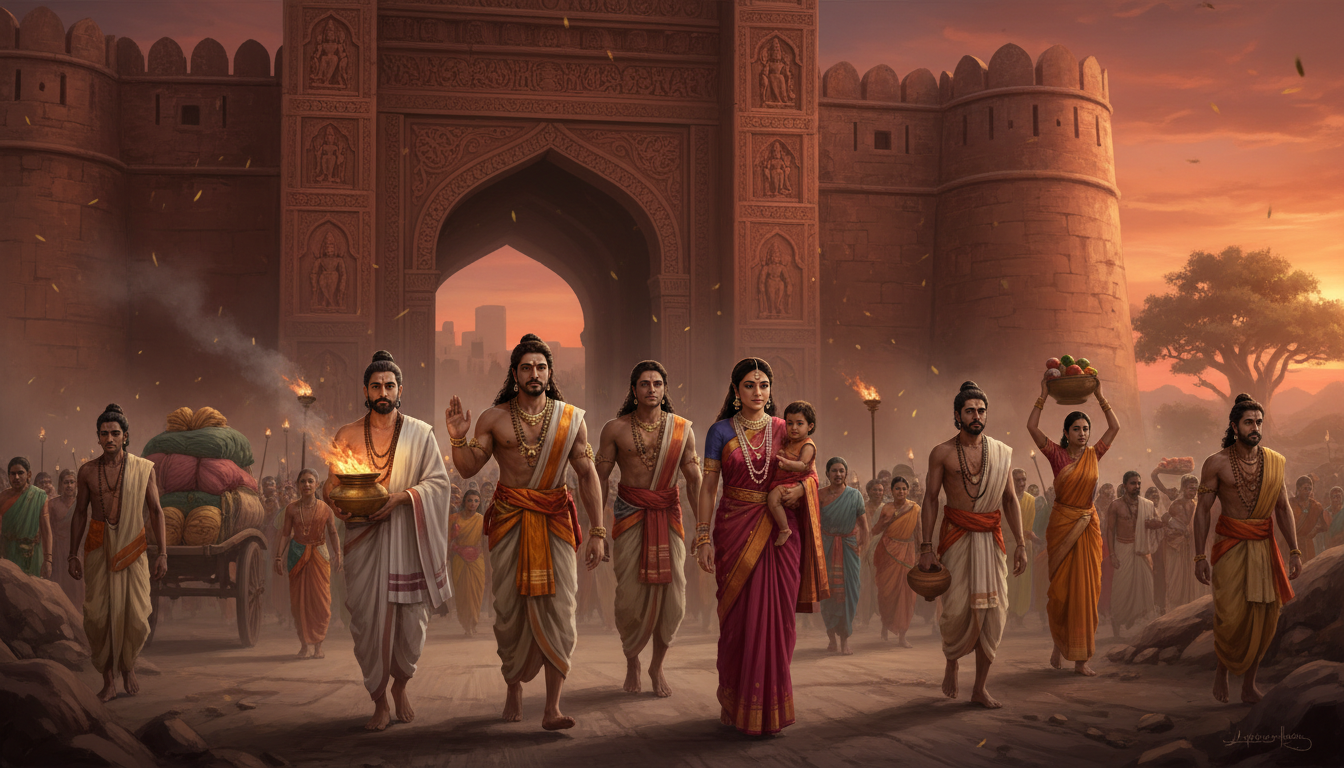
The defeat had been taken and the terms read out, and the sons of Pritha, incensed by the wicked sons of Dhritarashtra and their counsellors, set out from Hastinapura. They issued from the city through the Vardhamana gate, bearing their weapons, with Draupadi walking among them, and turned to the north. Indrasena and the others followed on swift cars, servants numbering fourteen in all, with their wives, and their household priest went before them. That was the whole procession of the men who had ruled Indraprastha.
What nobody in that house had reckoned on was the city.
What Was Said in the Streets
The citizens learned of the departure and were overwhelmed with sorrow, and the first thing the sorrow turned into was blame. They censured Bhishma. They censured Vidura, and Drona, and Kripa of Gautama's line. Four men who had sat in that hall and had authority and had let the thing happen.
Then they met together, in the ways and at the gates, and spoke to one another without any fear at all of who might be listening.
"Alas, our families, and we ourselves, and our homes are all gone," they said, "now that the wicked Duryodhana, backed by the son of Suvala and by Karna and Dushasana, aspires to this kingdom. Our families, our ancestral usages, our virtue and our prosperity are all doomed where this sinful wretch, supported by wretches as sinful, aspires to the kingdom. And how can there be happiness where these are not? Duryodhana bears malice towards all his superiors. He has taken leave of good conduct. He quarrels with those that are nearest to him in blood. He is covetous and vain and mean, and cruel by nature. The whole earth is doomed when Duryodhana becomes its ruler."
And having said that much they said the rest of it, which was not a complaint but a decision.
"Thither, therefore, let us go, where the merciful and high-minded sons of Pandu are going, who have their passions under control, who are victorious over foes, who are possessed of modesty and renown, and who are devoted to pious practices."
Then they went out of their houses after the Pandavas on the northern road, and not as a delegation. They went as a city.
Where Will You Go, Leaving Us
They caught the Pandavas on the road and came round them, and stood with their hands joined, and addressed the sons of Kunti and Madri all together.
"Blest be ye. Where will ye go, leaving us in grief? We will follow you whithersoever ye will go. Surely we have been distressed on learning that ye have been deceitfully vanquished by relentless enemies. It behoveth you not to forsake us, who are your loving subjects and your devoted friends, always seeking your welfare and employed in doing what is agreeable to you. We desire not to be overwhelmed in certain destruction, living in the dominions of the Kuru king."
Yudhishthira began to answer, and they would not let him, because they had an argument prepared and they meant to make it.
"Ye bulls among men, listen while we tell you the merits and the demerits that spring from association with what is good and what is bad. As cloth, and water, and the ground, and sesame seeds are perfumed by lying among flowers, even so are a man's qualities the product of the company he keeps. Association with fools produces an illusion that entangles the mind, while daily communion with the good and the wise leads to the practice of virtue. They that desire emancipation should associate with those that are wise and old and honest and pure in conduct. They should wait upon those whose three possessions, their knowledge of the Vedas, their origin, and their acts, are all pure; and such association is even superior to the study of the scriptures.
"We are devoid of religious acts ourselves. We know it. But we shall yet reap religious merit by association with the righteous, exactly as we should come by sin by waiting upon the sinful. The very sight of the dishonest, and the touch of them, and converse and association with them, cause diminution of virtue, and men doomed to these never attain purity of mind. Association with the base impairs the understanding; association with the indifferent makes it indifferent; communion with the good ever exalts it. All those attributes which are spoken of in the world as the sources of religious merit and worldly prosperity, which the people regard and the Vedas extol and the well-behaved approve, exist in you, separately and jointly. Therefore, desirous of our own welfare, we wish to live amongst you who possess them."
It was not a lament. It was a reasoned case, made by shopkeepers and cartwrights standing in the dust, that a man becomes what he stands next to.
The One Thing He Asked of Them
"Blessed are we," Yudhishthira said, "since the people, with the brahmanas at their head, moved by affection and by compassion, credit us with merits we have not."
He let that stand a moment. Then he asked them for the thing he wanted, and it was not their company.
"I, with my brothers, would ask all of you to do one thing. Ye should not, through affection and pity for us, act otherwise than I say. Our grandfather Bhishma is in the city of Hastinapura. The king is there. Vidura is there. My mother is there, and most of my well-wishers are there. Therefore, if ye are minded to seek our welfare, cherish ye them with care, uniting together, for they are overwhelmed with sorrow and affliction. Grieved at our departure, ye have come far. Go ye back, and let your hearts be directed with tenderness towards the relatives I entrust to you as pledges. This, of all things, is the one act upon which my heart is set, and by doing this ye would give me great satisfaction and pay me your best regards."
He had turned their own argument round and handed it back. If a man takes the character of the company he keeps, then the people who most need good company are the ones being left behind in the house of Duryodhana: an old blind king, a grandsire on a bed he could not leave, a minister who had already been called a traitor once for speaking, and Kunti in a widow's rooms with all five of her sons walking away up the north road.
Thus exhorted by Yudhishthira the just, the people set up a loud wail in a body, crying Alas, O king. And afflicted and overwhelmed with sorrow, remembering the virtues of Pritha's son, they unwillingly turned round and asked leave of the Pandavas, and went back to the city they had just decided to abandon.
The Banian Tree Called Pramana
The citizens having ceased to follow, the Pandavas mounted their cars and went on, and they reached that evening the site of the mighty banian tree called Pramana, on the banks of the Ganges.
They came to it about the close of the day. They purified themselves by touching the sacred water, and passed the night there, and that night they took water alone as their sustenance and nothing else. It was the first of the nights, and it set the shape of what was coming: the water of the Ganges, a tree instead of a roof, and five men and a woman lying down on ground they did not own.
But they were not alone under the banian. Certain brahmanas had followed them out of Hastinapura, both classes of them, those who maintained the sacrificial fire and those who did not, and they had brought their disciples and their relatives, and they passed that night there too.
So the fires were lit under the branches, and surrounded by those utterers of Brahma the king shone resplendent in the middle of them, though he had nothing left to be resplendent with. And that evening, which was at once beautiful and terrible, the brahmanas chanted the Vedas and held converse with one another, and with voices sweet as a swan's they spent the whole of the night comforting that best of the Kurus.
He lay awake through most of it doing sums. No revenues, no stores. A bow, four brothers, a wife, fourteen servants, and a following of holy men who ate.
Our Path Is the One You Are Taking
When that night passed away and the day broke, the brahmanas who supported themselves by mendicancy stood up in front of the Pandavas, who were about to enter the deep woods. They stood there in a body to make it plain that they were coming.
Yudhishthira addressed them.
"Robbed of our prosperity and our kingdom, robbed of everything, we are about to enter the deep woods in sorrow, depending for our food upon fruits and roots and the produce of the chase. The forest too is full of dangers, and abounds with reptiles and with beasts of prey. It appears to me that ye will certainly have to suffer much privation and misery there. The sufferings of brahmanas might overpower even the gods. That they would overwhelm me is too certain. Therefore, O brahmanas, go ye back whithersoever ye list."
"O king, our path is even that on which ye are setting out," they answered. "It behoveth thee not, therefore, to forsake us, who are thy devoted admirers, practising the true religion. The very gods have compassion upon their worshippers, and specially upon brahmanas of regulated lives."
"Ye regenerate ones, I too am devoted to the brahmanas," he said. "But this destitution that has overtaken me has overwhelmed me with confusion. These my brothers, who would have to procure the fruits and the roots and the deer for you, are stupefied with grief, arising from their own afflictions and from the distress of Draupadi and the loss of our kingdom. Alas, as they are distressed, I cannot employ them in painful tasks."
"Let no anxiety in respect of our maintenance find a place in thy heart, O king," they said. "We shall provide our own food and follow thee, and by meditation and by saying our prayers we shall compass thy welfare, and by pleasant converse we shall entertain thee and be cheered ourselves."
They had answered every objection he had. He made one more, and it was not an objection but a confession.
"Without doubt it must be as ye say, for I am ever pleased with the company of the regenerate ones. But my fallen condition makes me behold in myself an object of reproach. How shall I look at you all, who do not deserve to bear trouble, painfully subsisting for love of me upon food procured by your own toil? Oh, fie upon the wicked sons of Dhritarashtra."
And saying this, the king wept, and sat himself down upon the ground.
Saunaka Begins
Then a learned brahmana came forward out of that company, Saunaka by name, versed in self-knowledge and skilled in the Sankhya system of yoga, and he did not lift the king up or console him. He argued with him.
"Causes of grief by thousands, and causes of fear by hundreds, day after day overwhelm the ignorant," Saunaka said, "but not the wise. Surely sensible men like thee never suffer themselves to be deluded by acts that are opposed to true knowledge, fraught with every kind of evil, and destructive of salvation. In thee, O king, dwells that understanding furnished with the eight attributes, which is said to be capable of providing against all evils, and which results from the study of the Sruti and the scriptures. Men like thee are never stupefied by the accession of poverty, nor by an affliction overtaking their friends, whether it be bodily or mental uneasiness.
"Listen. I shall tell thee the verses chanted of old by the illustrious Janaka, touching the control of the self. This world is afflicted with two kinds of suffering, bodily and mental, and I shall indicate the means of allaying both. Disease, contact with painful things, toil, and want of the objects desired: these are the four causes that induce bodily suffering. Disease may be allayed by the application of medicine, while mental ailments are cured by seeking to forget them in meditation. For that reason sensible physicians first seek to allay the mental sufferings of their patients by agreeable converse and by the offer of desirable objects. And as a hot iron bar thrust into a jar makes the water in it hot, even so does mental grief bring on bodily agony. And as water quenches fire, so does true knowledge allay mental disquietude. The mind attaining ease, the body finds ease also."
The king was still sitting on the ground. But he had stopped weeping, because a man cannot weep and follow an argument at the same time, which is the oldest reason in the world for giving a grieving man something difficult to think about.
The Root Is Affection
"It seems that affection is the root of all mental sorrow," Saunaka went on. "It is affection that makes every creature miserable and brings on every kind of woe. From affection spring all our purposes, and from affection springs the love of worldly goods, and both of these are sources of evil, though the first is worse than the second. As a small portion of fire thrust into the hollow of a tree consumes the tree itself down to its roots, even so does affection, ever so little, destroy both virtue and profit.
"He cannot be said to have renounced the world who has merely withdrawn from its possessions; he who, in actual contact with the world, regards its faults, has truly renounced it. Like the lotus leaf that is never drenched by the water it lies upon, the souls of men who can distinguish between the ephemeral and the everlasting, who are devoted to the pursuit of the eternal and purified by knowledge, can never be moved by affection.
"The man influenced by affection is tortured by desire, and from the desire that springs up in his heart his thirst for possessions increases. This thirst is sinful, and is the source of all anxieties, and it leans always toward unrighteous acts. It has neither beginning nor end. Dwelling within the heart, it destroys creatures like a fire of incorporeal origin, and a person of impure soul is consumed by the covetousness born of his own heart as a faggot is consumed by the fire it feeds.
"And as creatures endued with life have ever a dread of death, so are men of wealth in constant apprehension of the king and of the thief, of water and of fire, and even of their own relatives. As a morsel of meat, if it is in the air, may be devoured by birds, and if on the ground by beasts of prey, and if in water by the fishes, even so is the man of wealth exposed to danger wherever he may be. Wealth alone is the root of niggardliness and boastfulness and pride and fear and anxiety. Men undergo infinite miseries in acquiring it and in keeping it, its expenditure is fraught with grief, and sometimes life itself is lost for its sake; and even they that are cherished by a man's wealth become his enemies for the sake of it.
"When, therefore, the possession of wealth is fraught with such misery as this, one should not mind its loss. It is the ignorant alone who are discontented. The wise are always content. The thirst of wealth can never be assuaged. Contentment is the highest happiness, and it is for that reason that the wise regard contentment as the highest object of pursuit. And, O Yudhishthira, it behoveth thee not to covet anything. If thou wouldst have virtue, emancipate thyself from the desire of worldly possessions."
But I Have Guests
"O brahmana," said Yudhishthira, "this desire of wealth in me is not for enjoying it when it is obtained. It is only for the support of the brahmanas that I desire it, and not because I am actuated by avarice. For what purpose does one like me lead a domestic life at all, if he cannot cherish and support those that follow him? All creatures are seen to divide the food they procure among those that depend upon them. So should a man leading a domestic life give a share of his food to the Yatis and the Brahmacharins, who have renounced cooking for themselves.
"The houses of good men can never be in want of four things: grass for a seat, space for rest, water to wash with and to assuage thirst, and fourthly, sweet words. To the weary a bed; to one fatigued with standing, a seat; to the thirsty, water; and to the hungry, food, should ever be given. To a guest are due pleasant looks, and a cheerful heart, and sweet words. The host, rising up, should advance toward the guest, offer him a seat, and duly worship him. Even this is eternal morality.
"None should cook his food for himself alone. Nor should one eat of food that has not been duly dedicated to the gods and the pitris. By scattering food on the earth, morning and evening, for dogs and Chandalas and birds, should a person perform the Viswedeva sacrifice. What remains in a sacrifice after the dedication to the gods and the pitris is regarded as ambrosia, and what remains after feeding a guest is called Vighasa, and is equivalent to ambrosia itself. He that eats the Vighasa is regarded as eating ambrosia. Feeding a guest is equivalent to a sacrifice, and the pleasant looks the host casts upon his guest, and the attention he devotes to him, and the sweet words in which he addresses him, and the respect he pays by following him, and the food and drink with which he treats him, are the five Dakshinas in that sacrifice. He who gives food without stint to a fatigued wayfarer he has never seen before obtains great merit. What, O brahmana, is thy opinion of this?"
He had gone the whole way round and come back to where he started, and everyone under the banian understood what he had done. He had not asked for his kingdom. He had asked whether a man who has been stripped of everything is still permitted to be a householder.
The Eight Duties
"Alas, this world is full of contradictions," Saunaka said. "That which shames the good gratifies the wicked. Moved by ignorance and passion, and slaves of their own senses, even fools perform many acts of apparent merit in order to gratify their appetites in an after-life. With their eyes open these men are led astray by their seducing senses, as a charioteer is led astray by restive and wicked steeds when he has lost his own senses.
"When any of the six senses finds its particular object, a desire springs up in the heart to enjoy it, and a wish is entertained, which in its turn gives birth to a resolve. And finally, like an insect falling into a flame out of love of the light, the man falls into the fire of temptation, pierced by the shafts of enjoyment discharged by the desire that was the seed of the resolve. Thenceforth, blinded by pleasure which he seeks without stint, and steeped in a dark ignorance which he mistakes for happiness, he does not know himself. And like a wheel that is incessantly rolling, every creature, from ignorance and deed and desire, falls into various states, wandering from one birth to another, and ranges the entire circle of existences from a Brahma down to the point of a blade of grass, now in water, now on land, and now in the air.
"That is the career of those who are without knowledge. Listen now to the course of the wise, who are intent on profitable virtue and desirous of emancipation. The Vedas enjoin action, but renounce interest in action. Therefore shouldst thou act, renouncing the sense of I and mine. Sacrifice, study of the Vedas, gifts, penance, truth in both speech and act, forgiveness, subduing of the senses, and renunciation of desire: these eight have been declared to be the cardinal duties that constitute the true path. Of these, the first four pave the way to the world of the pitris and should be practised without any sense of self; the last four are observed by the pious, to attain the heaven of the gods.
"By renouncing desire and aversion the gods themselves attained prosperity. It is by virtue of their wealth of yoga that the Rudras and the Sadhyas and the Adityas and the Vasus and the twin Aswins rule the creatures. Therefore, O son of Kunti, like them, refrain entirely from action done with a motive, and strive to attain success in yoga and in ascetic austerities. Thou hast already achieved the success that is due to thy ancestors, both male and female, and the success that is derived from sacrifices. Do thou now, for the sake of serving the regenerate ones, endeavour to attain success in penances. Those that are crowned with ascetic success can, by virtue of that success, do whatever they list. Do thou, therefore, practise asceticism, and realise all thy wishes."
And there was the answer to the question he had actually asked. Not that he should stop wanting to feed them, but that there was more than one way to get the food.
So the king rose from the ground, and the fires were put out under the banian, and they went on into the woods together, the five brothers and the daughter of Drupada and their priest, and behind them a crowd of holy men who would not be sent away.
Dharma Lesson
Grief by thousands overwhelms the ignorant and not the wise, because grief is fed by attachment rather than by loss. A ruler who cannot bear to be served has not yet understood that those who follow him are choosing their own dharma, and that refusing their choice is another kind of pride.