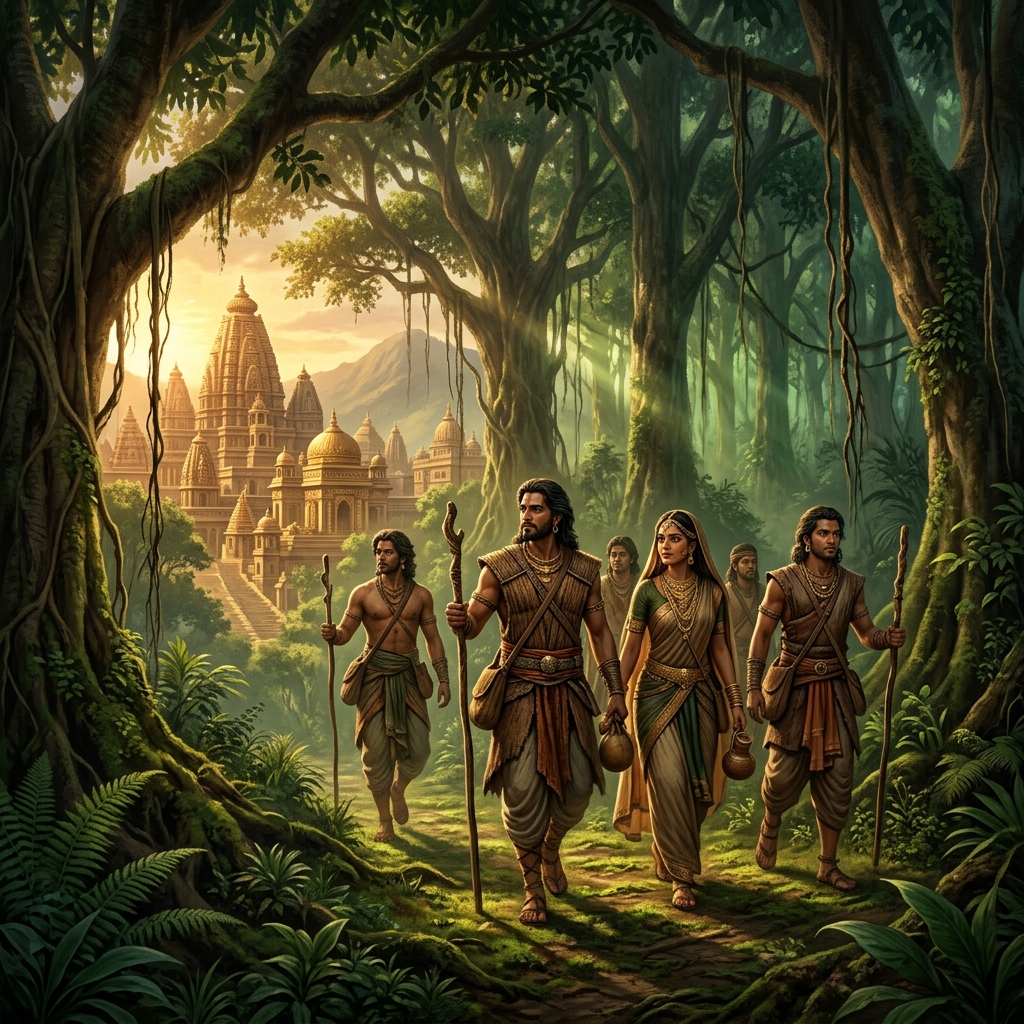
Through the Gate of Exile
When the Pandavas walked out of Hastinapura in the plain garments of exiles, stripped of their kingdom by a game of dice, it was to the forest of Kamyaka that their feet first carried them. The forest lay on the banks of the Saraswati where the river ran toward the edge of the desert, a country of tamarisk and open sky, thinning at its western border into sand. It was not wilderness in the emptied sense; hermitages already dotted its shade, and brahmins moved among its trees performing their daily rites, so that the Pandavas arrived not into silence but into a waiting community.
Yudhishthira chose it deliberately. A forest already home to ascetics and sages was a forest where dharma could still be practiced and witnessed, even by a king reduced to wearing bark and deerskin. Draupadi, who had been dragged by her hair into the Kuru assembly hall only days before, walked into Kamyaka still carrying that memory in her body, her unbound hair a vow of its own, unstruck until Duryodhana's thigh had been broken and Dushasana's chest torn open. The forest would hold that vow, unspoken, through every season that followed.
For twelve years the Pandavas would move between forests as danger and the seasons required, but Kamyaka was the first door, the place where exile stopped being an idea and became a daily fact: game hunted for food, water drawn from the Saraswati, brahmins to be fed from a dwindling store before the family's own hunger was answered. It was here that the long wilderness years properly began.
Kirmira Barred the Gate
The forest did not let them settle unchallenged. Not long after their arrival, a rakshasa named Kirmira came out from among the trees to bar their path, a demon of considerable size and hunger who had made Kamyaka his own hunting ground and resented any who trespassed on it. When he learned who had entered his forest, his fury sharpened further, for Kirmira was brother to the rakshasa Baka, whom this same family had slain years before at Ekachakra, and to Hidimba, whom Bhima had killed even earlier still. Vengeance and territory together drove him forward.
Kirmira challenged the Pandavas by night, boasting that he would feast on Yudhishthira and avenge his brother's death in the same hour, and Bhima, who had ended both of those earlier threats, rose to answer him without waiting to be asked twice. The two grappled in the dark forest under a sky just beginning to redden with dawn, uprooting trees to use as weapons when their bare strength was not destruction enough, the ground churned beneath them as each sought to break the other.
Bhima's strength, as it always did against such foes, proved greater in the end. He crushed Kirmira in a final grip and flung the huge body down among the trees the rakshasa had ruled, and the forest brahmins who had watched from a fearful distance came forward with blessings, for a demon that had troubled their hermitages for years was gone in a single night. It was, in its way, the Pandavas' introduction of themselves to Kamyaka: this family, however reduced in fortune, still carried destruction enough in its hands to clear a road for others.
A Forest of Visitors
News of where the Pandavas had settled traveled quickly, and Kamyaka became less a hiding place than a kind of open court, visited by nearly everyone who had counsel or comfort to give. Krishna came often, and came in both moods that the family needed from him. He arrived in fury over the dice hall and Draupadi's humiliation, swearing that the men responsible would answer for it on a battlefield if nowhere else, and he arrived in gentler visits too, sitting with Draupadi and Yudhishthira through long evenings of grief and doubt, turning their anger toward patience without ever asking them to forget its cause.
Vyasa came as well, the sage whose blood ran in both branches of the Kuru line, bringing not comfort alone but instruction: mantras of memory and invocation that would let Arjuna call the gods themselves to his aid when the years of exile finally ended and war could no longer be avoided. And the sage Markandeya, ancient beyond ordinary reckoning, sat with the brothers and told them of the ages of the world, the yugas that rise and fall and rise again, a vision of time so vast that even a kingdom's loss shrank a little beside it.
Brahmins without number passed through as well, sharing the sacred fire the Pandavas kept burning and receiving what hospitality could be managed from a family living on forest fare. Kamyaka, in those months, was less a refuge than a threshold the whole moral world of the epic seemed to cross through, each visitor leaving something of Kurukshetra's coming shape a little more visible.
The Vanishing of Draupadi
It was from Kamyaka, in a season when the brothers had gone out hunting and left Draupadi under only the protection of a priest, that catastrophe found them again. Jayadratha, king of Sindhu, passing near the forest on his own travels, saw Draupadi outside their hermitage and, inflamed by her beauty and by an old grudge nursed since his earlier humiliation at Pandava hands, seized her against every plea and every warning and carried her off in his chariot toward his own kingdom.
The brothers, returning to find their hermitage empty and the signs of a struggle in the dust, tracked the chariot's path with a fury that outran the horses pulling it. Bhima and his brothers caught Jayadratha before he could cross into safety, cut down his escort, and dragged him back to Kamyaka in a humiliation that mirrored, almost exactly, what Trigarta's king would later suffer at Virata's borders. Yudhishthira again counseled restraint over execution, and Jayadratha was spared his life, sent home shaved and shamed rather than killed outright, a mercy he would remember with resentment rather than gratitude in the years to come.
The abduction, though ended in an afternoon, left its mark on the forest's memory as surely as Kirmira's death had. Kamyaka, which had sheltered sages and sheltered grief, had also failed to shelter Draupadi in the one hour it mattered most, and the family's watchfulness over her never fully relaxed again for the rest of the exile.
Yudhishthira's mercy toward Jayadratha, extended once more despite the provocation, would echo far beyond that single afternoon. The Sindhu king carried his humiliation back to his own court like a coal banked under ash, and the grudge born on Kamyaka's riverside would not stay buried; it waited, patient as the forest itself, for a battlefield still years away.
Between Two Forests
No single forest held the Pandavas for the whole of their twelve years; the exile moved with the seasons and with danger, and Kamyaka shared its burden of shelter with Dvaitavana to its west, the two forests trading the family back and forth as game grew scarce in one or safety grew doubtful in the other. They would leave Kamyaka's tamarisk shade for Dvaitavana's lake country, and return again when circumstance or restlessness turned them back, so that neither forest alone contains the whole story of those years.
Yet Kamyaka kept its place as the first among their refuges, the forest that had received them still raw from the dice hall's humiliation and had watched them become, gradually, a household that could survive its own ruin. It was where Bhima's strength first proved itself again after the fall from power, where Krishna's anger and Vyasa's counsel first reached them in exile, where a demon's death and a queen's abduction both took place within the same stretch of riverside trees.
When the twelve years finally closed and the thirteenth, hidden year at Virata's court began, it was Kamyaka the family carried in memory as the place exile had first taught them to endure, a lesson the Saraswati's slow water seemed to have written into the ground itself, patient and unhurried, exactly as Yudhishthira had learned, against every instinct in him, to be.
Long after the throne was won back and the war's dead were mourned, the forest by the desert's edge remained, in the family's own telling of their exile, the place where the ordeal first became bearable rather than merely survivable, the ground where grief learned, slowly, to walk beside patience instead of against it.
Dharma Lesson
Kamyaka shows dharma sustained through hospitality and patience rather than through triumph: the family keeps feeding wandering brahmins and tending the sacred fire even in destitution. When Jayadratha is captured after abducting Draupadi, Yudhishthira insists on sparing his life, showing that restraint remains a duty even toward those who have wronged you most. The forest becomes proof that exile need not mean abandoning the disciplines of a righteous household.