The Year of Masks
The Virata Parva shows that even the mightiest must sometimes hide and endure.
The Thirteenth Year
Twelve years of forest exile were finished. The Pandavas had slept on bare earth, eaten what the wilderness gave them, and endured insults that would have broken lesser men. But the cruelest year was the one that remained. By the terms of the dice game lost to Duryodhana, the brothers had to live one final year unrecognized. If anyone identified them before the year was out, the whole exile would begin again - twelve more years in the forest, and another year in hiding.
The five brothers and their wife Draupadi sat together at the edge of the woods and weighed where to spend that final, most dangerous year. They needed a kingdom large enough to lose themselves in, ruled by a man honest and kindly enough that they would be safe at his court. Yudhishthira chose the realm of Matsya and its aged king, Virata, a ruler famous for his decency and for his great herds of cattle.
"We will go to Virata's city," Yudhishthira told them, "and each of us will take a hidden name and a humble trade. We must bury our pride deeper than we have ever buried anything. A warrior is known by his bearing, his scars, his speech. We must each become someone a king would never glance at twice."
Before they parted, they buried their weapons. Arjuna's mighty bow, the Gandiva, and the quivers that never emptied were wrapped in cloth and hidden high in the branches of a great shami tree near a cremation ground, so that no traveler would go near. To explain the foul shape bound in the tree, they tied a corpse beside it and let villagers believe an old mother lay there by family custom. Then, weaponless and disguised in their hearts, the heirs of the Kuru line walked toward Virata's gates as beggars seeking work.
Five Disguises and a Queen's Maid
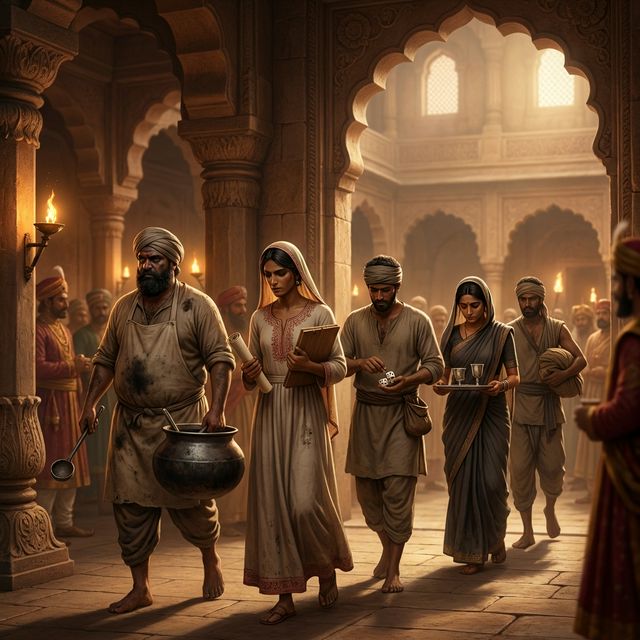
One by one, the Pandavas entered Virata's service, and not one of them came as himself.
Yudhishthira approached the king's court first, calling himself Kanka, a learned brahmin skilled at dice. "I was once the friend and companion of King Yudhishthira," he said, which was true in a way no listener could guess. Virata, charmed by his wisdom and his fairness at the gaming board, made him a courtier and seated him close. "You carry yourself like a king," the old monarch said, never imagining how right he was.
Bhima came as Vallabha, a cook and wrestler. Broad as a doorway and laughing easily, he took charge of the royal kitchens and produced feasts that delighted the whole household. When the court wanted entertainment, this cook would step into the wrestling ring and hurl champions about like sheaves of straw, careful never to kill so plainly that questions would follow.
Arjuna's disguise was the strangest of all. A year before, the celestial dancer Urvashi had cursed him to live a season as a eunuch, and now that curse became his shelter. He bound his warrior's arms in bangles, braided his hair, and named himself Brihannala. He entered the women's quarters as a teacher of dance, song, and music to the young princess Uttara and her companions, the calloused fingers that drew the Gandiva now plucking the strings of a vina.
Nakula became Granthika, master of the king's horses, for there was no one who understood the temper of a horse as he did. Sahadeva became Tantripala, keeper of the vast Matsya cattle herds, naming each beast and knowing the land by its grazing.
Last came Draupadi, the proud daughter of a king and wife of five heroes, now bowing her head as Sairandhri, a serving-maid skilled in dressing hair and perfumes. She offered herself to Queen Sudeshna, on one condition: she would serve no man, eat no leavings, and wash no feet, for she had, she said, a band of unseen gandharva husbands who guarded her honor. Sudeshna, taken with her beauty and her grace, agreed and brought her into her own apartments. So the six of them passed into the kingdom of Matsya, hidden in plain sight, counting the days.
Months in the Shadows
The months passed, and the disguises held. There was a strange tenderness in those days, and a strange shame. The man who had ruled an empire from Indraprastha now diced quietly in a corner of another king's hall. The strongest man alive sweated over cooking pots. The greatest archer in the world taught little girls to keep time with their ankle bells.
There were close calls. When Virata once set a tiger and a wrestler upon his cook to test him, Bhima had to fight while hiding the full measure of his strength, lest a stranger killing a beast bare-handed remind someone of the wolf-bellied Pandava. Kanka the courtier had to bite back his judgment when the king praised the absent Kauravas. Brihannala had to bear the giggles of the women who thought a once-great figure had been reduced to a clown in skirts.
Hardest of all was their meeting in secret. The brothers, who had ridden into battle shoulder to shoulder, could now exchange only a glance across a courtyard, a word disguised as idle talk. And Draupadi, who had been honored as the jewel of Indraprastha, swept floors and braided another woman's hair while keeping a careful eye out for any face from Hastinapura that might know her.
Yet for all the swallowed pride, they were safe. The year was draining away like sand, and freedom and vengeance lay just on the far side of it. They needed only to remain unseen a little longer. But the queen's own brother was about to make that impossible.
Kichaka's Desire
Kichaka was the commander of Virata's armies and the brother of Queen Sudeshna. He was a giant of a man, a renowned warrior who had crushed Matsya's enemies, and the true power behind the throne. The old king feared him; the kingdom obeyed him. And one day Kichaka, walking through his sister's apartments, saw the maid Sairandhri and was instantly inflamed with desire.
He came to her with honeyed words and then with naked demand. "There is no one in this kingdom I cannot have," he told her. "Forget your hidden husbands. Come to my house and you will be a queen there, not a servant scrubbing floors."
Draupadi drew herself up. "I am a married woman, and my husbands are gandharvas of great power. They watch over me unseen. If you persist, they will destroy you. Do not court your own death."
Kichaka only laughed and went straight to his sister. "Sudeshna, I am burning. Send your maid to my house, on whatever pretext you like. Send her to fetch wine from me this evening."
The queen knew her brother and feared what he might do if crossed. Caught between her servant and her kinsman, she chose the safer cruelty. "Sairandhri," she said when the maid attended her, "go to Kichaka's house and bring me wine." Draupadi pleaded to be spared, warning that the general meant her harm. But the queen would not relent, and a serving-woman could not refuse a queen. With dread in her heart, Draupadi went, praying for any escape.
Assaulted in the Open Court
Draupadi reached Kichaka's house trembling and asked only for the wine the queen had sent her for. Kichaka tried again to seize her with soft promises, and when she turned to flee, he caught her by the end of her garment. She tore free and ran, running not away into the streets but toward the one place she thought might shield her - the king's own assembly hall, where Virata sat in council and where Yudhishthira, as Kanka, sat among the courtiers.
Kichaka pursued her into the hall before the eyes of the king and the court. He caught her by the hair, flung her to the floor, and kicked her in his fury. It was an unbearable echo of the day in Hastinapura when Dushasana had dragged her by the hair into another court while kings looked on and did nothing.
And again, the powerful did nothing. Virata, who feared his commander, lowered his eyes. The courtiers murmured but stayed seated. Yudhishthira sat rigid, his face a mask, knowing that one word, one move to defend his wife, would unmask them all and cost them everything.
Draupadi cried out to the assembly. "Shame on this court, where a defenseless woman is beaten before kings and not one of you lifts a hand. Where is justice in Matsya?" Then, with a meaning only one man in the room could read, she fixed her eyes on Kanka and said that men who could not protect their wives were no men at all. Yudhishthira answered her stiffly, as a stranger would, telling her to return to the queen's quarters and not weep in the king's hall, lest her gandharva husbands grow angry. The words were ice, but his hands shook beneath the table. Draupadi understood the message inside them: not here, not yet, but soon.
Draupadi Goes to Bhima
That night Draupadi could not stay still. While the palace slept she slipped into the royal kitchens, where Bhima lay on his cook's pallet. She knelt beside him and woke him, and all the grief and rage of the day poured out of her at once.
"How can you sleep," she whispered fiercely, "while the man who beat me before the whole court breathes easily in his own bed? You who killed Bakasura and Hidimba, you who carried us all through the wilderness - have you become a cook in truth, content to stir pots while your wife is kicked like a stray dog? Look at these hands, that once knew sandalwood and now know only ash and labor. Look at me. If you will not avenge this, I have no reason to live. I will take poison before the sun rises rather than face that man again."
Bhima gathered her hands in his and felt the calluses there, and his eyes filled. "Do not speak of poison," he said. "I have endured this disguise only because my brother bound us to it, and one day soon we will repay every insult with interest. But I will not let you wait that long for this one. Kichaka will not see another dawn. Listen to me, and we will be careful, so that no suspicion falls on any of us and the year is not lost."
They made their plan in low voices over the embers. "Speak gently to Kichaka tomorrow," Bhima said. "Pretend you have softened toward him. Tell him to come alone, after dark, to the dancing hall where the court holds its music by day and which lies empty at night. Tell him to tell no one. He will come thinking to meet you. He will meet me instead."
Draupadi looked at her husband, and for the first time in many days she smiled. "Then I will play the part," she said. "And you will end it."
Death in the Dancing Hall
The next day Draupadi sought out Kichaka and let her eyes drop and her voice grow soft. "My anger has cooled," she told him. "Come to the dancing hall tonight when the household sleeps. Come alone, and tell no one, or my gandharva husbands will know. I will be waiting." Kichaka, drunk on his own certainty, believed every word. He bathed and perfumed himself and decked himself in his finest garments, boasting in his heart of his conquest.
In darkness he entered the dancing hall and saw a shape resting on a couch in the gloom, covered, as he thought, by his shy beloved. He came near and put out his hand and spoke a lover's words. The shape rose. It was not Sairandhri. It was the cook, Vallabha, and the hand that closed on Kichaka's wrist was the hand of the wind god's son.
"You laid hands on my wife," Bhima said. "Now feel my hands."
Kichaka was no weakling. He was among the strongest men in all Matsya, a warrior who had broken armies, and he fought back with all his might. The two giants grappled in the dark, hurling each other against the walls and pillars until the great hall shook. But against Bhima there could be only one ending. Bhima seized him, lifted him, and crushed the life from him, driving his head and limbs into his body until what lay on the floor was no longer recognizable as a man but a shapeless ball of flesh and bone. Then Bhima washed himself, returned quietly to the kitchen, and sent word to Draupadi that the deed was done.
The Vengeance of the Kichakas
When servants found the formless heap that had been their commander, terror swept the palace. "No mortal could have done this," they whispered. "It was her gandharva husbands, as she always warned. The maid is cursed." Draupadi let them believe it, saying only that her unseen guardians protected her honor.
But Kichaka had a hundred and five kinsmen, the Upakichakas, brothers and cousins of equal pride and lesser sense. They gathered around the ruined body of their leader, and their grief turned swiftly to fury, and their fury fell upon Draupadi. "This woman brought his death," they cried. "Let her burn upon his pyre, so the gandharvas are repaid in kind." They seized her, and over her cries they carried her to the cremation ground to burn her alongside the corpse of the man she had refused.
Draupadi screamed for help, and her cry carried through the night to the kitchens. Bhima heard it. There was no time for disguise now. He scaled the rampart, tore a great tree from the earth to serve as a club, and came roaring down upon the Upakichakas like death itself. The men who had thought a vengeful spirit guarded the maid now believed it more than ever, for one shape moved among them shattering bone and skull, and one by one all hundred and five fell. Bhima cut Draupadi loose, told her to walk back to the palace as though nothing had happened, and vanished into the dark before the household could gather.
The Cattle Raid Begins
News of the death of mighty Kichaka and all his kinsmen spread far beyond Matsya, and it reached the ears of those who had long wished Virata ill. The Trigarta king Susharma, an old enemy whom Kichaka had often defeated, saw his chance. "Their great commander is gone," he told the Kauravas, with whom he was allied. "Matsya is weak now. Let us fall upon Virata's herds and seize his wealth."
Duryodhana, Karna, and the Kuru leaders agreed eagerly, the more so because the thirteenth year of the Pandavas' exile was nearly spent, and spies had failed to find them anywhere. The plan was twofold. From the south, Susharma's Trigartas would raid Virata's cattle first, drawing the king and his army out to defend them. Then, a day later, the great Kuru host - Bhishma, Drona, Kripa, Karna, Ashwatthama, Duryodhana himself - would strike from the north and carry off the rest of the herds while Matsya's defenders were away.
It happened as planned. Susharma's raiders swept down and seized thousands of cattle, and the cowherds came running to the city in panic. King Virata armed himself and rode out with his brother and his forces to recover his wealth. And because the king wished every able man at his side, four humble servants rode out with him - the cook Vallabha, the courtier Kanka, the horse-keeper Granthika, and the cattle-keeper Tantripala. Quietly, on the field against the Trigartas, four of the Pandavas fought, with Bhima especially turning the tide. When Susharma captured Virata and bore him off the field, it was Bhima who broke through, freed the king, and took the Trigarta lord prisoner. Virata, grateful and amazed at the prowess of his servants, recovered his cattle and prepared to ride home in triumph, never guessing who had saved him.
Uttara's Flight and Brihannala's Bow
While the king and his army were away in the south, the great Kuru host descended from the north exactly as Duryodhana had planned, sweeping up the cattle of Matsya. The cowherds raced to the palace, but the king and every fighting man had gone. The only one left of the royal house was Prince Uttara, the young son of Virata - brave in his boasting but untried in war.
"If only I had a charioteer," Uttara cried before the women of the court, "I would ride out and scatter the Kurus single-handed and bring back my father's cattle." Hearing this, Draupadi quietly told the princess that her dance-teacher Brihannala had once been the charioteer of the great Arjuna himself and knew the art of war. Princess Uttara begged Brihannala to drive her brother's chariot, and Brihannala, after a show of clumsy reluctance, agreed - even letting the girls dress him for the part, all the while hiding a knowing smile.
So Arjuna in his bangles and braid took up the reins and drove Prince Uttara out to face the army of Hastinapura. But when the boy saw the vast Kuru host arrayed before him, the white banners of Bhishma and Drona, the bristling ranks, his courage drained away utterly. He leapt from the chariot and ran, weeping with terror. Brihannala sprang down, chased him, caught him, and dragged him back. "I cannot fight them," the prince sobbed. "Then hold the reins and I will fight," said Brihannala, "but first we must fetch better weapons." He drove the chariot to the cremation ground where the great shami tree stood, climbed it, and brought down the bundle hidden there. As the wrappings fell away, the boy saw the Gandiva gleam in the sunlight, and the celestial quivers, and the great conch.
Arjuna Against the Kuru Host
Then Arjuna shed the last of his disguise before the trembling prince. "I am Arjuna, third of the Pandavas," he said. "The cook is Bhima, the courtier is Yudhishthira my brother and king, the horse-keeper is Nakula, the cattle-keeper is Sahadeva, and Sairandhri is Draupadi, daughter of Drupada. We have lived this year in your father's house. Take heart, and hold these reins, for today you will witness what the Gandiva can do."
He strung the great bow, and the sound of it was like thunder rolling over the plain. He blew his conch, and the Kuru ranks across the field stirred and stared. Drona knew that sound at once. "That is the bow of Arjuna," he said gravely to the Kuru elders. "The Pandavas have shown themselves. The thirteenth year is ended." Duryodhana argued that the term was not yet spent, but Bhishma, counting the days by the moon, declared the exile honorably completed.
Whether the term was finished or not no longer mattered on that field, for Arjuna fell upon the whole assembled might of Hastinapura alone. He fought Karna and drove him back, his arrows tearing through the Kuru lines. He met Drona and Kripa and Ashwatthama in turn, honoring his teachers even as he overcame them. Then, to spare bloodshed and to crown his victory with mercy, he loosed the sleep-inducing Sammohana weapon, and one by one the great warriors of the Kuru host sank down senseless upon their chariots. Across the dust lay Bhishma, Drona, Karna, Duryodhana, all stilled. At Arjuna's bidding, the awestruck Prince Uttara stepped down and stripped the upper garments from the sleeping captains to carry home as proof, and Arjuna turned the recovered cattle of Matsya back toward the city.
Masks Removed
King Virata returned from his victory over the Trigartas to find that the Kurus had raided from the north and that his young son had ridden out against them. In his fear for the boy he was beside himself, until messengers brought word that Uttara was returning safe and triumphant, the cattle recovered and the great Kuru host turned back. In his joy and pride Virata boasted in the assembly of his son's prowess, declaring that the prince had defeated Bhishma and Drona single-handed. Kanka the courtier could not help correcting him: such a feat, he said, could only have been done by the one who drove the chariot. The old king, stung, struck Kanka across the face with a die, drawing blood, and Draupadi rushed to gather the falling drops, for it was the blood of a Pandava and a king.
When Prince Uttara entered, he set his father right at once. "It was not I who fought, Father. A son of the gods drove my chariot and defeated the Kurus. He saved us all." And the next day, the truth came fully into the light. The five brothers seated themselves upon the royal thrones of the assembly, clad now as the princes they were, and Arjuna revealed all their names and their year of hidden service. Virata was overcome - first with shame at the insults and humble work he had laid upon the heirs of the Kuru line, then with awe and gratitude. He begged their forgiveness and offered his whole kingdom, and to seal a bond between their houses he gave his daughter, Princess Uttara, in marriage to Arjuna's son Abhimanyu. Arjuna, who had been her teacher and guardian and would not take as wife one who had been as a daughter to him, gladly accepted her instead as his daughter-in-law.
So the thirteenth year ended in honor. The disguises fell away, the weapons came down from the tree, and the Pandavas stood once more in their own shapes. The hardest part of the exile was behind them. Ahead lay a far greater reckoning - the demand for the return of their kingdom, and, when that demand was refused, the war that would consume the world. But for now, in the joyful hall of Virata, six who had hidden so long could at last be known.
Dharma Lesson
The Virata Parva shows that even the mightiest must sometimes hide and endure. The Pandavas could have fought - but they chose patience over pride. Yet when Draupadi was assaulted, even patience had limits. Bhima's killing of Kichaka was justice, not murder. The story teaches balance: know when to wait, and know when to act.