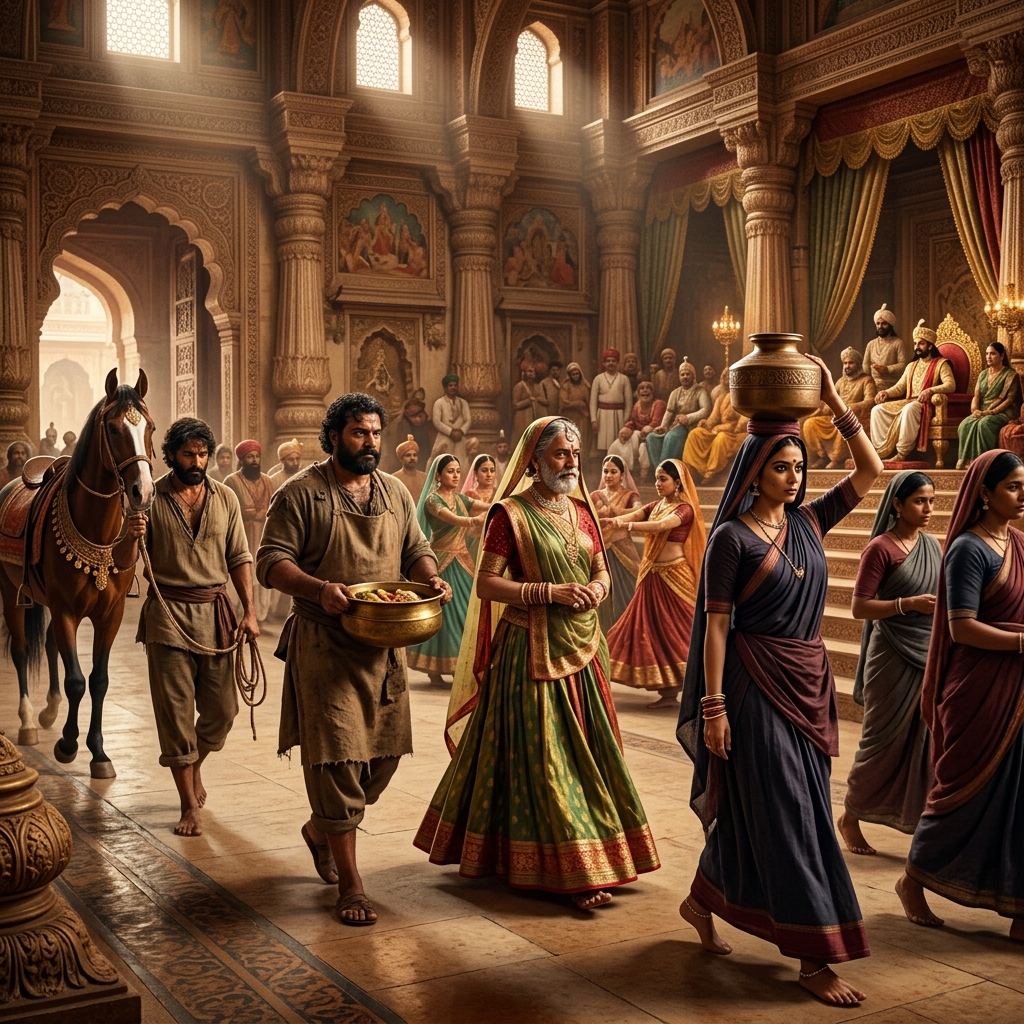
The Year of Disguise
The Pandavas Hidden at Virata's Court
The Last Year Must Be Hidden
Twelve years had passed. The forest had taken its toll on the five sons of Pandu and on Draupadi who had walked every mile of exile beside them. They had slept on bare ground through twelve cold seasons, eaten what the wild gave them, and carried the memory of the dice-hall in Hastinapura like a stone sewn into the lining of the heart. Now the twelfth year was ending, and the terms of their banishment turned to their last and strangest clause. Twelve years in the forest, and then one year more lived in disguise - the ajnatavasa, the year unknown. If in that thirteenth year any of them were recognized by anyone who could swear to it, the whole exile would begin again from the first day.
They gathered at the edge of the woods of Kamyaka and the meadows of Upaplavya, and Yudhishthira called his brothers and his wife to council. "The hardest part is not behind us," he said. "It is before us. To live in the forest, men only had to endure. To live unknown among men, we must become other than ourselves and never once forget it. A single careless word, a single proud gesture, and thirteen years are thrown away."
The brothers were silent. Bhima, who had wanted nothing all these years but to walk into Hastinapura and break it, sat with his great hands open on his knees. Arjuna looked at the bow he would have to set aside. Draupadi, daughter of fire, queen of Indraprastha, looked at the calloused hands that had once worn rings worth provinces.
"Where do we go?" asked Sahadeva, who of the five saw furthest. "Duryodhana has spies in every great court. He will be watching the famous kingdoms most closely of all."
Yudhishthira had already decided. "For that reason, we go to no great kingdom. We go to Matsya, to the court of old King Virata. It is a small realm. It makes no wars and sends no embassies. Nothing happens there worth a spy's report. A king who has never had a reason to look closely at his servants will not begin now."
The Weapons in the Tree
Before they could enter Virata's city as servants, they had a problem of iron and wood to solve. Five men could change their names and their clothes. They could not change the great bow Gandiva, taller than a man and known to every warrior in the world; nor Bhima's mace; nor the swords and the long spear and the inexhaustible quivers. To carry such weapons was to announce themselves. To leave them behind was unthinkable, for the year might yet end in blood.
They walked out beyond the city to a cremation ground, a place men avoided, where a great old Shami tree stood by the river. Its branches were thick and high, and the wood of the Shami is hard. "Here," said Yudhishthira. "No one comes to a burning-ground without need, and no one climbs a tree in such a place."
They wrapped each weapon carefully in cloth and skins to keep off the rain, and bound Gandiva and the others into a single long bundle that they hauled up into the high branches and lashed fast. Then, so that no curious herdsman would ever climb to investigate, they tied to the bundle the body of a dead beast, wrapped as a corpse, and let the word go about that an old woman of a hundred and eighty years had died and that her body, by the custom of their people, had been hung in the tree.
"Who would touch it?" said Nakula. The smell alone would turn men away, and the dread of a corpse hung in a haunted tree near a burning-ground would do the rest.
Arjuna stood a long moment with his hand on the rough bark before he climbed down. To set Gandiva aside was a kind of small death. "A year," he murmured to the bow as if it could hear him. "One year, and I will come back for you." Then they turned their faces to the city, five kings and a queen walking toward a year of servitude, and did not look back at the tree.
Kanka the Dice-Courtier
They entered the city of Virata one at a time, on different days, so that no one should mark five strangers arriving together. Yudhishthira came first. He had laid aside everything that marked a king. He wore the plain cloth of a Brahmin and carried in his hand a set of dice made of beryl and gold, and he came to the gate of Virata's hall like a man seeking a quiet place to grow old.
King Virata, an old man fond of company and of the long game of dice that filled the empty evenings of a peaceful reign, received him. "Who are you, Brahmin, and what do you seek?"
"I am called Kanka," said Yudhishthira, and the name came easily, for it had been decided in council. "Once I was a friend and counselor to King Yudhishthira of the Pandavas, in the days when he had a court. I am skilled at dice above other men, and skilled too at gentle counsel. I ask only to sit at your side and be your companion at the board."
There was a bitter irony in it that only he could taste. Dice had cost him his kingdom, his brothers' freedom, and his wife's dignity. He had sworn off the game in his soul, and yet here he was offering himself to a king as a master of it, because the disguise required it. He swallowed the irony whole and smiled the mild smile of a harmless scholar.
Virata was delighted. "Stay, then. Sit by me. You shall be honored as a friend, eat at my table, and want for nothing. But know my one rule, learned in a long life: at the board I do not like to lose, and I do not like to be made to lose. A wise companion knows when to let a king win."
"I know it well, great king," said Yudhishthira, bowing. And so the eldest of the Pandavas, who had once ruled from a hall paved with crystal so clear that men mistook it for water, took his seat as a courtier of an old king of a forgotten kingdom, and learned the slow art of losing on purpose.
Vallabha in the Kitchen
Bhima came next. Of all the brothers his disguise sat hardest on the eye, for there is no easy way to hide a man built like a hill. So they did not try to hide his size, only to give it a harmless name. He came to the palace girt in a cook's cloth, a ladle thrust in his belt, and presented himself as Vallabha, a cook who had once served in a royal kitchen and who could, besides cooking, wrestle for the amusement of a court.
Virata laughed when he saw the size of the man. "You are too large for a kitchen, friend. You should be breaking heads in my army."
"I can cook, lord, as no other man can," said Bhima, "and when the court wants sport I will throw any wrestler you put before me. But meat and bread are my trade." To prove the first half, he cooked; to prove the second, he is said to have seized the horns of two of the king's full-grown bulls and held them apart with his bare arms as if they were lambs. The court roared. Virata appointed him master of the royal kitchen on the spot.
It was, for Bhima, a torment dressed as a joke. He had the strength to tear the roof from the hall and the temper to want to. Instead he stood over pots, tasting sauces, while lesser men gave him orders. When the wrestling festivals came he threw the kingdom's champions for the crowd's delight, and was careful, always careful, to throw them as a strong cook might and not as the second of the Pandavas could. It would have been the easiest thing in the world to kill a man in the ring and be done with the pretense. He swallowed that ease a hundred times.
In the quiet of the night, when the kitchen fires were banked, Bhima would sit alone and grind his teeth, and think of Draupadi's loosened hair in the dice-hall, and tell himself the same thing every night: not yet, not yet, one year, and then everything. The waiting was harder than any war. He kept it inside, behind the broad good-natured face of Vallabha the cook, and no one in Matsya guessed that the man who flavored their feasts could have ended their world.
Brihannala in the Women's Quarters
Arjuna's disguise was the strangest of any of them, and it was no invention of the moment. Years before, in the heaven of his father Indra, the celestial nymph Urvashi had come to him in desire, and he had refused her, for he honored her as a mother of his line. In her wounded pride she cursed him: that he should pass a year as a eunuch, a dancer among women, neither man nor warrior. Indra had softened the curse to a single year of Arjuna's choosing. Arjuna, hearing of it, had thanked the gods, for he saw that a curse can be a doorway. Now the year had come, and the doorway opened exactly where he needed it.
He braided his long hair and hung rings in his ears and bangles on the wrists that had bent Gandiva, and covered the bowstring scars on his arms. He came to Virata's court as Brihannala, tall and fluid of motion, a teacher of song and dance, neither plainly man nor plainly woman. Virata, uncertain, had him examined and tested, and being satisfied that this was no warrior in disguise but truly one set apart, sent him into the inner apartments to teach the king's young daughter, the princess Uttara, and her companions the arts of dance and music.
So the greatest archer of the age spent his year of disguise among girls, beating time with his bangled hands, teaching the steps of dances and the turns of songs. The man whose name made armies pale taught a young princess to hold her wrists just so. He did it gravely and well, and the princess and her friends loved their gentle teacher and never dreamed who taught them.
There was a deep humility in it that few could have borne. A proud man would have found the bangles unbearable. Arjuna wore them as a discipline, the way a soldier holds a post he is forbidden to leave. He kept his eyes lowered and his voice soft, and at night, alone, he flexed the calluses on his fingers so they should not soften past use, and waited, as all of them waited, for the year to turn.
The Twins at the Stables and the Herds
The twins came last of the brothers, and their disguises fit them like worn leather, for they took up the work they had always loved. Nakula, who among all men understood horses, who could read a stallion's temper from the set of its ears and gentle a wild colt with a hand and a word, came to Virata as Granthika, a keeper of horses. He told the king he had once tended the stables of King Yudhishthira and knew the care and training and healing of horses as few men did.
Virata watched him move among the animals, watched the nervous beasts settle under his hand, and gave him charge of the royal stables. There Nakula passed his year, currying and feeding and breaking horses, sleeping in the straw, content in a way that surprised him, for the work was honest and the horses did not care that he had once been a prince. A man can hide most easily inside a thing he truly loves.
Sahadeva, the youngest, who knew cattle as Nakula knew horses, who could tell the worth of a cow at a glance and read the health of a whole herd by the way it grazed, came as Tantripala, a cowherd. He offered the king his skill with the great herds that were the true wealth of a pastoral kingdom like Matsya. Virata, impressed, set him over the royal cattle.
So Sahadeva spent the thirteenth year in the byres and the pastures, among the lowing of cattle and the smell of milk and dung, walking the herds out at dawn and home at dusk. He who had sat in council at Indraprastha and was reckoned the wisest of the five in matters of the future now counted calves and salved the hooves of oxen, and asked nothing more of the year than to pass through it unseen. The twins, who had always been quiet, found the quiet life of servants easier to bear than their brothers did. They bent their heads, did their work, and let the days go by.
Sairandhri, the Queen's Maid
Of them all, Draupadi's disguise cost the most pride and carried the most danger. She was the daughter of fire, born from a sacrifice, wife to five kings, the most beautiful woman of the age - and beauty cannot be set aside in a tree like a bow. She could change her name and her clothes; she could not become plain. So she chose a station high enough to keep her near a queen and not a common drudge, and a craft she could honestly claim.
She came to Sudeshna, Virata's queen, and named herself Sairandhri, a sairandhri being a skilled and high-born female attendant, a hairdresser and confidante of the kind who passed between royal courts and was treated almost as a friend. "I dress hair and prepare unguents and perfumes," she told the queen. "I have served great ladies. I ask only honest service in a good house."
Sudeshna looked at her and was uneasy. "You are too beautiful for a servant," she said frankly. "A maid as lovely as you will turn the head of every man in this palace, and the king's eye is not the steadiest. You will bring trouble."
"Neither lord nor king need fear me, and I need fear no man," Draupadi answered, and she spoke the careful tale they had prepared: that she was a sairandhri protected by five powerful Gandharva husbands, unseen but ever near, who destroyed any man who dared lay hands on her. "Let no one approach me with desire, and there will be no trouble. Press me to no man's bed, set me to no unclean task, and I will serve you faithfully." Sudeshna, reassured and pleased to have so accomplished an attendant, agreed and took her in.
The strain on her was the cruelest of the five. The brothers at least worked at trades they could respect. Draupadi, who had been a sovereign queen, now braided another woman's hair and carried her perfumes and walked a half-step behind her. She did it with her face composed and her grief locked away. And when, in the course of her duties, she would pass one of her husbands in a corridor - Bhima with his ladle, Yudhishthira at the king's dice, the bangled figure of Arjuna - not one of them dared show by a flicker that they knew her, nor she them. They lived a year in the same walls and grieved separately and said nothing, and that silence, more than any labor, was the true price of the year unknown.
The Discipline of Small Days
So the months passed, and the great secret held. The genius of the disguise was not in any single clever stroke but in the patience to keep it through a thousand small days. Each morning the five rose to servants' work; each evening they lay down as servants; and never, waking or weary or provoked, did one of them slip.
Yudhishthira sat at the board with Virata night after night, losing with grace, winning with apology, soothing the old king's temper, and listening - for a quiet courtier hears everything, and he gathered the gossip of the realm and the rumors from the wider world like a man collecting straws against winter. Bhima fed the court and threw its wrestlers and ground his teeth in the dark. Arjuna kept time for the dances of girls. Nakula gentled the horses, Sahadeva counted the herds, and Draupadi dressed the queen's hair and turned aside the eyes of men.
They took quiet comfort where they could. Sometimes, in passing, Draupadi would slip a portion of fine food from the queen's table toward the kitchen, knowing Bhima labored hungry there; sometimes Bhima would set aside the choicest dish for the unnamed maid. They could not speak. They learned to say everything in a glance held one heartbeat too long and then broken. It was a marriage and a kingship conducted entirely in silence, and it required of them a self-command that no battlefield ever had.
Virata's court, all the while, thought itself well served by a lucky run of excellent strangers - a wise companion, a wonderful cook, a graceful dance-teacher, a master of horses, a skilled herder, and a peerless maid. It never occurred to a single soul in Matsya that they were feeding, housing, and ordering about the five most formidable men alive and their fire-born queen. There is no hiding-place so perfect as the contempt men have for servants. The Pandavas wrapped themselves in it and disappeared.
The Strain on the Fire-Born Queen
If the disguise held, it was not because it was easy. The deepest danger to the secret was not a spy or a clever question. It was the human heart pushed past what it can bear, and the heart nearest to breaking belonged to Draupadi.
Night after night she lay in the women's quarters and remembered what she had been. She remembered the crystal hall of Indraprastha, the kings who had bowed, the sacrifice from which she had risen, the vow she still carried that her hair should not be bound until it was washed in the blood of those who had shamed her. Now her hands, that had once been kissed by emperors, dressed the hair of another woman. Now she fetched and carried. She bore the careless commands of the queen and the heavy stares of courtiers, and she could not so much as weep aloud, for a weeping maid invites questions, and questions were the one thing they could not survive.
Once, in a corner where she thought herself unseen, she let the grief show on her face, and Bhima, passing with his cook's burden, saw it. His own face never changed - a cook does not stop for a maid - but his hand tightened white on the wood he carried, and he went on, and in the dark of the kitchen that night he wept the tears she could not, for both of them. This was their constant peril: not that they would be unmasked by cunning, but that pride or pity or rage would break out of one of them at the wrong moment and undo a year of iron patience.
Draupadi held. She had endured the dice-hall; she had endured the forest; she set her jaw and endured this too, telling herself, as Bhima told himself, that the year was wearing thin and that on its far side waited not servitude but reckoning. The thing that nearly broke her was not the labor and not the shame. It was a man.
The queen's brother was Kichaka, the commander of all Virata's armies, the true power behind the soft old king. He was a man who had never been refused anything. One day he saw the maid Sairandhri attending his sister, and from that hour he wanted her, and the wanting of such a man was a danger greater than any Kaurava spy. Draupadi felt the year, so carefully kept, begin to teeter on the edge of a single man's lust. That reckoning with Kichaka, and the cattle-raid that ended the year, are tales of their own; here it is enough to say that the danger had at last found a face.
The Year Turns
Through all of it - the labor, the lust, the grief, the daily grinding patience - the calendar moved, and that, in the end, was the only ally the Pandavas truly needed. They had not to win the year. They had only to survive it unknown, and survival is a matter of days, and days end.
The troubles came near the close, as troubles do. The desire of Kichaka had to be answered, and it was answered in darkness and in death; and on the heels of that, Duryodhana, hearing of a captain of armies slain by an unseen hand, guessed at last where his cousins might be hiding and launched a raid upon Virata's cattle to flush them into the open. Both storms broke in the final days of the thirteenth year, and both were weathered - but those are stories told elsewhere. What belongs to this tale is its quiet center: that for the long stretch of months between, five kings and a queen lived as servants and were not found out.
When the year had run its full course and the disguises could be set aside, the change came over them like sunrise on a mountain. Yudhishthira rose from the dice-board no longer Kanka but a king. Bhima laid down the ladle. Arjuna took the bangles from his wrists and went out to the old Shami tree in the burning-ground and brought down the long bundle from the high branches and unwrapped Gandiva, and the great bow came into his hand again like a limb restored. The twins left horse and herd. Draupadi unbent from her year of service and stood once more as the queen she had never stopped being inside.
Old Virata, learning whom he had housed and ordered about for a year - that the cook who fed him was the world's strongest man, that the dance-teacher of his daughter was the world's greatest archer, that the gentle dice-companion at his side was the eldest Pandava himself - fell first into astonishment and then into awe, and offered his alliance and his friendship and, in time, the hand of his daughter Uttara for the line of the Pandavas. The thirteenth year, the year unknown, was complete. The exile was over.
They had not won it with the bow or the mace. They had won it with patience, with humility, with the willingness of proud people to be nobody for a while. Of all the trials the Pandavas passed, this hidden year asked the rarest strength: not to act, when every nerve cried out to act, and to wait in silence for the slow turning of time. They waited. And the time turned. And on its far side lay the road, at last, to Kurukshetra.
Dharma Lesson
Greatness can wear bangles for a year if it must. The Pandavas, the most famous men of the age, served a small king as cook, charioteer, dance-teacher, and stable-master without complaint and without being recognized. Discipline is not visible from outside; it shows itself only in the moment when a dance-teacher walks to a Shami tree and brings down a bow.