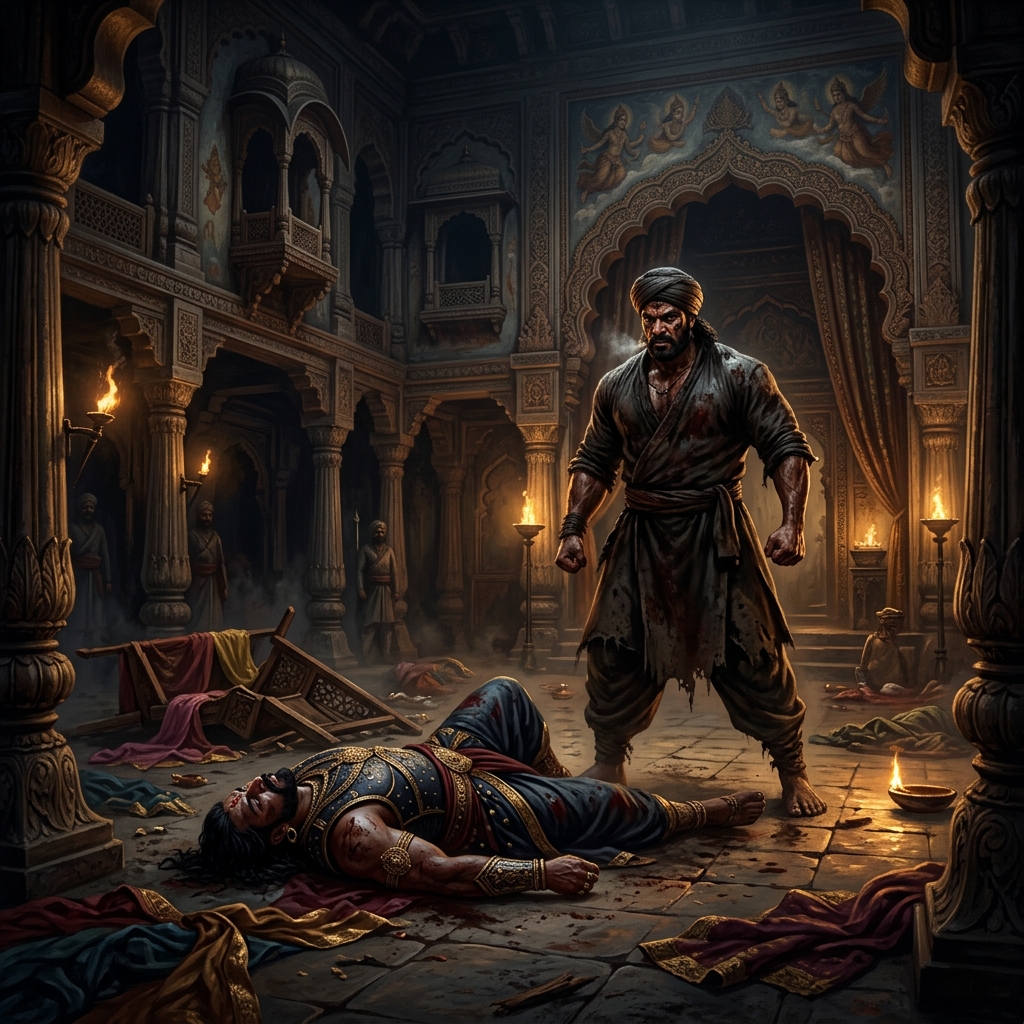
In Disguise at Virata
Twelve years of forest exile had ended, and the hardest year remained. The thirteenth was to be spent in concealment, lived openly among people yet seen by none for who they truly were. If they were discovered in this final year, the whole bitter cycle of banishment would begin again. So the sons of Pandu, who had ruled Indraprastha and humbled kings, agreed to set down their names and bodies of their own choosing and become servants. They chose the kingdom of Virata, a quiet realm of cattle and grain ruled by an aging king of the Matsyas, where strangers came and went and no one looked too closely.
Yudhishthira entered the court as Kanka, a learned brahmana skilled at dice, a companion to amuse the king. Bhima, whose arms could break a chariot, became Vallabha, a cook in the royal kitchens, and let it be known he could wrestle and tame wild beasts for the king's pleasure. Arjuna, the conqueror of heaven's foes, bound up his hair, put on bangles, and became Brihannala, a teacher of dance and song to the women of the palace, hiding the calluses of the bowstring under a eunuch's dress. Nakula took charge of the king's horses, Sahadeva of his cattle.
And Draupadi, who had been born of fire and wed to five kings, bound her dark hair into a single braid, dressed in soiled garments, and presented herself to Queen Sudeshna as Sairandhri, a serving-woman skilled in dressing hair and mixing perfumes. She told the queen that she was a wife of the gandharvas, that five invisible husbands watched over her, and that she would touch no man and eat no leavings. Sudeshna, charmed and a little uneasy at the beauty that even rags could not hide, took her in. For ten months it held. The disguise was good, the work was done, and no one guessed that beggars at the gate were emperors.
The Return of Kichaka
The peace of those months broke on the day Kichaka came home. He was the brother of Queen Sudeshna and the commander of all the armies of Virata, and though the crown sat on the old king's head, the strength of the kingdom sat in Kichaka's arm. He had subdued the Matsyas' enemies, held back the Trigartas, and made the realm safe, and he knew it. The king feared him a little, the people feared him much, and Kichaka feared nothing. He walked through the palace as if it were his own, and in many ways it was.
Returning to his sister's apartments to pay his respects, he saw, standing behind the queen with a comb in her hand, a woman whose beauty stopped him where he stood. The plain dress, the single braid, the lowered eyes - none of it mattered. To Kichaka she seemed a goddess strayed into a mortal house, and the sight of her set a fire in him that he made no effort to govern.
He turned to Sudeshna and asked, not softly, who this woman was, where she had come from, and why he had never seen her before. "She has stolen my heart," he said, as though that settled the matter. "Tell me her name." The queen, hearing the tone she knew too well in her brother, felt a flicker of dread. "She is Sairandhri," she answered carefully, "a serving-woman who tends my hair. She is a wife of gandharvas, and you would do well to leave her alone." But Kichaka had already stopped listening. A man who had never been refused anything could not imagine being refused now.
The Harassment Begins
Kichaka began to court Sairandhri the only way he knew, which was to press and press until resistance gave way. He found reasons to cross her path, lavished her with smooth words and the promise of every comfort. "What is this drudgery to a woman like you?" he murmured. "Become mine, and you shall have silks, ornaments, a house of your own, servants of your own. Why carry water and dress another woman's hair when you could be a queen in all but name?"
Draupadi met him with the cold dignity that had not deserted her even through exile. "I am a married woman, and not your equal in birth," she told him plainly. "It is shameful for you to desire another man's wife. My husbands are gandharvas, swift and terrible. They watch over me unseen. Provoke them, and you will not survive the night. Turn your eyes elsewhere, before you destroy yourself." The warning would have frightened a wiser man. It only inflamed Kichaka, who took her refusals as a game of pursuit and her fear as proof of feeling she would not confess.
Day after day the harassment continued. Sairandhri began to dread the corridors of the palace, to move quickly, to keep to crowded rooms. She said nothing to her husbands, for what could the cook and the dance-teacher do without throwing away the year they had nearly survived? She carried it alone, as she had carried so much, and prayed that Kichaka's appetite would tire of a woman who gave him nothing. It did not. Appetite of that kind, denied, only grows teeth.
The Queen Is Persuaded
When his own efforts failed, Kichaka went to the one person who could open a door for him. He came to Sudeshna and laid himself bare, half threat and half plea. "Sister, I am dying of this longing," he said. "Sairandhri will not so much as look at me. You are her mistress; she must obey you. Find me a way to be alone with her, or you will lose a brother to grief." He spoke of the wealth he had won for the realm, the battles fought, the safety he had given them all, as though these were a coin with which a woman's body might be purchased.
Sudeshna was caught between two fears. She knew, better than most, what kind of woman Sairandhri was, and she half believed the talk of gandharva husbands and the danger that hung about her. But she also knew her brother, the prop of the throne, a man whose displeasure no one in Virata could afford. To refuse him outright was to make an enemy of the kingdom's strong right arm. So she yielded, and in yielding became part of the trap.
"On a feast day soon," she told him, "I will send her to your house to fetch wine for me. Spirits will be flowing, the corridors will be empty. When she comes, she will be alone, and the rest is yours." It was a betrayal dressed as a small errand. Sudeshna told herself it was nothing, only a cup of wine carried from one room to another. She did not let herself think past that, because thinking past it would have shown her clearly what she had agreed to do to a woman who had served her faithfully and asked only to be left in peace.
Sent to His Chamber
The feast day came, and with it the queen's command. "Sairandhri," Sudeshna said, not meeting her eyes, "go to my brother Kichaka's house and bring me the fine wine he keeps. I am thirsty for it, and only you can be trusted to carry it without spilling." Draupadi understood at once what was being asked and what waited at the end of the errand. She trembled and begged to be excused. "Send anyone but me, my queen. You know how he looks at me. He will not let me leave that house. Have mercy and choose another."
But Sudeshna had hardened herself and would not be moved. "He is my brother," she said. "He means you no harm. Go, and do not shame me by refusing." There was no door left open. To refuse a direct order would have invited questions about who this servant truly was, who dared defy a queen. So Draupadi, with a prayer to the sun and to the gods she still trusted, set out for Kichaka's house, walking like one going to her own execution and clinging to the hope that her unseen husbands, in whatever form, would not abandon her.
Kichaka was waiting. He had dressed his rooms with wine and garlands and dismissed his servants, and when she entered he could barely contain his triumph. He came toward her with open arms and honeyed words, promising her the world, telling her the wine was a pretext they both understood. She held the empty pitcher between them like a shield. "I have come for wine, on the queen's order, nothing more," she said, her voice steady though her heart hammered. "Stand aside and let me serve my mistress." But the time for words had passed, and Kichaka was not a man to be served when he wanted to be loved.
The Kick in the Court
When she turned to flee, Kichaka seized her by the garment. Draupadi tore free, leaving the cloth in his grip, and ran. She ran from his house out into the open, toward the king's assembly hall where the court sat and Virata himself presided, hoping that in the sight of so many witnesses even Kichaka would not dare lay hands on her. But he ran her down before she reached safety. In full view of the assembled nobles he caught her by the hair, threw her to the ground, and kicked her before them all.
The hall fell silent. There, among the courtiers, sat Yudhishthira in his brahmana's dress, watching his queen, the daughter of Drupada, struck down in the dust by a brute. There in his thoughts was Bhima, who would have killed Kichaka with a single blow. But to move was to be unmasked, and to be unmasked was to forfeit everything they had endured for thirteen years and condemn them all to begin again. Yudhishthira's face was a mask of stone, and only the slightest hardening of his eyes betrayed the war inside him.
From the back of the hall Bhima was already rising, his hand reaching for a tree he could uproot and turn into a club. Across the room, Yudhishthira caught his eye and held it. A single look passed between them, cold and commanding, and it carried a whole speech: not now, not here, not yet. Bhima froze, his whole frame shaking with the effort of stillness, and sank back. Draupadi, lifting her face from the floor, looked to the king and to her husband Kanka and cried out for justice. Virata murmured that the quarrel was not one he understood and would be settled later; the courtiers looked away. No hand was raised for her. She gathered herself from the dust, and in that humiliation the seed of Kichaka's death was planted.
Draupadi's Night Appeal
That night, when the palace slept, Draupadi rose and went to the royal kitchens where Bhima lay. She would not weep before the court, but here, in the dark, before the one husband whose strength matched her grief, the tears came. She woke him and poured out everything: the harassment, the queen's betrayal, the wine that was no wine, the hands in her hair, the kick before the assembly while her own husbands sat and did nothing.
"Of what use is your strength," she demanded, her voice fierce and low, "if a wretch like Kichaka can drag me by the hair and kick me in open court while you watch and chew your food? I who was an empress now carry water and grind sandal-paste for another woman, and still I am not safe. How long must I suffer this? I would rather drink poison than live another day to be touched by that man." Each word fell on Bhima like a lash, and he took her hands and pressed them to his face, weeping with her, ashamed of the silence the disguise had forced on him.
"Forgive us," he said. "Forgive me. I swear to you it ends now. Wipe your tears and do exactly as I tell you, and Kichaka will trouble you no more." Then he laid out the plan, soft and careful, so that no listening ear would catch it. "Go to Kichaka tomorrow. Hide your loathing. Tell him you have changed your mind, that you will meet him alone, by night, in the dancing-hall, the great hall where the women practice, which stands empty after dark. Tell him to come there, secretly, without a soul knowing, and you will be his. He will come running. But it will not be you who waits for him on that couch. It will be me."
The Lure
When morning came, Draupadi found Kichaka and forced herself to play the part. She lowered her eyes, softened her voice, and let a reluctant warmth into it. "You have pursued me without rest," she said, "and a woman's heart is not stone forever. But I am surrounded by eyes. My gandharva husbands watch, the queen watches, the court whispers. If we are to meet, it must be in perfect secrecy."
Kichaka, hardly able to believe his fortune, swore to whatever she asked. "Name the place," he said. "Name the hour. No one will know." Draupadi named them. "The dancing-hall, where the women learn their steps. It is deserted after the lamps are out. Come there alone tonight, late, telling no one - not a servant, not your sister, not a friend. If even one person learns of it, my husbands will know, and there will be no second meeting for either of us. Come quietly, and come unarmed, and I will be waiting."
He agreed to every condition, blind with desire and convinced that the long chase was over. All day he prepared himself, bathing and perfuming and dressing in his finest, boasting to no one because she had bound him to secrecy, which suited the plan perfectly. He counted the hours like a boy. And as the sun went down, Bhima slipped from the kitchen and made his way to the dancing-hall, and lay down upon the couch where the dancer should have been, and drew a cloth over his great body, and waited in the dark with the patience of a hunter who knows the prey is already walking into the snare.
In the Dancing-Hall
Deep in the night Kichaka came. The hall was black, the lamps long dead, and he entered softly, his heart pounding with triumph. He saw the shape of a body on the couch, covered, still, and took it for the woman he had hunted so long. "O lovely Sairandhri," he whispered, sinking down beside the figure, his hands reaching out greedily, "I knew you would come to your senses. There is no one in all this kingdom to compare with me. From this night you shall want for nothing."
His hand found a shoulder broad as a doorway, an arm hard as a beam of oak. In the instant his fingers closed on muscle no woman ever wore, the covered figure surged upright and flung off the cloth. "You speak of a woman," said a voice like a landslide in the dark, "but it is a man who has been waiting for you. I am the Sairandhri you sought. Embrace me, then, if you can." It was Bhima, son of the Wind, risen to his full and terrible height in the blackness of the hall.
Kichaka, for all his terror, was no coward and no weakling. He was the strongest warrior of the Matsyas, a champion wrestler who had never been thrown. He answered Bhima's challenge and the two of them came together in the dark like two bull elephants, grappling and heaving, locked arm to arm. They tore at each other, hurled each other against the pillars until the great hall shook, fought without a single shout that might bring witnesses, two giants wrestling in silence and darkness with nothing between them but hatred and strength. For a while Kichaka held; he was mighty, and his fury matched his fear. But he was matched against the divine strength of the son of Vayu, and against a man whose patience of thirteen years had all come due in a single night.
Crushed to a Shapeless Mass
Bhima felt the moment Kichaka began to fail, the strength leaking out of those great arms, and he closed in for the end. He caught the commander in a grip there was no breaking, drove him down, and set a knee against his spine. Kichaka strained and bellowed in a half-strangled whisper, but the iron arms only tightened, and his ribs began to crack like green wood.
"This is for the kick you gave a queen before the court," Bhima breathed into his ear. "This is for the hands you laid on a woman who told you again and again to let her be." Then, with a final surge of that wind-born strength, he broke the commander utterly. He pressed Kichaka's head down into his body, drove his arms and legs and neck back into the trunk, and pounded the great frame again and again until there was no shape left to it at all - no arms, no legs, no face that any man could name. He left him a rounded ball of flesh and shattered bone, a thing without form, so that whoever found it in the morning would not even be sure what it had once been.
Then Bhima rose, breathing hard, and called softly for Draupadi, who had kept watch nearby. "It is done," he told her. "Come and look on the man who insulted you. He will never trouble you, nor any woman, again." She came and looked at the heap that had been Kichaka, and the long terror of those months loosened in her at last. Bhima washed himself, slipped back through the sleeping palace to his kitchen, and lay down as though nothing in the world had happened, while Draupadi returned quietly to her quarters with the first easy breath she had drawn in a very long time.
The Pyre and the Upakichakas
At dawn the dancing-hall was opened, and the servants who entered fled screaming. On the floor lay a thing of horror, a mound of crushed flesh with neither limbs nor head, and only by his garments and ornaments could they tell that this had been Kichaka, the commander of the king's armies. Terror ran through the palace. No mortal man, they whispered, could have done this; it was the work of demons, or of the gandharva husbands Sairandhri had always warned them about. The strongest warrior in the kingdom had been folded into a ball like wet clay.
Kichaka's kinsmen, the Upakichakas, came to mourn him and to carry his body to the burning-ground. There they saw Sairandhri standing nearby, and their grief turned to rage. "It is this woman who brought death on him," they cried. "Her unseen husbands killed our kinsman for her sake. Let her burn with him, then, on his pyre, and follow him into the fire she made for him." They seized Draupadi, bound her, and set her upon the bier beside the broken corpse to be burned alive, and carried her toward the flames while she cried out for her husbands to save her.
Her cry reached the kitchens. Bhima heard it and did not pause to count the odds or to think of disguise. He leaped over the palace wall, tore a great tree out of the earth by its roots, stripped it of its branches as he ran, and fell upon the Upakichakas like a storm. They were many, but he scattered them, struck them down where they stood, freed Draupadi from the bier and faced the rest. The kinsmen who had meant to burn her now ran from him, and those who did not run he killed, one hundred and five of them by the old count, until the burning-ground was littered with the dead and the fire stood unfed. He cut Draupadi loose, told her gently to go back and have no fear, and vanished into the palace again before the rest of the city could gather and see who their gandharva had been.
Suspicion at the Court
The slaughter shook Virata to its foundations. In a single night and morning, the commander of the army and a hundred of his kinsmen had been destroyed, and no one had seen the hand that did it. The people came to King Virata in fear and begged him to send Sairandhri away, for wherever this woman went, death followed her, and her invisible husbands would unmake the whole kingdom if she stayed. The king, shaken and unwilling to anger powers he could not see, sent word through the queen that the servant should leave.
Draupadi asked only for a little time. "Let me stay a few days more," she told Sudeshna, "and my husbands will reward you and the king for your kindness, and the danger will pass." The queen, who had had her own part in beginning all of this and was now half terrified of the woman she had wronged, granted it without argument. So Sairandhri remained, no longer harassed, no longer dragged through the corridors, suddenly a person whom everyone in the palace took the greatest care never to offend.
But a quieter thing had begun to stir at court. Thoughtful men weighed what they had seen. A serving-woman of unearthly beauty; a cook of impossible strength who could break a champion to pulp and uproot trees; a brahmana dice-companion of royal bearing; a dance-teacher whose hands knew more than dance. They had heard, too, of five Pandavas hidden somewhere in the world, men of exactly such gifts, men whose enemies were hunting them through this very year of concealment. No one dared yet to say the names aloud. But the suspicion was awake now and would not sleep, that the gods of the dancing-hall were no gandharvas at all, and that the wandering emperors of Indraprastha had been living, all this while, as servants in the house of Virata.
Dharma Lesson
Even in the most difficult circumstances, one must stand up against injustice and harassment. Bhima and Draupadi's actions demonstrate that while patience is a virtue, there is a limit to how much humiliation one should endure. Protecting the dignity of the innocent is a primary duty that transcends even the need for secrecy.
Common Questions
Who killed Kichaka and how?
Bhima, disguised as the cook Vallabha. Draupadi arranged a night meeting in the dance hall as though yielding to Kichaka's advances; Bhima waited there in her place and crushed the general with his bare hands, pounding the body into a shapeless mass so no weapon or technique could identify the killer.
Why did Kichaka have to die?
Kichaka, the queen's brother and Virata's commander, harassed Draupadi and kicked her in open court while the king said nothing. Yudhishthira could not act without breaking their disguise. Bhima killed him to protect her dignity, accepting the risk of discovery rather than letting the abuse continue.
What happened after Kichaka's death?
His kinsmen blamed Sairandhri and tried to burn her on his pyre, and Bhima intervened again, killing them as a supposed gandharva. The loss of Kichaka left Matsya without its strongest defender, which is precisely why Duryodhana chose that moment to raid Virata's cattle.
Did the Kichaka episode expose the Pandavas?
Not conclusively, but it aroused suspicion. Duryodhana's spies reported that an unarmed man had killed the strongest wrestler in the land, and Duryodhana reasoned that only Bhima could have done it. The raid on Matsya's cattle was partly a way of testing that guess.