The Brahmin's Lost Fire
In the twelfth year of the forest exile, the Pandavas had wandered from the woods of Kamyaka into the deep green silence of Dvaitavana, living on roots and fruit, sleeping on the bare earth, and counting the slow turn of the seasons that still kept them from their kingdom. The hardship had not broken them, but it had worn them thin, and each of them carried the quiet ache of injustice like a stone in the chest.
One afternoon the calm of the hermitage was shattered by the arrival of a Brahmin, breathless and trembling, who came running to Yudhishthira with his hands raised in distress. He told a strange story. He had hung his fire-sticks, the sacred arani used to kindle the flame for the Agnihotra sacrifice, upon a tree, together with the wooden churning rod. A deer, wild and swift, had come bounding through the grove. As it scratched its body against the tree, the fire-sticks had caught fast in its antlers, and the startled animal had leapt away into the forest, carrying the precious instruments of worship upon its head.
"Without the arani I cannot light the holy fire," the Brahmin pleaded. "My daily rites will fail, and the merit of years will be lost. You are Kshatriyas, protectors of the helpless and guardians of dharma. I beg you - recover my fire-sticks before that deer is gone forever."
Yudhishthira rose at once. To shield a Brahmin and to uphold the rituals that sustained the world was a duty no son of Pandu could refuse. He called his four brothers, and the five of them took up their bows and set off after the deer, following the faint prints it had left in the soft soil of Dvaitavana.
The Deer That Could Not Be Caught
The chase led them deeper into the forest than any of them expected. The deer was no ordinary beast. It moved with a speed that mocked their skill, appearing just within bowshot, lingering as if it would let itself be taken, and then vanishing between the trees the instant an arrow left the string. Arjuna loosed shaft after shaft from the Gandiva, and not one found its mark. Nakula and Sahadeva flanked it, Bhima crashed through the undergrowth to cut it off, and still the creature slipped away, light as a shadow and just as impossible to hold.
Hour after hour the pursuit dragged on under the climbing heat. The sun beat down through the canopy, the air grew thick and still, and the five brothers, who had crossed battlefields and humbled kings, found themselves stumbling after a single deer like exhausted children. At last the animal led them into a remote and trackless part of the woods and was simply gone, leaving no trail and no sound.
The brothers halted, chests heaving, their throats raw and their bodies streaked with dust and sweat. They had run themselves to the edge of collapse. Defeated and humiliated, they sank down in the shade of a spreading banyan tree, too tired even to speak for a while.
"We have failed," Nakula said bitterly, breaking the silence. "We who once ruled the earth from Indraprastha cannot run down one deer to help a single Brahmin. How low we have fallen." His words hung in the heavy air, and not one of his brothers could answer them.
The Question of Suffering
It was Nakula again who gave voice to the deeper grief. "Tell me, brother," he said, turning to Yudhishthira, "we have never strayed from virtue. We have spoken no lie, harmed no innocent, neglected no duty. Why then does sorrow pursue us so relentlessly? Why does calamity follow calamity upon men who keep to the path of righteousness?"
Yudhishthira, even in his exhaustion, answered with the calm that never left him. "There is no fixed boundary to misfortune, brother, and no man can name the single cause of his suffering. Calamity does not come because we have sinned, nor does it stay away because we are pure. The wise know that joy and grief, gain and loss, turn upon us like the spokes of a wheel, and a steady soul must bear both without losing himself. Brooding upon the reason will not slake our thirst. Let us first find water, for our bodies are failing, and then we may speak of dharma."
He lifted his eyes to the tall trees around them. "Nakula, you are nimble. Climb to the top of that tree and look in every direction. Search for water - a river, a pool, anything green that grows where water gathers. Listen for the birds that nest near lakes. Then come and tell us where to go."
Nakula nodded and pulled himself up the trunk, branch by branch, until he stood high above the forest, scanning the endless rolling sea of leaves for any glimmer of relief.
The Voice by the Lake
From his high perch Nakula saw it - a stretch of darker green where water plants grew thick, and the wheeling shapes of cranes that haunt the edges of still pools. "There is water, brother," he called down. "I see the marks of it, and the birds that love it." Yudhishthira sent him at once to fetch some, telling him to fill their quivers and water-vessels for all.
Nakula made his way to the place and came upon a lake so clear and lovely it seemed a fragment of heaven set down upon the earth. The water was bright as crystal, fringed with lotus and lined with cool green reeds, and to a man dying of thirst it was the most beautiful sight in the world. He ran to the bank and bent to drink.
But as his cupped hands neared the water, a voice rang out from the air around him, deep and resonant and stern, with no body to be seen. "Stop. Do not act rashly. This lake is mine. First answer my questions, O son of Madri, and only then may you drink your fill."
Nakula's throat was on fire, and his pride and his thirst together made him deaf to the warning. What was an unseen voice to a prince of the Kuru house? He plunged his hands into the cool water and drank deeply. The instant it touched his lips the strength went out of him. He swayed, his eyes dimmed, and he fell upon the bank like a felled tree, lifeless beside the very water he had longed for.
Four Brothers Fallen
When Nakula did not return, Yudhishthira grew uneasy and sent Sahadeva to find his twin. Sahadeva followed the same path, came upon the same shining lake, and saw his brother lying still upon the bank. Grief and dread filled him, but his thirst was greater, and when he stooped to drink the same voice forbade him. "Answer my questions, son of Madri, before you touch this water." Sahadeva, like his twin, could not bear the warning of an unseen power, and he too drank, and he too fell dead beside Nakula.
Uneasy now and fearful, Yudhishthira sent Arjuna, the unconquered, the wielder of the Gandiva. Arjuna reached the lake and found his brothers, the sons of Madri, lying dead upon the shore with no wound upon them. Rage and sorrow seized him. When the voice spoke its command, Arjuna answered with arrows, loosing a storm of shafts in every direction to strike the unseen speaker. But the voice only laughed. "Words, not arrows, will win you this water, son of Kunti. Answer first, and then drink. Drink before you answer, and you die." Burning with thirst and fury, Arjuna ignored the warning and drank, and the greatest archer in the world sank down beside his cousins.
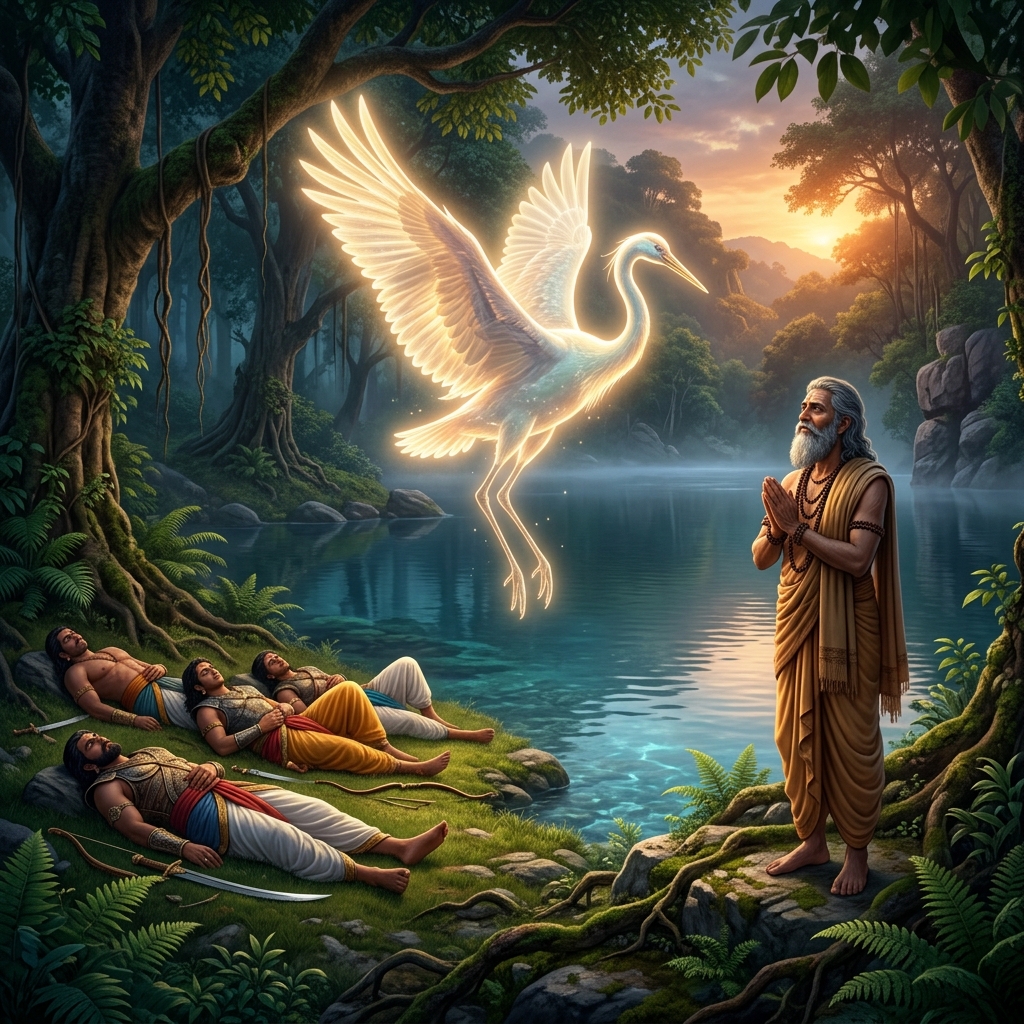
Last went Bhima, mighty Bhima, when none of the others came back. He found the three of them fallen and knew at once that some powerful Yaksha or god had done this. Resolving to drink first and avenge them after, he too heard the voice forbid him, and he too, trusting in the strength of his arms above all warnings, set his lips to the water. And Bhima, who had no equal in the strength of his body, fell senseless among his brothers, the four of them lying together upon the cool green bank in the deepening gold of the evening light.
Yudhishthira at the Water
When not one of his four brothers returned, a cold fear settled over Yudhishthira, and he rose and went to find them himself. The forest was silent as he walked, and the lowering sun threw long shadows across his path. At last he came to the lake, and there the sight that met him struck him like a blow to the heart.
His four brothers lay strewn upon the bank like fallen mountains - Bhima whose strength had shaken kingdoms, Arjuna who had humbled gods, the gentle twins Nakula and Sahadeva. They did not stir. Yudhishthira fell to his knees and wept aloud, his composure broken at last. These were the men with whom he had sworn to win back the world, the brothers who had shared every hardship of the exile, and now they lay dead before they had ever tasted victory.
But grief did not blind his reason. As his weeping eased, the king looked more carefully at the bodies, and a deep strangeness came over him. There were no wounds upon his brothers, no sign of struggle, no mark of beast or weapon. Their faces were calm. And the lake itself lay undisturbed, its water clear and bright, the lotuses unbroken. No army had passed here. No animal had dragged them down.
"This is no common death," he murmured, rising slowly to his feet. "No mortal hand has done this. Some power guards this water, some being beyond the world of men. I must be careful here." He stepped toward the shining lake, his senses sharpened by sorrow, ready for whatever dwelt within it.
The Yaksha Reveals Himself
As Yudhishthira approached the bank, the voice came again, no longer disembodied. Above the still water there rose a form vast and terrible to behold - a Yaksha, a spirit of the wild places, towering and strange, with eyes that burned and a presence that made the very air tremble. He had taken the shape of a great crane upon the lake, the guardian of its waters, and now he spoke directly to the king.
"I am the master of this lake," the Yaksha declared. "It was I who struck down your brothers, for they were rash and proud. Each of them I warned, and each of them scorned the warning and drank, and so each of them died. Do not follow them, O King of Justice. This water is mine, and no man drinks of it until he has answered what I ask. Answer my questions, and then you may drink and live."
Yudhishthira did not rage as Arjuna had, nor reach for a weapon. He bowed his head before the great being with folded hands. "I do not seek to take what is yours, O mighty one," he said quietly. "I covet nothing that belongs to another. Ask me your questions, and I shall answer them as far as my understanding reaches. Such is the duty of a guest before the lord of a place."
The Yaksha regarded him with those burning eyes, and something in the king's calm and his courtesy seemed to please the spirit. "Well spoken," he said. "Then let us begin. Answer truly, son of Pandu, for your life and the lives of your brothers hang upon your words."
The Riddles of Dharma
Then the Yaksha unloosed a torrent of questions, swift and searching, that ranged across the whole of life and law and the hidden nature of things. Yudhishthira answered each without pause, his voice steady in the fading light.
"What is heavier than the earth?" asked the Yaksha. "What is higher than the heavens, swifter than the wind, more numerous than the blades of grass?" Yudhishthira answered, "A mother is heavier than the earth. A father is higher than the heavens. The mind is swifter than the wind. And our cares and anxieties are more numerous than the blades of grass."
"Who is the traveler's friend?" the Yaksha pressed on. "Who is the friend of the one who stays at home, of the sick man, of the dying?" The king replied, "The companion on the road is the traveler's friend. The wife is the friend of the householder. The physician is the friend of the sick. And charity, the gift given freely, is the friend of the dying man."
The Yaksha asked, "By renouncing what does a man become beloved? By renouncing what does he never grieve, become wealthy, become happy?" Yudhishthira answered, "By renouncing pride a man becomes beloved. By renouncing anger he ceases to grieve. By renouncing desire he becomes wealthy. And by renouncing greed he becomes happy."
Question followed question, and answer followed answer, the spirit probing ever deeper into the soul of the king, and Yudhishthira, weary and grieving though he was, met each one with a clarity that did not waver.
The Greatest Wonder
At last the Yaksha came to the questions that cut nearest to the heart of things, and a hush seemed to fall upon the forest as he asked them.
"Tell me, O King," said the Yaksha, "what is the greatest wonder in all the world?" Yudhishthira answered without hesitation, and his words have echoed down the ages. "Day after day countless living beings pass into the abode of Death, and yet those who remain behind believe themselves immortal and live as though they will never die. What greater wonder is there than this?"
The Yaksha asked, "What makes a man a true Brahmin - is it birth, or learning, or conduct? Tell me with certainty." Yudhishthira replied, "It is neither birth nor scripture nor learning that makes one a Brahmin. It is conduct alone. A man of noble character, however he is born, is a Brahmin; and one of vile conduct, though learned in every scripture, is no Brahmin at all. Character is the measure."
"And what," asked the Yaksha, "is the true path that a man should follow? The scriptures differ, the sages disagree, and reason alone gives no sure footing. How shall a man know the way?" Yudhishthira bowed his head and answered, "Argument leads to no certainty, and the scriptures are many and divided. The truth of dharma lies hidden in the cave of the heart. The true path is simply this - the way trodden by the great and the good. Follow where the noble have walked, and you will not go astray."
The terrible form of the Yaksha softened as he listened, and a gentle radiance began to gather about him, as if the answers themselves had kindled a light in the gathering dusk.
The Choice of Nakula
When the long questioning was done, the Yaksha looked upon Yudhishthira with something close to wonder. "O King, you have answered all that I have asked, truly and without fault. I am well pleased with you. Therefore I will grant you a boon. One of your fallen brothers shall I restore to life - choose which of the four you would have rise again."
Yudhishthira did not hesitate. "Let Nakula live," he said. "Let the son of Madri rise."
The Yaksha was astonished. "Nakula? Why Nakula, O King? Bhima has the strength of ten thousand elephants and is the very arm of your defense. Arjuna's skill in arms is the hope upon which your whole kingdom rests. Either of them would serve you a hundred times more than this stepbrother of yours. Why pass over your own true brothers, the sons of your own mother, to save the son of your father's other wife?"
Yudhishthira folded his hands and answered with quiet conviction. "O great one, dharma is the only shield a man truly has, and to abandon it for advantage is to abandon oneself. My father Pandu had two wives, Kunti and Madri, and to me both are mothers and both are equal. I, a son of Kunti, am alive, and so Kunti is not left wholly childless. But Madri has no living son if Nakula is not restored. That her line should perish while mine endures would be a failure of justice. So that both my mothers may each have a living son, let Nakula rise. I will not let the scales of fairness fall, not even to keep my mightiest brothers."
Dharma's True Form
At this the Yaksha laughed aloud, and it was a sound of pure delight that rolled through the trees like the first thunder of rain after a long drought. "O Yudhishthira," he cried, "in choosing thus you have chosen rightly beyond all measure. You set even-handed justice above your own strength and your own blood. There is no impartiality higher than this. Because your love of fairness is so perfect that it spares not even your own advantage, I will not give you one brother only. Behold, I give you all four."
With those words the dreadful shape upon the water dissolved, and in its place there stood revealed a form of surpassing majesty. The Yaksha had been no mere spirit of the lake. He was Dharma himself, the very Lord of Righteousness, who is also Yama the just judge of the dead - and he was Yudhishthira's own divine father, from whom the king had taken his birth and his nature.
"My son," said Dharma gently, "it was I who took the form of the deer that carried off the Brahmin's fire-sticks, and I who became this Yaksha of the lake. I did all this only to test you, to see whether the son I had given the world was worthy of his name. And you have not failed me. Your devotion to truth and justice is without flaw." He passed his hand over the still forms upon the bank, and at his touch Bhima, Arjuna, Nakula, and Sahadeva stirred and sat up, whole and refreshed, as though they had merely woken from a deep and pleasant sleep, with no memory of having died.
The Boon for the Year Unseen
The brothers gathered around their father with bowed heads, full of awe, and the Brahmin's fire-sticks were returned, so that the holy rites that had set the whole adventure in motion might continue unbroken. But before he departed, Dharma had more to give, for he knew the trial that still lay ahead of his sons.
"You have endured twelve years in the forest," Dharma said, "and now the thirteenth year approaches, the year in which you must live among men unrecognized, for if you are discovered the whole term of exile begins again. Ask of me what you will, and I shall grant it to aid you in that hidden year."
Yudhishthira asked for steadfastness in dharma, that they might never be turned from the right path by anger or fear or desire. Dharma granted it gladly, and added a boon of his own choosing that touched their immediate need. "Through this coming year," he said, "none of you shall be known, however near you stand to those who seek you. Disguise will hold, and the eyes of your enemies will pass over you as if you were strangers. Live without fear of discovery, and pass your thirteenth year in peace."
Then Dharma blessed his sons and vanished from sight, and the five Pandavas stood alone again by the quiet lake in the last light of evening. They returned the arani to the grateful Brahmin and made their way back through Dvaitavana toward their hermitage, their thirst long forgotten. They had set out chasing a deer and had instead been weighed in the balance of the Lord of Justice himself - and had not been found wanting. Strengthened in spirit and armed with a boon that would carry them through the perilous year to come, they walked on into the dusk, ready at last for the final trial of their long exile.
Dharma Lesson
True wisdom is knowing that life is temporary, yet living with absolute adherence to justice. Yudhishthira's choice to save his stepbrother Nakula over his mighty brothers Bhima and Arjuna demonstrates that true Dharma is impartial. It places righteousness and fairness above personal attachment and strategic advantage.