The Eve of Battle
Last Embassies Before Kurukshetra
The Last Embassy Fails
When the thirteen years of exile and the year of concealment had been served in full, the Pandavas asked only for what was theirs: the kingdom of Indraprastha, or some honorable portion of the ancestral land. Duryodhana answered that he would not yield to them so much as the point of a needle could cover, not without war. Yet Yudhishthira, who hated the very thought of slaying his elders and cousins, made one final effort. He sent Krishna himself to Hastinapur as envoy, reasoning that if Krishna could not prevent the war, then no living being could.
Krishna rode into the old Kuru capital and would not be flattered by Duryodhana's lavish welcome. He refused the prince's banquet and took his meal instead in the humble house of Vidura, saying that food given in love nourishes, while food given in pride does not. The next morning he entered the great assembly hall, where the blind king Dhritarashtra sat among Bhishma, Drona, Kripa, and the gathered Kuru elders.
There Krishna pleaded for peace with a patience that astonished all who heard it. He asked at last for almost nothing: let the Pandavas have only five villages, one for each brother, and the rest of the empire would remain Duryodhana's. Bhishma urged the prince to accept. Drona urged it. Vidura urged it. Dhritarashtra wept and urged it. But Duryodhana rose in fury and swore again that not a needle's point of earth would the sons of Pandu receive while he drew breath.
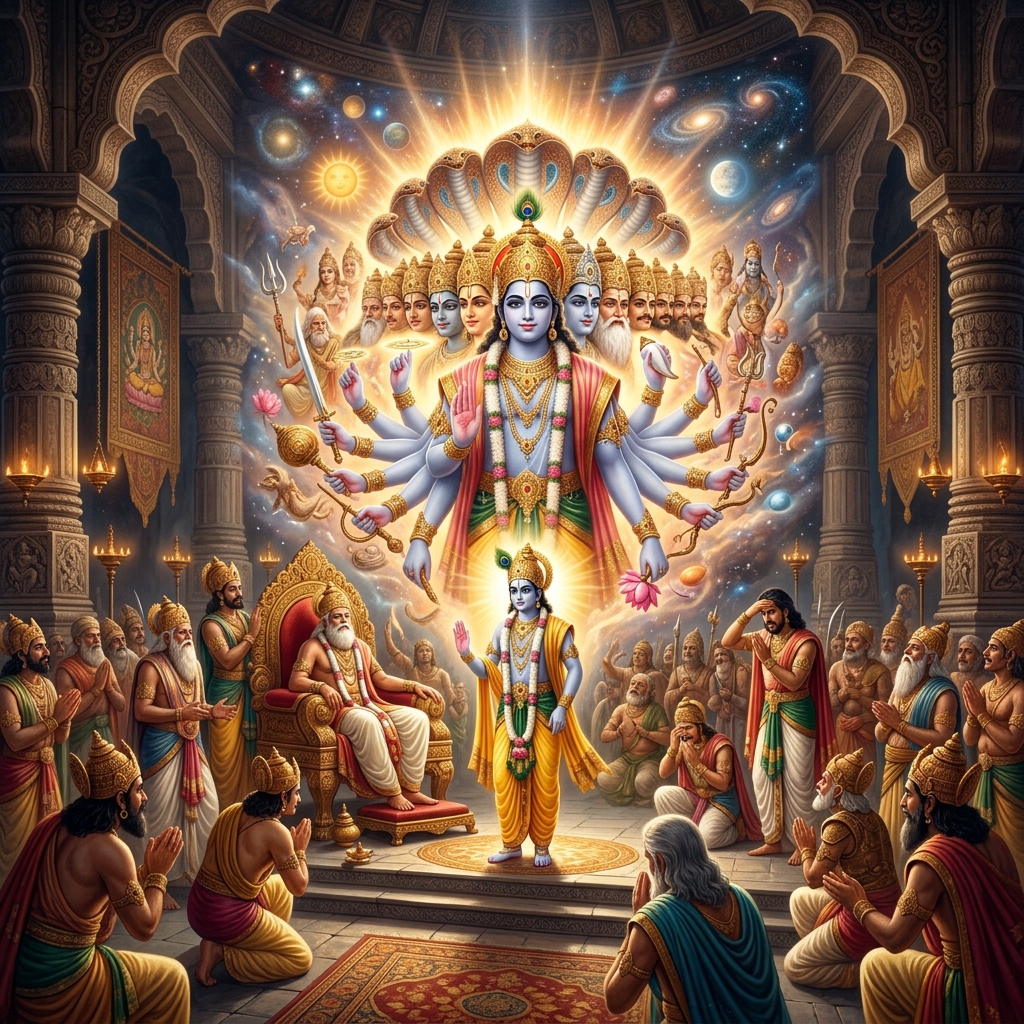
Worse, Duryodhana had laid a trap: he meant to seize Krishna in the hall and bind him, thinking that without Krishna the Pandavas were as good as beaten. When the signal was given and the guards advanced, Krishna laughed and revealed his cosmic form, blazing with the light of a thousand suns, until the whole court fell back in terror and even Bhishma covered his eyes. Then he resumed his human shape, refused Duryodhana even a cup of parting water, and walked out. The embassy had failed. War was now certain, and both sides turned their faces toward the wide plain of Kurukshetra.
Gathering the Kings of the Earth
With peace dead, both cousins sent riders to every corner of Bharatavarsha, and the kings of the earth made their choices. Old alliances, old marriages, old debts, and old fears all came due at once. Some princes followed their conscience, some their kinship, and some merely the side that asked them first.
Duryodhana, by an old cleverness, had once secured Krishna's vast Narayani army of herdsmen-warriors for himself, while Arjuna, choosing Krishna alone and unarmed as his charioteer, had let the army go to the enemy. So the Vrishni soldiers marched under the Kaurava banner, though Krishna's own counsel went to the Pandavas. Shalya, the king of Madra and uncle to Nakula and Sahadeva, set out meaning to join his nephews, but Duryodhana met him on the road with such honor and feasting that Shalya, bound by the courtesy he had unknowingly accepted, was shamed into fighting for the Kauravas instead.
To Duryodhana came eleven akshauhinis: the mighty Bhishma, grandsire of them all; Drona the teacher with his son Ashwatthama; Kripa the immortal; Karna, dearest of Duryodhana's friends; Jayadratha of the Sindhus; Bhagadatta of the east with his war-elephant; Kritavarma of the Vrishnis; and a host of lesser kings besides.
To Yudhishthira came seven akshauhinis: Drupada of Panchala with his sons Dhrishtadyumna and Shikhandi; Virata of the Matsyas, in whose court they had hidden; Satyaki the Yadava; Ghatotkacha the rakshasa son of Bhima; Abhimanyu, Arjuna's young son; and many faithful chiefs who loved Yudhishthira's righteousness. Eighteen akshauhinis in all gathered, each a sea of foot soldiers, horses, chariots, and elephants in the ancient proportion. No such host had ever assembled in the memory of the world, and the earth itself seemed to groan beneath the weight of so many destined to die upon it.
The Field of the Kurus
The chosen ground was Kurukshetra, the field of the Kurus, a level and sacred plain watered by the Saraswati and hallowed by the rites of ancestors. It was called also Dharmakshetra, the field of righteousness, for kings of old had performed sacrifices there, and it was said that any who died upon that soil, on whichever side, would be carried straight to the worlds of the blessed. Duryodhana and Yudhishthira alike thought this a fitting place to settle the quarrel of a dynasty.
The Pandava host crossed onto the western reaches of the plain and raised their tents, and the Kaurava host spread across the eastern reaches, until the two camps lay within sight of one another, separated only by the open ground where the battle would be joined. Surveyors marked the limits of the field. The smoke of countless cook-fires rose from both encampments and met above the plain like the smoke of a single vast altar.
Water was found and divided, fodder was stacked for the horses and elephants, smiths set up their forges to mend armor and sharpen iron, and the wheelwrights labored over the chariots through the day. Standards and banners were raised over every division so that in the chaos to come each warrior might know his own. Brahmins moved through the camps performing the rites that ready a man to kill and to die. By night the plain was a field of lamps, two glittering cities of cloth and fire facing each other across a darkness that everyone knew would soon be filled with blood.
Veterans walked the lines and felt the strange hush that falls over an army the night before its first battle. The young men boasted to hide their fear; the old men were quiet, having seen war before and knowing what it asked. Above them the stars wheeled on, indifferent, while down on the plain the most terrible host ever gathered waited for the dawn.
The Kauravas Choose Bhishma
An army of eleven akshauhinis could not move as one without a single will to command it, and so Duryodhana came before the gathered kings to name his supreme commander. There was only one choice that all could honor. He went to Bhishma, the grandsire, the son of Ganga and Shantanu, oldest and greatest of all the Kuru line, invincible by his father's boon, unconquered in a lifetime of war.
"You are our root and our refuge," Duryodhana said. "Be our general, as Indra is general of the gods, and lead us to victory." Bhishma agreed, but he set down conditions that troubled the prince even as he accepted them. "I will lead your army and I will fight with all my strength," the old man said. "But know this. The Pandavas are as dear to me as you are. I will slay ten thousand of the enemy host each day, yet I will not kill the five sons of Pandu, for I cannot bring myself to take their lives. And there is one I will not face at all: Shikhandi, the warrior of Drupada's house who was born a woman. Against that one I will not lift a weapon. Accept me with these conditions or choose another."
Then Bhishma spoke a harder word still. "And so long as Karna fights while I command, I shall not draw my bow beside him, nor he beside me, for he has slighted me and I him." At this Karna swore that he would not enter the war at all until Bhishma had fallen, and he withdrew to his tent. Duryodhana, weighing all of it, accepted Bhishma as commander, for no other could hold the host together.
With great ceremony Bhishma was consecrated. The kings poured sacred water over him from golden vessels, conches and drums sounded, and the eleven akshauhinis acknowledged him as their lord. The grandsire took up his white banner bearing the device of a golden palmyra and five stars, and the Kaurava army, vast and bright and confident, had its head.
The Pandavas Choose Dhrishtadyumna
In the western camp, Yudhishthira gathered his own kings to name a commander for the seven akshauhinis. He asked Krishna whom they should choose, and Krishna, with the others, named the warriors fit to lead: Drupada, weighty with years; Virata, lord of the Matsyas; Shikhandi, born to be the death of Bhishma; Satyaki of the Yadavas; and Dhrishtadyumna, son of Drupada, who had risen from the sacrificial fire for one purpose, the slaying of Drona.
It was Dhrishtadyumna whom they chose. He had been born of fire and fate to be the end of the very teacher who had wronged his father, and the army trusted his command. Sahadeva and the others assented; Arjuna lifted his hand for him; and so the prince of Panchala was made supreme commander of the Pandava host.
Krishna himself took no command and bore no weapon, for he had vowed to Duryodhana that he would not fight in this war. He had chosen instead to serve as Arjuna's charioteer, to hold the reins of the white horses while Arjuna held the bow. Those who understood whispered that the Lord of all the worlds had made himself a servant out of love, and that in his hands the reins were worth more than any general's sword.
The Pandavas consecrated Dhrishtadyumna as the Kauravas had consecrated Bhishma, with water and fire and the sound of conches. He surveyed the seven akshauhinis that were now his to wield, smaller than the enemy by four, and he was not dismayed, for righteousness, said Yudhishthira, weighs more in the scale of war than mere numbers, and where Krishna stands, victory has already chosen its house. Yet not a man among them was foolish enough to think the fight would be anything but terrible.
The Rules of War
Before a single arrow flew, the leaders of both armies met upon the open field and bound themselves by the rules of righteous war, for even in the killing of kinsmen there was an order that warriors of dharma would not break. They spoke the covenants aloud so that all might hear and remember.
Fighting would begin only after sunrise and would cease at sunset; in the dark of night there would be no combat, and men of both sides might mingle in peace, tend their wounded, and mourn their dead. A warrior would fight only one of equal kind: chariot against chariot, elephant against elephant, horse against horse, foot soldier against foot soldier. No man would strike one who had turned away in flight, nor one who had surrendered, nor one disarmed or unconscious or weeping or whose weapon had broken.
No one would attack a charioteer, a drummer, a conch-blower, a bearer of standards, or any who carried no weapon and only served behind the lines. None would strike a man engaged with another foe, nor one whose attention was elsewhere. Those who fled would not be pursued and slain. Combat once begun between two warriors would be honored as a duel until it ended.
So they agreed, the grandsire Bhishma and the prince of Panchala and all the kings, and for a moment, swearing to fight cleanly the dirtiest thing that men can do, they seemed almost like brothers again. Every man there knew in his heart that some of these vows would be broken before the eighteen days were done, broken by grief and rage and the cunning of the gods themselves. But on that morning the covenants were spoken in good faith, and the warriors returned to their lines to wait.
Two Hosts Facing
On the morning the war was to begin, the two armies arrayed themselves in their battle formations and the plain of Kurukshetra became a spectacle of dread and splendor such as the world had never seen. From the eastern side rolled the Kaurava sea, eleven akshauhinis deep, and from the western side the Pandava host of seven, and between them lay only a narrowing ribbon of bare ground.
Elephants stood in their hundreds of thousands, painted and armored, with archers and bannermen mounted in towers upon their backs, swaying like dark hills. Chariots without number gleamed in the rising sun, their wheels iron-shod, their poles flying the standards of every kingdom in Bharatavarsha: the golden palmyra of Bhishma, the bull of Drupada, the lion of Duryodhana, and on Arjuna's car the banner of Hanuman, who had come to sit upon it and roar so that the enemy's hearts would fail. The horse-warriors massed in shining squadrons, and behind them the foot soldiers stretched back farther than the eye could follow, a forest of spears.
The noise was the noise of an ocean. Drums and kettledrums thundered, conches bellowed, trumpets brayed, and the whole host shouted as one until the very birds fell from the sky and the earth seemed to tremble. Banners snapped in the wind. The morning light caught a million points of polished iron and turned the field into a plain of fire.
Warriors looked across that narrowing space and saw, in the ranks opposite, the faces they had grown up beside: a grandfather, a teacher, a cousin, an uncle, a childhood friend. The splendor was terrible because everyone could feel the death folded inside it. Brave men who had longed for this day felt their courage curdle into foreboding, and even the boldest fell silent for a moment, looking out at the dreadful beauty of the two greatest armies ever gathered, drawn up to destroy one another.
The Night Before
The last night before the first day was long, and few in either camp slept the sleep of the untroubled. The covenants were sworn, the commanders were chosen, the formations were planned; nothing remained but the dawn, and the dawn would bring slaughter among kinsmen. In the dark the two camps lay like banked fires, and across the plain a man could hear the low murmur of an army that cannot rest.
In the Kaurava tents, Duryodhana walked among his kings, hot with the certainty of victory, counting his eleven akshauhinis against the enemy's seven and Karna's promise to enter the fight the moment Bhishma fell. Yet even he, in the quiet, must have felt the cold edge beneath his confidence. Bhishma lay awake, the grandsire who would lead an army against grandchildren he loved, knowing he must kill many he had cradled and protect five he could not bear to harm. Drona thought of the pupils he had taught to draw a bow, now drawn against him. Karna, sworn out of the early days, lay in his tent and brooded on the slight that had stung his pride.
In the Pandava tents, Bhima sharpened his rage like a blade, longing for the dawn that would let him keep his oaths against Duryodhana and Dushasana. Yudhishthira could not sleep at all, sick at the price of the throne he had never truly wanted, asking himself again whether any kingdom on earth was worth the rivers of kindred blood that tomorrow would spill. The young Abhimanyu burned to prove himself; Dhrishtadyumna turned over his plans for the morning; and Arjuna, the greatest archer of the age, felt creeping into his heart a doubt that no enemy had ever put there.
Across both camps the same thoughts moved from tent to tent: resolve and fear, glory and foreboding, the soldier's hunger for the fight and the man's horror at what the fight would cost. Out on the dark plain the bare ground waited between them, and the night thinned slowly toward the morning that everyone dreaded and no one any longer could prevent.
Yudhishthira Crosses the Field
As the two armies stood arrayed at last, ready to be loosed at one another, the eldest Pandava did a thing that stunned both hosts. Yudhishthira laid down his weapons, took off his armor, joined his palms, and on foot, alone, walked out from his own ranks straight toward the enemy line. The Kaurava warriors thought at first that fear had broken him and that he came to surrender, and they jeered. His own brothers cried out and hurried after him, bewildered, and Krishna alone smiled, for he understood.
Yudhishthira walked through the bristling Kaurava front until he came to Bhishma. He bowed and clasped the old man's feet. "Grandsire," he said, "we wage this unholy war against you. Give us your leave to fight you, and give us your blessing." Bhishma's eyes filled. "Child, had you not come to me thus, I would have cursed you to defeat. Now I bless you. Fight, and may you win. I am bound to the Kauravas by the salt I have eaten and I must fight for them, but my heart is with dharma, which is with you. Ask me a boon." "Tell me," said Yudhishthira, "how you may be conquered, for while you live we cannot prevail." And Bhishma, who longed to lay down the burden of his deathless life, told him: he would not raise his weapon against one who was once a woman, and behind Shikhandi the Pandavas might bring him down.
Yudhishthira went next to Drona and bowed to his teacher's feet. Drona too blessed him and told him the truth: while Drona held his bow no army could defeat him, but if ever he laid that bow down in grief, then he might be slain. Then Yudhishthira came to Kripa, the immortal teacher, who blessed him and wept that he was bound to the wrong side, and last to Shalya, his own kinsman fighting for the foe. Shalya blessed him and made a secret promise: when the day came that Shalya drove Karna's chariot, he would so dishearten Karna with cold words that the great archer's strength would fail at the fatal hour.
Then Yudhishthira walked back across the open ground to his own lines, and he had won something no weapon could win: the blessing of every elder he was about to fight, and from each the secret of his own undoing. The Kaurava warriors who had jeered fell silent, for they had seen righteousness walk unarmed through a forest of spears and come away unharmed and victorious in spirit before a single arrow had flown.
The Conches Sound at Dawn
The sun lifted clear of the horizon, and the time for waiting was over. Along the whole vast front the commanders gave the sign, and the war-conches were lifted to a hundred thousand lips. Bhishma, to gladden Duryodhana's heart, blew his conch with a roar like a lion, and the kettledrums and cow-horns and trumpets of the Kaurava host answered in a tumult that shook the sky.
Then from the Pandava side the great conches replied, and their sound rolled back across the plain even louder. Krishna blew Panchajanya, the conch born of the ocean; Arjuna blew Devadatta, the gift of the gods; Bhima of terrible deeds blew his mighty Paundra. Yudhishthira sounded Anantavijaya, the conch of endless victory; Nakula blew Sughosha and Sahadeva blew Manipushpaka; and Drupada and the sons of Draupadi and Dhrishtadyumna and Satyaki and all the kings of the Pandava side blew their conches together. The uproar tore through the earth and sky and made the hearts of Duryodhana's men tremble.
In the swelling thunder of the conches the two armies began to stir, drawing the strings of their bows, gripping their maces and spears, the elephants trumpeting and the horses straining at the rein, each man fixing his eyes on the foe across the narrowing ground. The whole creation seemed to hold its breath upon the edge of that sound.
Then Arjuna, mightiest of the Pandava archers, his Hanuman-banner streaming above him, looked across at the enemy and spoke to his charioteer. "Krishna," he said, "draw up my chariot between the two armies, that I may look upon those who have come here lusting for battle, and see with whom I must fight in this great clash of arms." Krishna took the reins of the white horses and drove the splendid chariot out into the open space between the hosts, and halted it there in the sight of all the kings of the earth, before Bhishma and Drona and the assembled lords. "Behold," said Krishna, "the Kurus gathered together." And there, in the still center of the two greatest armies the world had ever seen, on the brink of the most terrible of wars, Arjuna looked upon the faces of his kinsmen, and his bow began to slip from his hand.
Dharma Lesson
Peace requires effort even when it seems impossible - Krishna asked for five villages and offered to wear the rest of the throne as the price. Pride refused. Loyalty, of the kind Karna gave Duryodhana, can be a kind of dharma even when the cause is wrong. The war's true victors were already named before a single arrow flew: not those who knew they would win, but those who knew, like Barbarik, why they had to.