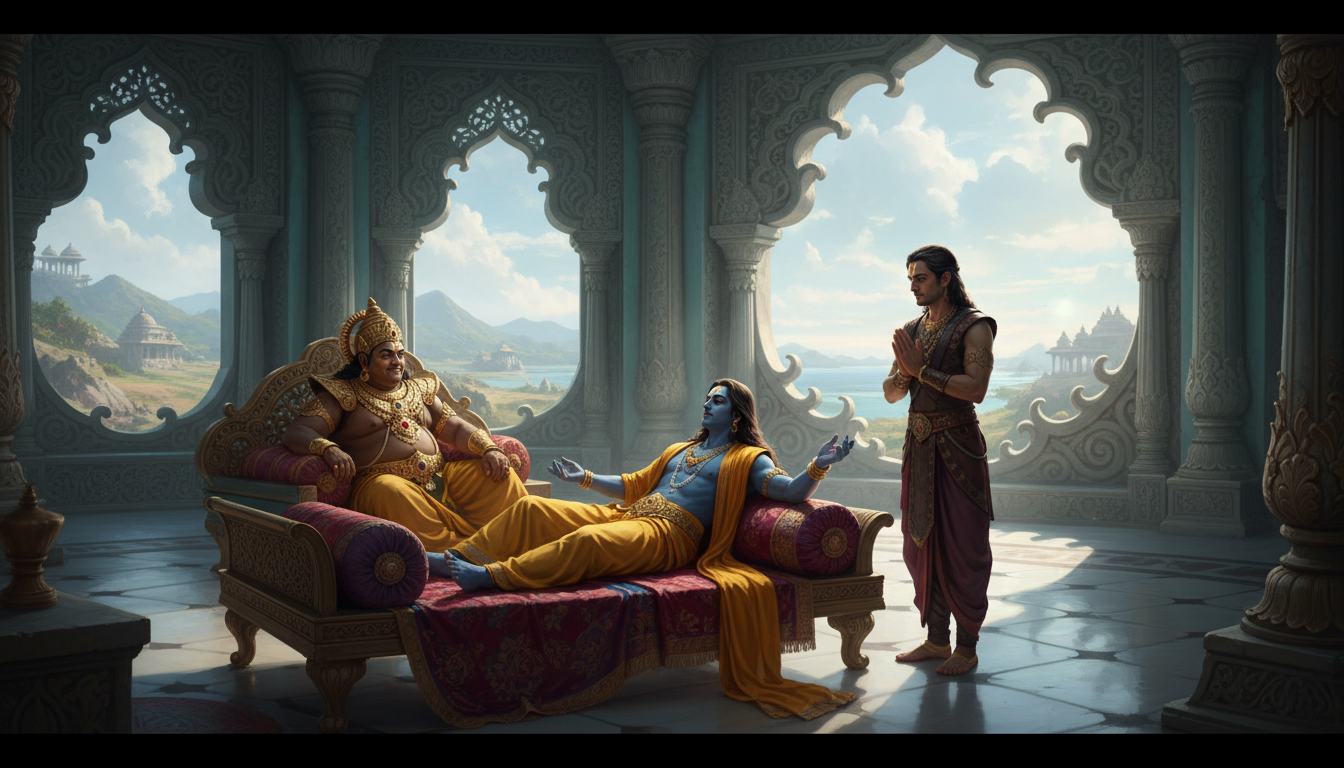
The Choice at Dwaraka
Ten crore soldiers on one side of the bed, one unarmed man on the other
The Hall After the Wedding
The wedding of Abhimanyu and Uttaraa was over and the kings who had come for it were still in the hall at Upaplavya, and instead of going home they began to talk about the kingdom.
Krishna spoke first, and moderately. "What Duryodhana thinks is not exactly known, nor what he may do. When the mind of the other side is not known, what opinion can be formed about what is best to be done? Let a man who is virtuous and honest and of respectable birth and wary, an able ambassador, set out to beseech them mildly, and induce them to give half the kingdom to Yudhishthira."
His elder brother stood up and praised the speech and then went further than it. "These valiant sons of Kunti are ready to give up half their kingdom," said Baladeva, "and they make that sacrifice for Duryodhana's sake. Let the message be humble. Let them not be provoked, for they have taken possession of the kingdom with a strong hand. And remember how it was lost. Yudhishthira had a throne and forgot himself in gambling. He was not skilled in dice, and all his friends dissuaded him, and he challenged the son of the king of Gandhara, who was an adept, of all the men in the world. There were thousands of dice-players in that hall he could have beaten. He picked Shakuni. And when the dice went against him again and again he would still have nobody but Shakuni for his opponent. For that, no blame can attach to Shakuni. Do not seek war with the Kurus. Address Duryodhana only in a conciliatory tone."
The son of Sini was on his feet before Baladeva had finished.
"As a man's heart is, so does he speak," Satyaki said. "You are speaking in strict conformity with the nature of your heart. I do not condemn your words. I condemn the men who are sitting here listening to them. How is a man who unblushingly attaches even the slightest blame to the virtuous king Yudhishthira to be permitted to speak at all in an assembly?
"Persons clever at dice challenged a man unskilled at it, and he trusted them, and he was defeated. Do you call that winning virtuously? If they had come here and beaten him at play in his own house among his brothers, what they won would have been righteously won. They challenged a man bound in conscience to follow the rules of his order, and they won by a trick. What is righteous in that? He has performed the stipulations to the last day, he is free of the forest, and the throne is his by birth. Why should he humble himself now? Even if he coveted another man's property it would not become him to beg for it.
"The means with which I would beseech them are sharp arrows. Either Yudhishthira gets back his kingdom this very day, or all our enemies lie down on the earth slain by me."
Word Sent to Every King on Earth
Drupada agreed with the young man and did not say so directly.
"It will be as you have said," he told Satyaki. "Duryodhana will never give up the kingdom by peaceful means, and Dhritarashtra, who dotes on his son, will follow him. So will Bhishma and Drona from imbecility, and Karna and Shakuni from folly. What Baladeva has said commends itself to my judgment, and a man who desires a peaceful settlement should follow it. But Duryodhana should never be addressed in mild words. In respect of an ass, mildness is in place. In respect of animals of the bovine species, severity is what serves. Speak mildly to that man and the fool will think he has won.
"So let us do both things. Let us send my priest, who is old in years and in understanding, to Dhritarashtra, and let us at the same time send word to our friends to collect an army."
Then he named the kings, and it took him a long time. Salya. Dhrishtaketu. Jayatsena and the prince of the Kekayas. Bhagadatta of immeasurable valour on the eastern sea-coast. Hardikya, and Ahuka, and the king of the Mallas, and Rochamana. Vrihanta and king Senavindu. The rulers of the Chedis, the kings of the Sakas and the Pahlavas and the Daradas, the Kambojas, the king of Kasi, the lords of the land of the five rivers, the rulers of the mountain regions, and thirty more besides.
"Duryodhana will send word to all the kings on his part," Drupada said. "But right-minded men respond to whoever asks them first. Therefore be quick."
Then he took his own priest aside and instructed him, since a message is only as good as the mouth it goes in.
"You are distinguished both for age and for learning, and you are equal in intellect to Sukra or to Brihaspati the son of Angiras. You know what kind of man the chief of the Kuru race is, and what kind of man Yudhishthira is. It was with Dhritarashtra's knowledge that the Pandavas were deceived, and though Vidura instructed him he still follows his son. Shakuni advisedly challenged a man unskilled in gambling. Having cheated the virtuous king in that fashion, they will by no means voluntarily yield up the kingdom.
"So speak words of righteousness to Dhritarashtra, and you will gain the hearts of his fighting men. Vidura will take up those same words and use them to alienate Bhishma and Drona and Kripa. When the officers of state are estranged and the fighting men are backward, their whole task becomes winning those hearts back, and while they are doing that they will not be able to prepare for war, and the Pandavas will be preparing at their ease.
"Speak to the compassionate about the hardships these men have endured. Speak to the aged about the family usages their forefathers followed. Fear nothing from them: you are a brahmana versed in the Vedas, you go as an ambassador, and you are old. Set out under the combination called Pushya, at that part of the day called Jaya."
And the priest set out for the city named after the elephant with a following of disciples.
So Virata honoured Krishna and sent him home to Dwaraka with his followers, and the messengers went out in every direction from both houses, and within a season the whole land was thronged with rulers of the earth marching to join one side or the other, with all four kinds of forces moving on every road, and the goddess Earth with her mountains and her forests seemed to tremble under the tread of them.
Two Men on the Same Road
Krishna and Valadeva had gone back to Dwaraka with all the Vrishnis and the Andhakas and the Bhojas, in their hundreds, and the city on the western sea had every fighting man of that race inside it.
Which meant that whoever got there first, and asked first, and asked well, might come away with an army nobody else on the subcontinent could match.
Arjuna set out from Upaplavya. He went himself; he did not send a messenger, because there are errands a man does not delegate.
Duryodhana had secret emissaries in the Pandava camp, and they had furnished him with information of everything the Pandavas did, and the moment he learned that Krishna had gone home he took horses that had the speed of the wind and a small number of troops and went for Dwaraka himself.
So the two of them came to the beautiful city of the Anarta land on the very same day: the prince of the Kurus with his handful of picked men, and the son of Kunti alone.
They were told the same thing at the door. Krishna was asleep.
Neither of them was willing to wait outside, and so those two tigers among men went in together to the room where he lay, and looked at him, and then had to decide, each of them and very quickly, where in that room to put himself.
The Head of the Bed and the Foot
Duryodhana went in first, and he did what a king does. There was a fine seat standing at the head of the bed and he took it and sat down, at the level of the sleeping man's face, in the place a person of consequence occupies.
After him came the wearer of the diadem, and he went past the seat without looking at it, and took up his position at the foot of the bed, and stood there. He did not sit down at all. He bowed, and joined his hands, and waited.
The room was quiet. Two armies were being assembled at that moment in two halves of the country, and every road in Bharatavarsha was full of marching men, and in this room there was one man asleep and two men standing over him, one at either end, in the two attitudes that had governed their whole lives.
Neither of them had chosen his place carelessly. The seat at the head is the seat of the person who has come to be attended to. The foot of the bed is where a man stands who has come to attend. Duryodhana took the position his rank entitled him to, which nobody could have faulted him for, and Arjuna took the position of a suppliant, which nobody had asked him to take.
Nobody spoke. There was nothing to do but wait for him to open his eyes, and the only question left was which of them he would see when he did.
He woke facing the foot of the bed.
His eyes fell first on Arjuna. Then, turning, he saw the Kaurava seated above his head, and greeted him too, and asked them both about the safety of their journeys, and bestowed his greetings fitly on each, and then asked what the occasion of the visit was, as though he did not know.
I Was Here First
Duryodhana spoke with a cheerful countenance, and he had his argument ready, because he had been putting it together the whole way from Hastinapura.
"It behoves you to lend me your help in the impending war. Arjuna and I are both equally your friends, and you bear the same relationship to both of us. And today, slayer of Madhu, I have been the first to come to you.
"Right-minded persons take up the cause of him who comes to them first. This is how the ancients acted. And you stand at the very top of all right-minded persons in the world, and are always respected. I ask you to follow the rule of conduct observed by right-minded men."
It was not a bad case. It rested on precedent, and on the equality of the relationship, and on Krishna's own reputation, and it asked for nothing that could be called unjust. It had exactly one weakness, which was that both men in the room knew what time each of them had actually walked through the door, and only one of them knew where Krishna's eyes had been when they opened.
Arjuna, at the foot of the bed, still had not said a word.
The Terms
"That you came first, king, I do not in the least doubt," Krishna said. "But the son of Kunti was beheld by me first.
"On account of your first arrival, and on account of my having beheld Arjuna first, I shall lend my assistance to both of you. But it is said that those who are junior in years should have the first choice. Therefore Dhananjaya, the son of Kunti, is entitled to choose first."
Then he laid out what there was to choose between, and he laid it out without any weighting at all.
"There is a large body of cowherds numbering ten crores, rivalling me in strength, known as the Narayanas. All of them are able to fight in the thick of battle. These soldiers are irresistible in battle, and they shall be sent to one of you.
"And I alone, resolved not to fight on the field, and laying down my arms, will go to the other.
"You may choose first, son of Kunti. According to law, you have the right to the first choice."
Ten crores of fighting men on one side. On the other, one man, unarmed, who had already said in advance that he would not lift a weapon.
It was not a trick and it was not a test. The terms were exactly what they sounded like. The Narayanas were real, they were the equals of the man describing them, and whoever got them would have a force in the field that no other king on earth could put together; and the man who took the other half of the offer would be taking a driver, a counsellor, and a witness, and nothing else at all.
Duryodhana sat very still at the head of the bed and did not trust himself to speak until the choice had been made, in case he was heard wanting the wrong thing.
What Each of Them Took
Arjuna selected Kesava.
He took the man who was not going to fight on the battlefield: Narayana himself, the slayer of foes, unborn and born among men at his own will, the foremost of all kshatriyas and above the gods and the danavas, standing there having just given his word to carry no weapon.
And Duryodhana selected for himself the entire army.
He could hardly believe it had happened. He had come expecting to fight for a decision and he was walking out with ten crores of soldiers, thousands upon thousands of them, the finest body of troops in the world, handed over without an argument. He was exceedingly delighted, although he knew perfectly well that Krishna was not on his side, and he did not spend much time thinking about what that meant.
Every man in that room got precisely what he asked for. That is the part of the story people forget when they tell it. Nobody was cheated at Dwaraka. Two men were shown the same two things and allowed to say which they wanted, and what each of them wanted turned out to be the whole account of him, and eighteen days on a field in Kurukshetra were only the reading out of the sum.
There was another call to make before he left the city.
The Plough-Bearer Will Not Come
He went to the son of Rohini, who was the strongest man in Dwaraka and the one who had spoken for conciliation at Upaplavya, and explained why he had come.
And the descendant of Sura answered him.
"You should remember, tiger among men, all that I said at the marriage ceremony celebrated by Virata. For your sake I contradicted Krishna there and spoke against his opinions. Again and again I alluded to the equality of our relationship to both the parties. But Krishna did not adopt the views I expressed then.
"Nor can I separate myself from Krishna for even a single moment.
"And seeing that I cannot act against Krishna, this is the resolution I have formed: that I will fight neither for Kunti's sons nor for you. Born as you are in Bharata's race, which is honoured by all the kings, go and fight in accordance with the rules of propriety."
So the man who had argued the Kaurava case in the Pandava hall would not carry a mace for either side, and said so to the only person who had wanted him to.
Duryodhana embraced that hero who wields a plough for his weapon of battle, and went on to Kritavarman, who gave him a body of troops numbering an akshauhini. And surrounded by that military host, which was terrible to behold, the Kaurava marched out of the western city delighting his friends; and although he knew that Krishna had been taken away from his side, he regarded Arjuna as already vanquished.
Drive for Me
After Duryodhana had gone, Krishna, the Creator of the world, in his yellow attire, turned to the man still standing at the foot of the bed and asked the obvious question.
"For what reason is it that you have selected me, who will not fight at all?"
"I do not question that you are able to slay them all," Arjuna said. "I also am alone capable of slaying them, best of men. But you are an illustrious person in the world, and this renown will accompany you. I too am a suitor for fame. Therefore you have been selected by me.
"And there is this. It has always been my desire to have you for driving my car. I ask you now to fulfil a wish I have cherished for a long time."
He had been given the choice between ten crores of soldiers and one unarmed man, and he had used it to ask for a charioteer.
"It beseems you well, son of Kunti," Krishna said, "that you measure yourself with me. I will act as your charioteer. Let your wish be fulfilled."
And then, with a glad heart, Kunti's son, accompanied by Krishna and by the flower of the Dasarha race, went back along the road he had come by to Yudhishthira, to tell his brother what the two of them had brought home from Dwaraka: no soldiers at all, and the reins.
Dharma Lesson
What a man reaches for when he is offered everything and one person reveals what he actually values. Nobody was cheated at Dwaraka: the same two things were shown to both men and each said aloud which he wanted. Duryodhana took the largest army in the world and Arjuna took a charioteer, and the war only read out the sum they had already written.