The Net and the Mountain Honey
Two birds who quarrelled in flight, and a cliff nobody came down from
The Man Who Walked Out of the Hall
Sanjaya had come back from the Pandavas, and the court at Hastinapura had been arguing ever since, and on this particular day the arguing had already cost them a commander.
Karna had stood up and offered to end the business himself. "When I obtained the Brahma weapon from Rama under a false pretence," he said, "he told me that when my hour came my memory would fail me in respect of that weapon. For so great an offence he cursed me lightly, and by attention and personal bravery I appeased his heart. I have the weapon still, and my period is not yet run. Let the responsibility be mine. Having obtained the favour of that rishi, I will slay in the twinkling of an eye the Panchalas and the Karushas and the Matsyas and the sons of Pritha with their sons and their grandsons. Let the Grandsire and Drona and all the kings stay here with you. Let that task be mine."
"What are you saying, Karna?" said Bhishma. "Your intellect is clouded at the approach of your hour. Do you not know that when the chief is slain the sons of Dhritarashtra will all be slain? You have heard what Dhananjaya achieved at the burning of the Khandava forest, with Krishna alone for his ally. The shaft that great Indra gave you will be broken and reduced to ashes when Kesava strikes it with his discus. That other shaft of the serpentine mouth, which shines in your quiver and which you worship with flowery garlands, will perish along with you."
Karna heard him out.
"I lay down my weapons," he said. "The Grandsire will henceforth behold me in court only, and not in battle. After you have become quiet, the rulers of the earth will see what I can do."
And he left the hall, and took his weapons home with him.
Bhishma laughed aloud after him and turned to Duryodhana in the middle of the Kurus. "How truly the Suta's son keeps his promises. He gave his pledge over and over in this room, saying that with the kings of Avanti and Kalinga and Jayadratha and Chediddhaja and Bahlika standing there as spectators he would slay hostile warriors by thousands and by tens of thousands. How will he discharge that obligation now? Look instead at the havoc Bhimasena will make of your divisions, scattering heads by the thousand. And understand this too: the moment when Vikartana's son represented himself as a brahmana to the holy and blameless Rama in order to get that weapon was the moment he lost both his virtue and his asceticism."
That is how the argument stood when Duryodhana began to speak.
The Three of Us Will Do It
"The sons of Pritha are as other men," Duryodhana said, "and are in fact of earthly birth like other men. Why then do you think they are sure to win?
"Both ourselves and they are equal in energy, in prowess, in age, in intelligence, in knowledge of the scriptures, in weapons, in the art of war, in lightness of hand and in skill. All of us are of the same species, all of us men by birth. How then, grandsire, do you know that victory will be theirs?
"I do not seek the accomplishment of my aims by relying upon you, or upon Drona, or Kripa, or Bahlika, or upon any of the other kings. Myself, and Karna the son of Vikartana, and my brother Dussasana: we three will slay the five sons of Pandu in battle with sharpened arrows.
"Then, king, we shall gratify the brahmanas with great sacrifices of every kind, with abundant fees, and with gifts of cattle and horses and wealth. When my troops drag the Pandavas about the field by the strength of their arms, like hunters dragging a herd of deer in a net, or whirlpools pulling down a boat with nobody aboard it, then the sons of Pandu, seeing us supported by crowds and cars and elephants, will give up their pride. And not they alone. Kesava also."
He had put in one speech a net and a boat with nobody steering it, and he had put both of them on the other side of the field. His uncle, who was sitting listening, gave him back the same two pictures with the men in them exchanged.
What Self-Restraint Looks Like
Vidura did not begin with the birds. He began somewhere that sounded, to the men in that hall, like a change of subject.
"Venerable persons of infallible knowledge say that in this world self-restraint is highly beneficial. He whose self-restraint follows charity and asceticism and knowledge and the study of the Vedas always wins success and forgiveness and the fruit of his gifts. Self-restraint enhances energy. It is an excellent and holy attribute. Freed from sin, and with his energy increased by self-restraint, a man acquires even Brahma through it.
"People are always afraid of men who have no self-restraint, as if they were rakshasas, and it was for keeping such men in check that the Self-existent created the kshatriyas.
"I regard these as its indications: forgiveness, firmness of mind, abstention from injury, an equal regard for all things, truthfulness of speech, simplicity, control over the senses, patience, gentleness of speech, modesty, steadiness, liberality, mildness, contentment and faith. He who has self-restraint casts off lust, avarice, pride, wrath, sleep, boastfulness, self-esteem, malice and sorrow.
"Purity, and the absence of crookedness and fraud, are the distinctive marks of the man of self-restraint. He who is not covetous, who is satisfied with a little, who does not regard the objects that provoke lust, and who is as grave as the ocean, is known as a man of self-restraint.
"He who is well-behaved, of good disposition and contented soul, and who knows his own self, is possessed of wisdom, and wins great regard here and attains a blissful state hereafter. Possessed of mature wisdom, the man who has no fear of other creatures and whom other creatures do not fear is said to be the foremost of men. Seeking the good of all, he is a universal friend, and nobody is made unhappy by him. Endued with a gravity like the ocean's, such a man is always calm and cheerful.
"And as the track of feathery creatures in the sky cannot be perceived, so the path of the sage who is contented in consequence of his knowledge is not visible."
He had just described, item by item, a man who was the exact reverse of the one on the throne, and the throne had heard nothing in it but a sermon, which is what usually happens.
So he stopped arguing, and told two stories instead.
Two Birds and a Net
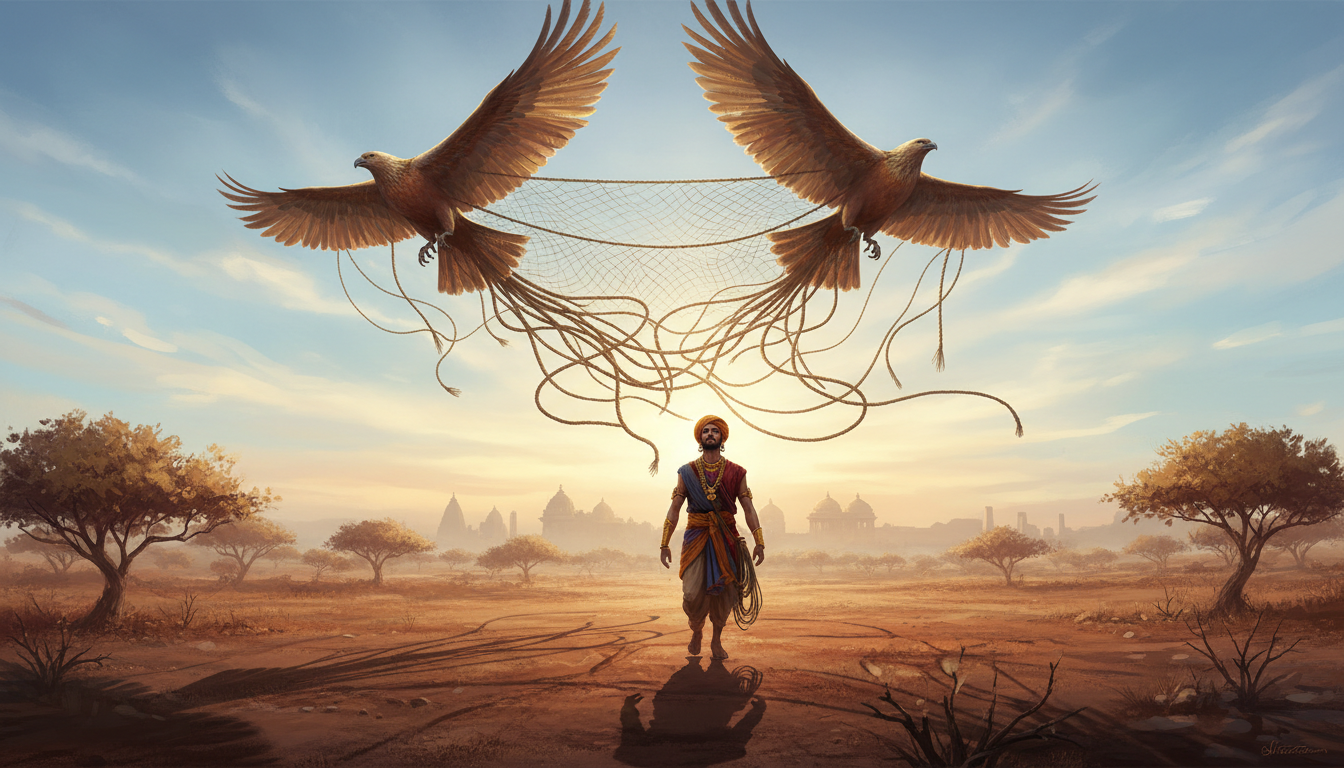
"We have heard, sire, from old men," said Vidura, "that once upon a time a fowler spread his net upon the ground for the catching of the feathery denizens of the air.
"And in that net there were ensnared, at the same moment, two birds that lived together.
"And taking the net up between them, the two winged creatures soared together into the air."
He let the court have the picture: the net rising off the ground with the pegs pulling loose, and the two birds beating upward under the weight of it, and the whole snare going up into the sky with the catch inside it and nobody's hand on it any more.
"And seeing them soar into the sky, the fowler, without giving way to despair, began to follow them on foot in the direction they were flying."
That was the detail Vidura wanted his brother to notice, and he said it twice before he went on: that the man on the ground did not shout, and did not throw anything, and did not sit down and mourn his net. He simply began to walk, in the direction the birds had chosen, at the pace a man walks.
It is a story with almost nothing in it. Two birds, one net, one man on foot. There are no gods in it and no weapons and no kings, and Vidura told it to a court that had spent the whole day discussing celestial weapons and the exact number of akshauhinis on either side, and he told it slowly, the way a man tells a thing to children.
The Ascetic's Question and the Fowler's Answer
"Just then an ascetic, living in a hermitage close by, who had finished his morning prayers, saw the fowler running in that manner, still hoping to secure the feathery creatures.
"And seeing that tenant of the earth quickly pursuing those tenants of the air, the ascetic addressed him in this verse: Fowler, it appears very strange and wonderful to me that you, who are a treader of the earth, should be pursuing a couple of creatures who are tenants of the air.
"And the fowler said:
"These two, united together, are taking away my snare. There, however, where they will quarrel, they will come under my control."
Vidura stopped there for a moment, in a hall containing a hundred sons of one father, most of whom had spent the previous hour agreeing loudly with one another about how easily the war would go, and let the sentence stand by itself.
The hunter, it should be noticed, made no claim at all about his own speed. He did not say he would catch them. He said where. He was not chasing birds; he was following a quarrel he had not yet heard, toward a place on the ground he could not yet see, and he was perfectly content to walk there.
Charred Brands
"The two birds, doomed to death, soon after quarrelled," said Vidura. "And when the foolish pair quarrelled, they both fell upon the earth. And when, ensnared in the meshes of death, they began to contend angrily against each other, the fowler approached unperceived and seized them both.
"Even so do those kinsmen who fall out with one another for the sake of wealth fall into the hands of the enemy, like the birds I have cited, in consequence of their quarrel.
"Eating together, talking together: these are the duties of kinsmen, and not contention under any circumstances. Those kinsmen who with loving hearts wait upon the old become unconquerable, like a forest guarded by lions. But those who, having won enormous riches, nevertheless behave like mean-minded men, always contribute to the prosperity of their foes.
"Kinsmen, Dhritarashtra, bull of the Bharata race, are like charred brands. United, they blaze up. Disunited, they only smoke."
That was the first story and it was over in a hundred words. It named nobody. It required nothing of the king except that he look at his own house and identify which two things in it were carrying the same net, and how long they had been beating their wings at each other while a man on the ground kept walking.
And note what the parable does not say. It does not say the birds were weak, or that the fowler was strong, or that the net could not have been carried. The birds were winning. They had the snare in the air and the hunter reduced to walking underneath it, and the only thing they had to do in order to keep on winning was to go on wanting the same direction. They fell because they disagreed about which way to fly, and the ground did the rest.
The Jar on the Precipice
"I will now tell you something else that I saw on a mountain-breast," Vidura said. "Having listened to that also, do what is best for you.
"Once upon a time we repaired to the northern mountain, in company with some hunters and with a number of brahmanas who were fond of discoursing on charms and on medicinal plants. That northern mountain, Gandhamadana, looked like a grove. Its breast was overgrown on every side with trees and with diverse kinds of luminous medicinal herbs, and it was inhabited by siddhas and by gandharvas.
"And there we all saw a quantity of honey, of a bright yellow colour, and of the measure of a jar, standing on an inaccessible precipice of that mountain.
"That honey was Kuvera's favourite drink, and it was guarded by snakes of virulent poison. And it was such that a mortal drinking of it would win immortality, a sightless man would obtain sight, and an old man would become a youth. This is what the brahmanas conversant with sorcery told us about that honey."
He was speaking, in that room, to a man who had never once seen anything with his eyes, and he did not soften the sentence about sight, and nobody who heard it missed what had been done.
He had also, in three sentences, described a thing worth having. That is the part of the parable that is usually skipped. The honey was real. It was Kuvera's own drink and it stood there in a quantity you could measure with a jar, on a mountain where medicinal herbs grow bright enough to see by, and everything the brahmanas said about it was true. Nobody in that story was chasing a delusion. They were chasing something genuinely worth a fortune, up a cliff nobody could climb, past snakes nobody mentioned twice.
He Beholds the Honey
"And the hunters, seeing that honey, desired to obtain it," said Vidura.
"And they all perished in that inaccessible mountain cave, which abounded with snakes.
"In the same way, this your son desires to enjoy the whole earth without a rival. He beholds the honey. He does not see, from folly, the terrible fall.
"It is true that Duryodhana desires an encounter in battle with Savyasachin, but I do not see in him that energy or that prowess which might carry him safely through it. On a single car Arjuna conquered the whole earth. At the head of their hosts, Bhishma and Drona and the others were frightened by Arjuna and utterly routed at the city of Virata. Remember what took place on that occasion. It was one man against all of you, and you have not yet finished explaining it to yourselves.
"And he forgives still. He is looking up at your face and waiting to know what you will do.
"Drupada, and the king of the Matsyas, and Dhananjaya, when they are angry, will leave no remnant of your army, like flames of fire urged along by the wind. Take king Yudhishthira upon your lap, since neither party can under any circumstances have victory when your will is engaged in the battle."
The Father Tries Once More
Then the blind king took up what his brother had said, and put it into plain words with no birds in it at all.
"Consider, Duryodhana, dear son, what I tell you. Like an ignorant traveller you think the wrong path to be the right one, since you desire to rob the energy of the five sons of Pandu, who are like the five elements of the universe in their subtle form, upholding everything that moves and everything that does not.
"Without the certain sacrifice of your own life you are unable to vanquish Yudhishthira, who is the foremost of all virtuous persons in this world. Like a tree defying a mighty tempest, you chafe at Bhimasena, who has no peer among men in might and who is equal to Yama himself in battle. What man of sense would encounter in battle the wielder of Gandiva, who is the foremost of all wielders of weapons, as Meru is foremost among mountains? What man is there whom Dhrishtadyumna cannot overthrow, shooting his arrows among the foes like the chief of the celestials hurling his thunderbolt? The irresistible Satyaki will slaughter your host.
"And what man of sense would encounter the lotus-eyed Krishna, who in the measure of his energy and his power surpasses the three worlds? As regards Krishna, put his wives, his kinsmen, his relatives, his own soul and the whole earth into one scale, and they weigh even with Dhananjaya in the other. That host where Kesava is becomes irresistible everywhere.
"Listen therefore to the counsels of those well-wishers of yours whose words are always for your good. Accept your aged grandsire, Bhishma the son of Santanu, as your guide. Listen to what Drona and Kripa and Vikarna and king Bahlika say. They are all as I myself am.
"The panic and the rout at the city of Virata, before your own eyes, of all your troops and your brothers, and that wonderful encounter of one man against many, are proof enough of what I am saying. When Arjuna singly achieves all that, what will the Pandavas not achieve when they are united?
"Take them by the hands as your brothers, and cherish them with a share of the kingdom."
The court had now heard a net, a jar of honey on a cliff, and a father's plain request, all in one afternoon, and the man they were addressed to said nothing at all in reply to any of the three. So the two birds went on carrying the snare between them, quarrelling as they flew, and out on the plain below them a patient man went on walking in the direction they had chosen.
Dharma Lesson
Kinsmen carry a shared burden only as long as they refuse to fight over it, and a prize seen without its guardians is not a prize but a fall. The birds were winning while they agreed about the direction; the ground did the rest. The honey on the precipice was genuinely worth a fortune, which is exactly why the men who saw only the honey died in the cave.