How a Charioteer Came to Know God
The blind king asks why the sight was given to a suta
The Discus No Kuru Can See
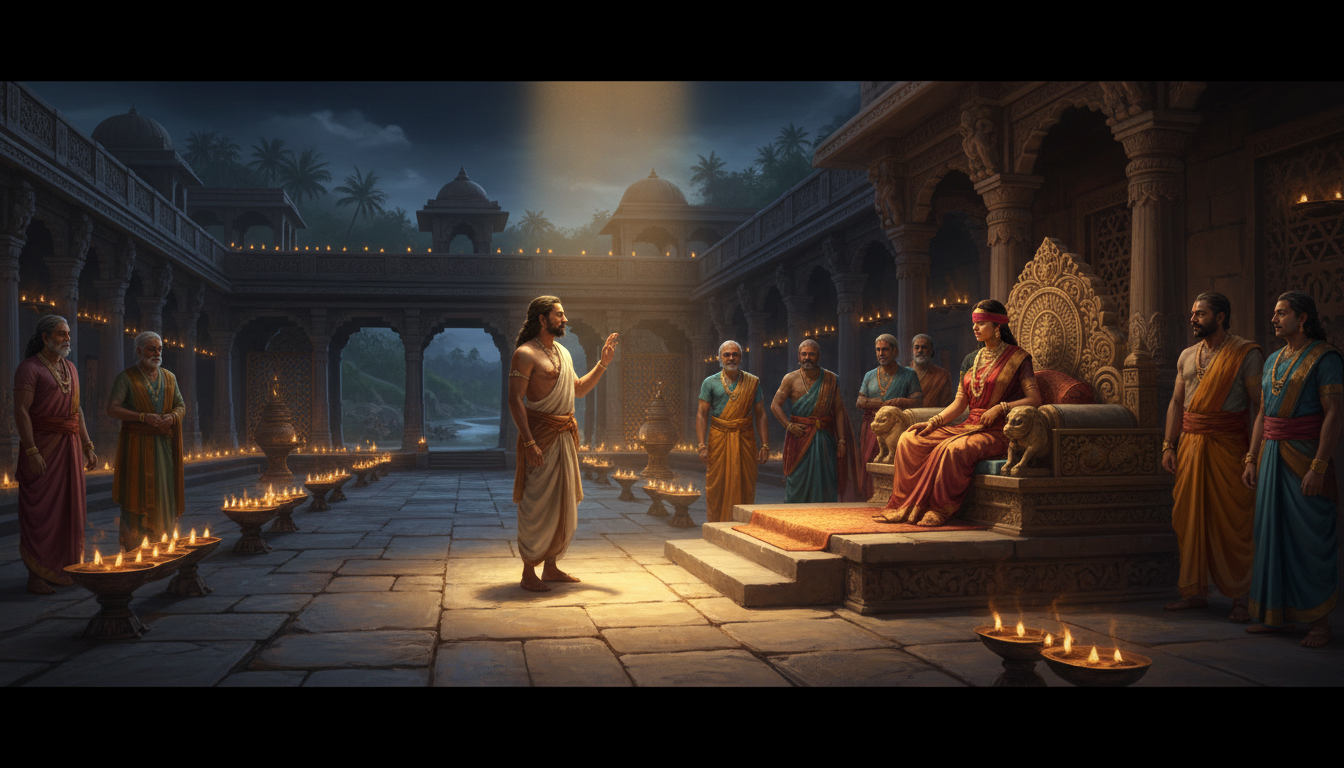
Sanjaya had been standing on the same square of floor in the Kuru court since morning, and the blind king had asked him the same thing eleven different ways.
"Their strength," Dhritarashtra said again. "Their weakness. You have been among them. You have slept in their camp at Upaplavya and eaten what they set before you. Tell me plainly where the sons of Pandu are thin."
"Then hear it in brief, O king, and hear it once," Sanjaya said. "Those two adorable bowmen, Arjuna and Vasudeva, are perfectly equal to each other in respect of their godlike nature, and neither of them was born the way you were born or I was. They have taken their births of their own will."
A murmur went along the benches. Sanjaya did not wait for it to finish.
"The discus that Vasudeva owns is of abundant energy. It occupies a space full five cubits across, and it can be hurled at a foe in a form large or small according to the will of the wielder at the instant of the throw, for it does not depend upon the arm. It depends upon illusion. It is always conspicuous by its effulgence, and it is invisible to the Kurus. You keep asking me on what ground the strength or the weakness of the Pandavas is to be measured. That discus is the best ground there is. Go and look at it. You will find that not one man in this hall can see it."
"Weapons can be answered," said a voice from among the princes.
"That scion of Madhu's race," Sanjaya said, "vanquished Naraka, and Samvara, and Kamsa, and Shishupala the chief of the Chedis, and he vanquished all four with an effort so small that those who watched it thought he was playing. Possessed of divinity and of a soul superior to everything, that most exalted of male beings can bring the earth, the firmament and the heaven under his control by his will alone. He does not need the discus. The discus is a convenience."
If the Universe Were Weighed
"You want a measure," Sanjaya said. "Take a measure, then. If the whole universe were placed upon one scale and Janardana upon the other, Janardana would outweigh the entire universe. Janardana at his pleasure can reduce the universe to ashes; the entire universe is incapable of reducing Janardana to ashes. That is the arithmetic, O king. There is no other."
"You speak of him as men speak of the Grandsire," Dhritarashtra said.
"I speak of him as I have learned to speak of him. Wherever there is truthfulness, wherever there is virtue, wherever there is modesty, wherever there is simplicity, even there is Govinda. And thither where Krishna is, success must be. He guides the earth and the firmament and the heaven as if in sport, and he has made the Pandavas his indirect means. It is not the sons of Pandu who are moving against your sons. It is he, beguiling the whole world while he does it, and he wishes to blast your children because they are addicted to sin."
Duryodhana laughed, once, on a single breath, and Sanjaya turned his head toward the sound and went on.
"Endued with divine attributes, Kesava by the power of his soul causes the wheel of Time to revolve, and the wheel of the Universe, and the wheel of the Yuga, and he does not stop turning them. I tell you truly that that glorious Being is alone the Lord of Time, and of Death, and of this universe of mobile and immobile objects. And yet, though he is the Lord of the whole of it, that great ascetic Hari still betakes himself to work like a humble labourer who tills a field for hire. He drives horses. He carries messages. He sits at the feet of the old and lets himself be sent for. Kesava beguiles all by the aid of his illusion. Only those men who have attained to him are not deceived."
How Does a Charioteer Know?
The king sat forward on his seat, and the hand that was always searching the air for something to hold found the arm of his chair and gripped it.
"How have you been able to know Madhava as the Supreme Lord of the universe?" he said. "How is it, O Sanjaya, that I am unable to know him as such? Tell me this. You drive a chariot. Your father drove a chariot. I am the head of the house of Kuru, I have listened to Brahmanas all my life, I have paid for sacrifices I will never be able to count, and this thing you say you have, I do not have. Explain it to me."
There was a silence in which everybody in the hall understood what had just been asked, and understood also that it had been asked in front of two hundred people.
"Listen, O king," Sanjaya said. "You have no Knowledge, whereas my Knowledge has suffered no diminution. He that is without Knowledge and is shrouded with the darkness of ignorance does not know Kesava. That is the whole of the answer. It has nothing to do with your house or with mine."
"And what is it you claim to know?"
"Aided by my knowledge, sire, I know the slayer of Madhu to be the union of the Gross, and the Subtle, and the Cause. I know that he is the Creator of all and is himself increate. I know that he is that One from whom everything springs, and he is that One unto whom all things return. I did not inherit this and I was not given it because of my birth. If it could be inherited, O king, you would have had it from your fathers, and I would not have it at all."
The Nature of That Faith
"Then tell me what it is you have that I have not," said Dhritarashtra. "O son of Gavalgana, what is the nature of that Faith of yours in Janardana, in consequence of which you know the slayer of Madhu to be the union of the Gross, the Subtle and the Cause?"
"Blessed be you, O king, for asking it," Sanjaya said. "I will tell you and you will not like the smallness of it. I have no regard for the illusion. The pleasures that men chase and call the world, I have not chased. And I never practise the useless virtues."
"There are no useless virtues."
"There are, sire. A vow undertaken without any reliance upon him is a useless virtue. Work performed without purity of soul is a useless virtue. A man may keep a fast for thirty years and be no nearer than when he began, because he kept it in order to be seen keeping it. I have not done that. Having obtained purity of soul through faith, I have known Janardana from the scriptures, and the scriptures were open to you before they were open to me. They lie in this house. Nobody hid them."
The old king turned his face toward the place where his eldest son was sitting.
"Duryodhana," he said, "seek you the protection of Janardana, otherwise called Hrishikesa. O child, Sanjaya is one of the trustiest friends we have. He has just told you what the man is. Seek refuge with Kesava."
The Refusal
Duryodhana rose. He took his time about it, as a man does when he knows the room will wait for him.
"If the divine son of Devaki," he said, "united in friendship with Arjuna, were to slay all mankind, I could not, even then, resign myself to Kesava."
He said it without heat. That was the part of it that emptied the hall of sound. He was not raging at his father; he was stating a fact about himself that he had evidently settled long ago and had merely been waiting for an occasion to say aloud. All mankind, and he would still not bow. The arithmetic Sanjaya had offered a moment before, the universe in one scale and Janardana in the other, had been answered with an arithmetic of its own: put every living creature on the scale, and Duryodhana's neck outweighs them.
Dhritarashtra turned his blind face toward his wife, who sat where she always sat, with the cloth bound across her eyes.
"This evil-minded son of yours, O Gandhari," he said, "is resolved to sink in misery. Envious, wicked-souled and vain, he sets aside the words of all his superiors. I have said it. Vidura has said it. The grandsire has said it. Now my own envoy has said it, and you have heard what he answers."
Gandhari's Word
Gandhari did not stand. She spoke from where she sat, and her voice went into every corner of that hall without being raised.
"You covetous wretch," she said, "who disregards the commands of the aged. You who abandon your father and myself. You who give up prosperity and life together, who enhance the joy of your foes and afflict me with deep distress."
Nobody moved. It is one thing for a mother to scold a prince and another for her to say the next sentence, and everyone in the room could feel that there was a next sentence.
"You will remember your father's words, O fool," said Gandhari, "when, struck by Bhimasena, you will bite the dust."
She did not say it as a curse. She said it the way a woman says a thing she has already seen. The blindfold had been on her eyes since the day she married into this house, worn out of love for a husband who could not see, and it had never once been lifted; and the men in the hall, who could all see perfectly well, had spent the whole morning being told what was in front of them and had not managed to look at it.
Duryodhana said nothing to his mother. He sat down.
Vyasa Tells the King to Listen
Then Vyasa, who had come into the hall without anyone marking the moment of his coming, as he always did, spoke to the king.
"Listen to me, O king. You, Dhritarashtra, are the beloved of Krishna. That is not a small thing and you have done nothing to earn it. When Sanjaya has been your envoy, he will verily lead you to your good. He knows Hrishikesa, that ancient and exalted One. If you listen to him with attention, he will certainly save you from the great danger that hangs upon you now, over this roof, at this hour."
"I am listening," said Dhritarashtra.
"You are hearing," said Vyasa. "O son of Vichitravirya, men subject to wrath and joy are entangled in various snares. They that are not contented with their own possessions, deprived of sense as they are by avarice and desire, repeatedly become subject to Death in consequence of their own acts. They go like blind men led by blind men, and they fall into pits, and the pit is always the one they were warned of. There is one path that does not end in the pit, and it is the path trodden by the wise. They that are superior keep that path in view, and they overcome death, and they reach the goal by it."
The old king was quiet for a while.
"Tell me, O Sanjaya," he said at last, "of that path without terrors, by which, obtaining Hrishikesa, salvation may be mine."
The Path Without Terrors
"A man of uncontrolled mind," Sanjaya said, "can by no means know Janardana, whose soul is under perfect command. That is the first thing, and there is no way around it and no substitute for it. The performance of sacrifices without controlling one's senses is no means to that end at all. You may pour clarified butter into fire from now until your death and it will buy you nothing."
"I have poured a great deal of it," said the king.
"I know, sire. So has your son. Renunciation of the objects of our excited senses is due to spiritual light. Both spiritual light and abstention from injury arise, doubtless, from true wisdom. So resolve, O king, to subdue your senses with all possible vigour. Do not let your intellect deviate from true knowledge. Restrain your heart from the worldly temptations that surround it, and they surround you closely, for they are your own children and they are asking you for a kingdom that is not theirs."
"And this subjugation. What do the learned call it?"
"Learned Brahmanas describe this subjugation of the senses to be true wisdom, and this wisdom is the path by which learned men proceed to their goal. Kesava is not obtainable, O king, by men who have not subdued their senses. He that has subdued them desires spiritual knowledge, and the knowledge comes to him through the scriptures and through the pleasure of absorption in Yoga. That is the whole road. It has no terrors in it. It has only the one difficulty, which is that a man must give up wanting what he wants."
The Meanings Inside the Names
"Tell me again of the lotus-eyed Krishna," said Dhritarashtra. "By being acquainted with the import of his names, O son, I may yet obtain that most exalted of male beings."
"The auspicious names have been heard by me before," said Sanjaya, "and of those I will tell you as many as I know. Understand first that Kesava is immeasurable and is above the power of speech to describe, so that what I give you are handles, not the thing itself.
"He is called Vasudeva because he envelops all creatures with the screen of illusion, and because of his splendour, and because he is the resting place of the gods. He is called Vishnu because his nature pervades everything. He is called Madhava because he practises, as a Muni does, concentration of the mind upon truth. He is called Madhusudana because he slew the Asura Madhu. He is called Krishna because in himself he unites what is meant by the two words krishi, which signifies that which exists, and na, which signifies eternal peace. He is called Pundarikaksha from pundarika, his high and eternal abode, and aksha, indestructible. He is called Janardana because he strikes fear into the hearts of all wicked beings, and if any man in this hall has felt that fear, he now knows the name for it.
"He is called Vrishabhakshana, from vrishabha, the Vedas, and ikshana, eye: the Vedas are his eyes, and the Vedas are the eyes through which he may be seen. He is called Aja, the unborn, because he has not taken birth from any being in the ordinary way. He is called Damodara because his effulgence is his own and increate, unlike the gods, and because he has self-control. He is called Hrishikesa, from hrishika, eternal happiness, and isa, the six divine attributes. He is called Mahabahu because he upholds the earth and the sky with his two arms. He is called Adhokshaja because he never falls down nor suffers any deterioration, and Narayana because he is the refuge of all human beings. He is called Purushottama because he creates, preserves and destroys the universe. He knows all things, and so he is Sarva. Krishna is always in Truth and Truth is always in him, and Govinda is Truth's Truth, and therefore he is called Satya. He is Jishnu because of his success and Ananta because of his eternity."
Sanjaya stopped.
"Possessed of these attributes, ever devoted to righteousness, that mighty-armed one incapable of decay will come hither," he said. "He is coming to this city, O king, for the purpose of preventing the slaughter of the Kurus. You have some time yet in which to decide what you will say to him."
I Envy Those Who Will See Him
The old king put both hands over his eyes, which he did sometimes when he was tired, though there was nothing there to shade.
"I envy those gifted with sight," he said, "who will behold before them that Vasudeva whose body, endued with great beauty, shines with an effulgence that illuminates the cardinal points of the compass and the points between them. I envy those who will hear him give utterance to words that the Bharatas will listen to with respect. They will be words auspicious to the Srinjayas, acceptable to those desirous of prosperity, faultless in every respect, and unacceptable only by those that are doomed to death.
"The assembled Kauravas will behold that high-souled and adorable One, that chief of the Vrishnis, uttering words full of kindness and fascinating everyone of my party, and I shall sit here and be told afterwards what his face did. I put myself in the hand of that Eternal one, that Rishi endued with the knowledge of Self, that ocean of eloquence, that Being who is easily attainable by ascetics and by nobody else, that bird called Arishta furnished with beautiful wings, that refuge of the universe, that one of a thousand heads, that Creator and Destroyer of all things, that Ancient one without beginning, middle or end, that cause of the Prime seed, that unborn one, that Eternity's self, that highest of the high, that Author of gods and Asuras and Nagas and Rakshasas, that younger brother of Indra."
He let his hands fall.
A suta's son had stood on the floor all morning and named the Lord of the universe twenty different ways, and had told a king exactly what road to walk and what it would cost him to walk it; and the king had understood every word and had asked for more of them, and had put himself into that hand in a sentence forty clauses long, and would do nothing. On the benches his eldest son sat with his arms folded, unmoved, having already said in front of everyone that the destruction of mankind would not be enough to bend him.
Outside, on the northern road, Krishna had not yet set out from Upaplavya.
Dharma Lesson
Sight of the truth is given to the disciplined and not to the highborn, and a man may sit through the whole description of the road and still refuse to walk it. Dhritarashtra hears every word, asks for more, and does nothing. Duryodhana says plainly that the destruction of all mankind would not bend him, and no one in the hall can pretend afterwards that they were not told.