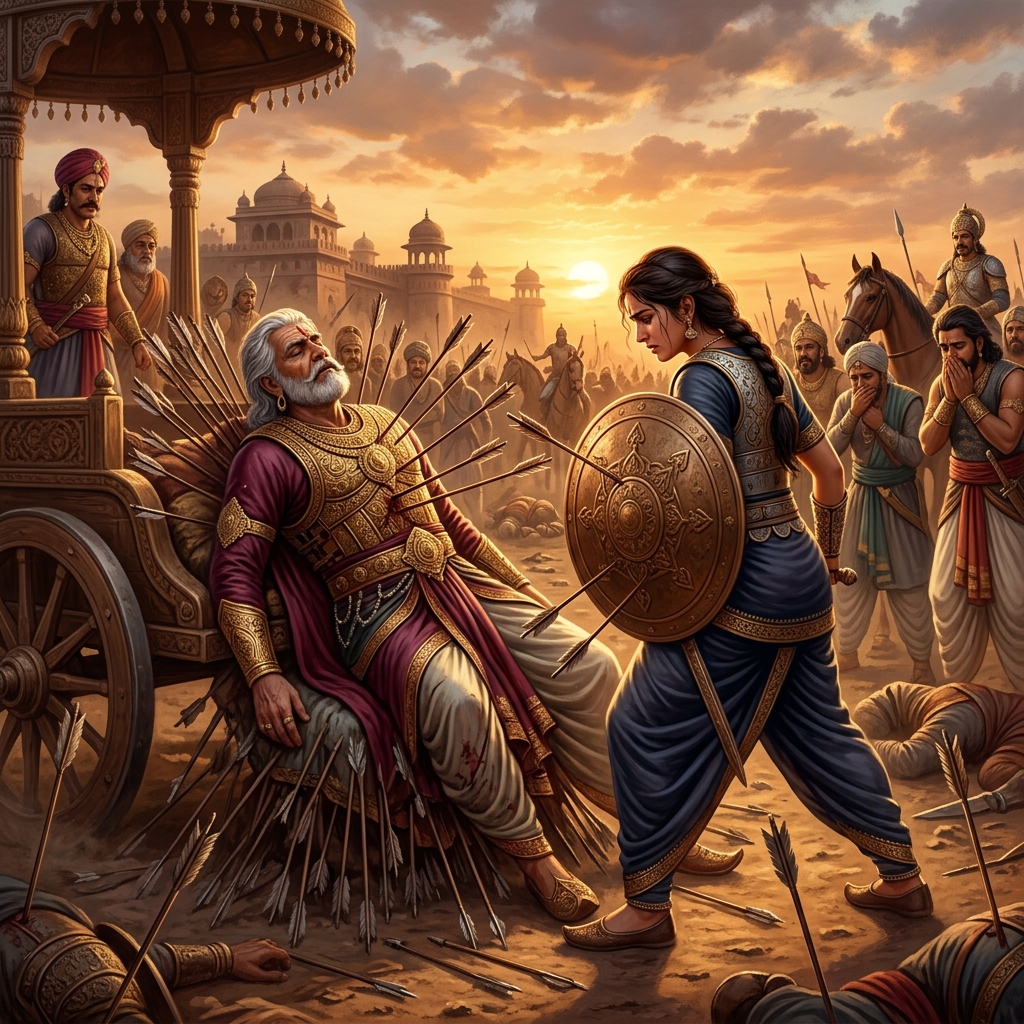
The Bed of Arrows
Winter had begun to loosen its hold on Kurukshetra, and the sun, after its long season of decline, had at last begun its turning toward the north. For fifty-eight nights Bhishma had lain upon a bed not of cotton or straw but of his own arrows, driven into his body by Arjuna's bow, holding him above the earth as though the ground itself were unworthy to receive him until his hour came. He had waited for this turning of the sun, for it was said that a soul departing during the sun's northern course finds the gentler road beyond death, and Bhishma, who had mastered so much else, meant to master even the manner of his dying.
Around him now sat the Pandavas, and Krishna, and the sages who had gathered to hear the old warrior speak of law and duty in the days since the war's end. Bhishma had already given long discourse - on the duties of kings, on the four aims of life, on the conduct proper to each order of men. His voice, though weakened by the wounds that still held him fast, had not once failed to find its thread. But something remained undone, and Yudhishthira, newly crowned and newly grieving, felt it as a hunger he could not yet name.
"Grandfather," he said, kneeling close, "you have taught me the law of kings and the law of the ages. But tell me now the deepest thing you know. Who is the one God of this world, praised by all beings? By taking refuge in whom does a man find the highest good? By praising whom is he freed from birth and death? What is the highest dharma, greater than every other dharma? And by what japa, what constant repetition, is a creature released at last from the bondage of this existence?"
A stillness settled over the assembly. Krishna, seated a little apart, said nothing, though every eye that was not on Bhishma had drifted, without quite meaning to, toward him.
The Answer Before the Answer
Bhishma closed his eyes for a moment, as a man does who is gathering not words but breath enough to carry them. When he opened them again he looked, not at Yudhishthira, but past him, toward Krishna, and a faint smile moved across his ruined face.
"You ask me five questions, child, and I will answer them with a single name," he said. "There is one being, eternal, imperishable, who is praised by all the worlds with a thousand names drawn from his thousand qualities and deeds. He is Vishnu, the one who pervades all things, who is both the maker and the made, both the singer and the song. To take refuge in him is to take refuge in the only shelter that does not crumble. To praise him is to be freed. Constant repetition of his names, offered with a peaceful mind and a heart empty of malice, is itself the highest dharma, for it asks nothing of birth or caste or fortune, only faith."
He paused, and his breath rattled faintly against the arrows that held him. "I learned this in the days when I still walked the earth on my own feet, from the sage Narada, and from Vyasa, and I have carried it since as a man carries the one coin he cannot bear to spend. Listen now, Yudhishthira, and I will give it to you as it was given to me - not as a list to be memorized, but as a river to be entered."
Yudhishthira bent his head. Beside him, Krishna's face was unreadable, neither modest nor expectant, only quiet, as the sky is quiet before rain it already knows is coming. The old man on the arrows drew one more breath, and began.
The River of Names
"He is Vishvam," Bhishma began, "the universe itself, for there is no place where he is not, and no thing that is not, in some hidden way, his own body. He is Vishnu, the all-pervading, water finding every crack in stone, light finding every corner of a room. He is Bhutakrit, the maker of all beings, and Bhutabhrit, the sustainer of what he has made, for creation without care would be no gift at all.
"He is Hrishikesha, lord of the senses, who sits within the eye that sees and the ear that hears, so that even our small perceptions are borrowed from his vastness. He is Purushottama, the supreme among persons, higher than the perishable and higher even than the imperishable, standing beyond both as the sky stands beyond the birds that cross it. He is Narasimha, who tore the pillar open with his own hands to prove that faith needs no door and no hour to be answered. He is Madhava, born of the Madhu lineage and husband of Lakshmi, in whom sweetness and fortune are held as one thing. He is Keshava, whose hair the sun and moon and fire adorn, and Ananta, the endless, who has no rim at which to stop and no floor beneath which to fall.
"He is Govinda, the finder of the earth, who lifted the world when it sank beneath the waters as a herdsman lifts a calf caught in the mud, careless of the mud upon his own hands. He is Damodara, bound about the belly with a rope by a mother who did not know she held the boundless in her arms - for even his captivity was a kind of love, and even a rope could not close around all that he is."
The names went on, not as beads counted but as a current, each one opening into the next, until the assembly could no longer say where one ended and the following began - only that they were, together, a single unbroken praising.
The Names in the Presence of the Named
It was Arjuna, listening near the edge of the gathering, who first felt the strangeness of the hour settle fully upon him. Here sat Krishna, his charioteer and his friend, the same hand that had held the reins at Kurukshetra and pointed out kinsmen across the battle line - and here, a few feet from him, the oldest and most learned man in the kingdom was reciting his names one by one, as though Krishna were a memory or a distant god and not a living presence seated in plain cotton cloth among them.
Bhishma did not pause for this thought, or perhaps he had already passed through it long before and found the far side of it peaceful. "It is no strange thing," he said, as though he had heard Arjuna's silence, "that I praise him who sits and listens. The sun does not blush to be praised by the eyes it lights. He who is Sahasrasirsha, the thousand-headed, contains this gathering and every gathering, this praising and every silence, and it costs him nothing to be named by name in a place where he himself abides. Rather it is the deepest proof of who he is - that truth does not require distance to be spoken, and that the highest being need not hide from his own praise to remain unshaken by it."
Krishna's expression through all of this had not changed, save that something like tenderness had crept, so slowly none could mark its arrival, into the set of his mouth. He did not correct Bhishma, and he did not confirm him. He only listened, as a river might listen to a hymn sung upon its banks by a traveler who had drunk from it every day of his life without ever quite naming what it was he drank.
Yudhishthira, watching the two of them, felt for the first time since the war a loosening in his chest, as though a fist long closed had begun, name by name, to open.
The Gift of the Recitation
When the last of the names had been spoken, Bhishma allowed himself a long silence, as a singer allows a hall its final quiet before the ordinary noises of the world return. Then he turned to Yudhishthira and, in a voice grown thinner but no less certain, told him what the recitation itself would give to any who took it up.
"Whoever hears this praising with faith, or repeats it with a steady mind, shall not want for good fortune in this life, and shall find, at the hour of death, that the road is not so dark as he had feared. It is not wealth that this japa promises, though wealth may follow it, and it is not length of days, though the fearful will find their fear grow smaller. It is refuge - the one thing that cannot be taken by an enemy, divided by an inheritance, or burned by a war. A man who has nothing else may still have this, and having it, may find he has enough."
Yudhishthira bowed low, his forehead nearly touching the frost-hardened ground beside the bed of arrows. He thought of the field beyond them, still bearing its scars, still giving up its dead to the crows; he thought of his brothers, of Draupadi's grief, of a throne he had not wanted at this cost. And he found, kneeling there, that some of the weight had gone out of it - not all, not even most, but enough that he could feel, for the first time since the eighteenth day of the war, something that was not merely endurance.
"Grandfather," he said, "you have given me more than the law of kings."
Bhishma's eyes had drifted, half-closed, toward the pale disc of the winter sun climbing its slow arc to the north. "I have given you what was given to me," he said. "Carry it as I carried it, and you will find it does not grow lighter with age. It only grows more necessary." Krishna, beside them both, said nothing at all, and needed to say nothing, for in that silence the whole of the recitation seemed, at last, to come to rest.
Dharma Lesson
The highest refuge is not a rule but a name held in the heart with faith; praise offered without expectation of reward is itself the path. Even the teacher of dharma must bow before the source of all dharma, and in that bowing find peace.