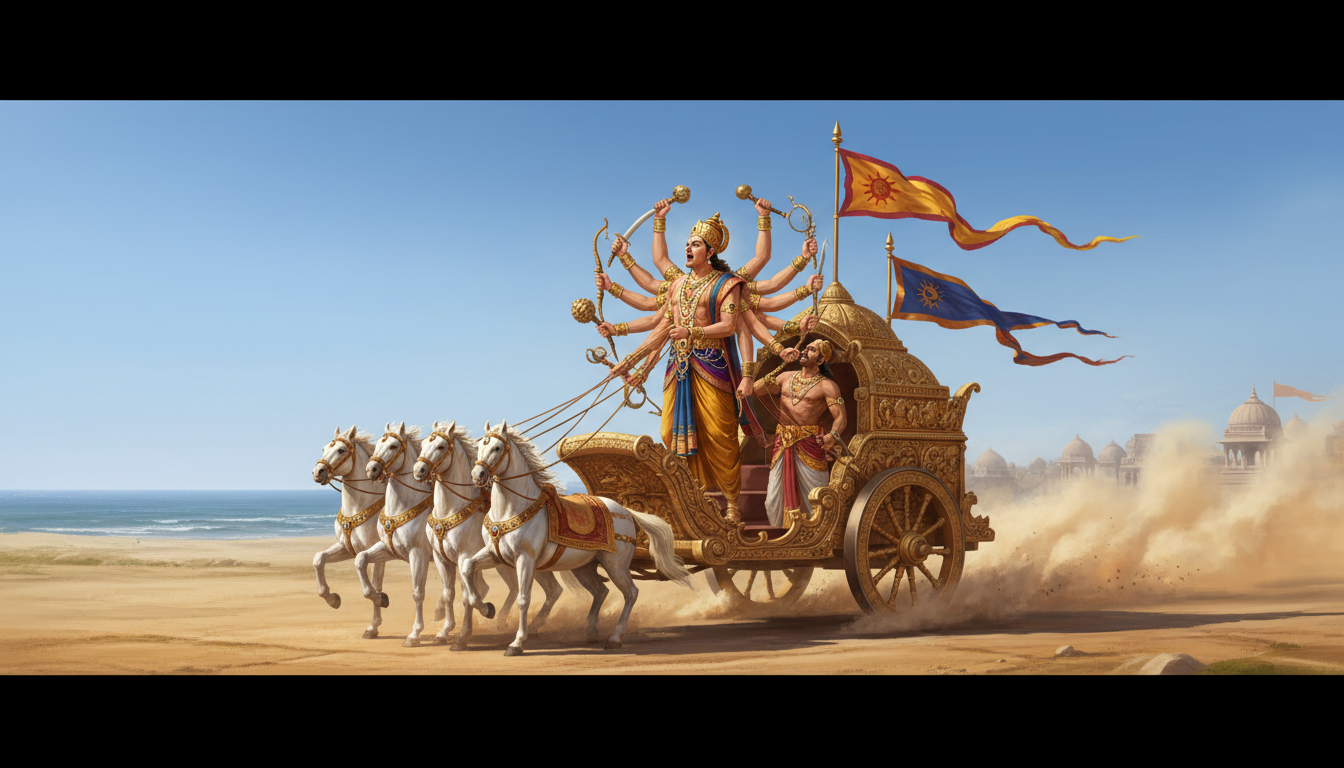
The Wind Answers the Thousand-Armed King
Kartavirya boasts, and an invisible voice begins to argue
Why the Grandsire Bows
"Tell us, O king," said Yudhishthira, "what is that reward attached to the worship of Brahmanas, seeing which thou worshippest them? What is that success, flowing from their worship, guided by which thou worshippest them?"
It was a fair question to put to a man on a bed of arrows. Bhishma had ruled Hastinapura in all but name for two generations. He had beaten Rama of Jamadagni's race to a standstill on the Kurukshetra plain. And every day of his life he had risen and made his salutation to men who owned nothing and carried a water pot.
"In this connection," Bhishma said, "is cited this old narrative of a conversation between Pavana and Arjuna. Not your brother. There was another Arjuna before him, and he had a thousand arms, and he was the lord of all the world, and he learned what I am about to tell you in the middle of the road, out loud, in front of his own army."
The Fourth Boon
Endued with a thousand arms and great beauty, the mighty Kartavirya in days of yore became the lord of all the world. He had his capital in the city of Mahishmati. Of unbaffled prowess, that chief of the Haihaya race of Kshatriyas swayed the whole earth with her belt of seas, together with all her islands and all her precious mines of gold and gems.
He had come by it honestly enough. Keeping before him the duties of the Kshatriya order, as also humility and Vedic knowledge, the king made large gifts of wealth unto the Rishi Dattatreya. The son of Kritavirya adored that great ascetic until he was pleased with him, and the ascetic asked him to solicit three boons.
"Let me become endued with a thousand arms when I am in the midst of my troops," said the king. "While, however, I remain at home, let me have, as usual, only two arms. Let combatants, when engaged in battle, behold me possessed of a thousand arms. Let me succeed in subjugating the whole earth by dint of my prowess. And having acquired the earth righteously, let me sway her with vigilance."
Then he asked for one more, and it is the only reason his name is worth remembering.
"There is a fourth boon which, foremost of regenerate persons, I solicit thee to grant. Dependent that I am on thee, whenever I may happen to go wrong, let the righteous come forth to instruct and set me right."
"So let it be," the Brahmana replied. And thus were those boons acquired by that king of blazing effulgence, including the one he would come to regret.
A Voice Out of the Empty Sky
Riding then on his car, whose splendour resembled that of fire or of the Sun, the monarch, blinded by his great prowess, said aloud what he had been thinking for some years.
"Who, indeed, is there that can be regarded as my equal in patience and energy, in fame and heroism, in prowess and strength?"
After he had uttered these words, an invisible voice in the welkin answered him. There was nothing overhead but sky.
"O ignorant wretch, dost thou not know that the Brahmana is superior to the Kshatriya? The Kshatriya, assisted by the Brahmana, rules all creatures."
The king did not flinch and did not look for the speaker. He argued.
"When gratified, I am able to create many creatures. When angry, I am able to destroy all. In thought, word and deed I am the foremost. The Brahmana is certainly not above me. Thou sayest that the two are united together in the act upon which the Kshatriya's superiority is founded, but a distinction is observable. It is seen that Brahmanas take refuge with Kshatriyas. The Kshatriyas never seek the refuge of Brahmanas. Throughout the earth the Brahmanas, accepting such refuge under the pretence of teaching the Vedas, draw their sustenance from the Kshatriyas. The duty of protecting all creatures is vested in Kshatriyas. It is from the Kshatriyas that the Brahmanas derive their sustenance. How then can the Brahmana be superior?
"Well. I shall from today bring under my subjection your Brahmanas, who are superior to all creatures but who have mendicancy for their occupation and who are so self-conceited. What the virgin Gayatri has said from the welkin is not true. Robed in skins, the Brahmanas move about in independence. I shall bring those independent wights under my subjection. Deity or man, there is none in the three worlds who can hurl me from the sovereignty I enjoy. This world that is now regarded as having Brahmanas for its foremost denizens shall soon be made such as to have Kshatriyas for its foremost denizens."
Hearing these words, the welkin-ranging goddess became agitated and said nothing more.
The Messenger of the Deities
Then somebody else spoke from the sky, and this one did not go away when contradicted.
"Cast off this sinful attitude. Bow unto the Brahmanas. By injuring them thou wilt bring about troubles on thy kingdom. The Brahmanas will either slay thee, king though thou art, or, endued with great might that they are, they will drive thee away from thy kingdom, despoiling thee of thy energy."
"Who, indeed, art thou?" said the king.
"I am the god of wind, and the messenger of the deities. I say unto thee what is for thy benefit."
And here the fourth boon began to work, though the king did not recognise it. He had asked that the righteous should come forth to set him right whenever he went wrong, and the righteous had come, and what the king did was open the argument wider.
"Oh, I see that thou hast today shown thy devotion and attachment to the Brahmanas," said Arjuna of the thousand arms. "Tell me now what kind of earthly creature the Brahmana is. Tell me, does a superior Brahmana resemble the Wind in any respect? Or is he like Water, or Fire, or the Sun, or the Firmament?"
"Hear, O deluded man," said the god of wind, "what the attributes are that belong to Brahmanas. The Brahmana is superior to all those which thou hast named."
And then, riding beside a chariot on an open road, the wind began to recite the record.
The Record, Read Out
"In days of yore the great Rishi Angiras, through his energy, drank off all the waters. Having drunk them off as if they were milk, he did not feel his thirst to be slaked, and he therefore caused the earth to be filled with water once more by raising a mighty wave. On another occasion, when Angiras became enraged with me, I fled away, leaving the world, and dwelt for a long time concealed in the Agnihotra of the Brahmanas through fear of that Rishi. I, whom you have just asked whether a Brahmana resembles the Wind.
"The illustrious Purandara, in consequence of his having coveted the body of Ahalya, was cursed by Gautama. Yet, for the sake of Righteousness and wealth, the Rishi did not destroy outright the chief of the deities, which he could have done.
"The Ocean, O king, that was full in former days of crystal water, cursed by the Brahmanas, became saline in taste. Even Agni, who is of the complexion of gold, and who blazes with effulgence when destitute of smoke, and whose flames uniting together burn upwards, when cursed by the angry Angiras became divested of all these attributes.
"Behold, the sixty thousand sons of Sagara, who came to adore the Ocean, have all been pulverised by the Brahmana Kapila of golden complexion. The large kingdom of the Dandakas was destroyed by a Brahmana. The mighty Kshatriya Talajangha was destroyed by a single Brahmana, Aurva.
"Thou too hast acquired a large kingdom, great might, religious merit and learning, all difficult of attainment, through the grace of Dattatreya. Why dost thou, Arjuna, worship Agni every day, who is a Brahmana? He is the bearer of sacrificial libations from every part of the universe. Art thou ignorant of this fact?"
The king rode on and said nothing, and the wind kept pace with him.
The Earth Who Tried to Leave
"Once on a time, O king, a ruler of the name of Anga desired to give away the whole earth as sacrificial present unto the Brahmanas. At this the earth became filled with anxiety.
"'I am the daughter of Brahman,' she said. 'I hold all creatures. Having obtained me, alas, why does this foremost of kings wish to give me away unto the Brahmanas? Abandoning my character as the soil, I shall now repair to the presence of my sire. Let this king with all his kingdom meet with destruction.'
"Arrived at this conclusion, she departed for the region of Brahman. That is to say, the ground itself intended to walk out from under the feet of every living thing, and there was no one to stop her.
"The Rishi Kasyapa, beholding the goddess Earth on the point of departing, immediately entered the visible embodiment of the goddess, casting off his own body by the aid of Yoga. The earth thus penetrated by the spirit of Kasyapa grew in prosperity and became full of all kinds of vegetable produce. For the time that Kasyapa pervaded the earth, Righteousness became foremost everywhere and all fears ceased.
"In this way the earth remained penetrated by the spirit of Kasyapa for thirty thousand celestial years, fully alive to all those functions which it used to discharge while it was penetrated by the spirit of Brahman's daughter. Upon the expiry of that period the goddess returned from the region of Brahman, and arrived here, and bowed unto Kasyapa, and from that time became the daughter of that Rishi.
"Kasyapa is a Brahmana. Even this was the feat that a Brahmana did. Tell me the name of the Kshatriya who can be held to be superior to Kasyapa."
Hearing these words, king Arjuna remained silent.
The Man Who Drank the Water Back
"Hear now the story of Utathya, who was born in the race of Angiras. The daughter of Soma, named Bhadra, came to be regarded as unrivalled in beauty, and her sire regarded Utathya to be the fittest of husbands for her. Soma's father Atri, inviting Utathya to his house, bestowed upon him the famous maiden, and Utathya duly received the girl for his wife.
"It so happened, however, that the handsome Varuna had from a long time before coveted the girl. Coming to the woods where Utathya dwelt, Varuna stole her away when she had plunged into the Yamuna for a bath, and the Lord of the waters took her to his own abode. That mansion was of a wonderful aspect. It was adorned with six hundred thousand lakes. There is no mansion that can be regarded more beautiful than that palace of Varuna.
"Having heard all the facts from Narada, Utathya said, 'Go, Narada, unto Varuna and speak with due severity unto him. Ask him why he has abducted my wife, and tell him in my name that he should yield her up. Say to him further, thou art a protector of the worlds, Varuna, and not a destroyer.'
"Narada went, and said what he was told to say. Varuna replied, 'This timid girl is exceedingly dear to me. I dare not let her go.' And when Narada returned cheerlessly, he said, 'Great ascetic, Varuna has driven me out from his house, seizing me by the throat.'
"Hearing this, Angiras became inflamed with wrath. Endued with wealth of penances, he solidified the waters and drank them off, aided by his energy. When all the waters were thus drunk off, the Lord of that element became very cheerless with all his friends and kinsfolk. For all that, he did not still give up Utathya's wife.
"Then Utathya commanded the Earth, saying, 'O amiable one, do thou show land where there are at present the six hundred thousand lakes.' At these words the Ocean receded from the spot indicated, and land appeared which was exceedingly sterile. And unto the rivers that flowed through that region Utathya said, 'O Saraswati, do thou become invisible here. Leaving this region, go thou to the desert. O auspicious goddess, let this region, destitute of thee, cease to become sacred.'
"When that region became dry, Varuna repaired to Angiras, taking Utathya's spouse with him, and made her over to him. Then that great Brahmana rescued both the universe and the Lord of waters from the situation of distress into which he had brought them. What, is there a Kshatriya that is superior to Utathya?"
Three Who Went to War Without Weapons
"Listen now to the greatness of the Brahmana Agastya. Once on a time the gods were subjugated by the Asuras. The sacrifices of the deities were all seized, and the Swadha of the Pitris was also misappropriated. All the religious acts and observances of human beings were suspended by the Danavas, and, divested of their prosperity, the deities wandered over the earth.
"One day in the course of their wandering they met Agastya of high vows, whose splendour was as blazing as that of the sun. 'We have been defeated by the Danavas in battle,' they said. 'Do thou rescue us from this situation of great fear.'
"Agastya became highly incensed. Possessed of great energy, he at once blazed forth like the all-consuming fire at the time of the universal dissolution, and with the blazing rays that emanated from him the Danavas began to be burnt. Thousands of them began to drop down from the sky. Burning with the energy of Agastya, they abandoned both heaven and earth and fled towards the southern direction. Afterwards the gods asked him to consume also those Asuras who had taken refuge in the nether regions, and he answered them, 'Yes, I am fully competent. But if I achieve such a feat my penances will suffer a diminution. Hence I shall not exert my power.' He knew the price of his own fire, and he stopped when he had spent enough.
"Hear also one of the great feats of the illustrious Vasishtha. The deities were performing a sacrifice on the shores of the lake Vaikhanasa when a race of Danavas called the Khalins, of statures as gigantic as mountains, desired to slay them. Those among the Khalins that were disabled or slain in the fight were plunged into the waters of the Manasa lake, and by the boon of the Grandsire they instantly came back to vigour and life. Taking up huge mountain summits and maces and trees, they agitated the waters of the lake, causing them to swell up to the height of a hundred yojanas.
"Vasava was afflicted by them and in his distress sought the protection of Vasishtha. The Rishi did it through compassion, seeing the gods so cheerless. He put forth his energy and burnt, without any exertion, those Danavas called Khalins. Then, possessed of wealth of penances, he brought the River Ganga, who had gone to Kailasa, to that spot. Ganga appeared, piercing through the waters of the lake, and flowed on from there under the name of Sarayu. The place whereon those Danavas fell came to be called after them. Was there a Kshatriya who could be said to surpass the Brahmana Vasishtha?"
Arjuna of the thousand arms remained silent.
The Rishi Who Became the Sun
"Hear me now, foremost one of the Haihayas, as I narrate the achievement of the high-souled Atri.
"Once on a time, as the gods and Danavas were fighting each other in the dark, Rahu pierced both Surya and Soma with his arrows. The gods, overwhelmed by darkness, began to fall before the mighty Danavas. Repeatedly struck by the Asuras, the denizens of heaven began to lose their strength. Then they beheld the learned Brahmana Atri, engaged in the observance of austerities, a Rishi who had conquered all his senses and in whom wrath had been extinguished.
"'Behold, O Rishi, these two, Soma and Surya, who have both been pierced by the Asuras with their arrows. Darkness has overtaken us, and we are being struck down by the foe. We do not see the end of our troubles.'
"'How, indeed, shall I protect you?' said the Rishi.
"'Do thou thyself become Chandramas. Do thou also become the sun. And do thou begin to slay these robbers.'
"Thus solicited, Atri assumed the form of the darkness-destroying Soma, and in consequence of his agreeable disposition he began to look as handsome and delightful as Soma himself. Beholding that the real Soma and the real Surya had been darkened by the shafts of the foe, Atri, assuming the forms of those luminaries, began to shine forth in splendour over the field of battle. Verily, Atri made the universe blaze forth in light, dispelling all its darkness, and by putting forth his puissance he subjugated the vast multitudes of those enemies of the deities. Beholding those great Asuras burnt by Atri, the gods also, protected by Atri's energy, began to despatch them quickly.
"Even this was the feat that a regenerate one accomplished, aided by his sacred fire: that silent reciter of Mantras, that one clad in deer-skins, who subsisted upon fruits only. Is there a Kshatriya that is superior to this regenerate Rishi?"
Thus addressed, Arjuna remained silent, and the wind told him about Chyavana, who had promised the twin Aswins a share of the Soma and would not go back on it. When Indra refused to drink in their company, Chyavana began the rite himself, and stupefied all the gods with his Mantras, and when Indra ran at him with a mountain and the thunderbolt in his hands, the Rishi threw a little water at him and paralysed him where he stood. Then out of the libations he had poured he created the Asura Mada, of mouth gaping wide, with a thousand teeth extending for a hundred yojanas, one cheek resting on the earth and the other touching the heavens, so that all the gods with Vasava among them stood at the root of that creature's tongue like fishes swimming into a leviathan's mouth. Standing in there, the gods held a quick consultation and told Indra to bow his head. He bowed it. And afterwards Chyavana called Mada back and assigned him his residence in dice, in hunting, in drinking, and in women, which is why men who betake themselves to these meet with destruction.
The Fires and the Warning
"When the denizens of heaven found themselves inside the mouth of the Asura Mada, Chyavana took away from them the earth. Deprived previously of heaven and now shorn of the earth also, the gods threw themselves upon the Grandsire's protection.
"'The earth has been taken from us by Chyavana,' they said, 'while we have been deprived of heaven by the Kapas.'
"'Repair quickly and seek the protection of the Brahmanas,' said Brahman. 'By gratifying them you will succeed in regaining both the regions as before.'
"The deities went and became suppliants. The Brahmanas asked them, 'Whom shall we subjugate?' 'Do ye subjugate the Kapas.' 'Bringing them down on the earth first, we shall speedily subjugate them.'
"The Kapas heard of it and sent a messenger named Dhanin, who came and sat down before those Brahmanas and made the best case that has ever been made by a doomed embassy. 'The Kapas are even like you all. All of them are well conversant with the Vedas and possessed of wisdom. All of them are mindful of sacrifices. All of them have Truth for their vow. The goddess of Prosperity sports among them. They never eat the flesh of such animals as have not been killed in sacrifices. They pour libations on the blazing fire every day and are obedient to the behests of their preceptors and seniors. They never take any food without dividing it duly among their children. They always proceed on cars and other vehicles together, without any of them riding while others journey on foot. When women quick with child or old men have not eaten, they never eat anything themselves. They never sleep during the day. When the Kapas have these and many other virtues, why, indeed, would you seek to subjugate them? You should abstain from the endeavour.'
"'Oh, we shall subjugate the Kapas,' the Brahmanas said. 'In this matter we are one with the deities. As regards Dhanin, he should return whence he came.'
"So Dhanin returned and told them, and all the Kapas took up their weapons and proceeded towards the Brahmanas with the standards of their cars upraised. The Brahmanas, beholding them advancing, created certain blazing fires for their destruction. Those eternal fires, created with the aid of Vedic Mantras, having effected the destruction of the Kapas, began to shine in the firmament like so many golden clouds. The gods, having assembled in battle, slew many of the Danavas and did not know at that time that it was the Brahmanas who had effected their destruction. It was Narada, coming there, who informed them."
After the god of wind had said these words, king Arjuna worshipped him duly, and answered.
"O puissant god, always and by all means do I live for the Brahmanas. Devoted to them, I worship them always. Through the grace of Dattatreya I have obtained this might of mine, and through his grace I have been able to accomplish great feats in the world and achieve high merit. I have heard with attention of the achievements of the Brahmanas with all their interesting details as recited by thee truly."
"Do thou protect and cherish the Brahmanas," said the god of wind, "in the exercise of those Kshatriya duties which are thine by birth. Do thou protect them even as thou protectest thy own senses." And then, before he went, he left one more thing on the road behind him. "There is danger to thee from the race of Bhrigu. All that, however, will take place on a distant day."
"He was warned," Bhishma said to Yudhishthira. "He had asked for the warning himself, in the form of a boon, before he ever needed it. And you know as well as I do what came out of the race of Bhrigu, and what it did to him, and to his sons, and to the Kshatriya order after them. That is the reward attached to the worship of Brahmanas, and that is also the cost of hearing the correction and not acting on it. He listened beautifully. He simply went on being who he was."
Dharma Lesson
The boon worth asking for is the one Kartavirya asked for last, that someone be permitted to tell you when you are wrong, and the measure of a king is whether he still listens when the correction comes. He listened beautifully, worshipped the god who corrected him, and then went on being exactly who he was. A warning heard and admired but not acted upon is worth no more than a warning never given.