Four Faces and a Blue Throat
Uma asks her husband to account for himself
The Fire Out of Krishna's Mouth
"I shall describe the puissance of that great god who has a bull for his device," said Bhishma. "Listen to me as I narrate also the doubt that filled the mind of the spouse of Rudra, and that of Rudra himself."
Yudhishthira had asked for discourses fraught with wonder, and the grandsire went a long way round to reach one, because the story he wanted had been told in front of Krishna and had to be introduced by way of Krishna.
"Once on a time the righteous-souled Krishna observed a vow extending for ten and two years. For beholding him who had gone through the rite of initiation, there came to that place Narada and Parvata, and the Island-born Krishna, and Dhaumya, that foremost of silent reciters, and Devala, and Kasyapa, and Hastikasyapa, and many other Rishis with their disciples. They were given such honours of hospitality as are offered unto the gods alone, and they sat down on seats some of which were green and some of the colour of gold and some fraught with the plumes of the peacock.
"Then, while they sat there conversing sweetly, the energy of Narayana rose in the form of fire from the fuel of that vow and issued out of the mouth of Krishna. It began to consume the mountain, with the trees and creepers and little plants, the birds and the deer and the beasts of prey and the reptiles, until the summit was bereft of every living creature and its cries. Then that fire of mighty flames, having consumed everything, came back to Vishnu and touched his feet like a docile disciple. And Krishna cast a benignant look upon the mountain and brought it back to what it had been, flowering and full of birds.
"The ascetics sat there with their hairs standing on end and their vision blurred with tears, and Krishna asked them, with perfect courtesy, why they were amazed."
Tell Me Something Wonderful
"Krishna explained the fire to them," said Bhishma. "He had come to that mountain to obtain by penance a son who would be his equal in energy, and the Grandsire had told his soul that half the energy of the great god who has the bull for his device would take birth as that son. The fire was that errand, going and returning.
"Then he asked the ascetics for payment.
"'I now ask you to tell me something that is highly wonderful which you have heard of or seen on earth or in heaven. I feel an eager desire to taste the honey of that speech which will drop from your lips. Anything whose knowledge dwells in me, or is acquired by my own inspiration, ceases to appear wonderful to me. Anything, however, that is recited by pious persons and that is heard from those that are good deserves to be accepted with respect and faith. Such discourses exist on earth for a long time and are as durable as characters engraved on rocks.'
"That is a strange thing for the lord of the universe to say and I have thought about it often. He was telling them that what he knows by being what he is gives him no pleasure, and that a thing only becomes wonderful when a good man tells it to you. So the ascetics put their heads together and appointed one of their number to speak, and they chose the one who is always chosen.
"'It behoves you, O Narada, to describe in full, from the beginning, that wonderful and inconceivable incident which occurred on the mountains of Himavat and which was witnessed by those of us that had proceeded thither in course of our pilgrimage.'
"And Narada, that friend of Narayana, began the account of the discourse between Sankara and his spouse Uma."
The Company on the Mountain
"Once on a time," said Narada, "the lord of all the deities, with the bull for his device, practised severe penances on the sacred mountains of Himavat.
"He was not alone. He was surrounded by hundreds of ghostly beings, and if you wish to know what the household of that god looks like, here it is. Some of them were ugly and awkward, some were of very handsome features, and some presented the most wonderful appearances. Some had faces like the lion's, some like the tiger's, some like the elephant's. Some had faces resembling the jackal's, some the pard's, some like the ape's, some like the bull's. Some had faces like the owl's, some like the hawk's, some like those of deer of diverse varieties. There were Kinnaras with them, and Yakshas and Gandharvas and Rakshasas. It resounded with the beat of Mridangas and Panavas and the blare of conchs, and the ghostly tribes danced in joy, and the peacocks danced with them with their plumes outspread.
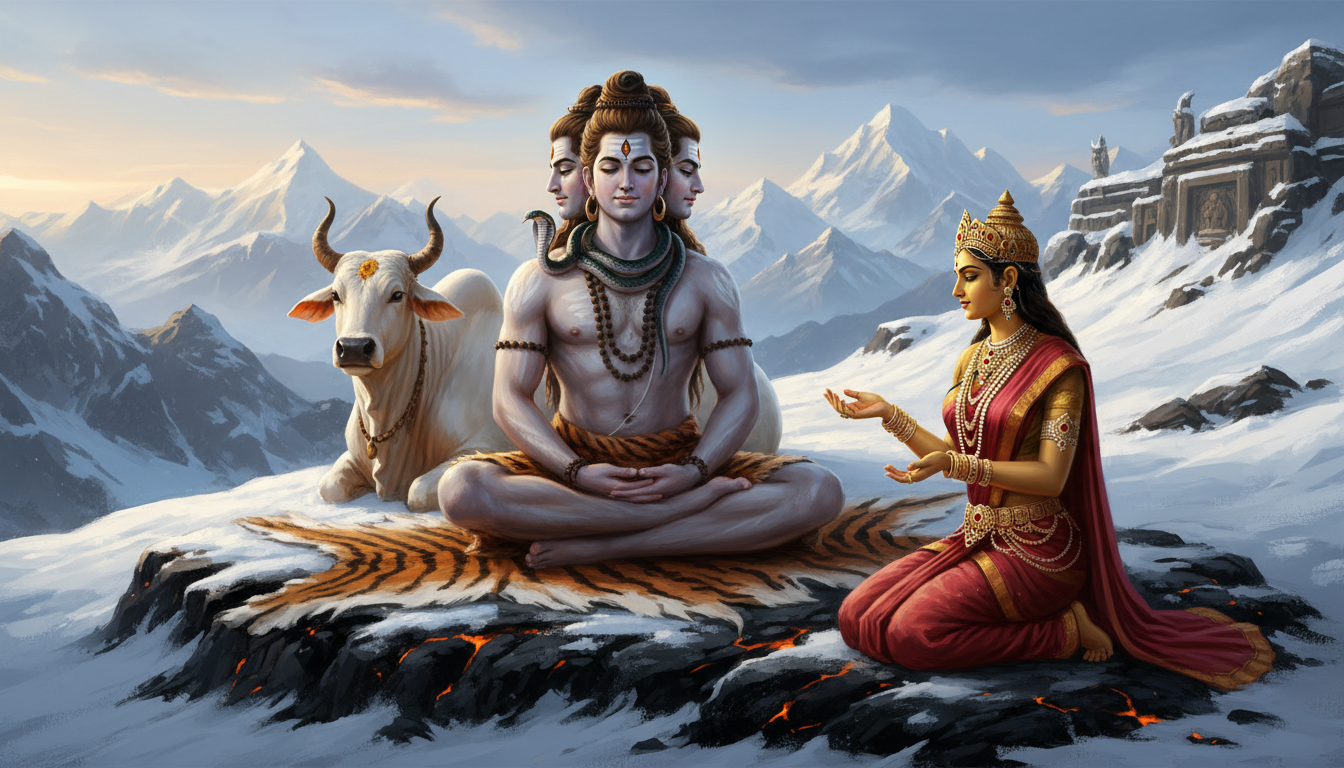
"And in the middle of that racket sat the great deity himself, on a peak adorned with excellent minerals as though it served the purpose of a fine bedstead. Round his loins was a tiger-skin. A lion-skin formed his upper garments. His sacred thread was a snake. His arms were decked with a pair of red Angadas. His beard was green. He had matted locks on his head. Of terrible features, he it is that inspires with fear the hearts of all the enemies of the gods, and it is he, again, that assures all creatures by dispelling their fears.
"The great Rishis, beholding him, bowed by touching the ground with their heads, and were cleansed of every sin by the sight. That is what we saw when we came up the path. And then his wife arrived, and everything that follows happened because she was in a good mood."
Two Hands Over His Eyes
"The daughter of Himavat came to her lord surrounded by the wives of the ghostly beings," said Narada. "Her attire was like that of her lord and the vows she observed were like his. She held on her loins a jar filled with the waters of every Tirtha, and the presiding goddesses of all the mountain streams walked in her train, and she came on raining flowers and sweet perfumes on every side.
"And the beautiful Uma, with smiling lips, desirous of playing a jest, covered from behind, with her two beautiful hands, the eyes of Mahadeva.
"It was a wife's joke. What it did was this. As soon as those eyes were covered, all the regions became dark and life seemed to be extinct everywhere in the universe. The Homa rites ceased. The universe was suddenly deprived of the sacred Vashat. All living creatures became cheerless and filled with fear. When the eyes of the lord of all creatures were closed, the universe seemed to become sunless, and there was nothing playful about it anywhere except in the two hands that had done it.
"Then the darkness disappeared. A mighty and blazing flame of fire emanated from Mahadeva's forehead, and a third eye, resembling another sun, appeared on it. That eye began to blaze like the Yuga-fire, and it began to consume that mountain.
"Himavat burned. The Was trees and the trees of straight trunk, the delightful sandals, the excellent medicinal herbs, the minerals, the summits, all of it went up, and the fire soared to the very heavens and covered every side like a dozen suns. The herds of deer and the other animals came running in fright to the place where Hara sat and sought his protection, and the retreat filled up with terrified creatures, and that is the sight I most remember: everything that could still move on that mountain running towards the god who was burning it, because there was nowhere safer.
"The large-eyed daughter of the prince of mountains bowed her head and stood before him with her hands joined. She could not bear to look at her father in that plight. And Sarva, seeing her overcome by an accession of womanly mildness, cast benignant looks upon the mountain, and in a moment the whole of Himavat was restored, and every tree on it was covered with flowers."
The Questions of the Daughter of the Mountain
"Then the goddess, divested of every fault, addressed her lord," said Narada.
"'O holy one, O deity that art armed with the trident, a great doubt has filled my mind. For what reason has this third eye appeared in your forehead? Why also was the mountain consumed with the woods and all that belonged to it? Why also have you restored the mountain to its former condition? Indeed, having burnt it once, why have you again caused it to be covered with trees?'
"'O goddess without any fault,' said Maheswara, 'in consequence of your having covered my eyes through an act of indiscretion the universe became in a moment devoid of light. When the universe became sunless and therefore all became dark, I created the third eye desirous of protecting all creatures. The high energy of that eye crushed and consumed this mountain. For pleasing you, however, O goddess, I once more made Himavat what he was by repairing the injury.'
"He had answered her, and she did not stop. This is the moment the whole story turns on, and it is easy to walk past it. A woman standing on a mountain that has just been burned and remade for her sake looks at her husband and realises that she has never once asked him about himself. So she asked. Not about duty, which is what everyone asks that god. About his face.
"'O holy one, why are those faces of yours which are on the east, the north and the west so handsome and so agreeable to look at, like the very moon? And why is that face of yours which is on the south so terrible? Why are your matted locks tawny in hue and so erect? Why is your throat blue after the manner of the peacock's plumes? Why is the Pinaka always in your hand? Why are you always a Brahmacharin with matted locks? O lord, it behoves you to explain all these to me. I am your spouse, who seeks to follow the same duties with you. Further, I am your devoted worshipper, O deity having the bull for your mark.'
"And the wielder of Pinaka became highly gratified with her, and said, 'O blessed lady, listen to me as I explain, with the reasons thereof, why my forms are so.'"
The Woman Assembled Out of Beauties
"'In days of yore,' said the blessed and holy one, 'a blessed woman was created by Brahman, called Tilottama, by culling grains of beauty from every beautiful object in the universe.
"'One day that lady of beautiful face, unrivalled in the universe for beauty of form, came to me, O goddess, for circumambulating me, but really impelled by the desire of tempting me.
"'In whatever direction that lady of beautiful teeth turned, a new face of mine instantly appeared. So eager did I become to see her. All those faces of mine became agreeable to look at. Thus, in consequence of the desire of beholding her, I became four-faced, through Yoga-puissance. Thus I showed my high Yoga-power in becoming four-faced.'
"He told it to his wife exactly like that," said Narada, "without softening it and without pretending it had been anything other than what it was. The most famous ascetic in the universe was walked around by a woman put together out of every lovely thing there is, and he could not bear to lose sight of her for the length of one circuit, and grew a face after her each time she passed out of view. Four faces, and a reason for each of them that any husband would rather not have given.
"But he did not leave them useless. Hear what he does with them now.
"'With that face of mine which is turned towards the east, I exercise the sovereignty of the universe. With that face of mine which is turned towards the north, I sport with you, O you of faultless features. That face of mine which is turned towards the west is agreeable and auspicious. With it I ordain the happiness of all creatures. That face of mine which is turned towards the south is terrible. With it I destroy all creatures.'
"Four faces, and one of them exists in order to look at her. That was the answer to why three are as handsome as the moon and one is dreadful. The dreadful one is pointed at the south, where the dead go, and it is doing necessary work, and it is not turned towards his wife."
The Thunderbolt at the Throat
"'I live as a Brahmacharin with matted locks on my head,' said Mahadeva, 'impelled by the desire of doing good to all creatures. The bow Pinaka is always in my hand for accomplishing the purposes of the deities.'
"Two answers in two lines," said Narada, "and both of them say the same thing, which is that neither the discipline nor the weapon is for himself. The locks are the mark of a man under vow, and he keeps the vow on behalf of creatures who do not know he is keeping it. The bow is kept strung because the gods will need it and not because he wants a war.
"Then he answered the question about his throat, and it is the shortest answer he gave and the ugliest thing in it.
"'In days of yore, Indra, desirous of acquiring my prosperity, had hurled his thunderbolt at me. With that weapon my throat was scorched. For this reason I have become blue-throated.'
"That is all. No battle described, no vengeance recorded, no curse laid on the king of the gods, who is still king of the gods and still receives his share. The most recognisable feature of the greatest of the deities, the blue throat that every child can name him by, is a burn scar, and the man who gave it to him did it out of envy of his prosperity and was allowed to walk away.
"Understand what the goddess was being told, one item at a time. The four faces are an old embarrassment. The matted hair is a vow undertaken for strangers. The bow is somebody else's errand. The throat is where a friend struck him. She had asked why her husband looked so strange, and every answer was a thing that had been done to him or for others, and not one of them was an ornament he had chosen."
The Froth From a Calf's Mouth
"'When, O foremost of all creatures, there are so many excellent vehicles endued with great beauty,' said Uma, 'why is it that you have selected a bovine bull for your vehicle?'
"It is a wife's question and there is a little mockery in it. He rides a farm animal. The Regents of the world go about on elephants and horses and swans and he goes about on the thing that pulls a cart.
"'In the days of yore,' said Maheswara, 'the Grandsire Brahma created the celestial cow Surabhi, yielding abundant milk. After her creation there sprang from her a large number of kine, all of which yielded copious quantities of milk sweet as nectar.
"'Once on a time a quantity of froth fell from the mouth of one of her calves on my body. I was enraged at this, and my wrath scorched all the kine, which thereupon became diversified in hue. I was then pacified by the Master of all the worlds, Brahma, conversant with all topics. It was he who gave me this bull, both as a vehicle for bearing me and as a device on my banner.'
"He does not defend the anger," said Narada. "He states it. A calf shook milk off its muzzle, some of it landed on him, and the herds of the world were burnt into every colour that cattle have worn since, which is why you will never find two of them alike in a field at dawn. And when he had been calmed, the one who calmed him did not fine him or curse him. He handed him a bull.
"That is worth sitting with. The penalty for scorching the cattle was to be given a bullock to carry him, so that the god who lost his temper at a herd now cannot go anywhere in the universe except on the back of one of them, and cannot raise his standard in any battle without their shape flying over his head. He has ridden his own bad morning ever since, and he was gratified by the arrangement."
Why He Will Not Leave the Burning Ground
"Then the goddess asked the question she had been working towards all along," said Narada, "and she did not spare him a single detail of it.
"'You have many abodes in heaven, of diverse forms and possessed of every comfort and luxury. Why, O holy one, do you reside in the crematorium, abandoning all those delightful mansions? The crematorium is full of the hair and bones of the dead, abounds with vultures and jackals, and is strewn with hundreds of funeral pyres. Full of carrion and muddy with fat and blood, with entrails and bones strewn all over it, and always echoing with the howls of jackals, it is certainly an unclean place.'
"She had lived in it with him. That is what gives the question its edge. She was not repeating a rumour, she was reciting an address.
"'I always wander over the whole earth in search of a sacred spot,' said Maheswara. 'I do not, however, see any spot that is more sacred than the crematorium. Hence, of all abodes, the crematorium pleases my heart most, shaded as it generally is by branches of the banian and adorned with torn garlands of flowers.
"'O you of sweet smiles, the multitudes of ghostly beings that are my companions love to reside in such spots. I do not like, O goddess, to reside anywhere without those ghostly creatures being by my side. Hence the crematorium is a sacred abode to me. Indeed, O auspicious lady, it seems to me to be the very heaven.'
"There is the answer, and there is the whole of him in it. He will not live in the palaces because his friends are not admitted to the palaces. The beings with the faces of owls and jackals and apes, who are welcome nowhere else in the universe, are welcome on the burning ground, and he will live where they can live. Every frightening thing about that god, when you get behind it and look, turns out to be a scar or a promise. The faces are an old shame. The throat is a friend's blow. The bull is a penance he came to love. And the graveyard is loyalty."
And Then She Asked About Duty
"The catechism ended there," said Narada, "and the goddess turned back to the world.
"'O holy one, O lord of all creatures, I have a great doubt. These ascetics have undergone diverse kinds of austerities. In the world are seen ascetics wandering everywhere under diverse forms and clad in diverse kinds of attire. For benefiting this large assemblage of Rishis, as also myself, do you kindly resolve this doubt of mine. What indications has Religion or Duty been said to possess?'
"And when the daughter of Himavat put that question, the conclave of Rishis there present worshipped the goddess and adored her with words adorned with Riks and with hymns fraught with deep import. We had been sitting on that mountain the whole time. We had heard a god account for his own face to his wife, and we had said nothing, and now that she had turned the talk back to the duties of ordinary people we stood up and praised her, because we knew what she had done for us.
"'Abstention from injury, truthfulness of speech, compassion towards all beings, tranquillity of soul, and the making of gifts to the best of one's power,' said Maheswara, 'are the foremost duties of the householder. Abstention from sexual congress with the spouses of other men, protection of the wealth and the woman committed to one's charge, unwillingness to appropriate what is not given to one, and avoidance of honey and meat, these are the five chief duties. Indeed, Religion or Duty has many branches, all of which are fraught with happiness.'
"And from there he went on to the four orders, and the householder and the mendicant, and the religion of the Rishis, and all of that is another discourse and a long one."
Bhishma stopped there and let Yudhishthira have the point.
"You will hear men say that god is unapproachable and that his forms are not to be enquired into. She enquired into them. She covered his eyes for a joke, she watched her father's mountain burn and be put back, and then she asked her husband to account for himself item by item, and he did it, in order, without one word of reproof. There is no one in the three worlds who knows what those four faces are for except the woman who asked."
Dharma Lesson
The things that make a being look frightening from outside are usually scars and promises seen from the wrong side. The four faces are an old embarrassment, the blue throat is where a friend's thunderbolt struck, the bull is a penance he came to love, and the burning ground is loyalty to companions welcome nowhere else. Only someone who loves a person enough to ask, item by item, ever learns which is which.