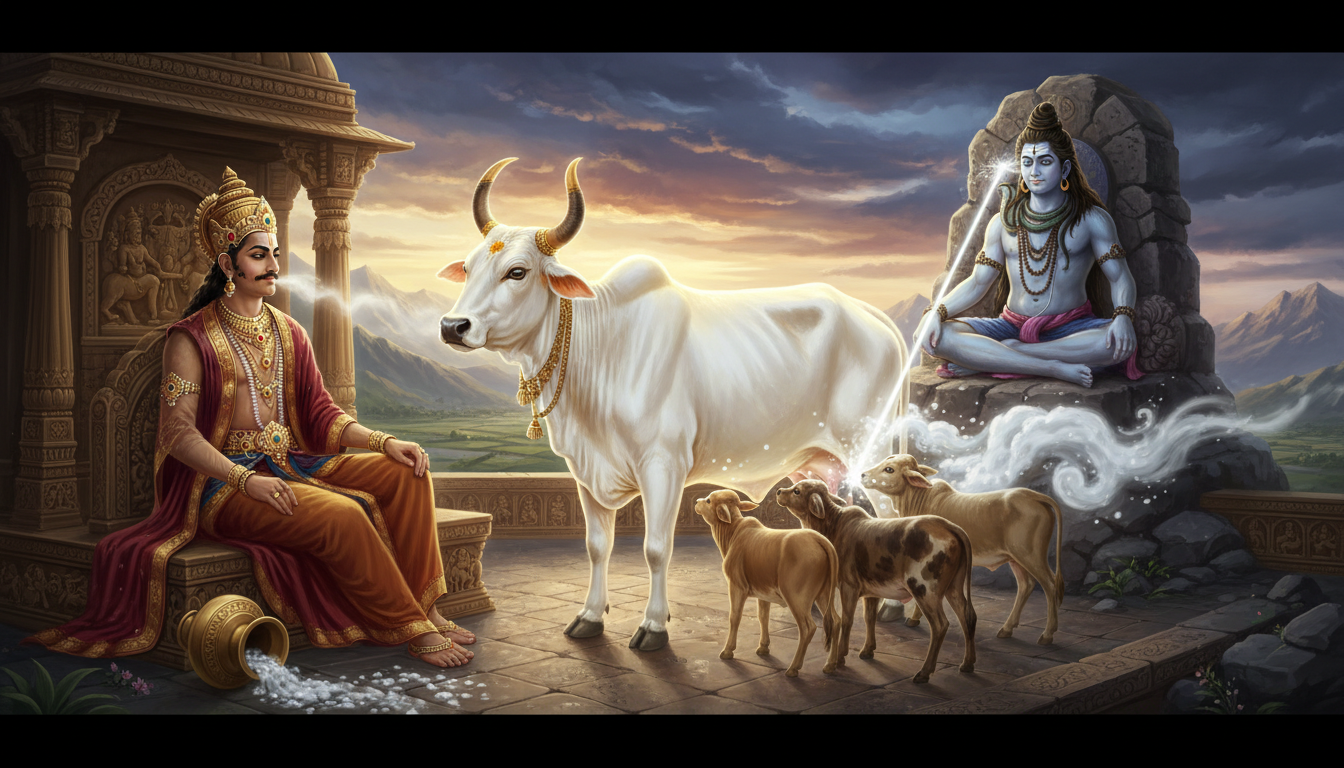
The Cow Born of Nectar
Daksha's gift, Mahadeva's third eye, and why cattle wear many colours
Not Yet Satiated
"King Yudhishthira, endued with humility, once again questioned the royal son of Shantanu on the subject of the gift of kine in detail," said Vaishampayana.
Janamejaya moved his hand. "Again? He had already asked twice."
"He had asked three times, O king, and he asked a fourth, and this is what he said to the old man on the arrows. 'Discourse to me once more, Bharata, in detail, on the merits of giving away kine. Verily, hero, I have not been satiated with hearing your words, which are like nectar.'
"You must understand what the request was really for. The war was over. Every man of that generation whom Yudhishthira had grown up beside was ash on the Kurukshetra plain, and the grandsire was going to die as soon as the sun turned north, and the king had discovered the one thing that would keep him talking. So he asked about cows. And Santanu's son, thus addressed by Yudhishthira the just, began once again to discourse in detail upon the merits attaching to the gift of kine, and did not once say that he had covered it already."
Janamejaya said, "And this is where the cow of the gods comes into it."
"This is where she comes into it," said Vaishampayana. "But Bhishma began with the cows a man can actually put his hand on, because he always did, and the celestial part only arrived because the king interrupted him with a question about colour."
Which Cow May Be Given
"'By giving to a brahmana a cow possessed of a calf,' said Bhishma, 'a cow endued with docility and other virtues, young in years, and wrapped round with a piece of cloth, a man becomes cleansed of all his sins. There are many regions in hell which are sunless. One who makes the gift of such a cow does not have to go there.'
"Then he turned it over, because the shape of a duty is best seen from its wrong side.
"'That man, however, who gives to a brahmana a cow that is incapable of drinking or eating, whose milk has dried up, whose senses have all been weakened, that is diseased and overcome with decrepitude, a cow that may therefore be likened to a tank whose water has been dried up, that man, who thereby inflicts only pain and disappointment upon the one he pretends to honour, has certainly to enter into dark hell.
"'A cow that is wrathful and vicious, or diseased, or weak, or that has been purchased without the price agreed upon having been paid, a cow that would only afflict the regenerate recipient with distress and disappointment, should never be given. Whatever regions such a man may acquire as the reward of other righteous acts will fail to give him any happiness or impart to him any energy. Only such kine as are strong, endued with good behaviour, young in years, and possessed of fragrance, are applauded in the matter of gift.'
"He let that stand a moment, and then he added the sentence that started everything else.
"'Verily, as Ganga is the foremost of all rivers, even so is a Kapila cow the foremost of all kine.'"
Why the Tawny One?
"'Why, grandsire,' said Yudhishthira, 'do the righteous applaud the gift of a Kapila cow as more meritorious, when all good kine that are given away should be regarded as equal? You are competent to discourse on this. I wish to hear what the distinction is that attaches to her.'
"It is a small question and it opened a door in the old man. He was quiet for a while, the way a man is quiet who is going a long way back.
"'I have heard old men recite this history,' he said, 'respecting the circumstances under which the Kapila cow was created. I shall recite that old history to you.
"'In days of yore, the Self born Brahman commanded the rishi Daksha, saying, Do you create living creatures.
"'Now mark what Daksha did with that order, because it is not what anyone else would have done with it. He was told to make creatures. From a desire of doing good to the creatures, Daksha in the first instance created food.
"'Even as the deities exist depending upon nectar, so all living creatures, puissant one, live depending upon the sustenance assigned to them by Daksha. Among all objects mobile and immobile, the mobile are superior. Among mobile creatures the brahmanas are superior. The sacrifices are all established upon them. It is by sacrifice that Soma is got. And sacrifice itself has been established upon kine, for it is from the cow that the offering comes. The gods become gratified through sacrifices. So the chain runs down from the gods to the grass, and at the middle of it stands a cow.
"'As regards the creation, then, the means of support came first, and the creatures came next. Remember the order. It is the whole of Daksha's wisdom.'"
The Children Cried for Food
"'As soon as the creatures were born,' said Bhishma, 'they began to cry aloud for food.
"'There is no dignity in the beginning of the world. Picture it as it was. Everything that breathes has just been made, all of it at once, and none of it knows anything, and every one of them opens its mouth and makes the one sound that a new creature makes. All of them then approached their creator who was to give them food, like children approaching their father or their mother.
"'And Daksha, the holy lord of all creatures, knew the intention that moved them. He had prepared for exactly this. He had made the food before he made the mouths.
"'What he did then is the strangest turn in the story, and I have never heard it explained. For the sake of the beings he had created, he himself drank a quantity of nectar.
"'He did not pour it out for them. He did not hand it down. He drank it, himself, on their behalf, as a mother eats so that a child may be fed. He became gratified with the nectar he had quaffed.'"
Janamejaya said, "And nothing came of it?"
"Everything came of it," said Vaishampayana, "and it came out of his mouth."
The Fragrant Breath
"'Thereupon an eructation came out of him,' said Bhishma, 'diffusing an excellent perfume all around.
"'That is what the text says and I will not dress it up for you. The mother of the cattle of this world was born of a belch. There is a lesson in that for men who are particular about where holiness is permitted to come from.
"'As the result of that eructation, Daksha saw that it had given birth to a cow. He named her Surabhi, the fragrant one, and this Surabhi was thus a daughter of his that had sprung from his mouth.'
"Consider her a moment," said Vaishampayana, "before the story runs on and leaves her behind. She was not created by a plan. She was the overflow of a father's satisfaction after he had swallowed sweetness on behalf of his crying children, and she came out of him smelling of it, and every cow that has ever stood in a field chewing in the sun is her daughter, and that faint sweet smell that hangs about a cattle byre at evening is her name. Surabhi. The fragrance.
"And Daksha, having been ordered to make creatures and having made food first, now found that food had made herself into a creature, and that the creature would go on making food forever. That was the end of the problem of hunger, and he had solved it by drinking."
The Mothers of the World
"'The cow called Surabhi brought forth a number of daughters,' said Bhishma, 'who came to be regarded as the mothers of the world.
"'Their complexion was like that of gold, and they were all Kapilas. There is your answer, son of Pritha, and it has taken us this far to reach it. The tawny gold cow whose gift the righteous applaud above every other is not merely a fine animal of a favoured colour. She is the colour they were all born in. She is what the daughters of Surabhi looked like before anything happened to them.
"'They were the means of sustenance for all creatures. Everything that eats, eats from them, either directly or at one remove or at ten. And those kine, whose complexion resembled that of Amrita, since they had come out of nectar and were nectar in another form, began to pour milk.
"'And here the trouble starts, and it starts for the reason trouble usually starts, which is that something good was overflowing and it splashed on somebody important.
"'The froth of that milk arose and began to spread on every side, even as when the waves of a running stream dash against one another and copious froth is produced that spreads on every side. Milk enough for the world makes froth enough for the world. It went out in every direction from under the calves, white and warm and full of air, and it went where nobody had directed it, because that is the nature of froth.'"
It Fell on Mahadeva
"'Some of that froth fell,' said Bhishma, 'from the mouths of the calves that were sucking, upon the head of Mahadeva, who was then sitting on the earth.
"'He was not enthroned. He was not in his mountain. He was sitting on the ground, as he does, in the middle of the new world, and the spatter of milk that a calf shakes off its muzzle came down on the head of the god who wears the moon.
"'The puissant Mahadeva thereupon, filled with wrath, cast his eyes upon those kine.
"'Understand what was in the anger, for it was not simple bad temper. What had touched him was ucchishta, the leavings of another mouth, the remnant of food that somebody else has been eating. A god who has been touched by leavings has been defiled, and defilement in a being of that power does not stay a private matter.
"'With that third eye of his which adorns his forehead, he seemed to burn those kine as he looked at them.'"
"Every herd on earth," said Vaishampayana, "stood in the open with the eye on them, and not one of them had done anything except be a mother and let a calf drink."
Why Cattle Wear Many Colours
"'Like the sun tingeing masses of clouds with diverse colours,' said Bhishma, 'the energy that issued from the third eye of Mahadeva produced, O monarch, diverse complexion in those kine.
"'That is the answer to a question no one thinks to ask. Go out at dawn and look at the cattle standing in the mist and count what you see. Black, red, dun, brindled, white with a black shoulder, roan, spotted along the flank. Not one of those colours was intended. They are all scorch marks. They are what the light did to gold as it passed over the herd, the way a cloud takes on twenty colours when the sun goes across it, and the cattle of this world have worn the record of one god's bad morning ever since.
"'Those amongst them, however, which succeeded in escaping from the glance of Mahadeva by entering the region of Soma, remained of the same colour with which they were born, for no change was produced in their complexion.
"'They ran into the moon and the moon hid them. Those are the Kapilas, the tawny gold ones, who kept the colour of nectar because they were not standing in the open when the eye opened. So when you are told to give a Kapila cow above all others, you are being told to give one of the unaltered ones, a daughter of Surabhi as she came from Surabhi, with nothing burnt into her hide.'"
The Argument of Daksha
"'Seeing that Mahadeva had become exceedingly angry,' said Bhishma, 'Daksha, the lord of all creatures, addressed him.
"'Do not imagine he began by apologising. He began by correcting the god's understanding of what had happened.
"'You have been drenched with nectar, great deity. The milk or the froth that escapes from the mouths of calves sucking their dams is never regarded as an impure remnant. Chandramas, after drinking the nectar, pours it out once more, and it is not on that account looked upon as impure. After the same manner, the milk that these kine yield, being itself born of nectar, should not be regarded as impure, even though the udders have been touched by the calves with their mouths.
"'Then he gave the list, and it is worth learning by heart.
"'The wind can never become impure. Fire can never become impure. Gold can never become impure. The ocean can never become impure. The nectar, even when drunk by the deities, can never become impure. Similarly, the milk of a cow, even when her udders are sucked by her calf, can never become impure.
"'These kine will support all these worlds with the milk they will yield and the ghee that will be manufactured from it. All creatures wish to enjoy the auspicious wealth, identifiable with nectar, that kine possess.
"'There is the whole doctrine, son of Pandu, in six examples and a conclusion. Some things are of such a nature that use does not soil them. What feeds the world cannot be made filthy by the mouth that feeds from it, any more than the sea is made filthy by the rivers that run into it or fire by what is thrown on it.'"
The Bull on the Banner
"'Having said these words,' said Bhishma, 'the lord of creatures made a present to Mahadeva of a bull, together with certain kine. With that present Daksha gratified the heart of Rudra.
"'And Mahadeva, thus gratified, made that bull his vehicle. It was after the form of that bull that he adopted the device on the standard floating over his battle car. For this reason Rudra came to be known as the bull bannered deity. And it was on that occasion also that the celestials, uniting together, made Mahadeva the lord of animals, and the great Rudra became the master of kine.
"'So the god who came to that herd in anger left it as its own master, and he has carried it on his flag ever since, and he rides it still. Hence, O king, in the matter of giving away kine, the gift is regarded as primarily desirable of Kapila kine, which are endued with great energy and possessed of colour unchanged. Thus are kine the foremost of all creatures in the world. It is from them that the means have flowed for the sustenance of all the worlds. They have Rudra for their master. They yield Soma in the form of milk. They are auspicious and sacred, and grantors of every wish, and givers of life.'"
Vaishampayana turned back to Janamejaya. "Hearing these words of his grandsire, Pritha's son, the royal Yudhishthira of Ajamida's race, united with his brothers and began to make gifts of bulls and of kine of different colours to the foremost of brahmanas. For the purpose of subduing regions of felicity in the next world, and of winning great fame, that king performed many sacrifices, and as sacrificial presents he gave away hundreds of thousands of kine.
"Of different colours, O king. He had just been told which colour was best, and he gave away all of them."
Dharma Lesson
What feeds the world cannot be made impure by the mouth that feeds from it, and Daksha proves it not by apology but by argument: wind, fire, gold, the ocean and nectar itself are all things that use does not soil. The order of creation carries the same lesson, for the maker who was told to produce creatures produced their food first. The god who came to that herd in anger left it as its own master, riding one of them and carrying their shape on his banner.