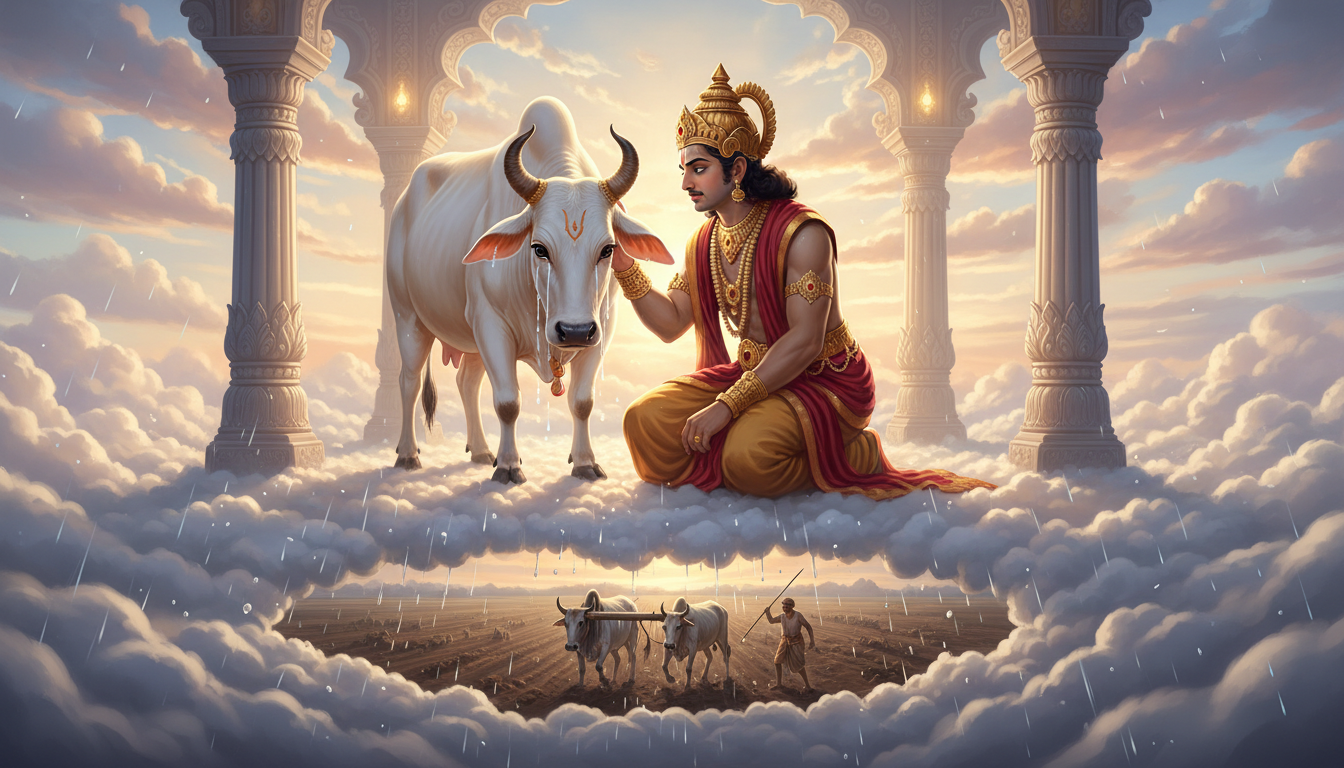
The Cow Who Wept for the Weaker Calf
Indra learns why a mother's love is not divided equally
The Riders Who Never Reached the Forest
Word went round the palace that Vidura had come back and that the king had taken him on his lap and asked his forgiveness, and Duryodhana, hearing it, began to burn.
He summoned the son of Suvala, and Karna, and Dussasana, into a room with the doors shut.
"The learned Vidura, my father's minister, has returned," he said. "He is the friend of the sons of Pandu and is ever engaged in doing what benefits them. So long as this Vidura does not succeed in inducing the king to bring them back, do you all think of what may benefit me. If ever I behold the sons of Pritha return to this city, I shall be emaciated again by renouncing food and drink. I shall take poison, or hang myself, or enter the pyre, or kill myself with my own weapons. I will never be able to look at the sons of Pandu in prosperity."
Shakuni told him to be calm: the Pandavas had given a particular pledge, and men who abide by the truth do not come home early. Dussasana agreed with his uncle, as he always agreed with his uncle. And then Karna lost patience with the whole conversation.
"Princes, know my opinion," he said. "We are all servants of the king, waiting upon him with joined palms, and we are not always able to seek his welfare with promptness. But let us now, encased in mail and armed with our weapons, mount our cars and go in a body and slay the Pandavas living in the forest. As long as they are in distress, as long as they are in sorrow, as long as they are destitute of help, so long are we a match for them. This is my mind."
They applauded him repeatedly, and at last exclaimed, very well. Each of them mounted his car. Sanguine of success, they rushed out in a body to kill the sons of Pandu.
They did not get out of the gates. Knowing by his spiritual vision that they had gone out, Krishna Dwaipayana came upon them on the road and commanded them to desist, and sent them back the way they had come. Then the holy one went in to the king, who was sitting at his ease and knew nothing of any of it.
What Waits at the End of Thirteen Years
"O wise Dhritarashtra, hear what I say," said Vyasa. "I will tell you that which is for the great good of all the Kauravas."
The blind king turned his face toward the voice and composed it into the expression of a man about to be told something he already knew.
"O you of mighty arms, it has not pleased me that the Pandavas have gone to the forest, dishonestly defeated at dice by Duryodhana and the others. O Bharata, on the expiration of the thirteenth year, recollecting all their woes, they may shower death-dealing weapons, even like virulent poison, upon the Kauravas."
He did not say it as prophecy. He said it as arithmetic. Thirteen years is a long time to be a strong man with nothing to do but remember.
"Why does your sinful son of wicked heart, ever inflamed with ire, seek to slay the sons of Pandu for the sake of their kingdom? Let the fool be restrained. Let your son remain quiet. In attempting to slay the Pandavas in exile he will only lose his own life. You are as honest as the wise Vidura, or as Bhishma, or as ourselves, or as Kripa, or as Drona. O you of great wisdom, dissensions with one's own kin are forbidden, sinful and reprehensible. Therefore, O king, it behoves you to desist from such acts."
Then the muni offered him a strange remedy, and offered it seriously.
"Or let this wicked son of yours, O monarch, alone and unaccompanied, himself go to the forest and live with the sons of Pandu. For then, if the Pandavas from association feel an attachment for Duryodhana, good fortune may yet be yours."
He paused, and took the hope back with his next breath.
"This, however, may not be. For it has been heard that one's congenital nature leaves him not till death. But what do Bhishma and Drona and Vidura think? What also do you think? That which is beneficial should be done while there is time, or your purposes will be unrealised."
Drawn By Fate
Dhritarashtra did what he did best, which was to agree completely and change nothing.
"O holy one, I did not like this business of gambling," he said. "But, O muni, I think I was made to consent to it, drawn by fate. Neither Bhishma, nor Drona, nor Vidura, nor Gandhari liked this game at dice. No doubt it was begot of folly."
He had the whole list ready, and every name on it was a name that had told him no. He recited them like a man producing witnesses to his own good character, and did not appear to notice that the list was, in fact, the case against him: four people of sense had objected, and the thing had happened anyway, in his hall, at his word, and there had been nobody in the world with the authority to permit it except himself.
Then he came to the sentence he had been walking toward the whole time, and his voice went out of the register of statecraft altogether.
"And, O you who delight in the observance of vows, O illustrious one, knowing everything, yet influenced by paternal affection, I am unable to cast off my senseless son Duryodhana."
There it was, laid on the floor between them. Not a defence of the boy. Not even a claim that the boy was right. Simply the confession of an old man who could see the ruin coming down the road toward his house and could not make his hands do the one thing that would have turned it aside.
Vyasa was quiet for a moment. He was the father of this king, though the court did not often say so aloud, and he had been told a great many things by a great many men in trouble.
"O king, O son of Vichitravirya," he said at last, "what you say is true."
Nothing So Good As a Son
"We know it well," Vyasa went on, "that a son is the best of all things, and that there is nothing that is so good as a son. I am not going to argue you out of loving him. It is not an error. It is the one true thing you have said this evening.
"But you have taken a true thing and used it as a licence, and that is a different matter. So let me put it to you the way it was once put to the king of the gods, who also had to be taught it, and who was not a fool either. Instructed by the tears of Surabhi, Indra came to know that a son surpasses in worth all other valuable possessions. O monarch, I will in this connection relate to you that excellent and best of stories, the conversation between Indra and Surabhi."
The lamps were lit around the chamber. Somewhere out beyond the doors the household was going about its evening, and in the hall behind them the dicing board had long since been carried away and the floor swept. The blind king turned his ear toward the sage and sat still, which was the thing he did well, and waited.
"In days of yore," said Vyasa, "Surabhi, the mother of cows, was once weeping in the celestial regions."
Weeping in the Celestial Regions
She was the mother of all cattle that walk the earth, and she stood in heaven, among the immortals, in a place where grief has no obvious business, and she was weeping.
Indra saw her, and Indra took compassion upon her, and went to her; and because he was the king of that place and had a king's habit of mind, his first thought was that something had gone wrong with the administration of the worlds.
"O auspicious one, why do you weep?" he asked. "Is everything well with the celestials? Has any misfortune, ever so little, befallen the world of men, or of serpents?"
It is worth marking what he had reached for. A goddess in tears must mean a breach somewhere: a war among the gods, a plague among mortals, some disorder in the lower regions. He had run through the whole map of creation looking for the size of catastrophe that would account for what he was seeing on her face.
"No evil has befallen you, that I perceive," said Surabhi. "But I am aggrieved on account of my son, and it is therefore, O Kausika, that I weep."
Indra waited for the rest of it, for the name of the demon or the disease. It did not come. Instead she turned her head and looked down, past the floor of heaven, past the clouds, at a field.
The Pair at the Plough
"See, O chief of the celestials," she said. "Yonder cruel husbandman is belabouring my weak son with the wooden stick, and oppressing him with the weight of the plough, in consequence of which my child, agitated with agony, is falling upon the ground and is at the point of death."
Indra looked where she was looking, and there was nothing there worth the notice of the lord of the three worlds: a man, a field, a plough, and two bullocks under one yoke, at the ordinary work of the ordinary earth on an ordinary afternoon.
"At the sight of this, O lord of the celestials, I am filled with compassion, and my mind is agitated."
Then she made him look properly, and told him what to look at, and it was in the difference between the two animals that the whole of the thing lay.
"The one that is the stronger of the pair is bearing his burden of greater weight with ease. But, O Vasava, the other is lean, and weak, and is a mass of veins and arteries. He bears his burden with difficulty. And it is for him that I grieve. See, O Vasava, sore inflicted with the whip, and harassed exceedingly, he is unable to bear his burden. And it is for him that, moved by grief, I weep in heaviness of heart, and these tears of compassion trickle down my eyes."
One yoke. One field. One driver, with one stick, laying it about him impartially. And under the beam, two creatures of the same birth and the same mother, of whom one was managing and one was going down.
Why One, When You Have Thousands
Sakra put to her the question that any sensible administrator of the universe would have put, and it was not a cruel question. It was the arithmetic of scale, which is the arithmetic that kings and gods are trained in.
"O fair one," he said, "when thousands of your sons are daily oppressed, why do you grieve for one under infliction?"
It was, on its face, unanswerable. She was the mother of every cow in the world. At that hour there were beasts being goaded in ten thousand fields, beasts falling in harness, beasts driven past their strength on every road between the mountains and the sea. If she was going to weep for them, she would have to weep for all of them, and if she wept for all of them she could not possibly be weeping like this for one lean bullock in one field in the afternoon. Grief on that scale is not grief. It is weather.
Surabhi answered him without any difficulty at all, because she was not reasoning about it. She was only reporting what was true.
"Although I have a thousand offspring, yet my affections flow equally towards all. But, O Sakra, I feel greater compassion for one that is weak and innocent."
There is the whole teaching, in two clauses, and the second does not contradict the first. Love is not the thing being divided. Love goes out to all of them at once and undiminished. What moves, what leans, what goes where it is needed, is the other thing: the pity, the attention, the hand that reaches down. And that does not distribute itself evenly at all. It goes to the one who is failing, and it goes there for the plain reason that he is failing.
The Shower That Stopped the Plough
Then Indra, having heard these words of Surabhi, was much surprised.
He was the wielder of the thunderbolt, the chastiser of Paka, the slayer of the demon hosts, and he had just been instructed in something by a cow. He did not resent it. He became convinced, O you of the Kuru race, that a son is dearer than one's own life; and being convinced, he did what he was uniquely equipped to do about it.
He made it rain.
Not a sign, not a portent, not a voice out of the sky rebuking the ploughman for his cruelty. The illustrious chastiser of Paka thereupon suddenly poured down there a thick shower, and caused obstruction to the husbandman's work.
Down in the field the man straightened up, looked at the sky in disgust, and swore, because the weather had turned against him for no reason that any farmer could see. The furrow filled. The oxen stood in the wet with the beam gone slack across their shoulders. He unhitched them and drove them off the sodden ground, and the lean one, that had been at the point of death an hour before, walked off the field alive.
That was the whole of the divine intervention. No miracle was announced and no one on earth knew that anything had happened. The king of the gods had been told about one weak animal, and had reached down and taken the weight off him for an afternoon, and had gone back to his throne.
Your Hundred and One, and His Five
Vyasa let the rain stop, and then turned the whole thing around and set it down in front of the blind king with the point outward.
"And as Surabhi said, so your affections, O king, flow equally towards all your sons. Let them be greater towards those that are weak."
Dhritarashtra said nothing.
"And as my son Pandu is to me, so are you, O son, and so also is Vidura of profound wisdom. It is out of affection that I tell you all this."
He had not raised his voice once in the entire evening, and he did not raise it now.
"O Bharata, you are possessed of a hundred and one sons. Pandu has only five. And they are in a bad plight, and passing their days in sorrow. How may they save their lives, how may they thrive: such thoughts regarding the distressed sons of Pritha continually agitate my soul."
There was the yoke, then, laid across the Kuru house. One team, one field, one father holding the stick. On one side a hundred and one sons in a walled city with the granaries and the treasury and the army and the elephants, carrying their burden of greater weight with perfect ease. On the other side five men in a forest, and a woman with her hair unbound, eating roots.
"O king of the earth," said Vyasa, "if you desire all the Kauravas to live, let your son Duryodhana make peace with the Pandavas."
Everything But the Doing of It
"O muni of profound wisdom, it is even as you say," said Dhritarashtra. "I know it well, as do all these kings. Indeed, what you consider to be beneficial for the Kurus was pointed out to me, O muni, by Vidura and Bhishma and Drona."
It was the same answer he had given before the dice and would give again before the war: yes, and everyone has told me so, and I understand it perfectly. He had heard the parable. He had taken the point of it entire. He had even conceded that the good men of his court had said the same thing first. And then, at the very end of his agreement, he handed the work back.
"And if I deserve your favour, and if you have kindness for the Kurus, do you exhort my wicked son Duryodhana."
A man who cannot cast off his son also cannot correct him, and so he asked another man to do it. Vyasa did not argue. He had known this king a long time.
"O king, after having seen the Pandava brothers, here comes the holy rishi Maitreya, with the desire of seeing us. That mighty rishi will admonish your son for the welfare of this race. And, O Kauravya, what he advises must be followed undoubtingly, for if what he recommends is not done, the sage will curse your son in anger."
Saying this, Vyasa departed.
So the parable was told in full, and heard in full, and agreed with in full, and the one act it asked for was passed along to a guest who had not yet crossed the threshold. Out in the Kamyaka woods the five weak ones went on eating what the forest gave them. Their father's brother sat in a lamplit room in Hastinapura, weeping easily, loving all his sons equally, and reaching down to help none of them.
Dharma Lesson
Partiality that runs toward the weak is compassion; partiality that runs toward the strong is only appetite wearing a father's face. Affection may flow equally to every child at once, but the hand that reaches down has to choose, and it belongs to whichever of them is going under the yoke. Dhritarashtra agreed with every word of this and still did nothing, which is the other half of the lesson.