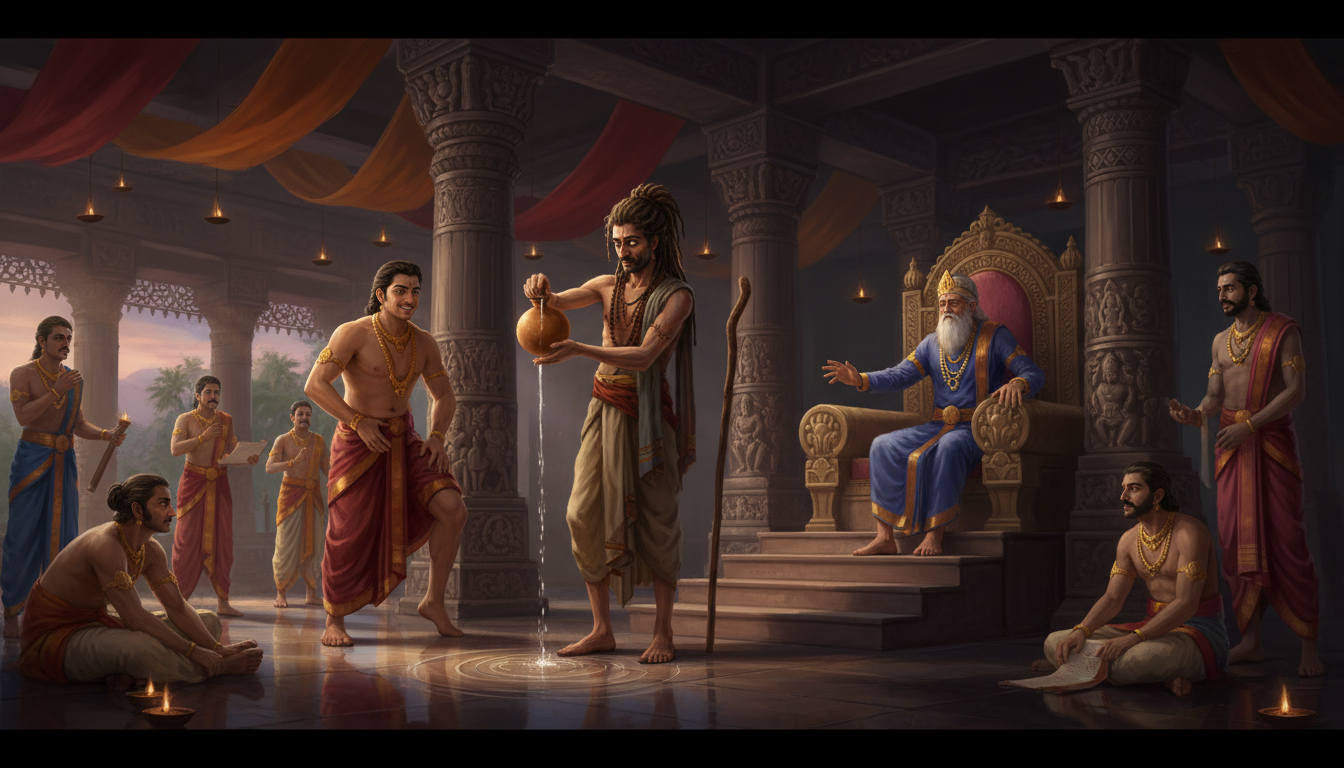
The Curse on Duryodhana's Thigh
A sage asks politely once, and is answered with a scratched foot
The Chariots That Did Not Leave the Gate
Vaishampayana said: The exile was only weeks old when Karna made his proposal in Duryodhana's hall, and he made it plainly, as a soldier states a window of opportunity.
"We are not always able to seek the king's welfare with promptness," he said, "because we depend upon Dhritarashtra. But let us now, encased in mail and armed with our weapons, mount our cars and go in a body to slay the Pandavas where they are living in the forest. When they have been quieted, and have gone upon the unknown journey, then both we and the sons of Dhritarashtra will find peace. So long as they are in distress, so long as they are in sorrow, so long as they are destitute of help, we are a match for them. This is my mind."
They applauded him again and again, and at last cried out together, "Very well." Each of them went to his car. They were sanguine of success. They rushed out in a body to kill five men who at that moment owned nothing but bark cloth and a bow apiece.
And Krishna-Dwaipayana Vyasa, knowing by his spiritual vision that they had set out, came upon them on the road and commanded them to desist.
That is all the text says of it, and it is enough. There is no fight in it. An old man in a rag stood in front of the chariots of the Kuru princes and told them to go back, and they went back, and the greatest archer of the age turned his horses round with the rest. Having sent them home, the holy one, worshipped by all the worlds, went quickly to the king whose intelligence served him for eyesight, and found him sitting comfortably, hearing nothing of any of it.
What Vyasa Told the Blind King
"O wise Dhritarashtra, hear what I say," Vyasa said. "I will tell thee what is for the great good of all the Kauravas.
"O thou of mighty arms, it has not pleased me that the Pandavas have gone to the forest, dishonestly defeated at dice by Duryodhana and the others. O Bharata, on the expiration of the thirteenth year, recollecting all their woes, they may shower death-dealing weapons upon the Kauravas, like virulent poison. Why does thy sinful son, of wicked heart and ever inflamed with ire, seek to slay the sons of Pandu for the sake of their kingdom? Let the fool be restrained. Let thy son remain quiet. In attempting to slay the Pandavas in exile, he will only lose his own life.
"Thou art as honest as the wise Vidura, or as Bhishma, or as ourselves, or as Kripa, or as Drona. O thou of great wisdom, dissensions with one's own kin are forbidden, and sinful, and reprehensible. It behoveth thee to desist from such acts. Duryodhana looks with such jealousy upon the Pandavas that great harm will follow if thou dost not interfere."
Then he offered a remedy so strange that the court remembered it for years afterward, and none of them ever knew whether he had meant it seriously.
"Or let this wicked son of thine go alone and unaccompanied to the forest, and live there with the sons of Pandu. For if the Pandavas, from association, come to feel an attachment for Duryodhana, then, O king of men, good fortune may yet be thine." And then, in the same breath, Vyasa took the remedy away again. "This, however, may not be. For it has been heard that a man's congenital nature leaves him not till death.
"But what do Bhishma and Drona and Vidura think? And what dost thou think? That which is beneficial should be done while there is time, or else thy purposes will remain unrealised."
Why the Cow Wept
"O holy one," said Dhritarashtra, "I did not like this business of gambling. But I think I was made to consent to it, drawn by fate. Neither Bhishma, nor Drona, nor Vidura, nor Gandhari liked that game at dice. No doubt it was begotten of folly. And knowing everything, yet influenced by a father's affection, I am unable to cast off my senseless son Duryodhana."
"What thou sayest is true," said Vyasa. "We know well that a son is the best of all things, and that there is nothing so good as a son. Instructed by the tears of Surabhi, even Indra came to know that a son surpasses in worth every other possession. I will relate to thee that conversation.
"In days of yore Surabhi, the mother of cows, was weeping in the celestial regions, and Indra took compassion upon her and asked her why. 'No evil has befallen thee that I perceive,' she said. 'But I am aggrieved on account of my son, and it is therefore that I weep. See, O chief of the celestials, yonder cruel husbandman is belabouring my weak son with a wooden stick and oppressing him with the weight of the plough, so that my child, agitated with agony, is falling upon the ground at the point of death. The one that is the stronger of the pair bears his burden of greater weight with ease, but the other is lean and weak and a mass of veins, and bears it with difficulty. It is for him that I grieve. Sore inflicted with the whip, and harassed exceedingly, he is unable to bear his load, and it is for him that these tears of compassion trickle down my eyes.'
"'O fair one,' said Sakra, 'when thousands of thy sons are oppressed daily, why dost thou grieve for one under infliction?'
"'Although I have a thousand offspring, my affections flow equally toward all,' Surabhi said. 'But I feel greater compassion for the one that is weak and innocent.'
"Then Indra was much surprised, and became convinced that a son is dearer than one's own life, and the chastiser of Paka suddenly poured a thick shower down upon that field, and put a stop to the husbandman's work.
"And as Surabhi said, so thy affections, O king, flow equally toward all thy sons. Let them be greater toward those that are weak. As my son Pandu was to me, so art thou, and so also is Vidura of profound wisdom. It is out of affection that I tell thee all this. O Bharata, thou art possessed of a hundred and one sons, and Pandu has only five, and they are in a bad plight and passing their days in sorrow. How may they save their lives, how may they thrive, these thoughts continually agitate my soul. O king of the earth, if thou desirest all the Kauravas to live, let thy son Duryodhana make peace with the Pandavas."
There Is a Sage on the Road
"O Muni of profound wisdom, it is even as thou sayest," the king answered. "I know it well, and so do all these kings. Indeed, what thou considerest to be beneficial for the Kurus was pointed out to me by Vidura, and by Bhishma, and by Drona." He turned his blind face toward the voice. "And if I deserve thy favour, and if thou hast any kindness for the Kurus, do thou exhort my wicked son Duryodhana."
It was the whole of Dhritarashtra in one sentence. He agreed with everything. He had been told the same thing by three men already. And what he asked for was not the strength to command his son but another visitor who might succeed where he had not tried.
Vyasa did not refuse him. He gave him something instead, and he gave it as a warning.
"O king, after having seen the Pandava brothers, the holy Rishi Maitreya is coming here, with the desire of seeing us. That mighty Rishi will admonish thy son, for the welfare of this race. And, O Kauravya, what he advises must be followed without any doubting. For if what he recommends is not done, the sage will curse thy son in anger."
Saying that, Vyasa departed, and did not stay for the visit.
So the household had it in advance, in plain words, from the one man in the world none of them had ever caught in an error: a sage is on the road, obey him, or your son is cursed. There was time to prepare. There was time to speak to Duryodhana. Nobody did either.
The Arghya at the Door
Maitreya came in dusty and travel-worn, and the king with his son received him respectfully, with the offering of the Arghya and the other rites. Water for the feet, water for the hands, honey and curds, a seat. It was done properly. Whatever else that court had lost, it had not lost its manners at a door.
Then Dhritarashtra, the son of Ambika, addressed the sage in words of respect, and asked three questions in a row, and every one of them was the question of a man who wants to be told that nothing has happened.
"O holy one, has thy journey from the Kuru-jangala been a pleasant one? Are those heroes, the five Pandavas, living happily? Do those bulls of the Kuru race intend to stay out their time?"
And then a fourth, which was the only one he really cared about.
"Will the brotherly affection of the Kauravas ever be impaired?"
Duryodhana sat beside him and said nothing. He knew who this was. He knew, because Vyasa had told the whole hall, what the old man had come for, and he had decided in advance how he would receive it.
What I Saw in the Woods of Kamyaka
"Setting out on a pilgrimage to the different shrines, I arrived at Kuru-jangala," Maitreya said, "and there I unexpectedly saw Yudhishthira the just, in the woods of Kamyaka."
He described what he had seen, and he did not describe it kindly, because he was not making conversation.
"Many Munis had come there to behold that high-souled one, dwelling in an ascetic asylum, clad in deer-skin and wearing matted locks. It was there, O king of kings, that I heard of the grave error committed by thy sons, and of the calamity and the terrible danger arisen from dice that has overtaken them. Therefore it is that I have come to thee, for the good of the Kauravas, since my affection is great for thee, and I am delighted with thee.
"O king, it is not fit that thy sons should on any account quarrel with one another while thyself and Bhishma are living. Thou art the stake to which the bulls are tied when they tread out the corn. Thou art competent to punish and to reward. Why then dost thou overlook this great evil that is about to overtake all?"
And then he said the sentence that the son of Ambika would have given his kingdom not to hear, and he said it in the voice a man uses for reporting weather.
"And, O descendant of the Kurus, for those wrongs that were perpetrated in thy court, which are even like the acts of wretched outcasts, thou art not well thought of amongst the ascetics."
Not condemned. Not cursed. Simply no longer well thought of, in the quiet rooms in the forest where such things are discussed, by men who had once come to the Kuru gate to be honoured. Whatever the hall had gained in the dicing, it had spent that.
Soft Words to Duryodhana
Then the illustrious Rishi turned to the wrathful prince, and he began with three courtesies, which is worth noticing in a man who was about to be insulted.
"O mighty-armed Duryodhana. O best of all eloquent men. O illustrious one. Give heed unto the words I utter for thy good. O king, seek not to quarrel with the Pandavas. Compass thou thy own good, and theirs, and that of the Kurus, and of the world.
"All those tigers among men are heroes of high prowess in war. They are gifted with the strength of ten thousand elephants. Their bodies are hard as the thunderbolt. They hold fast by their promises, and they are proud of their manliness. They have slain those enemies of the celestials, the Rakshasas capable of assuming any form at will, such as were headed by Hidimba and by Kirmira.
"Consider what happened when the high-souled ones went from here. That Rakshasa of fierce soul obstructed their path in the night like an immoveable hill, and Bhima, foremost of all men endued with strength and ever delighted in a fight, slew that monster as a tiger slays a little deer. Consider also, O king, how Bhima, while out upon his campaign of conquest, slew in battle that mighty warrior Jarasandha, who possessed the strength of ten thousand elephants.
"And who that is subject to decrepitude and death would undertake to cope with such men in battle, when they are related to Vasudeva, and have the sons of king Drupada for their brothers-in-law? O bull of the Bharata race, let there be peace between thee and the Pandavas. Follow thou my counsels, and surrender not thyself to anger."
It was a careful speech. Every argument in it was one that a man of Duryodhana's temper could accept without losing face, because none of it asked him to admit that he had done wrong. It only asked him to count.
The Answer of a Foot on the Floor
Duryodhana heard him out. He was in his own hall, with his father beside him and his brothers along the wall, and he had been given the courtesy of three honorifics and a way to agree without apologising.
He began to slap his thigh.
It was the thigh that people compared to the trunk of an elephant, and he struck it slowly, the way a man does who is pleased with what he is sitting on, and while he did it he smiled. Then he lowered his eyes and began to scratch the floor with his foot, dragging the sole of it back and forth across the stone.
He did not say a word. He hung down his head, and went on scratching.
There is no rudeness in the world quite like that one. To refuse aloud is to enter into an argument, and an argument grants the other man standing. Duryodhana did not grant him standing. He simply waited, with his eyes on the floor and his hand on his leg, for the old man to finish being present. Everyone in the room understood it, including the blind king, who could hear the sole of a foot on stone as well as any of them.
And the Rishi Maitreya, who had walked from Kamyaka to say what he had said, sat there and was slighted, and became angry.
Water Touched in Anger
As though commissioned by fate, that best of Munis, overwhelmed with wrath, set his mind upon cursing the prince. He reached for the vessel beside him and touched the water, which is the act that makes such a thing binding, and his eyes were red.
"Since, slighting me, thou declinest to act according to my words," Maitreya said, "thou shalt speedily reap the fruit of this thy insolence. In the great war which shall spring out of the wrongs perpetrated by thee, the mighty Bhima shall smash that thigh of thine with a stroke of his mace."
That thigh. The one he had been slapping while the sage spoke, the elephant's trunk of a thigh, the pride of a wrestler who had trained under Balarama and had never been thrown. It was to be smashed with a mace, by the one man in the world he had never been able to intimidate, at the end of a war that had not yet been declared.
Dhritarashtra was on his feet, all courtesy now, trying to pacify the sage so that what had been spoken might not come to pass. He begged. It is one of the very few moments in the whole history of that house where the old king moved quickly.
Maitreya did not withdraw the curse. But he did something better, and it is the part of this story that is usually forgotten.
"O king, if thy son concludes peace with the Pandavas, this curse of mine, O child, will not take effect. Otherwise it must be as I have said."
So the thing was not sealed. It was left standing open for thirteen years, with the latch on Duryodhana's own side of the door, and every embassy that came to Hastinapura afterward, Sanjaya's and Krishna's and all the rest, was in some sense a hand on that latch. He never once lifted it.
I Shall Not Speak Again
There was a silence in the hall after that, and the first thing the blind king did with it was to ask about something else entirely.
He wanted to know about Bhima. Desirous of ascertaining the might of the man who was to break his son, the father of Duryodhana turned to the sage and said, "How was Kirmira slain by Bhima?"
It is a fair question and a father's question, and Maitreya would not answer it.
"I shall not speak again unto thee, O king," he said, "for my words are not regarded by thy son. After I have gone away, Vidura will relate everything unto thee."
And saying that, he went away to the place he had come from, still dusty, having been in that house perhaps an hour.
Duryodhana also went out. The text says he was perturbed, and it is careful about the reason: not by the curse, which he had heard laid on him in his own hall and had not answered, but at the tidings of Kirmira's death. That was the sentence that had gone in. Somewhere in the forest his cousin had walked into a Rakshasa on a black road and killed it with his hands, and the news of it had reached him sideways, in a speech he had been refusing to listen to.
Vidura was left with the errand, as Vidura usually was, and in a little while he sat down with the old king and began at the beginning: how the Pandavas came by night into the Kamyaka woods, and what met them there, and what Bhima did to it.
And the curse stood where it had been set down, waiting eighteen days of war and one afternoon on the bank of a lake, thirteen years off, when a mace would come round low and a man who had slapped his thigh in a council chamber would find out that sages keep accounts.
Dharma Lesson
Contempt shown in silence is still an answer, and a man who will not speak his refusal has chosen its consequences all the same. The curse was left conditional, revocable by a single act of peace, which means the thigh was broken not in that hall but in every year afterward that Duryodhana declined to lift the latch.