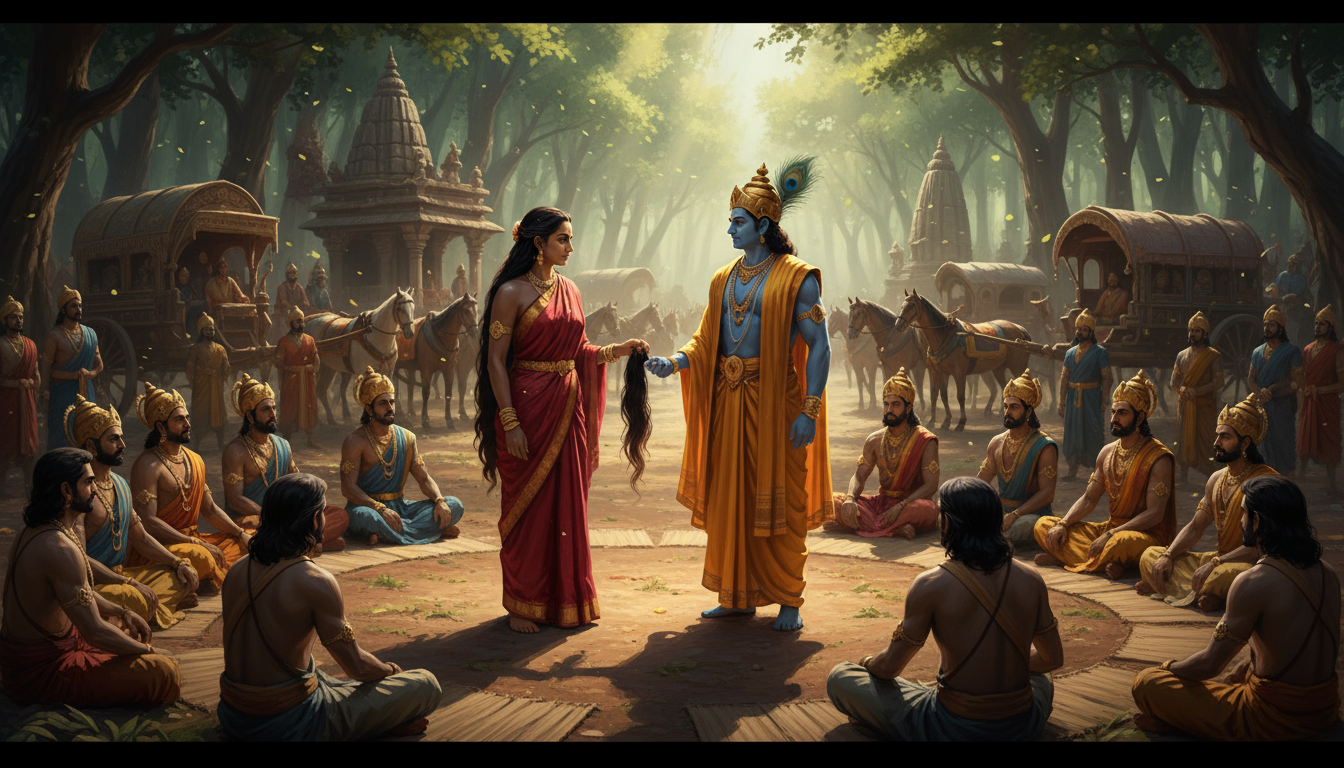
The Promise Made in the Kamyaka Woods
The allies arrive, and Draupadi asks Krishna what her friendship is worth
The Road Into the Woods
"When word went out that the sons of Pandu had been banished," said Vaishampayana to Janamejaya, "the men who loved them did not wait to be sent for. They came."
The Bhojas came, and the Vrishnis, and the Andhakas, riding down into the great forest to find the heroes living in affliction there. The blood relations of Panchala came. Dhrishtaketu, king of Chedi, came. The Kaikeya brothers came, those celebrated and powerful men, and their hearts were on fire as they rode.
They found the camp at Kamyaka and they hardly recognized it. Bark instead of silk. Cooking done in the open on a fire of gathered wood. The queen of Indraprastha carrying water like any woman of a hermitage.
The visitors reproached the sons of Dhritarashtra aloud, in language that would have started a war if any Kaurava had been standing there to hear it, and then they turned to the only man whose answer mattered and asked the plain question.
"What should we do?"
They seated themselves in a ring around Yudhishthira the just, those bulls of the Kshatriya race, and at their head sat Vasudeva. He saluted that foremost of the Kurus with full respect, as a guest should. Then he lifted his head, and what came out of him was not condolence.
The Earth Shall Drink
"The earth shall drink the blood of Duryodhana and Karna," Kesava said, "of Dussasana and the wicked Shakuni."
He said it mournfully, which was somehow worse than saying it in rage. He was not making a threat. He was describing a thing he had already decided upon and was now merely reporting.
"We will slay these four in battle. We will break their followers and their royal allies along with them. And then we will install Yudhishthira the just upon the throne. The wicked deserve to be slain. This is not my temper speaking. This is eternal morality."
The circle of kings did not move. There was a quality to Janardana in that moment that even men who had fought beside him for twenty years had rarely seen and never wished to see twice. He had got into a passion on account of the wrongs done to Pritha's sons, and he seemed, sitting there on the forest floor among the leaves, like something that had begun to consider consuming all created things and was still weighing whether to stop.
One man in that assembly moved. Arjuna rose from where he sat and came and stood in front of his friend, and he did not argue and he did not soothe. He began, in the voice men use for scripture, to recite to Krishna the deeds of Krishna's own former lives.
It was the only thing anyone present could have done. You do not calm the fire by talking about the house. You remind the fire what it is.
Ten Thousand Years on Gandhamadana
"In days of old, O Krishna," said Falguna, "you wandered on the Gandhamadana mountains for ten thousand years as a Muni who made his home wherever the evening found him.
"Living upon water alone, you dwelt eleven thousand years by the lake of Pushkara. With your arms upraised and standing on one leg you passed a hundred years on the high hills of Vadari, living all that while upon air. You laid aside your upper garment and let your body waste until you looked like a bundle of veins, and so you lived on the banks of the Saraswati, employed in a sacrifice that ran for twelve years. And in observance of your vow you stood on one leg for a thousand years of the celestials on the plains of Prabhasa, which it behoves the virtuous to visit.
"Vyasa has told me that you are the cause of the creation and of its course. You are the lord of Kshetra, the mover of all minds, the beginning and the end of all things. All asceticism rests in you. You are the embodiment of all sacrifices, and the eternal one."
Krishna did not stop him. The kings sat and listened, and the fire in the middle of them settled a little, the way a fire settles when someone puts a hand on the ground beside it.
"You floated on the primordial waters," Arjuna went on, "and afterwards became Hari, and Brahma, and Surya, and Dharma, and Dhatri, and Yama, and Anala, and Vasu, and Vaisravana, and Rudra, and Kala, and the firmament, and the earth, and the ten directions. Yourself increate, you are the lord of the mobile and the immobile universe."
The Count of the Deeds
"You slew the Asura Naraka, the first-begotten offspring of the Earth," Arjuna said, "and took his earrings, and performed the first horse sacrifice, offering up that Asura himself as the sacrificial horse. You slew the Daityas and the Danavas mustered in battle, and having given the lord of Sachi the sovereignty of the universe, you took your birth among men.
"Even while a child you filled the heaven, the firmament and the earth with three steps only, and dwelt in the body of the sun and afflicted him with your own splendour. You destroyed the Mauravas and the Pashas and slew Nisunda, and so made the road to Pragjyotisha safe again. You slew Ahvriti at Jaruthi, and Kratha, and Shishupala with all his adherents, and Jarasandha, and Saivya, and Satadhanwan. On a car that roared like clouds and shone like the sun you defeated Rukmi in battle and carried off the daughter of Bhoja for your queen. You slew Indradyumna, and the Yavana called Kaseruman. You killed Salwa the lord of Saubha, and then you destroyed the city of Saubha itself. At Iravati you killed the king of the Bhojas who was the equal of Karttavirya, and Gopati and Talaketu are dead by your hand also.
"You have made the sacred city of Dwaraka your own, rich and pleasing even to the Rishis, and at the end you will submerge it within the ocean.
"How can crookedness be in you, O Dasarha, who are without anger and without envy and without untruth and without cruelty? At the beginning of the Yuga, Brahma sprang from your lotus navel. When the dreadful Danavas Madhu and Kaitava were bent on slaying him, you grew angry, and from your forehead sprang Sambhu the holder of the trident. Two of the foremost of the deities came out of your body to do your work. Narada it was who told me this."
And having said it, the illustrious Pandava, who was the soul of Krishna, went silent.
Nara and Narayana
Janardana answered him in front of them all.
"You are mine and I am yours, and all that is mine is yours also. He that hates you hates me as well, and he that follows you follows me. O irrepressible one, you are Nara and I am Narayana, or Hari. We are the Rishis Nara and Narayana, born in the world of men for a particular purpose. You are from me and I am from you. No one can understand the difference that is between us."
That was the answer, and it was also the retraction of nothing. The anger had not been talked out of him. It had been given a shape and a name and set down in its place, and the kings sitting in that ring understood that they had just watched a thing be aimed.
So the assembly of brave men sat in the Kamyaka wood, all of them excited with anger, and it seemed for a moment that the matter had been settled between the two friends and was closed.
Then a woman came through the ring and stood in front of Krishna.
Panchali came surrounded by Dhrishtadyumna and her other heroic brothers, and she walked up to him of eyes like lotus leaves where he sat among his cousins, and she was not there to be comforted. She had listened to the whole of it, the oath and the hymn and the answer, and she had noticed what everyone else in that clearing had somehow failed to notice: that a great deal had been said about what Krishna was, and nothing at all about what he had not done.
What the Sages Call You
She began the way he had just been addressed, and every man there heard the edge under it.
"Asita and Devala have said that in the matter of the creation of all things you are indicated as the only Prajapati and the Creator of the worlds. Jamadagnya says that you are Vishnu, and that you are the sacrifice, the sacrificer, and he for whom the sacrifice is performed. The Rishis call you Forgiveness and Truth. Kasyapa has said that you are Sacrifice sprung from Truth. Narada calls you the god of the Sadhyas and of the Sivas, the Creator and the Lord of all.
"And you sport with the gods, with Brahma and Sankara and Sakra, as children sport with their toys. The firmament is covered by your head and the earth by your feet. These worlds are your womb. The rulers of the several worlds, the worlds themselves, the stellar conjunctions, the ten points of the horizon, the moon and the sun, are all established in you."
Then she stopped, and changed her voice, and the change was terrible.
"Therefore it is, O slayer of Madhu, that being what you are, and being moved by the affection you bear me, you will now hear my griefs.
"How could one like me, the wife of Pritha's sons, the sister of Dhrishtadyumna, and the friend of you, be dragged into an assembly? During my season, stained with blood, with a single cloth upon me, trembling all over and weeping, I was dragged into the court of the Kurus. And the wicked sons of Dhritarashtra looked at me standing there in my blood in the presence of those kings, and they laughed.
"While the sons of Pandu lived, and the Panchalas lived, and the Vrishnis lived, those men dared to say aloud that they wished to use me as their slave. I am, by the ordinance, the daughter-in-law of both Dhritarashtra and Bhishma. And they wished to make a slave of me by force."
Fie on the Gandiva
"I blame the Pandavas," she said, "who are mighty and foremost in battle, because they saw their own wedded wife, known over all the world, treated with such cruelty, and did not stir.
"Fie on the might of Bhimasena. Fie on the Gandiva of Arjuna. Both of them suffered me to be disgraced by little men.
"This is the eternal course of morality, followed always by the virtuous: that the husband, however weak he is, protects his wedded wife. By protecting the wife a man protects his offspring, and by protecting the offspring he protects his own self. One's own self is begotten upon one's wife, and that is why the wife is called Jaya. And the wife protects her lord in return, remembering that he must take his birth again in her womb.
"The Pandavas never forsake the person who asks them for protection. They abandoned me, who asked.
"By my five husbands five sons have been born of me, of energy that cannot be baffled: Prativindhya by Yudhishthira, Sutasoma by Vrikodara, Srutakirti by Arjuna, Satanika by Nakula, and Srutakarman by the youngest. They are mighty warriors, foremost of bowmen, invincible by any foe, the equals of your own Pradyumna. For their sake, if for nothing else, it was necessary to protect me.
"Why do these men bear the wrongs inflicted on me by the sons of Dhritarashtra, who are of such contemptible strength? Deprived of their kingdom by deception, the Pandavas were made bondsmen, and I was dragged into the assembly in my season with one cloth on. Fie on that Gandiva which no one else can string save Arjuna and Bhima and yourself. Fie on the strength of Bhima and fie on the prowess of Arjuna, since Duryodhana, after what he did, has drawn breath even for a moment."
The Ledger of the House
Then she opened the account and read it out, item by item, in front of the assembled kings of the Vrishnis and the Panchalas, and nobody interrupted her.
"It was he who drove the guileless Pandavas and their mother out of the kingdom when they were still children engaged in study and in the observance of their vows.
"It is that sinful wretch who mixed fresh and virulent poison, in full dose, into Bhima's food. Bhima digested the poison along with the meal and took no injury, because his days had not been ended.
"It is Duryodhana who, at the house standing by the banyan tree called Pramana, bound Bhima while he slept unsuspecting, threw him into the Ganges, and went back to the city. Bhima woke in the water, tore his bonds, and rose.
"It is Duryodhana who caused venomous black cobras to bite him all over his body, and that slayer of foes did not die. The son of Kunti woke, smashed the serpents, and with his left hand killed the man who had brought them, Duryodhana's own favourite charioteer.
"And it is he who set fire to the house at Varanavata while the children slept in it with their mother, intending to burn them to death. Who is there capable of doing such a thing?
"The illustrious Kunti, surrounded by the flames, cried out to the children, 'Alas, I am undone. How shall we escape from this fire today? I shall meet with destruction and my little children with me.' And Bhima comforted his mother and his brothers, saying, 'Like Garuda the son of Vinata, king of birds, I will spring up into the air. We have no fear from this fire.' He took his mother on his left flank and the king on his right, a twin upon each shoulder and Vivatsu upon his back, and cleared the fire at one leap with all of them."
Seized by the Hair
"They went out that night with their renowned mother and came near the forest of Hidimva," she said, "and while they slept a Rakshasa woman came and took Bhima's feet into her lap to press them, and warned them to fly because her brother was coming to kill them, and Bhima said, 'I do not fear him. If he comes here, I will slay him.' And he did, after long fighting, and they took the sister with them, of whom Ghatotkacha was afterwards born.
"Then, with Vyasa for their counsellor, they went to Ekachakra, and there they killed another cannibal as terrible as the first. And from there they came to the capital of Drupada, and there, O slayer of Madhu, as you obtained Rukmini the daughter of Bhishmaka, so Savyasachin obtained me. He won me at the swayamvara, having performed a feat that no other man could perform and having fought the assembled kings for it.
"And this is how I live now, afflicted with these griefs, with Dhaumya at our head and without the company of the adorable Kunti. Why do these men, gifted with strength and possessed of the prowess of the lion, sit indifferent while I am afflicted by enemies so despicable? Am I to burn in this grief for so long, at the hands of evil-doers of such small strength?
"I was born in a great race. I came into the world in an extraordinary way. I am the beloved wife of the Pandavas and the daughter-in-law of the illustrious Pandu. I am the foremost of women and devoted to my husbands. And I was seized by the hair, in the sight of the Pandavas, each of whom is like an Indra himself."
Then the mild-speeched Krishnaa hid her face in her soft hands, which were like the buds of lotuses, and wept. When she had wiped her eyes she spoke again, sighing between the words, in a choked voice and in anger.
"Husbands I have none. Nor sons, nor friends, nor brothers, nor father. Nor have I you, O slayer of Madhu, for all of you see me treated so cruelly by inferior foes and sit still and unmoved. My grief at Karna's ridicule cannot be assuaged. On four grounds I deserve to be protected by you always: our relationship, your respect for me, our friendship, and your lordship over me."
The Heavens Might Fall
In that assembly of heroes Vasudeva spoke to the weeping Draupadi, and he did not begin with sympathy.
"The wives of the men you are angry with shall weep even as you are weeping now, O fair lady, when they see their husbands dead upon the ground, weltering in blood, their bodies covered over with the arrows of Vivatsu.
"Weep no more. I will exert myself to the utmost of my powers for the sons of Pandu. I promise you that you shall be the queen of kings again.
"The heavens might fall. Himavat might split. The earth might be rent open, or the waters of the ocean dry up. My words shall never be futile."
Draupadi heard it, and then she looked sideways at her third husband, because a promise is worth what the men standing beside it are worth.
"O you of beautiful coppery eyes," Arjuna said, "grieve not. It shall be exactly as the slayer of Madhu has said. It can never be otherwise."
And then her brother stood up and did the last thing that was needed, which was to turn a vow into a list of assignments.
"I will slay Drona," said Dhrishtadyumna. "Shikhandi will slay the grandfather. Bhimasena will slay Duryodhana, and Dhananjaya will slay Karna. Assisted by Rama and Krishna, sister, we are invincible in battle by the slayer of Vritra himself. What then are the sons of Dhritarashtra?"
The forest was very quiet after that. Every hero in the circle turned his face toward Vasudeva, waiting for him to speak again, and the twelve years that still had to be endured had acquired, in a single afternoon, a shape and a purpose and a set of names at the end of it.
Dharma Lesson
A promise made to the powerless in the hour they are least able to enforce it is the only kind worth measuring a friend by. Krishna does not tell Draupadi her grief is excessive, and he does not tell her to wait quietly; he tells her exactly what will be done and puts his own word at risk on it. The oath costs him nothing on the day he swears it, which is precisely why she is right to hold him to it for thirteen years.