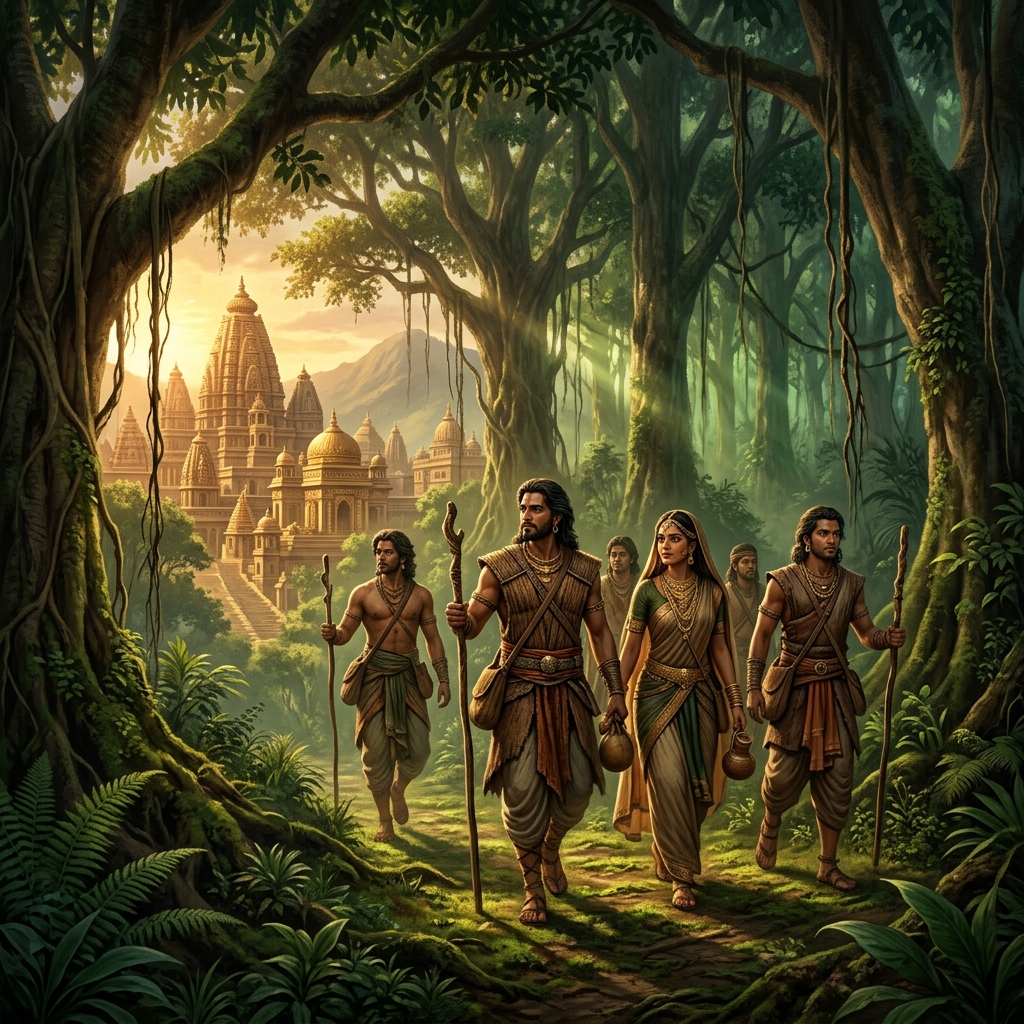
Krishna Comes to Kamyaka
The twelfth year of waiting had not yet come, but the forest of Kamyaka had already worn the five brothers down to a plainer shape than kings. When word ran ahead that Krishna was riding in with the Vrishnis and a company of Panchala chariots, the camp did what camps in exile do: it counted what it had to offer a guest, and found the count thin.
Krishna came all the same, dust on his yellow cloth, and he did not pretend not to notice. He found Yudhishthira measuring grain against the season that remained, and he found Draupadi with her hair still knotted the way she had sworn to leave it, unbound and unwashed, until it was combed again in Duryodhana's blood. She rose to greet him as a queen greets a kinsman, not as a woman greets pity, and he did not offer her either.
'Twelve years is a long road to walk without setting down what will not carry,' Krishna said, when the courtesies were finished and the leaf-cups of forest fare had gone around. 'I have not come only to sit with you.'
Draupadi understood him before he said more. She had five sons in this camp who ran wild between the trees like any forest children, ate what the hunt gave, and had not held a bow fitted to a grown man's draw in over a year. Subhadra's boy Abhimanyu, not yet old enough to be counted a warrior, was already imitating Arjuna's stance with a stick cut from a sal branch.
'Say it,' Draupadi told him. 'I would rather hear it plainly than watch you choose your words for my sake.'
The Practical Business
Krishna's proposal was not new; it was the kind of decision that camps make in a single evening and armies live with for thirteen years. Kamyaka could shelter grown men who had chosen exile with open eyes, but it was no place to raise the next generation of the very houses this waiting was meant to preserve. A forest teaches endurance. It does not teach the bow-hand, the assemblies, the genealogies a prince must carry before he can be trusted with an army.
Dhrishtadyumna, who had come with the Panchala escort, said what needed no persuading: Kampilya had masters of arms, a court, and a grandfather in Drupada who would not let a single grandson grow up counting roots. Draupadi's five sons belonged there until the thirteenth year released their fathers to claim them.
Subhadra, seated a little apart with Abhimanyu's hand in hers, needed no debate either. Dwaraka had Krishna's own sons for company, and archers who could finish what Arjuna had only begun teaching the boy in stolen hours between wanderings. She had watched her husband's exile eat thirteen years out of a life; she did not intend to let it eat her son's besides.
Yudhishthira asked only one question, the one a king asks before any decision, whatever else he privately felt: was this for the children's safety, or for something else. Krishna answered without softening it. 'Both,' he said. 'A camp of exiles is a target as much as a hardship, and a boy raised only on hunger and waiting learns a narrower dharma than his father's house requires of him.' No one in the clearing pretended the answer cost nothing.
The Road to Kampilya
Draupadi packed her sons' few belongings herself, refusing the hands that offered to do it for her. There was not much: a change of forest-worn cloth each, a string of beads carved from seed-pits during a slow season, and whatever weapons a boy that age could carry without it looking like an accusation against the men who could not yet keep them safe.
She did not weep in front of the column when Dhrishtadyumna mounted his chariot and set the five boys among the Panchala guard. Kampilya was her father's city, familiar even in memory to sons who had barely seen it, and she told herself that a grandfather's house was no exile at all, only a return she was not permitted to make with them.
'You will send word,' she said to her brother, and it was not a request.
'I will raise them as Panchalas raise princes,' Dhrishtadyumna answered, 'and as your husbands would raise them, if the dice had fallen otherwise.' It was the closest either of them came to naming what the parting was actually for.
The boys themselves did not understand enough to grieve properly; that mercy belonged to childhood and would not survive it. The eldest asked when the thirteen years would be finished, as if a number could be felt the way a season is felt, and no one corrected him. The chariots pulled away down the forest track toward the Ganga's plain, dust rising where the trees thinned, and Draupadi stood at the camp's edge until the sound of the wheels was gone as completely as if it had never been there.
Subhadra and the Boy of Dwaraka
Subhadra's leave-taking had less ceremony and no less weight. She was Krishna's sister as much as Arjuna's wife, and the road to Dwaraka was, in a sense, a road home for her, though she had not asked to travel it without her husband beside her.
Abhimanyu went without protest, the way children go toward novelty rather than away from loss, more curious about the chariots and the sea he had heard of than sorry to leave a forest he had never loved. His father knelt to him before the parting and said little; there was a discipline in the way he held the boy's shoulders that promised more than words would have.
'Teach him what you were taught,' the father told Krishna, 'and what I have not yet had the years to finish teaching him myself.'
'He will learn the chakravyuha's outer turns before he is old enough to be trusted with the whole of it,' Krishna said. 'The rest will wait for you.' Neither of them said aloud that thirteen years was a strange unit to measure a boy's growing against, long enough to turn a child into a soldier and short enough that his father might still expect to find a child waiting.
Subhadra mounted beside her son for the road west, and if she grieved the years that would pass between this parting and whatever meeting came after, she kept it from her face as carefully as Draupadi had kept hers. Dwaraka's princes would raise Abhimanyu among cousins who were also students of the bow, in a city that had never known dice or forest exile, and that difference, more than any other, was the whole of what this parting purchased.
What the Forest Kept
When the last chariot had gone and Kamyaka closed back over the camp the way a river closes over a stone, Draupadi did not speak of her sons again with the ease she had used before that morning. She asked after them through messengers, kept count of the seasons as carefully as Yudhishthira kept count of the exile's own remaining days, but she did not describe herself, even privately, as a mother waiting to raise five boys to manhood. That work had already passed to Kampilya and to Dwaraka, and she understood, more clearly than she said aloud, that it would not be handed back.
Krishna stayed only long enough to see the two households settled in his mind before returning to the business of a kingdom that could not itself afford twelve years in a forest. He left behind no promise about what the sons would be like when the exile ended, only the plain fact of the decision, made in an afternoon and never revisited by anyone in the clearing.
It proved, in the end, exactly the bargain it looked like. When the thirteenth year released the Pandavas at last, the five sons who rode out from Kampilya and the young man who came from Dwaraka were not the children who had been sent away. They had grown on Panchala drill-grounds and Vrishni water, trained by men who were not their fathers, into warriors their parents would recognize by name before they recognized them by face. Exile, Draupadi had learned without ever being told it in so many words, is measured less by what it costs the ones who endure it than by the childhoods it swallows whole in other people's houses, and returns thirteen years later as men already spoken for by a war.
Dharma Lesson
Protecting a child sometimes means sending him away from the very people who love him most. Draupadi and Subhadra accept this without protest, understanding that the forest can teach endurance but not the training a prince will need. The lesson of Kamyaka is that dharma often demands a cost paid quietly, in advance, by those who never appear in the histories of the war itself.