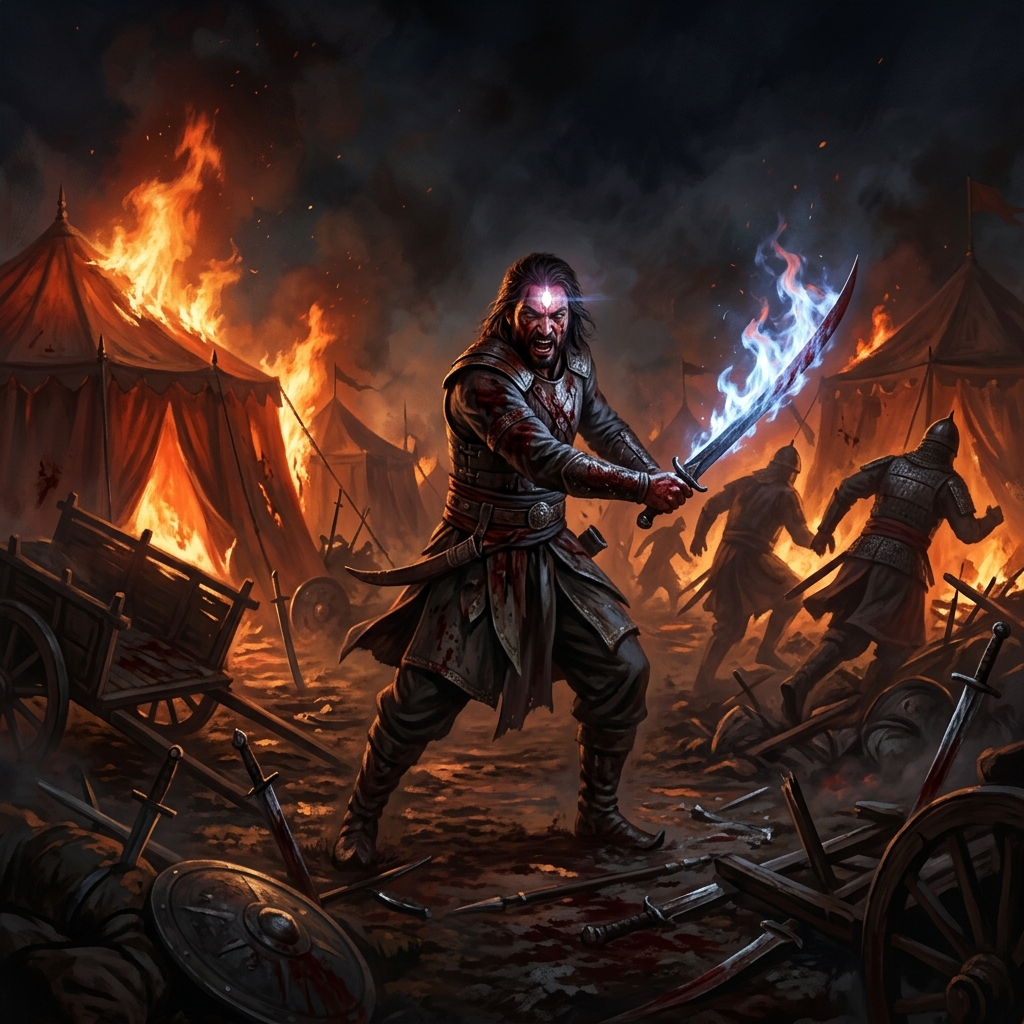
Five Sons, One House
Five times in the years of the Pandavas' rise, a son was born to Draupadi, and each time the father was a different husband, so that the queen of Indraprastha carried not one line into the next generation but five, bound into a single household by the marriage law the brothers had accepted and by a mother's love that made no distinctions among them.
To Yudhishthira she bore Prativindhya, first of the five, born while the eldest brother was still building the kingdom he would later lose on a throw of dice. To Bhima she bore Sutasoma, who announced himself loudly from his first cry, as if he meant to match his father's roar before he had learned to stand. To Arjuna she bore Shrutakarma, born in a year when his father was away more often than not, chasing horses and honor across the map. To Nakula she bore Shatanika, quick and watchful even as an infant, and to Sahadeva she bore Shrutasena, the youngest, loved no less for coming last.
They were princes of a kingdom that no longer existed by the time most of them could walk. Indraprastha was gone, wagered and lost, and their fathers were exiles in the forest and then in hiding, disguised servants in a stranger's court. The five boys grew up largely in Panchala, in Drupada's house, raised by a grandfather-king and an uncle who commanded armies, seeing their famous fathers only in visits, in letters, in the stories other people told about them.
"They will not remember us as children," Draupadi said once to her brother, watching the five of them sleep in a row. "They will remember us as a promise not yet paid." Dhrishtadyumna said nothing to that. He was already deciding, in the quiet way he decided everything, what he would make of the five when they were old enough to hold a bow.
Trained by Dhrishtadyumna
It was Dhrishtadyumna who made warriors of them, not their fathers. The commander of Panchala's armies had been raised for one purpose, born from fire to end Drona's life, and he brought the same unsentimental discipline to his five nephews that had been brought to him. There was no gentleness in the training ground at dawn, only repetition: the draw, the loose, the recovery, a thousand times before breakfast, until the motion belonged to the hand and not to thought.
Prativindhya, eldest and steadiest, took to strategy the way his father took to law, asking why before he asked how. Sutasoma matched his uncle blow for blow in the mace yard and grinned through the bruises, Bhima's temperament poured into a smaller frame. Shrutakarma had his father's eye for range and angle, dropping arrows into targets Dhrishtadyumna moved farther back each season. Shatanika learned the chariot faster than any of them, and Shrutasena, youngest, refused to be left behind at anything, which made him reckless and which made him good.
"You are not being raised to be remembered," Dhrishtadyumna told them once, when Sutasoma complained that the epics being sung in the hall that season named only the five Pandavas and never their sons. "You are being raised to be present when it matters. Those are different things, and only one of them is in your control."
Draupadi watched the training from the palace steps more often than she let her sons see. She had married five brothers and borne five sons, and in the arithmetic of that marriage she understood something Dhrishtadyumna's discipline never had to teach: that love multiplied by five did not divide the grief it would eventually owe. She said nothing of this to the boys. She only watched them longer than she needed to, each evening, before she let them go.
Eighteen Days
When the armies gathered at Kurukshetra, the five sons of Draupadi rode out with them, not as ornaments of their fathers' chariots but as commanders in their own right, each given men to lead and a place in the array to hold. They fought every one of the eighteen days. No chronicle of the war can say that of Bhishma, or Drona, or Karna, each of whom fell partway through and left the field to others. The five boys who are barely named fought from the first dawn to the last.
On the day of the chakravyuha, when Drona's wheel formation swallowed Abhimanyu and the army broke against it in waves, the five upapandavas were in those waves, cutting toward a nephew none of them reached in time. Sutasoma took a spear wound that day that would have ended a lesser fighter and fought on until the light failed. Shatanika held a flank alone for the better part of an hour after the captain beside him was cut down, because holding it was the assignment and no one had told him it was permitted to fall back.
Their fathers get the songs. Arjuna's grief for Abhimanyu, Bhima's oath against Duryodhana's thigh, Yudhishthira's slow unmaking under the weight of the war he had asked for, all of it is sung in every gathering where the epic is still told. The five sons who held the same lines, took the same wounds, and buried the same friends appear in those songs mostly as a number, five, mentioned when the poet needs to say that Draupadi's family, too, was at war.
"We are not fighting to be sung," Prativindhya told his brothers on the sixteenth night, when Shrutasena asked bitterly why the bards at the fire that evening had spent an hour on Arjuna and a sentence on all five of them together. "We are fighting because the line has to hold somewhere, and tonight it holds here." It was, Dhrishtadyumna's old lesson returning through a son who had absorbed it completely.
The Last Night
The war ended on the eighteenth day with the Kaurava line broken and the Pandavas' camp filled with the exhausted relief of men who had finally stopped counting how many more mornings they would have to survive. The five sons of Draupadi, who had fought every one of those mornings, slept that night in the tents at the heart of the victorious camp, certain for the first time in eighteen days that tomorrow required nothing more of them than to wake.
What happened after they slept belongs to another telling, the story of Ashwatthama's rage and the vow he carried into the dark, and it does not need repeating here in full. What belongs here is only this: that among the sleepers in that camp were the five boys who had held their lines through every one of the war's eighteen days without once breaking, and that the man who came through the tents that night did not stop to ask which sleepers had earned a longer life by their conduct in the field. He was not choosing among the deserving. He was ending a line, and the five sons of Draupadi were the clearest way to end it.
They died in their sleep, one after another, in the dark, without the chance to lift a weapon that had not failed them once in eighteen days of open battle. Whatever is owed to a warrior for meeting his death awake, upright, and armed, was denied to all five of them by an act that chose the hour precisely because they would not be. It was not a battle. It has never been called one.
By morning the camp that had been celebrating victory the night before held five small bodies where five young commanders had slept, and the war that had ended the previous afternoon exacted, in its final hours, a price from the one household that had already given the war everything else it had.
The Queen's Grief and the Line That Continued
Draupadi was brought to the tents before the sun had fully risen, and what she found there was the arithmetic she had refused to do aloud on the palace steps years earlier, finally and completely worked out. Five sons, one to each husband, and all five gone in a single night after eighteen days in which none of them had fallen. She did not weep quietly. The camp that had woken to celebrate a war's end woke instead to a mother's grief loud enough to silence every voice in it.
"I bore five sons so that no single line would carry the whole weight of what this family owed the world," she said to Yudhishthira, who stood over the bodies unable to offer the kind of comfort a king is supposed to have ready. "The war took the weight from all five lines in one night. Tell me again what the victory bought." He had no answer that satisfied her, because there was no answer that could survive contact with what lay in front of them.
The line did not end there, though it came close. Abhimanyu's son Parikshit, born after his father's death at the chakravyuha and carried in his mother's grief through the war's last months, survived to inherit the throne the five upapandavas had spent their whole short lives training to help defend. He would grow up knowing his father and his five cousins only as names attached to a debt he had not chosen and could never fully repay, a single boy carrying forward what six young men had died clearing the way for.
History, when it is told in songs, tends to follow the hero whose grief is loudest or whose name opens the widest door. Bhishma, Drona, Karna, Abhimanyu: these are remembered because the epic needed their deaths to move its story forward. Prativindhya, Sutasoma, Shrutakarma, Shatanika, and Shrutasena are remembered, when they are remembered at all, as the five sons Draupadi lost on the last night, after the winning. It is worth pausing, each time the story is told, to say their names in full and to understand that history is fought mostly by those it barely names.
Dharma Lesson
The five sons of Draupadi trained as hard, fought as long, and died as finally as any hero the epic names in its first rank, yet the songs remember them mostly as a grief that happened to their parents. Dharma does not grade its servants by the size of the verse written about them; the boy holding a line at the chakravyuha is owed the same regard as the archer the poets follow. History is fought mostly by those it barely names, and a just memory has to go looking for them on purpose.