Born of Reeds
Kripa's beginning was strange even by the standards of an epic built from strange beginnings. He was born, along with his twin sister Kripi, not from a mother's womb in the ordinary way but from the seed of the sage Sharadvan, spilled at the sight of a celestial woman and gathered, along with the sage's abandoned bow, in a clump of reeds where hunters from King Shantanu's court found the infants and brought them home out of pity and wonder.
Shantanu, recognizing that any child born under such circumstances carried some claim on the gods' attention, raised both twins in the Kuru palace as his own wards, and Kripa grew up with every advantage of a prince and none of a prince's certain lineage. He proved, early and repeatedly, that he did not need the lineage to earn the position. By the time he reached manhood he was already the foremost teacher of arms in the Kuru court, acharya to the royal house before Drona ever arrived to share the title, a master of both the bow and the deeper disciplines of strategy and law that a court needed as much as archery.
"You were found in the reeds and raised in the palace," his sister Kripi told him once, half in jest, when he had finished a day of drilling students twice his size in forms they would spend years perfecting. "You have spent your whole life proving the reeds were an accident and the palace was not." Kripa did not entirely disagree. He had built, out of an origin with no family and no certain claim to anything, a position that outlasted kings, and he intended, though he could not have known it then, to build a life that would outlast the entire age those kings belonged to.
Teacher to Every Boy on Both Sides
When Drona arrived at the Kuru court, Kripa did not resent sharing the title of acharya. He had already taught the elder generation, and he shared the younger one willingly, standing beside Drona through years of instruction that produced, on both sides of the field that would eventually open at Kurukshetra, warriors who called Kripa teacher in the same breath they called Drona teacher. Duryodhana had learned from him. Yudhishthira had learned from him. There was no side of the coming war that Kripa had not personally helped arm.
That fact did not make his choice of allegiance simple, and it did not make him pretend it was. When the armies gathered, Kripa fought for the Kauravas, and the reason he gave, to himself and to anyone who asked, was neither conviction nor hatred but something older and plainer: he had eaten the Kuru house's salt his entire life, been raised in its palace, paid in its coin, and a debt of that kind, in his accounting, did not wait for the debtor to agree with every decision the house had made.
"I do not fight because Duryodhana is right," he told Ashwatthama, his nephew by marriage, on the eve of the war, with the flat honesty of a man too old to dress the truth up for anyone. "I fight because I was fed at his father's table before he was born, and there are debts that outlive the question of whether they were wisely incurred." It was, in its way, its own form of dharma, loyalty chosen with open eyes rather than blind ones.
So he dueled his own students, day after day, across eighteen days of war, men he had personally taught to hold a bow the way they held it, and he did it, by every account, without hatred, a teacher performing the last and worst lesson his position required of him: showing former students exactly how much of what he had taught them could still be used against them.
The Pattern of His Survivals
There is a pattern in Kripa's war that no one on either side seemed to notice while it was happening, because it only becomes visible in hindsight, laid out across the whole eighteen days at once: he was present at nearly every great catastrophe of the war and was never the one it fell on.
He watched Bhishma fall on the tenth day, the grandsire's fall arranged by a trick of law and gender that Kripa, master of both law and combat, understood in its full cruelty even as he could do nothing to stop it. He watched Drona die on the fifteenth day, his fellow acharya cut down by a deception about a dead man's name, a lie Kripa had not told and could not undo. He watched Karna fall to Arjuna's arrow with the sun already low, and Shalya fall soon after to Yudhishthira's spear, each death another name struck from a list Kripa had personally helped train.
He stood at the lake where Duryodhana hid after the army broke, one of the three who found the fallen prince and could offer him nothing but company in defeat. He stood near the mace duel between Duryodhana and Bhima that ended the war outright, watching the last Kaurava claim fall the way he had watched every other pillar of that side fall before it, in sequence, as if the war had been designed to remove everyone around him while leaving him standing to watch it happen.
"I begin to think I am not meant to die in this war," Kripa said to Ashwatthama on the last evening, with a grimness that was not quite a joke. "I am beginning to wonder what I am meant for instead." Ashwatthama, still whole in body and already coming apart in something less visible, did not answer him. Neither of them yet knew that the war's cruelest chapter had not been fought yet, and that Kripa's survival was about to be tested by something worse than a battlefield.
The Gate He Guarded
What Ashwatthama did on the last night of the war belongs to its own telling, and this account will not repeat the massacre in full. What belongs here is only Kripa's part in it, and it is the hardest part of his story to hold steady.
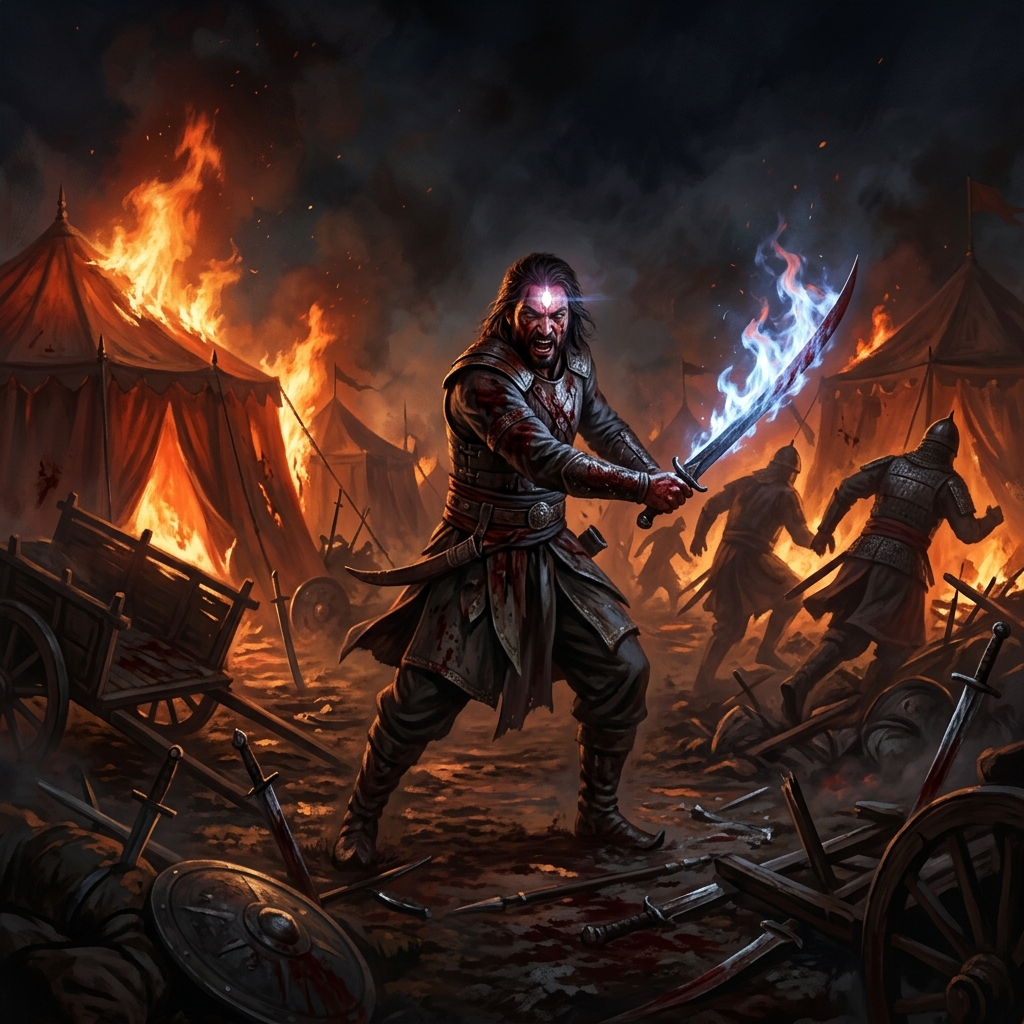
Kripa stood guard at the camp's gate that night, alongside Ashwatthama and Kritavarma, one of the three who rode out toward the sleeping victors when the fury that had been building in Ashwatthama since Dhrishtadyumna's killing of his father finally found its target. Kripa did not raise a weapon inside the tents. He did not strike the sleeping men and boys whose deaths would make that night infamous for as long as the epic is told. He stood at the gate, keeping watch, holding the perimeter, doing the only thing his old body could still do at speed, while inside a rage he had not caused and could not contain worked its way through a camp that trusted itself to be safe.
That is the whole of Kripa's action that night, and it is also the whole of the problem. He was present. He knew, standing at that gate in the dark, precisely what the silence from inside the tents meant, and he did not walk away from his post, did not refuse the duty, did not do anything the epic can point to as resistance. He guarded the door through which no rescue could come.
The epic never resolves what to make of this, and it should not be resolved on Kripa's behalf now. He was not the hand that struck. He was the watch that let the hand finish its work uninterrupted, and he carried that distinction, real but narrow, for the rest of a very long life. Whatever shame belongs to that night belonged afterward to Kripa as much as to the man who held the sword, and he never, in any telling worth trusting, tried to argue himself out of it.
The Amnesty and the Last Teachership
Of the three who rode to the gate that night, only Kripa returned to face the men whose camp he had helped seal shut. Ashwatthama fled into a curse that would keep him wandering, wounded and unaging, for as long as the world lasted. Kritavarma's part in the story ended elsewhere. Kripa alone walked back into the light among the people whose sons and brothers had died behind him, and stood before Yudhishthira to be judged.
Yudhishthira, who had lost more to that single night than any other man alive, chose amnesty. Kripa was forgiven, formally and completely, and more than forgiven: he was asked to stay, to take up once again the role he had held his entire adult life, teacher to the royal house of the Kurus, now reduced to a single surviving line.
"You taught me," Yudhishthira told him, when Kripa asked, plainly, why he was being spared rather than cast out. "You taught Duryodhana too, and you fought for him out of a debt I understand better than I would like to. I do not think forgiving you undoes what happened. I think refusing to forgive you would only make the debt larger, and this house has paid enough debts in blood already." Kripa accepted the amnesty the way he had accepted the war, with open eyes and no illusions about what it did and did not settle.
His last teachership was to Parikshit, grandson of Abhimanyu, the boy whose father had died in the very war Kripa's silence at the gate had helped make total, and Kripa taught him with the same rigor he had once brought to Duryodhana and to Yudhishthira, a debt of a different kind now, service offered to the heir of everything that night had cost. He is named among the chiranjivis, the long-lived who do not die with their age, and the honor reads, in his case, less like a reward than a sentence: the man who watched every side of the war fall was made to go on living, and to spend that long life teaching its heir exactly what he had watched it cost.
Dharma Lesson
Kripa's story refuses the comfort of a clean verdict: he taught both sides without hatred, fought for the Kauravas out of loyalty rather than conviction, and stood watch the night his own restraint could not save the boys he had trained. Survival was not, for him, an escape from judgment but a continuation of it, a long sentence of remembering served in the act of teaching the next generation what the last one had cost. Dharma, in his case, is not a clean answer but the discipline of staying present to a debt that can never be fully repaid.