The Riders Who Went South
Sanjaya said, "They went south, the three of them, when the field was lost. At the hour of sunset they came to a spot near the Kuru encampment and let their animals loose, and standing there in the last of the light they became very much frightened.
They had been cut and mangled with many keen weapons. They breathed long and hot sighs and thought of the Pandavas. Out of the east came the noise the victorious make, and hearing it they feared a pursuit and turned and fled eastward themselves, which is what men do when they have stopped knowing where they are going. After a while their animals were spent and the men were thirsty. Overpowered by wrath and vindictiveness, those great bowmen could not put up with what had occurred, burning as they did with grief at the slaughter of the king. So they halted, and took rest for a while."
Dhritarashtra broke in upon him. "The feat that Bhima achieved seems to me incredible, Sanjaya. My son who was struck down possessed the strength of ten thousand elephants. He was in manhood's prime. His frame was adamant. He was not capable of being slain by any creature, and he is dead."
"Without doubt my heart also is made of adamant, since it breaks not into a thousand fragments even after hearing of the slaughter of my hundred sons. Having been the sire of a king, and a king myself, how shall I pass my days as a slave obedient to his commands? How shall I be able to endure the words of Bhima, who single-handed has slain a full hundred sons of mine? The words of the high-souled Vidura have come to be realised, and my son would not listen to them."
Then, more quietly: "What did Kritavarma do, and Kripa, and Drona's son, after my son Duryodhana had been unfairly struck down?"
The Biggest Tree in That Forest
"They had not proceeded far, O king, when they stopped," Sanjaya said, "for they beheld in front of them a dense forest abounding with trees and creepers. Having rested a little and given their horses water, they entered it on their cars.
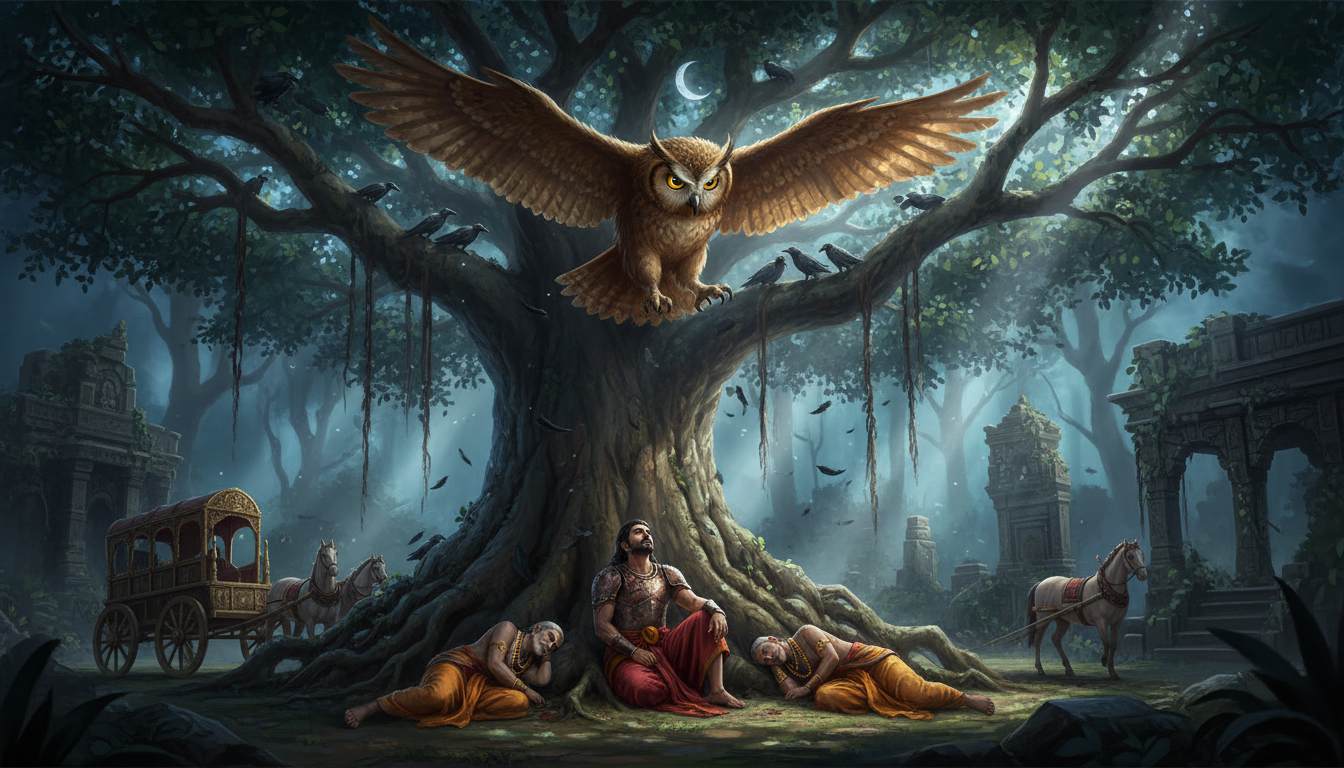
It was a forest full of animals of every kind, and it teemed with birds. Carnivorous creatures were in it. It was covered with pieces of water and adorned with flowers, and it had lakes overgrown with blue lotuses. Casting their eyes about them, those three foremost of men saw a gigantic banyan with thousands of branches, the biggest tree in that forest, and they went to it and took the shade of it. They alighted from their cars, let their animals loose, cleansed themselves duly, and said their evening prayers.
The Sun then reached the Asta mountains, and Night, the mother of the universe, came on. The firmament, bespangled with planets and stars, shone like an ornamented piece of brocade and presented a highly agreeable spectacle to anyone with the heart to look at it. Awful became the noise of the night-wandering animals. The carnivorous creatures became full of glee, and the night, as it deepened, became dreadful.
At that hour, filled with grief and sorrow, Kritavarma and Kripa and Drona's son all sat down together under the banyan, and they gave expression to their sorrow upon the one subject there was: the destruction that had taken place of both the Kurus and the Pandavas. Then sleep took two of them. Kripa and Kritavarma, deserving of happiness and undeserving of misery, laid themselves down on the bare earth, exceedingly tired and greatly mangled with shafts. Indeed, O monarch, those two who had always slept on costly beds now slept like helpless persons on the ground, afflicted with toil and grief."
What Came Out of the Dark
"Drona's son, however, yielding to the influence of wrath and of reverence for a dead father, could not sleep, but continued to breathe like a snake. Burning with rage, he could not get a wink of slumber. That hero of mighty arms cast his eyes on every side of that terrible forest.
As he surveyed it, he beheld a large banyan covered with crows. Thousands of crows roosted in it that night, each perching separately from its neighbour, and they slept at ease, O Kauravya, as birds sleep when nothing has ever hunted them in that tree before.
While those birds were sleeping securely on every side, Ashvatthama beheld an owl of terrible aspect suddenly make its appearance there. Of frightful cries and gigantic body it was, with green eyes and tawny plumage; its nose was very large and its talons were long, and the speed with which it came resembled that of Garuda. Uttering soft cries, that winged creature secretly approached the branches of the banyan.
That ranger of the sky, that slayer of crows, alighted on one of the branches and slew a large number of his sleeping enemies. He tore the wings of some. He cut off the heads of others with his sharp talons. He broke the legs of many. Endued with great strength, he slew many that fell down before his eyes. With the limbs and the bodies of the slain crows the ground covered by the spreading branches of that banyan became thickly strewn on every side.
Having slain them, the owl became filled with delight, like a slayer of foes who has behaved toward his foes exactly according to his pleasure. And in all that time not one crow woke, until it was too late to wake, and not one of them fought, because there had been nothing to fight."
This Owl Teaches Me a Lesson in Battle
"Beholding that highly suggestive deed perpetrated in the night by the owl, Drona's son began to reflect upon it, desirous of framing his own conduct by the light of that example. And he said to himself, sitting there in the dark with two sleeping men beside him:
'This owl teaches me a lesson in battle. Bent as I am upon the destruction of the foe, the time for the deed has come. The victorious Pandavas are incapable of being slain by me. They are possessed of might, endued with perseverance, sure of aim and skilled in smiting. In the presence of the king, however, I have vowed to slay them. I have thus pledged myself to a self-destructive act, like an insect essaying to rush into a blazing fire. If I were to fight fairly with them, I shall without doubt have to lay down my life. By an act of guile, however, success may yet be mine, and a great destruction may overtake my foes.
Whatever of censure and evil repute this act may provoke ought to be incurred by a person who is observant of kshatriya practices. The Pandavas of uncleansed souls have at every step perpetrated very ugly and censurable acts that are full of guile.'
And he found, as men in his condition always find, that there were verses for it. He said them over to himself, ancient verses, full of truth, sung by truth-seeing and righteousness-observing persons after a careful consideration of the demands of justice:
'The enemy's force, even when fatigued, or wounded with weapons, or employed in eating, or when retiring, or when resting within their camp, should be smitten. They should be dealt with in the same way when afflicted with sleep in the dead of night, or when reft of commanders, or when broken, or when under the impression of an error.'
Having reflected in this way, the valiant son of Drona formed the resolution of slaying during the night the slumbering Pandavas and Pancalas. And having formed that wicked resolution and pledged himself repeatedly to its execution, he got up and went to wake the two men who were asleep."
Three Left Out of Eleven Akshauhinis
"He awoke both his maternal uncle and the chief of the Bhojas, and told them what he intended. Awakened from sleep, those two illustrious and mighty persons heard Ashvatthama's scheme through to the end. Then, filled with shame, both of them abstained from giving any suitable reply at all.
Having waited a short while for an answer that did not come, Ashvatthama said, with tearful eyes:
'King Duryodhana, that one hero of great might, for whose sake we were waging hostilities with the Pandavas, has been slain. Deserted and alone, though he was the lord of eleven akshauhinis of troops, that hero of unstained prowess has been struck down by Bhimasena and a large number of wretches banded together in battle. And another wicked act has been perpetrated by the vile Vrikodara, for he has touched with his foot the head of a person whose coronal locks had undergone the sacred bath.
Listen. The Pancalas are uttering loud roars and cries and indulging in loud bursts of laughter. Filled with joy, they are blowing their conchs and beating their drums. The loud peal of their instruments, mingled with the blare of conchs, is frightful to the ear, and borne by the winds it is filling all the points of the compass. That deafening noise the rejoicing make as they march back to their quarters, and the clatter of their car-wheels with it, comes to us from the east.
So great has been the havoc made by the Pandavas upon the Dhartarashtras that we three are the only survivors of that great carnage. Some of the dead were endued with the might of a hundred elephants. Some were masters of all weapons. Yet they have been slain by the sons of Pandu. I regard this to be an instance of the reverses brought about by Time. Truly, this is the end to which such an act leads.
If your wisdom has not been driven away by stupefaction, then say what is proper for us to do in view of this calamitous and grave affair.'"
Rain on a Mountain, Rain on a Field
Kripa said, "We have heard all that thou hast said, O puissant one. Listen, however, to a few words of mine.
All men are subjected to and governed by these two forces, Destiny and Exertion. There is nothing higher than these two. Our acts do not become successful in consequence of destiny alone, nor of exertion alone. Success springs from the union of the two. What result is produced by the clouds pouring upon a mountain? What results are not produced by them pouring upon a cultivated field? Exertion where destiny is not auspicious, and absence of exertion where destiny is auspicious, both these are fruitless. If the rains properly moisten a well-tilled soil, the seed produces great results. Human success is of this nature.
But hear the rest of it, for this is the part that concerns us tonight. That person who, desirous of success, properly waits upon the aged, asks of them what is for his good, and obeys their beneficial counsels, is never lost. Men approved by the old should always be solicited for counsel while one has recourse to exertion. These men are the infallible root of means, and success is dependent on means. That man who, without reverence and respect for others capable of giving him good counsel, seeks the accomplishment of his purposes, moved by passion, anger, fear and avarice, soon loses his prosperity.
This Duryodhana, stained by covetousness and bereft of foresight, without taking counsel foolishly commenced to seek the accomplishment of an undigested project. Disregarding all his well-wishers and taking counsel with only the wicked, he had, though dissuaded, waged hostilities with the Pandavas, who are his superiors in all good qualities. He could not restrain himself. He did not do the bidding of friends. For all that, he is now burning in grief and amid calamity. And as regards ourselves, since we followed that sinful wretch, this great calamity has therefore overtaken us.
This great calamity has scorched my understanding. Plunged in reflection, I fail to see what is for our good. Let us, therefore, repair to Dhritarashtra and Gandhari and the high-souled Vidura, and ask them what we should do. Asked by us, they will say what, after all this, is for our good, and we should do what they say. Even this is my certain resolution."
Every Man Praises His Own Understanding
Sanjaya said, "Hearing these words of Kripa that were auspicious and fraught with morality and profit, Ashvatthama became overwhelmed with sorrow and grief. Burning as if with a blazing fire, he formed a wicked resolution, and then he addressed them both.
'The faculty of understanding is different in different men,' he said, 'and each man is pleased with his own. Every man regards himself more intelligent than others. As a skilful physician, having duly diagnosed a disease, prescribes a medicine by the application of his intelligence for effecting a cure, even so men use their intelligence for the accomplishment of their acts, and what they do is again disapproved by others.
So I will tell you the resolution that has possessed my mind today, as something capable of dispelling my grief.
The Creator, having formed his creatures, assigned unto each his occupation, and unto each order a portion of excellence. Unto brahmanas he assigned that foremost of all things, the Veda. Unto the kshatriya he assigned superior energy. Unto the vaishya he gave skill, and unto the shudra the duty of serving the three other classes. Hence a brahmana without self-restraint is censurable. A kshatriya without energy is base.
I am born in an adorable and high family of brahmanas. Through ill-luck, however, I am wedded to kshatriya practices. If, conversant as I am with kshatriya duties, I now adopt the duties of a brahmana, that course would not be consistent with nobleness. I hold an excellent bow and excellent weapons in battle. If I do not avenge the slaughter of my sire, how shall I open my mouth in the midst of men? Paying regard to kshatriya duties, therefore, without hesitation, I shall today walk in the steps of my high-souled sire and of the king.
The Pancalas, elated with victory, will trustfully sleep tonight, having put off their armour, in great glee, filled with happiness at the thought of the victory they have won and spent with toil. While they sleep at ease within their own camp, I shall make a great and terrible assault upon it. Like Maghavat slaying the danavas, attacking them while senseless and dead in sleep, I shall slay them all. Like a blazing fire consuming a heap of dry grass, I shall slay all of them assembled in one place with their leader Dhrishtadyumna. Putting forth my might, I shall tonight grind the head of Dhrishtadyumna, king of the Pancalas, like that of any animal. I shall make the Pancalas follow in the wake, hard to tread, of Duryodhana and Karna and Bhishma and the ruler of the Sindhus. Having exterminated their army tonight while it is sunk in sleep, I shall obtain great happiness and regard myself to have done my duty.'"
Four Things That Destroy Sleep
Kripa said, "By good luck, O thou of unfading glory, thy heart is set today on vengeance. The wielder of the thunder himself will not succeed in dissuading thee today. But hear me on one small matter. Both of us shall accompany thee in the morning, clad in mail and riding on our cars. Put off thy armour, take down thy standard, and take rest for this night.
Thou hast kept thyself awake for many a night. Having rested and slept and become quite refreshed, encounter the foe. Who is there that would, even if he were the chief of the gods himself, fight Drona's son when the latter proceeds accompanied by Kripa and protected by Kritavarma? Neither I, O son, nor Kritavarma, will ever retreat from battle without having vanquished the Pandavas. Having slain the angry Pancalas along with the Pandavas, we shall come away, or slain by them we shall proceed to heaven."
Addressed in these beneficial words by his maternal uncle, the son of Drona, with eyes red in rage, answered him.
"Where can a person that is afflicted, or one that is under the influence of rage, or one whose heart is always engaged in revolving projects for the acquisition of wealth, or one that is under the power of lust, obtain sleep? Behold, all these four causes are present in my case. Any one of them singly would destroy sleep.
How great is the grief of that person whose heart is always thinking of the slaughter of his sire. My heart is burning day and night. I fail to obtain peace. The way in which my sire in particular was slain by those sinful wretches was witnessed by you all. The thought of that slaughter is cutting all my vitals. How could a person like me live for even a moment after hearing the Pancalas say that they have slain my father? I cannot bear the thought of supporting life without having slain Dhrishtadyumna in battle.
Who is there so hard-hearted that would not burn after having heard the lamentations that I have heard of the king lying with broken thighs? Protected as they are by Vasudeva and Arjuna, I regard the Pandavas to be irresistible by the great Indra himself. I am unable to restrain this rising wrath in my heart. I do not behold the man in this world that can assuage it. Having caused a slaughter of my enemies during their sleep, I shall then take rest, and shall then sleep without anxiety."
A Red Spot on a White Sheet
Kripa said, "A brave man, if bereft of understanding, by waiting all his life upon a learned person fails to know his duties, like a wooden ladle unable to taste the juicy soup in which it lies immersed. The wise man, however, by waiting upon a learned person for even a moment, succeeds in knowing his duties, like the tongue tasting the soup as soon as it comes into contact with it.
Well-wishers seek to restrain a friend from sin. As a person of disordered brains is restrained by soothing words, even so should a friend be restrained by well-wishers. Setting thy heart on what is truly beneficial, and restraining thyself by thy own self, do my bidding, O son, so that thou mayst not have to repent afterwards.
In this world the slaughter of sleeping persons is not applauded, agreeably to the dictates of religion. The same is the case with persons that have laid down their arms and come down from cars and steeds. They also are unslayable who say 'We are thine,' and they that surrender themselves, and they whose locks are dishevelled, and they whose animals have been killed under them or whose cars have been broken. That crooked-minded man who would wage hostility with them then would sink in deep and limitless hell without a raft save himself.
Thou hast not as yet committed even a minute trespass. When the sun rises next morning and light shall discover all things, thyself, like a second sun in effulgence, wilt conquer the foe in battle. This censurable deed, so impossible in one like thee, will look like a red spot on a white sheet. Even this is my opinion."
Ashvatthama said, "Without doubt it is even so, O maternal uncle, as thou sayest. The Pandavas, however, have before this broken the bridge of righteousness into a hundred fragments. I will count them for you.
In the very sight of all the kings, before thy eyes also, my sire, after he had laid down his weapons, was slain by Dhrishtadyumna. Karna, that foremost of car-warriors, after the wheel of his car had sunk and he had been plunged into great distress, was slain by the wielder of Gandiva. Shantanu's son Bhishma, after he had laid aside his weapons and become disarmed, was slain by Arjuna with Shikhandi placed in his van. The mighty bowman Bhurishrava, while observant of the praya vow on the field of battle, was slain by Satyaki in total disregard of the cries of all the kings. Duryodhana too, having encountered Bhima in battle with the mace, has been slain unrighteously in the very sight of all the lords of earth; the king was all alone in the midst of a large number of mighty car-warriors standing around him, and under such circumstances was that tiger among men slain by Bhimasena.
The unrighteous and sinful Pancalas, who have broken down the barrier of virtue, are even such. Why do you not censure them who have transgressed all considerations?
Having slain the Pancalas, those slayers of my sire, in the night when they are buried in sleep, I care not if I am born a worm or a winged insect in my next life. That man is not yet born in the world, nor will be, who will succeed in baffling this resolution that I have formed for their destruction."
Three Fires Going Out to the Gate
Sanjaya continued, "Having said these words, O monarch, the valiant son of Drona yoked his steeds to his car at a corner of that place and set out toward the direction of his enemies.
Then Bhoja and Sharadvata's son, those high-souled persons, called after him. 'Why dost thou yoke the steeds to thy car? Upon what business art thou bent? We are determined to accompany thee tomorrow, O bull among men. We sympathise with thee in weal and woe. It behoveth thee not to mistrust us.'
Remembering the slaughter of his sire, Ashvatthama in rage told them truly about the feat that he had resolved to accomplish.
'When my sire, having slain hundreds and thousands of warriors with keen shafts, had laid aside his weapons, he was then slain by Dhrishtadyumna. I shall slay that slayer today in a similar condition, that is, when he will have laid aside his armour. The sinful son of the king of the Pancalas I shall today slay by a sinful act. It is my resolve to slay that sinful prince like an animal, in such a way that he may not attain to the regions earned by persons slain with weapons. Put on your coats of mail without delay and take your bows and swords, and wait for me here, ye foremost of car-warriors and scorchers of foes.'
Having said these words, Ashvatthama got upon his car and set out toward the direction of the enemy. Then Kripa, O king, and Kritavarma of the Satvata race, both followed him. While the three proceeded against the enemy, they shone like three blazing fires in a sacrifice, fed with libations of clarified butter.
They proceeded, O lord, toward the camp of the Pancalas, within which everybody was asleep. Having approached the gate, Drona's son, that mighty car-warrior, stopped."
Dharma Lesson
A man who has already decided will find a teacher in anything he looks at, and the counsel of friends is worth nothing to someone who asks for it only after the decision is made. Kripa says everything that ought to have been said, in the right order, with the right examples, and it changes nothing, because Ashvatthama was not asking for advice but for company.