Two Men Left at the Entrance
Dhritarashtra said, "Seeing Drona's son stop at the gate of the encampment, what, O Sanjaya, did those two mighty car-warriors, Kripa and Kritavarma, do? Tell me this."
Sanjaya said, "He called them up to him, O king. Inviting Kritavarma, as also the mighty car-warrior Kripa, Drona's son, filled with rage, approached the gate of the camp with them at his back, and there he told them, whisperingly, what he wanted.
'If you two exert yourselves, you are competent to exterminate all the kshatriyas,' he said. 'What need I say, therefore, of this remnant of the Pandava army, particularly when it is buried in sleep? I shall enter the camp and career there like Yama. I am sure that you two will act in such a way that no man may escape you with life.'
So the plan was settled at the threshold, in a whisper, between men who had been beaten twice in a day: the two of them standing at the gate to kill whatever ran out, and one of them going in alone. And that would have been the whole of it, O monarch, but that when he turned to go in he found that the gate was already kept.
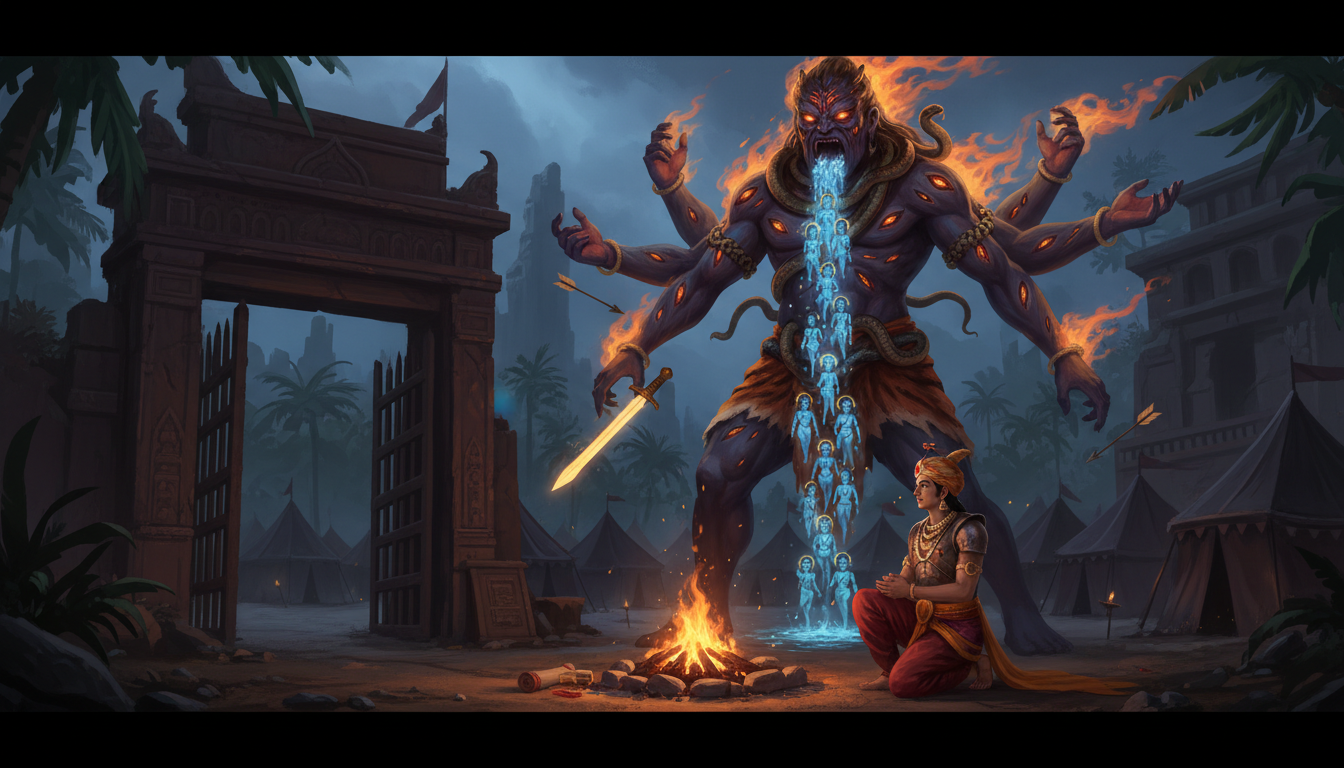
There stood before him a being of gigantic frame, capable of making the very hair stand on end, and possessed of the effulgence of the Sun or the Moon. It was guarding the entrance. It had not been there when they rode up, and it did not speak, and it did not challenge him, and it did not move aside."
A Thousand Eyes and All of Them Burning
"Round its loins was a tiger-skin dripping with blood, and it had a black deer for its upper garment. For its sacred thread it wore a large snake. Its arms were long and massive and held many kinds of uplifted weapons, and for the ornaments of its upper arms it had another great snake wound about them.
Its mouth seemed to blaze with flames of fire. Its teeth made its face terrible to behold. Its mouth was open and dreadful. Its face was adorned with thousands of beautiful eyes. Its body was incapable of being described, O king, as was its attire. The very mountains, upon beholding it, would split into a thousand fragments.
Blazing flames of fire seemed to issue from its mouth and its nose and its ears and from all those thousands of eyes. And from those blazing flames hundreds and thousands of Hrishikeshas issued out, armed with conchs and discs and maces, each one of them Krishna, each one of them looking at him.
Kripa saw it and Kritavarma saw it, and neither of them said a word, because there was nothing in the training of a car-warrior that covered it.
Beholding that extraordinary being capable of inspiring the whole world with terror, Drona's son did not feel any agitation. He was past the point where a man feels agitation. He covered it with showers of celestial weapons instead."
Everything He Threw
"That being, however, devoured all those shafts shot by Drona's son. Like the vadava fire devouring the waters of the ocean, it devoured the arrows one after another as fast as he could speed them, and stood where it had stood before.
Beholding his arrowy showers prove fruitless, Ashvatthama hurled at it a long dart blazing like a flame of fire. That dart of blazing point, striking against the being, broke into pieces like a huge meteor at the end of the yuga breaking and falling down from the firmament after striking against the Sun.
Ashvatthama then, without losing a moment, drew from its sheath an excellent scimitar of the colour of the sky and endued with a golden hilt. The scimitar came out like a blazing snake from its hole. The intelligent son of Drona hurled that excellent scimitar at the being. The weapon, approaching it, disappeared within its body like a mongoose disappearing into its hole.
Filled with rage, the son of Drona then hurled a blazing mace of the proportions of a pole set up in honour of Indra. The being devoured that mace also.
At last, when all his weapons were exhausted, Ashvatthama cast his eyes around him. There was nothing left in the car and nothing left in his hands. And the whole firmament above the camp was densely crowded with images of Janardana, standing in the air on every side of him, as many of them as there had been arrows."
The Words of Advising Friends
"Drona's son, divested of weapons, beholding that wonderful sight, recollected the words of Kripa. And turning pale with grief, he said:
'He that listens not to the beneficial words of advising friends is obliged to repent, being overwhelmed with calamity, even as my foolish self for having disregarded my two well-wishers. That fool who, disregarding the way pointed out by the scriptures, seeks to slay his enemies, falls off from the path of righteousness and is lost in the trackless wilderness of sin.
One should not cast weapons upon kine, brahmanas, kings, women, friends, one's own mother, one's own preceptor, a weak man, an idiot, a blind man, a sleeping man, a terrified man, one just arisen from sleep, an intoxicated person, a lunatic, and one that is heedless. The preceptors of old always inculcated this truth upon men. I have, however, by disregarding the eternal way pointed out by the scriptures, and by essaying to tread in a wrong path, fallen into terrible distress.
The wise have called that a terrible calamity when one falls back, through fear, from a great feat after having essayed to achieve it. I am unable, by putting forth only my skill and my might, to achieve that which I have vowed. Human exertion is never regarded more efficacious than destiny. If any human action that is commenced does not succeed through destiny, the actor becomes like one who, falling off from the path of righteousness, is lost in the wilderness of sin. The sages speak of defeat as foolishness when one, having commenced an act, swerves from it through fear. In consequence of the wickedness of my essay this great calamity has come upon me; otherwise Drona's son would never have been forced to hold back from battle.'
He was standing on the ground by then, O king, in front of an enemy he could not touch, saying over to himself in the dark the exact argument that his uncle had made to him under the banyan and that he had answered so well."
The Uplifted Rod
"Then he looked at the thing in the gateway again, and understood what he was looking at.
'This being whom I see before me is most wonderful,' he said. 'He stands there like the uplifted rod of divine chastisement. Reflecting even deeply, I cannot recognise who this being is. Without doubt, that being is the terrible fruit of this sinful determination of mine that I had essayed to achieve unrighteously. He stands there for baffling that determination. It seems, therefore, that in my case this falling off from the fight has been ordained by destiny. It is not for me to exert for the accomplishment of my purpose unless destiny becomes favourable.
I shall, therefore, at this hour, seek the protection of the puissant Mahadeva. He will dispel this dreadful rod of divine chastisement uplifted before me. I will take the shelter of that god, that source of everything beneficial, the lord of Uma, otherwise called Kapardin, decked with a garland of human skulls, that plucker of Bhaga's eyes, called also Rudra and Hara. In ascetic austerities and in prowess he far surpasses all the gods. I shall seek the protection of Girisha armed with the trident.'
Mark the turn of it, O king. He did not say that he had been wrong. He said that his purpose was true and that the obstacle was a technical one, and that there was a god who could remove obstacles. A man does not change his mind at that hour of the night. He only looks for a higher permission."
The Litany of Names
Sanjaya said, "The son of Drona, having reflected thus, descended from the terrace of his car and stood bending his head unto that supreme god. And he said:
'I seek the protection of Him called Ugra, Sthanu, Shiva, Rudra, Sharva, Ishana, Ishvara, Girisha; and of that boon-giving god who is the Creator and Lord of the universe; of Him whose throat is blue, who is without birth, who destroyed the sacrifice of Daksha, and who is called Hara; of Him whose form is the universe, who has three eyes, who is possessed of multifarious forms, and who is the lord of Uma; of Him who resides in crematoriums, who swells with energy, who is the lord of diverse tribes of ghostly beings; of Him who wields the skull-topped club, who bears matted locks on his head, and who is a brahmacari.
Purifying my soul that is so difficult to purify, and possessed as I am of small energy, I adore the Destroyer of the triple city, and offer myself as the victim. Hymned thou hast been, deserving art thou of hymns, and I hymn to thy glory.
Thy purposes are never baffled. Thou art robed in skins; thou hast red hair on thy head; thou art blue-throated; thou art unbearable; thou art irresistible. Thou art pure; thou art the Creator of Brahman; thou art Brahma; thou art a brahmacari; thou art an observer of vows; thou art devoted to ascetic austerities; thou art infinite; thou art the refuge of all ascetics; thou art multiform; thou art the leader of diverse tribes of ghostly beings; thou art three-eyed; thou art dear to Gauri's heart; thou art the sire of Kumara; thou art fond of those beings called companions; thou art always seen by the Lord of treasures; thou art tawny; thou hast for thy excellent bearer a bovine bull; thou art robed in a subtle attire; thou art most fierce; thou art eager to adorn Uma; thou art higher than all that is high; there is nothing higher than thou; thou art the wielder of weapons; thou art immeasurable, and thou art the protector of all quarters; thou art cased in golden armour; thou hast the moon as an ornament on thy brow.
With concentrated attention I seek thy protection, O god. For success in getting over this dreadful distress that is so difficult to get over, I sacrifice unto thee, the purest of the pure, offering for thy acceptance the five elements of which my body is composed.'"
What Came to Watch
"Knowing this to be his resolution, in consequence of his desire to accomplish his object, a golden altar appeared before the high-souled son of Drona. Upon the altar, O king, appeared a blazing fire, filling all the points of the compass, cardinal and subsidiary, with its splendour.
And out of the dark around that fire came the companions of the god, in their hundreds and their thousands. Many mighty beings of blazing mouths and eyes, of many feet and heads and arms, adorned with angadas set with gems, with their arms uplifted, looking like elephants and like mountains. Their faces resembled those of hares and boars and camels and horses and jackals and cows and bears and cats and tigers and crows and apes and parrots. The faces of some were like those of mighty snakes, and others had faces like those of ducks. Some had faces like tortoises and alligators and porpoises and huge sharks and whales, and some like lions and cranes and pigeons and elephants and stags. Some had ears on their hands. Some had a thousand eyes. Some had no flesh, and some, O Bharata, had no heads at all.
Some were armed with shataghnis, some with thunder, and some had mushalas in their hands. Some had nooses, and some had maces. On the backs of some were slung quivers containing excellent shafts, and all were fierce in battle. Some had large nooses in their uplifted arms, and some had clubs and bludgeons, and some had stout posts in their hands, and some had scimitars, and some had snakes with erect heads for their diadems. Some had matted locks on their heads, and some had five tufts of hair, and some had heads that were bald. Some had lean stomachs; some had four teeth, some had four tongues, some had ears straight as arrows, and some had diadems on their brows. Some were begrimed with dust, some smutted with mire, and all were attired in white robes and white garments. The limbs of some were blue, while others had limbs that were tawny. Some were of very short stature, and some were very high.
Those beings, called companions, possessed of golden complexions and filled with joy, played upon drums and horns and cymbals and jharjharas and anakas and gomukhas. Some sang and some danced about uttering loud sounds, and some leapt forward and cut capers and jumped sideways. Drinkers of blood and fat, they subsisted on the flesh and entrails of animals. They know not what it is to fear, and are capable of enduring the frowns of Hara. They are capable of bringing down the firmament with the sun, moon and stars upon the earth, and of exterminating the four orders of created things. They always act as they like, and are the lords of the lords of the three worlds. Having obtained the eight kinds of divine attributes, they are never elated with pride, and the divine Hara is always filled with wonder at their feats. Having adored the trident-bearing god with Vedic recitations, with brahmacarya, with austerities and with self-restraint, they have obtained the companionship of Bhava, and the divine Maheshvara, that lord of the past, the present and the future, eats with them, as does Parvati.
Causing the universe to resound with the peal of diverse kinds of instruments, with the noise of laughter, with shrieks and leonine roars, they approached Ashvatthama from every side. They came desirous of enhancing his honour and the glory of the high-souled Hara, and wishing to ascertain the extent of his energy, and desirous also of beholding the slaughter during the hour of sleep. They were capable of inspiring the three worlds with dread at their sight. The mighty Ashvatthama, however, beholding them, felt no fear."
His Bow for Fuel, His Soul for the Libation
"Drona's son, armed with his bow, and with his fingers cased in fences made of iguana skins, himself offered up his own self as a victim unto Mahadeva. Bows were the fuel, and sharp shafts were the ladles, and his own soul, possessed of great might, was the libation, O Bharata, in that act of sacrifice.
The valiant and wrathful son of Drona then, with propitiating mantras, offered up his own soul as the victim. Having with fierce rites adored Rudra of fierce deeds, Ashvatthama with joined hands said these words unto that high-souled god:
'Sprung from Angirasa's line, I am about to pour my soul, O god, as a libation on this fire. Accept, O lord, this victim. In this hour of distress, O Soul of the universe, I offer up my own self as the sacrificial victim, from devotion to thee and with my heart concentrated in meditation. All creatures are in thee and thou art in all creatures. Assemblage of all high attributes occur in thee. O lord, thou art the refuge of all creatures. I wait as a libation for thee, since I am unable to vanquish my foes. Accept me, O god.'
Having said these words, Drona's son ascended that sacrificial altar on which the fire blazed brightly, and offered himself up as the victim, and entered that blazing fire.
Understand what was done there, O king, and what it cost. He had come to the gate carrying a bow he could not use and a vow he could not keep. He put the bow into the fire as firewood, and the arrows in after it as the ladles that pour the butter, and then he put himself in after them. There was nothing of him left outside the flame to bargain with."
For Krishna's Sake, and No Longer
"Beholding him stand immovable with uplifted hands, an offering made of himself, the divine Mahadeva appeared in person, and smilingly said:
'With truth, purity, sincerity, resignation, ascetic austerities, vows, forgiveness, devotion, patience, thought and word, I have been duly adored by Krishna of pure deeds. For this there is none dearer to me than Krishna. For honouring him and at his word I have protected the Pancalas and displayed diverse kinds of illusion. By protecting the Pancalas I have honoured him. They have, however, been afflicted by time. The period of their lives has run out.'
So the guard at the gate had been the god himself, and the thousand faces of Janardana pouring out of that mouth had been the reason for the guard, and the reason had just expired.
Having said these words unto the high-souled Ashvatthama, the divine Mahadeva entered Ashvatthama's body, after giving him an excellent and polished sword.
Filled by that divine being, Drona's son blazed up with energy. In consequence of that energy derived from godhead he became all-powerful in battle, and what he had not been able to do with celestial weapons an hour before he was now able to do with an ordinary sword, because the difficulty had never been in the weapon. Many invisible beings and rakshasas proceeded along his right and his left as he set out, like the lord Mahadeva himself, for entering the camp of his foes.
And this, O king, is the answer to the question you asked me. Kripa and Kritavarma did nothing at the gate. They stood where he had put them and they watched a man argue with a god and win, and then they watched him walk in with a new sword in his hand and a crowd of things at his shoulder that they could hear and could not see."
Dharma Lesson
A man can be given the power to do a thing and still be the one who chose it; divine permission does not transfer the guilt. Ashvatthama is stopped at the gate by the exact shape of his own resolution, and instead of taking that as an answer he goes looking for a higher authority who will let him past.