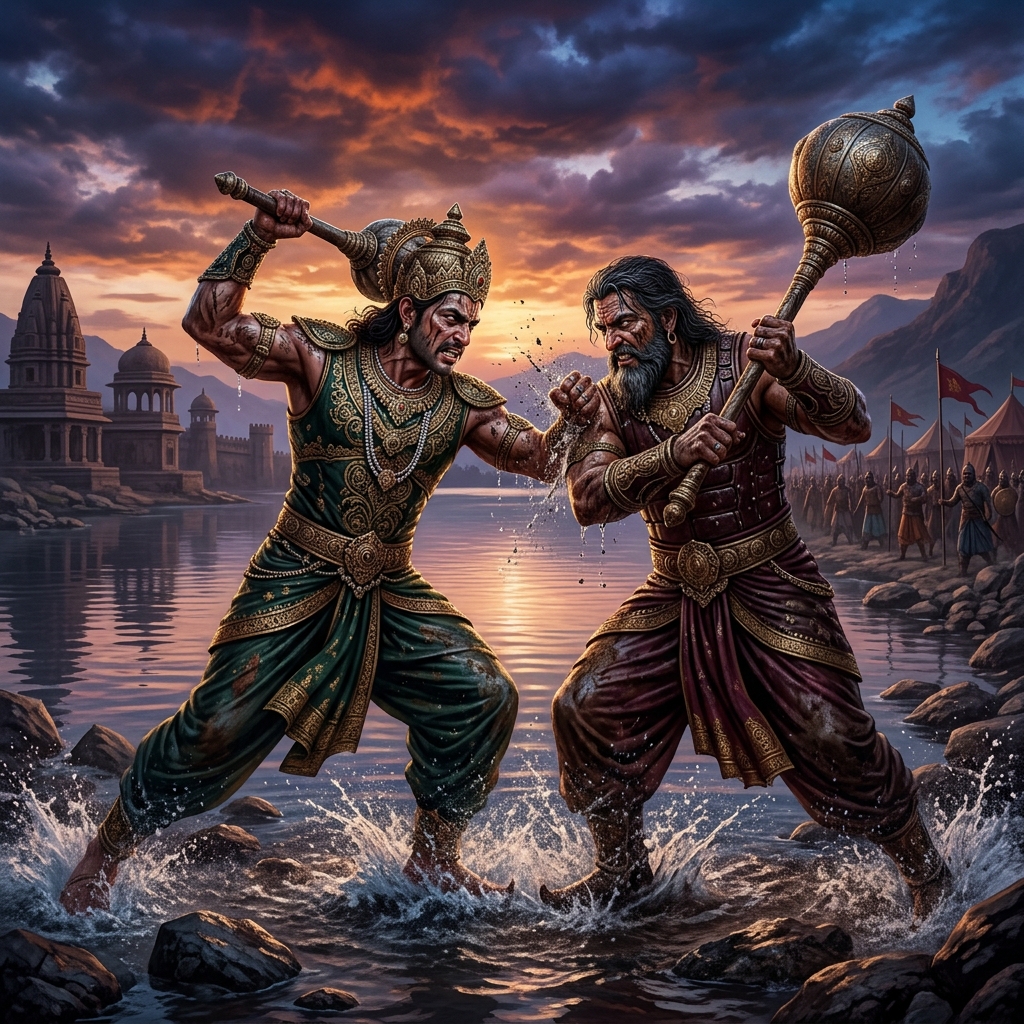
Duryodhana's Last Stand
Shalya, the Twins, and a King in a Lake
The Last King on the Field
The eighteenth day of the war at Kurukshetra burned down toward evening. The great plain that had once held two oceans of men was now a wreckage of broken chariots, dead horses, splintered standards, and the bodies of kings. The dust that had hung over the battle for more than two weeks settled at last, because there were no longer enough living men moving to keep it in the air. The vultures came down. The jackals waited at the edges of the light.
Duryodhana, son of Dhritarashtra, eldest of the hundred brothers, rode across this ruin alone. His chariot was gone; his horse had been killed under him; he walked now with a mace across his shoulder, and his armor was dented and dark with the blood of other men and his own. He was still a tall man, still powerful, still a king to look at, but he was a king of nothing. His army had been a sea, and the sea had drained away into the dry earth.
He had begun the war with eleven divisions, with Bhishma and Drona and Karna and Shalya to command them, with his hundred brothers around him, with Shakuni at his ear. Now Bhishma lay on his bed of arrows, waiting for the sun to turn north before he would let himself die. Drona had been beheaded after a lie about his son. Karna, his dearest friend, the man for whom he had defied the whole world, had been shot through the neck while his chariot wheel was sunk in the mud. Shalya, the last commander, had been killed that very morning by Yudhishthira's spear. And his brothers, all hundred of them, were dead. Every one.
Duryodhana stood in the middle of the emptiness and understood, for the first time fully, that he had lost. Not a battle. Everything. He had spent the lives of an entire age of warriors and the whole strength of the house of Kuru, and at the end of it he stood alone with a mace and no kingdom and no friend and no brother left alive.
He did not weep. Whatever else could be said of Duryodhana, and much could be said, none of it gentle, he did not weep at the end. He looked at the sun going down red through the dust and made a decision. He would not be cut down running. He would not be taken. He would hide, recover his strength, and choose his own ground for the last act.
The Blood of Dushasana
Above all the dead, one death sat in Duryodhana's mind and would not leave it. Dushasana. The brother who had stood closest to him through every cruelty and every scheme. The brother who, on the day of the dice-hall, had dragged Draupadi by the hair into the assembly while she bled and pleaded, and had laughed, and had tried to strip the single garment from her body before the whole court of the Kurus.
Bhima had made a vow that day. With his eyes red and his voice shaking, the second of the Pandavas had sworn before the assembly that he would one day tear open Dushasana's chest and drink the blood from it, and that until he had done so he would not count himself a man. The Kauravas had laughed at the vow as the empty rage of a beaten gambler's brother. They did not laugh now.
For on the field of Kurukshetra, Bhima had found Dushasana and had kept the vow exactly. He had broken him down, struck him to the ground, set a foot upon him, torn his arm, the very arm that had pulled Draupadi's hair, from its socket. Then, while the two armies watched and a stillness of horror spread across the field, Bhima had bent and tasted the blood of his enemy, and had risen with his mouth and chest dark and wet, and had roared that the vow of thirteen years was paid. Men who saw it said afterward that they had looked away. Some of the Kaurava soldiers had dropped their weapons and fled at the sight, certain that no human being but a demon could do such a thing.
Duryodhana had been told of it within the hour, and the knowing of it had hollowed him out. Dushasana had been more than a soldier to him. He had been the one brother who never doubted, never wavered, never counseled caution. To picture him torn open in the dust, his blood on Bhima's mouth, was to feel the last warmth go out of the world.
So as Duryodhana walked the ruined field that evening, it was not only defeat that drove him. It was grief turned to stone, and beneath the stone, banked low and patient, the ember of a single remaining desire: that somehow, before the end, the Pandavas should be made to pay. If not by his own hand, for he was one man with a mace, then by some other hand, some weapon he had not yet thought of. The thought was small and dark and he carried it with him toward the water.
Beneath the Waters of Dvaipayana
South of the battlefield lay a wide cold lake, the lake of Dvaipayana, fed by mountain water and very deep. Duryodhana came to its shore in the last of the light, and there he laid down his mace, and he stood at the edge of the water and looked into it.
He was a master of more than weapons. Like many of the great warriors of that age, he had been given knowledge of certain powers, the binding and loosing of the elements that a man of disciplined will could command. He gathered that power now. He waded out into the cold water until it closed over his shoulders, and then over his head, and at the bottom of the lake he cast the spell that hardened the water around him.
The water above him grew firm, like a roof of glass, leaving him a still pocket of air and stillness at the bottom of the lake. There he settled himself, cross-legged on the cold lakebed, the green dimness pressing down all around, and there he meant to wait. He would rest. He would recover his strength. He would let the Pandavas wear themselves out searching, and grow tired, and perhaps leave the country to take up the kingdom they had won. And when they were gone, he would rise out of the lake, and the line of Dhritarashtra would not be ended after all.
It was the act of a desperate man, and Duryodhana knew it. The proudest king of his age, the man who had refused to yield five villages to his cousins and had chosen instead a war that emptied the world, was now hiding under a lake like a hunted animal in a burrow. Some part of him felt the shame of it like a wound worse than any Bhima could give. But a larger part, the part that had always wanted, above everything, to outlast and outlive and finally to win, told him that a living king under the water was worth more than a dead king in glory on the field. So he closed his eyes in the green silence, and the world above forgot him for a while.
The Search
When the fighting ended and the field was searched, the Pandavas could not find Duryodhana. They counted the dead and he was not among them. They questioned the few prisoners and the wandering wounded and he was not among the living that anyone could point to. He had simply vanished, and with him the war refused to be over.
For while Duryodhana lived, nothing was finished. He was the king. He was the cause. Yudhishthira could not in justice be called the lord of the Kurus while the lawful claimant breathed somewhere in the dusk. Krishna knew it best of all. He stood with the brothers in the failing light and said plainly that they must find Duryodhana, that the war was a wound that would not close while he was loose, that a single surviving king with the knowledge of weapons and a grievance vast enough to swallow the world was more dangerous now than he had been at the head of his eleven divisions.
So they searched through the night and into the next day. They sent out scouts. They followed every rumor. And at last word came to them, some say from hunters, men of the forest who had been gathering meat near the lake of Dvaipayana and had crept close enough to overhear. These hunters had seen a great armored man walk into the water. They had seen the water close over him and grow strangely still and firm. They had heard, faintly, from beneath the surface, the murmur of a man speaking the words of a spell. They were poor men, and they came to the Pandava camp and told what they had seen in exchange for reward, and the brothers gave them what they asked and rode hard for the lake.
They came to the shore of Dvaipayana and stood looking at the flat green water, and they knew their enemy was beneath it. Bhima gripped his mace until his knuckles whitened. Arjuna strung his bow without thinking. Yudhishthira stood very still. And Krishna, looking at the unnatural stillness of the water, said quietly that the last king of the Kurus was lying at the bottom of that lake, and that they would now have to bring him up.
The Taunts on the Shore
There was no easy way to drag a man out of a roof of hardened water. So the Pandavas did the one thing that could reach Duryodhana where weapons could not: they spoke to him.
They stood on the shore and called him by name. They called him King of the Kurus, lord of nothing, hero who hid in a pond. Yudhishthira, who was a gentle man and hated cruelty, spoke first and most measured, but even he could not keep the edge from his voice. He called across the water that this was the very man who would not yield five villages, who had said the Pandavas should have no land they could balance on the point of a needle, and now lay drowned in a pond. The war you wanted is here, he called. Come and finish it. Or has the great Duryodhana learned at last to be afraid?
Bhima's voice came after, and it had no gentleness in it at all. Come out, coward, he roared. Come out and face me. Where is the king who patted his thigh at Draupadi? Where is the proud lord who watched my brother dragged into your hall? Your hundred brothers are dead and I killed most of them, and Dushasana's blood is barely dry on my chest. Come up out of your puddle and let me send you after them, you woman, you fish, you frog hiding in the mud.
The insults went on. They knew their man. Duryodhana could endure almost anything except the suggestion that he was a coward, for cowardice was the one accusation that had never in his life been true. He had been cruel and proud and stubborn and blind, but he had never once turned from a fight. And so the brothers worked at exactly that nerve, hour upon hour, until the words sank down through the water and the hardened roof and the cold green silence and found the man at the bottom of the lake.
Duryodhana heard them. He lay in his pocket of air with his eyes shut and his jaw clenched and let the insults break against him like waves, and for a long time he held. But Bhima's voice would not stop. Coward. Frog. Hiding fish. He thought of his dead brothers and his dead friend Karna and the throne he had wanted his whole life, and he thought that whatever happened above the water, it could not be worse than lying here while these men called him a coward to his face and the whole world listened. The proud thing in him, the thing that had ruined him, rose now and would not be held down.
He Will Not Fight Five
At last the water answered. From beneath the surface came Duryodhana's voice, hollow and changed by the water, but unmistakably his. He told them they were wrong to think him afraid. He was not afraid of any one of them, he said, or of all five of them together. He had no army left and no chariot and no brother to guard his flank, and that was why he had come into the water, not from fear of death, but because there was no honor in dying surrounded, cut down by five at once like a deer by a pack of dogs. A king does not die that way if he can help it. He had come there to rest, he said, not to hide.
Krishna answered him, and his voice was cold. You speak of honor now, Duryodhana, he said. You who cheated at dice, who poisoned Bhima as a boy, who burned the Pandavas in a house of lac, who refused them even their own kingdom, who stripped their wife in your hall. Now, at the bottom of a lake, you discover honor. Come up and be a king for once in your life, since you could not be one on a throne.
The water stirred. And then it broke, and Duryodhana rose up out of the lake. He came up streaming, the cold water sheeting off his shoulders and running from his hair and beard, his great frame straightening as he found his footing and climbed toward the shore. He looked at the five brothers standing in a line on the bank, and at Krishna beside them, and he was not afraid. Whatever he was, he was not that.
Here I am, he said. But I will not fight all five of you. I am one man and you are five and you have a god to advise you. That is not a battle, it is a slaughter, and I will not give you the satisfaction of pretending it was anything else. I will fight one of you. Single combat, on equal terms, in honest sight of all. And I will fight with the mace, the gada, the weapon I have trained in since I was a boy, the weapon in which I yield to no living man. Choose your champion. Let the rest stand aside. And when I have killed him, I will fight the next, and the next, until one of us is left standing. That is my answer. That is the only fight you will get from me.
He planted his mace on the ground before him and leaned on it and waited, dripping, a king with nothing left but his own two arms and the weapon in his hands, and somehow, in that moment, more truly royal than he had ever looked upon a throne.
Yudhishthira's Rash Offer
Now Yudhishthira did a thing so generous and so reckless that it nearly undid everything the war had been fought to win. Moved by the lonely courage of his cousin standing dripping and brotherless on the shore, and bound by his own deep love of fairness, he answered that Duryodhana should have his single combat. And more than that, he said, because he would not have it said that they forced an unequal fight upon him, Duryodhana might choose his opponent from among the five of them. Whichever of them he named would fight him. And he might choose the weapon, and if any one of them was defeated, Duryodhana would keep the kingdom. That was how sure Yudhishthira was that their cause was just. Choose, he said.
Krishna heard this and went pale with anger. He could not strike the offer down without shaming Yudhishthira before the enemy, but under his breath, fierce and low, he turned on his cousin. What have you done, he said. Do you understand what you have just offered? Duryodhana has trained at the mace under Balarama himself, my own brother, for years on end. In the gada he is the finest of all of you, finer than Bhima, by skill if not by strength. He has spent his whole life waiting for exactly this. If he chooses you, or Arjuna, or one of the twins, he will kill you within the hour. None of you can stand against him with the mace. You have offered him the one chance he had to win the whole war back in a single fight, and you have let him pick the man and the weapon both. Only Bhima has any hope at all against him, and only because Bhima is stronger, and even Bhima may not be enough by skill alone. You have gambled the kingdom on Duryodhana's pride.
Yudhishthira understood, too late, what he had done. The blood went out of his face. But the offer had been spoken aloud, before witnesses, and a king's word once given could not be taken back. They stood and waited to see whom Duryodhana would name.
Krishna watched the enemy's face and prayed to himself that pride would do what prudence could not, that Duryodhana, given the free choice of the weakest of his enemies, would be too proud to take the easy kill, and would instead choose the one man whose death would mean the most to him.
Bhima Steps Forward
Duryodhana looked along the line of his cousins. He could have named Yudhishthira, who had never been a mace-fighter and would have fallen in moments. He could have named Arjuna, the archer, awkward and overmatched with the heavy iron in his hands. He could have named Nakula or Sahadeva, the twins, neither of them his equal in this one art. Any of those choices would have given him a near-certain kill and a chance, however small, to fight his way back to the throne over the bodies of the rest.
But Duryodhana was the man he had always been, ruled by his pride to the last. To kill the weakest of them would be no triumph; it would only confirm that he had crept up out of a lake to murder a man who could not fight him. And there was one man among them he hated above all others, one man whose death he wanted more than he wanted the kingdom itself.
Bhima, he said. I choose Bhima.
Bhima had already stepped forward. He did not wait to be chosen; he had been waiting thirteen years for this. He came out from the line of his brothers and planted his own mace on the earth and the two great men faced each other across the trampled shore of the lake.
You drank my brother's blood, Duryodhana said. You broke my brothers one by one. You have been promising my death since the dice-hall. Here I am, Bhima. Make good your boast, if you can. I am not Dushasana, to be torn open while the field watches. You will have to earn me.
I have one vow left, Bhima answered, and his voice was low now, all the taunting gone out of it, because this was the thing itself and not the prelude to it. On the day you patted your thigh and called Draupadi to sit upon it like a slave, I swore before all the Kurus that I would break that thigh and grind it under my heel. Your hundred brothers are paid. Dushasana is paid. You are the last debt, Duryodhana, and I mean to settle it.
Krishna let out a long breath. Pride had chosen for them after all. Whether pride would be enough was another question, and it would be answered now, with iron, on the shore of the lake.
The Duel of Maces
They came together, and the sound of the first blow rang out across the water and came echoing back from the far shore like a struck bell.
Both men were enormous, both armored, both wielding heavy iron maces that an ordinary warrior could barely lift. They circled. They feinted. They closed and struck and broke apart, and when the maces met in the air the shock of it could be felt in the ground. They moved with a grace that seemed impossible in men so large, sidestepping, turning, leaping, whirling the great weapons in arcs that would have crushed a chariot. The other Pandavas, Krishna, Balarama, and the watching warriors of both sides who had gathered to see the war's last fight, stood in a wide ring and did not speak.
The duel went on far longer than any of them had thought a human body could endure. An hour. Then more. The two men tore the earth up around them with their footwork until they fought ankle-deep in churned soil. Their armor split and fell away in pieces. Both bled from a dozen places where a mace had glanced off a guard. Sweat and lake-water and blood ran down them and dried in the dust and ran again.
And as the fight wore on, the truth that Krishna had feared became plain to everyone watching. Duryodhana was the better mace-fighter. The years under Balarama showed in every movement, his guard was tighter, his strikes were cleaner, he read Bhima's attacks a half-instant before they came and turned them aside and answered them. Bhima was the stronger man and the more terrible to be hit by, but Bhima was being outfought. He was tiring. His blows began to come a little wild, a little late. Twice Duryodhana's mace got past his guard and rocked him, and the watchers saw him stagger. If the fight continued as it was going, by skill alone, Duryodhana would win it, and the kingdom would be his, and the whole vast war would have been for nothing.
Krishna saw it. He stood at the edge of the ring with his arms folded and his face grim, and he understood that strength and justice were not going to be enough, and that something would have to be done.
The Slap of the Thigh
Krishna leaned toward Arjuna, who stood beside him in the watching ring, and spoke without taking his eyes from the duel. Bhima cannot win this by skill, he said. Duryodhana is the better man with the mace and they both know it. But there is one place Duryodhana believes himself safe, and so he leaves it unguarded, and there is one vow Bhima made that he has not yet kept.
Then Krishna, where Bhima could see him across the dueling-ground, lifted his hand and struck his own thigh, a slow, deliberate slap on the upper leg, once, and then his open hand moving along the line of the thigh. It was not a thing the crowd would understand. But Bhima, in a clear moment between exchanges, saw it, and the meaning of it went through him like fire.
The thigh. Draupadi in the dice-hall, dragged in by the hair, and Duryodhana, this man, the man in front of him now, baring his left thigh and slapping it and inviting her with an obscene gesture to come and sit upon the lap of her master. The vow he had sworn that day, in front of all the Kurus, with his eyes red: that he would break that thigh. Krishna was reminding him. Krishna was telling him where to strike, and reminding him that the strike was already promised, already sworn, already owed.
In mace combat there was a law, old and absolute: no warrior strikes another below the navel. The thigh, the legs, were forbidden ground. To strike there was foul, a violation of the code that every fighter held sacred. Duryodhana, the master of the form, would never expect it, and so guarded his upper body and his head and left his thighs open without a thought.
Bhima understood all of it in the space of a breath. He saw the opening. He saw the foulness of it. And he saw his vow. He chose the vow.
The Forbidden Blow
In the next exchange, Duryodhana gathered himself and sprang into the air. It was his favorite stroke, the leaping attack that brought the full weight of his body and his mace down upon an enemy's head, and it had been beautiful to watch all through the duel. He leapt now, the mace lifted high, his whole frame committed to the downward blow.
And Bhima did not meet it. Instead, as Duryodhana hung in the air with his thighs exposed beneath his lifted arms, Bhima swung low with all the terrible strength that had no equal among living men. The mace came around in a flat, whistling arc and struck Duryodhana across both thighs.
The sound was not like the ringing of the earlier blows. It was a duller, heavier, sickening sound. Both of Duryodhana's thighs shattered. He came down out of his leap broken, and crashed into the churned earth, and could not rise. His legs would not answer him. He lay in the dust of the shore with the great war ended in his ruined body, and a long cry of rage and pain went up out of him that echoed off the water of the lake.
Bhima stood over him. For a moment the old fury took him and he set his foot upon Duryodhana's head, and the watching brothers had to call out to him to stop, for there is a limit even to a kept vow. Bhima stepped back. He lifted his arms and roared to the field that the vow of the dice-hall was paid in full, that the thigh Duryodhana had bared to Draupadi was broken, that thirteen years of waiting were over.
But not everyone on the shore cheered the blow. The law of mace combat had been broken in plain sight, before the gathered warriors of two armies, and there was one man there who held that law more sacred than his own life, and he had seen exactly what had been done, and to whom, and at whose silent signal.
Balarama's Fury, and a Broken King's Last Words
Balarama, elder brother of Krishna, master of the mace, the teacher who had trained both Duryodhana and Bhima, had come to watch his two finest students fight. He had seen the forbidden blow land. He saw his favored pupil lying in the dust with his thighs shattered by a stroke that the code of combat absolutely forbade, and a terrible anger rose in him. He took up his plough-weapon and started forward, declaring that Bhima had won by treachery, that a foul stroke had decided the war, that he would strike Bhima down where he stood for the dishonor of it.
Krishna stepped in front of his brother and held him. Quietly, urgently, he spoke, that Bhima had sworn this vow before all the Kurus on the day Draupadi was shamed, that a vow made in the face of such a wrong must be fulfilled, that Duryodhana had piled up cruelty after cruelty for thirteen years and could not now be defended by the very codes he had spent his life trampling. He reminded Balarama of the burning house, the poisoned food, the loaded dice, the stripping of Draupadi. The fight in Balarama did not leave him gladly, but it left him. He looked once more at his broken student, shook his head in grief and disgust, and turned away, and went from that place, and would not stay to see the rest.
Duryodhana, broken on the ground, found his voice. It came out bitter and clear and unbowed. Krishna, he said, it was you. Every foul thing in this war was your doing. You felled Bhishma behind a man who had once been a woman. You killed Drona with a lie about his son. You shot Karna while his wheel was in the mud. And now this, my own teacher's law broken at your signal, my thighs taken by a coward's stroke. You could never have beaten us cleanly, so you cheated, again and again, and called it victory.
He lifted his head as far as he could from the dirt. But hear me, he said. I have no regret. I lived as a king. I enjoyed the whole earth and the sea-girt world. I stood on the heads of my enemies. I gave to those who asked and I crushed those who opposed me, and I die now on the field of battle with my friends and my brothers gone before me, the death every warrior prays for, the death that opens the doors of heaven. Who has lived a fuller life than I have? You, the victors, you have won an empty country full of widows, and you will rule it knowing how you won it. I go to the company of heroes. It is you who must stay behind and live with what you did.
The Pandavas heard him and could not answer, for there was a hard truth twisted through the bitterness. And in the failing light, as they left him broken on the shore to die through the long night, Duryodhana's mind turned one last time, not to peace, not to the throne he had lost, but to vengeance. There was still Ashwatthama, son of Drona, alive somewhere in the dark, a warrior of terrible power who loved him and hated the Pandavas with a hate to match his own. If Duryodhana could not strike the final blow himself, perhaps another hand could be made to strike it for him. He held to that thought, lying alone under the rising stars, as the war that had emptied the world drained at last out of him, the proud, broken, unrepentant king, going down into the dark with a curse on his lips and a plan still flickering behind his eyes.
Dharma Lesson
Hospitality, given without examining the giver, can become a chain - Shalya granted a boon to Duryodhana that bound him to ride against his own nephews. Pride can win a war for the other side: Yudhishthira's careless invitation in the lake almost cost the Pandavas everything; Duryodhana's refusal to fight the right brother cost him his life. Even just wars end in stratagems no one is proud of.