The Fourth Commander
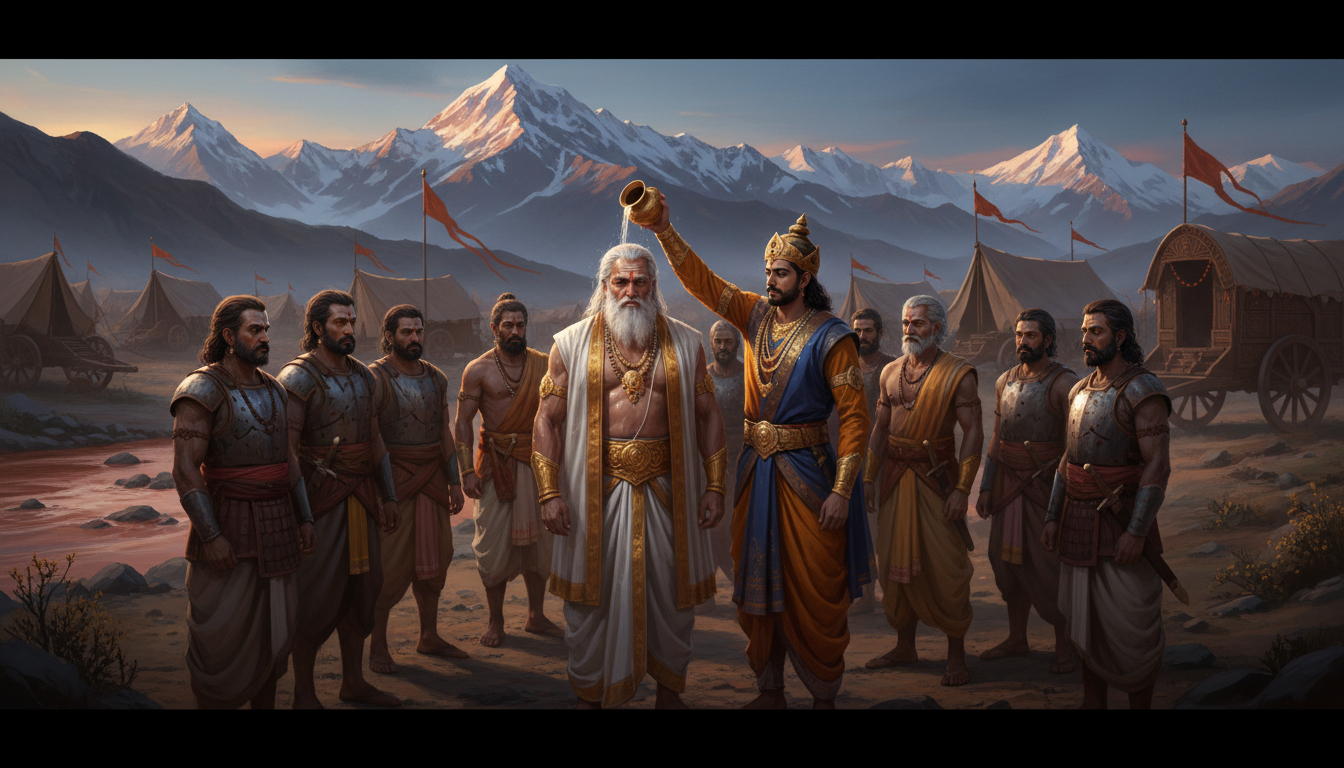
A nephew's water poured on an uncle's head at the foot of Himavat
Two Yojanas From the Field
The Kauravas made their camp a little less than two yojanas from the field, which is as far as men who intend to fight again in the morning are willing to go.
"They groomed their animals first," Sanjaya said. "That is how I knew they were not broken, O king. A beaten army does not groom its horses."
Dhritarashtra sat with his hands on his knees and did not interrupt.
"They came to the Sarasvati where her water runs red, on the sacred table-land at the foot of Himavat, and they bathed in that water and drank of it and quenched their thirst. Then they sat down on the ground and waited for the night to pass. Kripa had spoken to your son before they marched. He had counselled peace, and he had spoken as a friend speaks, and your son heard him to the end."
"And answered him?"
"He said: 'Whatever a friend should say, you have said to me. You have gone into the middle of the Pandava divisions without caring for your life. And your words do not please me, like medicine that ill pleases a man already dying. We took his kingdom from him at dice. Why should the son of Pandu believe me now? Krishna came to us as an envoy and we tried to seize him in our own hall. Why should Hrishikesha believe me? Draupadi wept in the middle of that assembly in a single garment. Krishna will not forget it. Keshava passes his nights in sorrow for his sister's son. Arjuna is wretched for Abhimanyu. Bhimasena has made a vow that he will break rather than bend. Dhrishtadyumna and Shikhandi have drawn their swords against me. Everything has flamed up, and that fire cannot be quenched.'"
"He always could speak," Dhritarashtra said.
"He said one thing more, and the kings around him shouted at it. He said: 'Having shone like the sun on the heads of all these kings, how shall I walk behind Yudhishthira like a slave? There is no happiness here. Fame is all a man acquires, and fame is got by battle and by no other means. Death on one's bed at home is highly sinful. We will go up now by the road our grandsire took, and the preceptor, and Jayadratha, and Karna, and Duhshasana. That road will be crowded.' And all the Kshatriyas cried, 'Excellent, excellent,' and nobody spoke of peace again."
So they passed the night on the table-land: Shalya, and Chitrasena, and Shakuni, and the son of Drona, and Kripa, and Kritavarma of the Satwata race, and Sushena, and Arishtasena, and Dhritasena, and Jayatsena, and every king still alive who could still climb into a car. After Karna fell they had found no place on the whole earth where they felt safe except the mountains, and they had gone to the mountains, and there they were.
What the Kings Asked For
In the morning the surviving kings came to Duryodhana together, and they came in a body because no one of them wanted to be the man who said it alone.
They worshipped him as the rites require, and they said it in the presence of Shalya, which was itself a kind of message.
"It is right that you should fight the enemy," they said. "But first make someone the generalissimo of your army. Protected by him in battle, we will conquer our foes."
They had done this three times before. Once for the grandsire, who held the host together for ten days simply by standing in it. Once for the preceptor, who held it for five. Once for the son of Radha, who held it for two. Each time the army had been given a head and each time the head had been struck off, and the men saying the words this morning knew the arithmetic of it as well as Duryodhana did. None of them said the word fourth.
Duryodhana did not get down from his car. He turned it and drove through the camp toward the one man he had already decided to ask.
The Son Not Born of Woman
Ashvatthama was standing by his own car when the king came.
There was no one in that camp, and perhaps no one alive, put together as he was. His head was well covered and his neck bore three lines like the whorls in a conch shell. His eyes were like the petals of a full-blown lotus and his face had the dignity of Meru. In neck and eye and tread and voice he was like the bull of Mahadeva. His arms were long and massive and well-joined, his chest broad, his thighs and waist and hips well made, his fingers and nails beautiful, and his body looked as though it had been assembled out of golden lotuses. He was equal to Garuda and to the wind for speed. He rivalled Usanas in intelligence and the moon in the charm of his face. Men said the Creator had made him slowly, gathering up one after another every good attribute in creation and putting them all into one body.
And he was learned as few men are learned. He knew the science of weapons in all its details, its four padas and its ten angas. He knew the four Vedas with all their branches, and the Akhyanas as a fifth. His father Drona had not been born of woman, and had worshipped the Three-eyed god with hard vows to beget him upon a wife who had not been born of woman either, so that there was something in his descent that stood a little outside the ordinary run of men. He had been driving foes before him for eighteen days and no one had yet forced him back.
Duryodhana came to him and said, "Son of my preceptor, you are our highest refuge today. Tell us who is to be the generalissimo of my forces. Name the man at whose head we may all stand together and defeat the Pandavas."
It was, though neither of them said so, an offer. There was one obvious answer to that question and both of them knew what it was, and Ashvatthama was being invited to give it.
Let the King of the Madras Lead
"Let Shalya become the leader of our army," said the son of Drona.
He said it at once, without the pause a man leaves when he wants to be argued with.
"In descent, in prowess, in energy, in fame, in beauty of person and in every other accomplishment he is superior. He owns a large force of his own. That mighty-armed one is a second Kartikeya, the generalissimo of heaven. Make that king the commander and we will gain the victory as the gods gained it after making the unvanquished Skanda their commander."
Then he said the thing that decided it, and he said it looking at Shalya and not at Duryodhana.
"And remember what he is. He was marching to join his sister's sons. He was on the road to the Pandavas, and we met him on that road with food and garlands and rest-houses and he took what we offered before he knew whose hands had set it out, and when he learned whose it was, he kept faith with the host who had fed him and abandoned the sons of his own sister. Mindful of the services rendered to him, he took up our side. A man who will do that for a meal will not leave us for anything the Pandavas can offer."
It was praise and it was an accounting, and Shalya stood there and took both.
All the kings came and stood in a ring around the ruler of the Madras and cried victory to him. Having made up their minds to a battle, they felt great joy. It is a curious thing about armies that the naming of a commander gives them back something the fighting has taken away, and for a little while that morning, on that table-land, they were happy.
The Time When Friends Are Examined
Then Duryodhana got down from his car.
He had not got down for the son of Drona. He got down for the king of the Madras, who was still on his own car and stayed there, and the king of the Kurus stood on the ground below him with his hands joined and looked up.
"You who are devoted to your friends," he said, "the time has come when intelligent men examine the persons who wear the guise of friends and find out which of them are friends in fact. Brave as you are, be our generalissimo at the head of our army. When you go out to battle the Pandavas and their allies will lose heart, and the Pancalas will be depressed."
Shalya answered him from the car. "I will accomplish what you ask me to accomplish, king of the Kurus. Everything I have is at your service. My life breath. My kingdom. My wealth."
"I solicit you with the leadership of my army, maternal uncle," Duryodhana said, and he used that word deliberately, standing on the ground in front of the whole camp. "Foremost of warriors, protect us beyond all measure, as Skanda protected the gods in battle. Install your own self in the command as the son of Pavaka was installed in the command of the celestials. Slay our foes, hero, as Indra slew the Danavas."
He was asking a man to lead his army against that man's own sister's children, and he called him uncle while he asked. Nobody in the hearing of it remarked on this. It had stopped being remarkable some days ago.
Water Poured in the Middle of the Troops
"Listen to me, mighty-armed Duryodhana," Shalya said, "foremost of eloquent men. You regard the two Krishnas, when they are on their car, as the foremost of car-warriors. The two of them together are not equal to me in strength of arm. What need is there to speak of the Pandavas? When I am angry I can fight at the front of a battle with the whole world risen up in arms against me, gods and Asuras and men together. I will defeat the assembled Parthas and the Somakas. Without doubt I will lead your troops. I will form such an array that our enemies will not be able to break it. I say this to you, Duryodhana. There is no doubt in it."
So Duryodhana lost no time. He called for the sanctified water and poured it himself, there, in the middle of the troops, on the head of the ruler of the Madras, with the rites as the scriptures ordain them.
When the water had run down that grey head, the roars went up. The Kaurava troops made a noise like lions and the drums were beaten and the horns and the conches were blown, and the Madraka car-warriors, who had been fighting for eighteen days under other men's standards, shouted louder than anyone.
And all of them praised him, calling out the old formula that soldiers call out and half believe:
"Victory to you, king! Long life to you! Slay all the assembled foes! Having got the might of your arms, let the sons of Dhritarashtra rule the wide earth without an enemy left in it! You are able to defeat the three worlds with the gods and the Asuras in them. What need be said of the Somakas and the Srinjayas, who are mortal?"
Thus praised, the king of the Madras obtained a great joy, of the kind that is not attainable by persons of unrefined souls.
Or Slain, Proceed to Heaven
Then Shalya, standing in the wet, made his own speech, and it was the speech of a man who has been given something late and knows it.
"Today, O king, I will either kill all the Pancalas with the Pandavas in battle, or, being killed by them, I will go to heaven. Let the world look at me today careering on the field without fear. Let all the sons of Pandu, and Vasudeva, and Satyaki, and the sons of Draupadi, and Dhrishtadyumna, and Shikhandi, and all the Prabhadrakas behold my prowess today, and the might of my bow, and the quickness of my hands, and the energy of my weapons, and the strength of my arms. Let the Parthas and the Siddhas and the Charanas see what wealth of weapons I possess. Seeing my prowess today, let the great car-warriors of the Pandavas take whatever counsel they can to counteract it. I will rout their troops on all sides. Surpassing Drona, and Bhishma, and the Suta's son in battle, I will range over that field, Kauravas, and do what is agreeable to you."
He named the three dead commanders and promised to be better than all of them in a single day.
And after Shalya had been invested with the command, no man in that army grieved any longer for Karna. That was the strangest part of it. The troops became cheerful and glad. They regarded the Parthas as already slain, as men already brought under the power of the ruler of the Madras. Having obtained that joy, your troops slept that night happily, O king, and were very cheerful.
No Compassion Here
The shouting carried across the plain, as such things do at night, and reached the Pandava camp, and Yudhishthira heard it and understood it before any herald came.
He went to Krishna and said it out loud in the hearing of all the Kshatriyas, so that no one could later say it had been discussed in a corner.
"The ruler of the Madras, Shalya, that great bowman whom all the warriors regard so highly, has been made leader of their forces by Dhritarashtra's son. Knowing what has happened, Madhava, do what is beneficial. You are our leader and our protector. Tell us what should next be done."
Krishna did not soften it.
"I know Artayani truly," he said. "He is illustrious, and endued with prowess and great energy. He is accomplished, conversant with every mode of warfare, and his hands are very light. I think the ruler of the Madras is equal in battle to Bhishma, or to Drona, or to Karna, and perhaps superior to them. I have reflected on it and I cannot find the warrior who is a match for Shalya in a fight. He is superior in might to Shikhandi and to Arjuna and to Bhima and to Satyaki and to Dhrishtadyumna. Endued with the prowess of a lion or an elephant, he will range that field fearlessly like the Destroyer himself in wrath at the end of an age. Day after day, in fight, he will shake your troops."
"Then who," said Yudhishthira.
"You. There is no other person in heaven or in the whole of this world, save you, who would be able to kill the ruler of the Madras when he is excited with wrath in battle. Go against him yourself, Partha. Kill him as Vasava killed the Asura Namuchi."
Yudhishthira said nothing for a moment, and Krishna, who could hear a silence as clearly as a sentence, answered the thing that had not been said.
"There is no need to show any compassion here, thinking that this one is your maternal uncle. Keep the duties of a Kshatriya before you and kill the ruler of the Madras. You have crossed the fathomless oceans called Bhishma and Drona and Karna. Do not sink now, with all your followers, in the print of a cow's hoof called Shalya. Show in that battle the whole of your ascetic power and the whole of your Kshatriya energy. Kill that car-warrior."
Then Keshava, who was worshipped by the Pandavas, went off to his own tent in the evening. After he had gone, Yudhishthira the just dismissed his brothers and the Somakas and slept that night like an elephant from whose body the darts have been drawn out. All the great bowmen of the Pancalas and the Pandavas slept happily, being delighted at the fall of Karna. The fever had gone out of that army. It had reached the shore, as it were, and knew it.
The Oath Before the Array
When that night had passed, Duryodhana went along his lines calling out one order.
"Arm, you mighty car-warriors."
Hearing the king's command, the warriors began to put on their mail. Some yoked their steeds to the cars quickly and others ran about looking for the men who were supposed to do it for them. The elephants were equipped. The foot-soldiers armed. Thousands of others were spreading carpets on the terraces of the cars. The instruments were sounded to raise the martial spirit of the men, and when they were all placed at their proper posts they stood there clad in mail with death fixed as their goal.
But before they moved, the great car-warriors who were left met your son and made an agreement among themselves, and it was the agreement of men who had watched what happened to Bhishma and to Drona and to Karna.
"None of us will fight the Pandavas individually and alone," they said. "Whoever among us fights alone and unsupported, or whoever abandons a comrade who is engaged in a fight, will be stained with the five grave sins and with all the minor ones as well. All of us, united together, will fight with the foe."
Having bound themselves so, they put the ruler of the Madras at their head and went quickly against their enemies.
Shalya went at the front of the array on the best of vehicles, drawn by horses of the Sindhu breed, shaking a bow that was beautiful and exceedingly strong and could throw a shaft a great distance. Around him were the brave Madrakas and the sons of Karna. On the left was Kritavarma with the Trigartas. On the right was Gautama with the Sakas and the Yavanas. In the rear was Ashvatthama with the Kambojas. In the centre was Duryodhana, protected by the foremost of the Kuru warriors, and Subala's son Shakuni and the mighty car-warrior Uluka came on with a large force of cavalry.
The Pandavas divided into three bodies. Dhrishtadyumna and Shikhandi and Satyaki drove hard at the army of Shalya. Arjuna went against Kritavarma and the Samsaptakas. Bhimasena and the Somakas went against Kripa. The two sons of Madri went against Shakuni and Uluka. And Yudhishthira, with his troops behind him, rushed at Shalya alone, wanting to kill him.
Later, when it was over, Dhritarashtra asked Sanjaya what the strength of the two armies had been on that morning, and Sanjaya counted it out for him. Eleven thousand cars, ten thousand seven hundred elephants, two hundred thousand horse and three million foot on the Kaurava side. Six thousand cars, six thousand elephants, ten thousand horse and one million foot on the other. That was all that was left of the world's kings after seventeen days.
Then those two hosts, whose noise was like an agitated ocean, came together at the dawn of that day, and the eighteenth battle began.
Dharma Lesson
Command is given for what a man can actually do, not for what he wishes he were free to do. Shalya is chosen precisely because he once kept faith with a host against his own blood, and by the same logic Krishna refuses Yudhishthira the excuse of kinship. Once the field is chosen, being someone's uncle is not an exemption.