A Cow Sunk in Mire
It was the morning of the eighteenth day, about the hour of sunrise, and the Kuru army was being taken apart.
"They were like a herd of she-deer that has smelt a forest fire," Sanjaya said. "Not beaten. Frightened, which is worse, because a beaten army can be rallied by a victory and a frightened one cannot be rallied by anything except a man. They were weakened and helpless, king, like a cow that has got into mud and cannot find the bottom with her feet."
Shalya, king of the Madras, had been given the command that morning because there was nobody else. Bhishma had fallen. Drona had put down his bow and been beheaded sitting. Karna had gone into the earth up to the hub of his own wheel and been shot standing beside it. The commander of the Kaurava army on the eighteenth day was the uncle of Nakula and Sahadeva, who had ridden north to fight for his nephews and been fed and flattered into the wrong side of the field by Duryodhana at a wayside camp, and who had spent yesterday holding the reins for a man he insulted all day.
He took up an excellent bow and went forward alone against the whole Pandava army.
And the sky did not like it. The earth trembled with all her mountains and made a loud noise. Meteors with points as bright as lance-heads came down through the air and struck the ground. Deer and buffalo and birds went past in large numbers, keeping your army on their right, king, which is the wrong side to be given. Venus and Mars stood in conjunction with Mercury, behind the Pandavas and in front of all your lords of earth. Flames seemed to come off the points of the weapons and dazzle the men holding them. Crows and owls came down and perched on the heads of the soldiers and on the tops of the standards and would not be driven off.
Under all of that, one chariot went forward.
Ten Arrows Each
He poured on Yudhishthira first, in dense showers, the way the thousand-eyed one pours rain when he means to flood a country.
Then he began working down the line. Bhimasena, ten arrows. The five sons of Draupadi, ten each. Dhrishtadyumna, who had killed Drona, ten. Nakula and Sahadeva, his own sister's sons, ten each. Satyaki, ten. Shikhandi, ten. Every shaft equipped with wings of gold and whetted on stone, and every one of them placed, and all of it done at the speed of a man drawing water.
The Prabhadrakas began to fall. So did the Somakas. Not in ones. They were seen going down by thousands, and the arrows that were doing it were described afterwards by men who had been standing in them as being like swarms of bees, or like flights of locusts, or like thunderbolts coming out of a cloud, and all three descriptions are about numbers rather than force, which is the point.
Elephants went down. Horses went down. Foot-soldiers who had never been within a mile of a great bowman before were struck and lay wailing, and men in chariots wandered because their drivers had been hit. The king of the Madras roared aloud like a bank of cloud in the rains and shrouded his enemies the way the Destroyer shrouds the world at the end of an age.
And the Pandava army, being slaughtered, did what armies do. It ran to Yudhishthira. All of it, in on itself, toward the white umbrella, for protection.
Which put every man Shalya wanted in one place.
Everyone Pairs Off
Yudhishthira came out to meet him and checked him with keen shafts the way a man checks a rutting elephant with iron hooks, and Shalya sent a single terrible arrow at him that went through the son of Kunti and out the other side and fell on the ground beyond.
After that the field simplified itself, as fields do. Bhima put seven arrows into Shalya. Sahadeva put in five. Nakula put in ten. The five sons of Draupadi poured on him together like a mass of clouds emptying on one mountain.
And your side came in to save their commander. Kritavarma and Kripa rushed to that spot in wrath. Uluka came, and Shakuni his father, and Ashvatthama with a smile on his lips, and all your surviving sons closed around the king of the Madras to protect him by every means.
So it broke into a hundred separate fights. Kritavarma took Bhima and shot him three times and then shrouded him. Kripa took Dhrishtadyumna. Shakuni went for the sons of Draupadi. Ashvatthama went for the twins. Duryodhana himself went for Krishna and Arjuna and struck them both with many arrows, which was a brave thing that achieved nothing.
The chief of the Bhojas killed Bhima's brown horses, and Bhima came down off the wrecked car with his mace like Death with a raised bludgeon. The king of the Madras killed Sahadeva's horses in front of his eyes, and Sahadeva answered by cutting down Shalya's own son with a sword, and if the two of them had any words about it afterwards nobody heard them.
Bhima was given fresh horses and they were killed under him again. He came down again with the mace, crushed Kritavarma's car and horses with it, and Kritavarma jumped clear and ran.
The Mace That Was Carried Up Gandhamadana
Then Bhima bit his lower lip, which everybody in both armies knew the meaning of by the eighteenth day, and took up the mace properly, and went for Shalya himself.
It was a famous weapon and Sanjaya named it out at length, because a court that has heard the names of the dead for eighteen days deserves to hear one thing described. It was made wholly of iron and it had eight sides. It was bound round with cloth of gold and hung with bells that shrieked when it was swung. It was rich with diamonds and gems, it was smeared with sandal-paste like a desirable woman and smutted with marrow and fat and blood like nothing of the kind, and it was said to look, going through the air, like a blazing meteor, or like a snake of virulent poison that has just come out of its old skin.
With that mace Bhima had gone up to Kailasa and challenged the Lord of Alaka in his rage. With that mace, resisted by many, he had killed a great number of proud Guhyakas who could cast illusions, on the slopes of Gandhamadana, for no better reason than that Draupadi had wanted the Mandara flowers that grew there and he had gone to get them.
He swung it now and crushed the four horses of Shalya's chariot, which had been chosen for their fleetness and were the best team left in your army.
Shalya did not step back. He hurled a lance at Bhima's broad chest and shouted, and the lance went clean through the son of Pandu's armour and stood in his body.
Bhima reached down, pulled it out of himself without any expression at all, turned it round, and threw it into the chest of Shalya's driver, who brought up blood and fell off the car with his heart shaking.
And the king of the Madras came down onto the ground and looked at Bhima, and his own feat had been turned back on him inside four heartbeats, and Sanjaya says he was filled with wonder. Not with fear. With wonder. He was a connoisseur of this, and he had just been shown something.
Two Poles Set Up for Indra
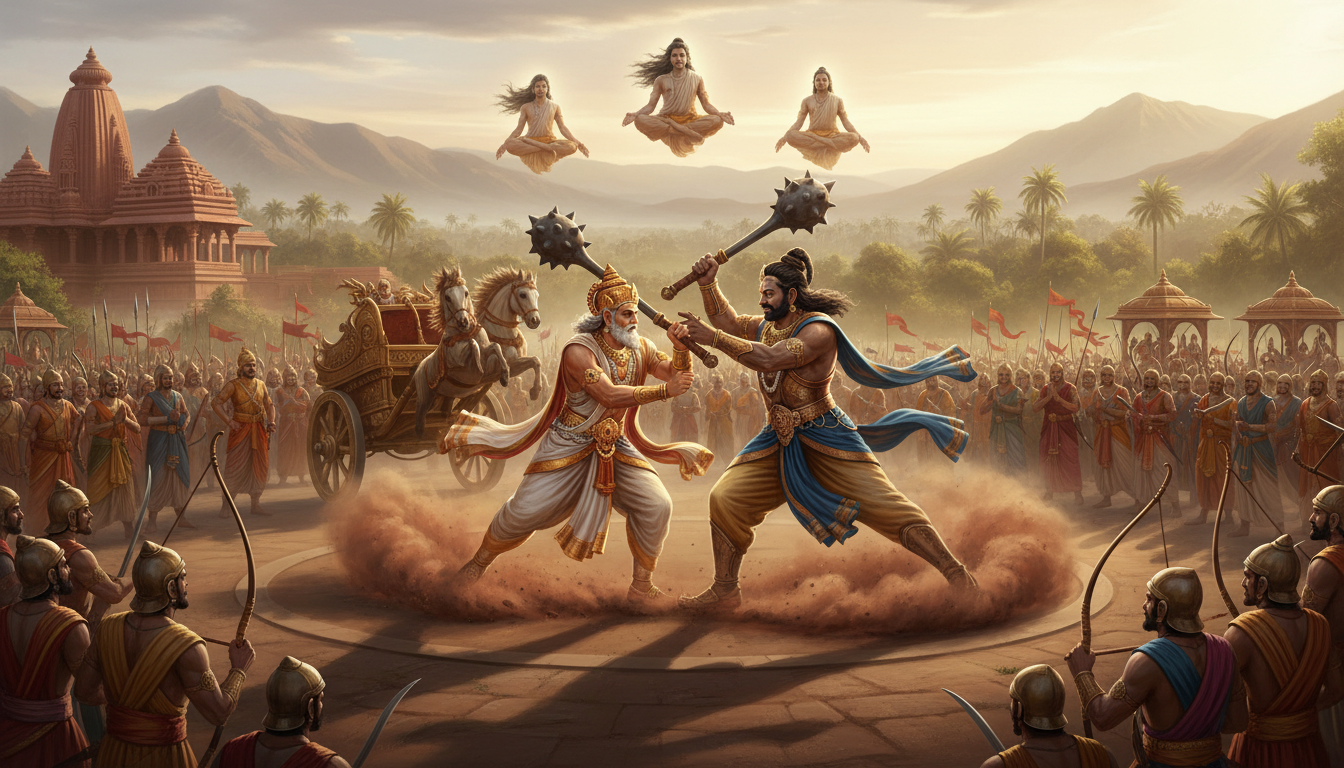
Shalya picked up his own mace, which was iron all through, and stood as still as a bull.
Bhima came at him. He looked, said the men watching, like the fire at the end of an age, or the Destroyer with his noose, or Kailasa with its crest on, or Indra holding the thunder, or Mahadeva with the trident, or simply an elephant in a forest that has decided.
Thousands of conchs went off around them and the trumpets and the leonine roars came up together, because the armies had understood what they were about to see. Men on both sides stopped fighting to watch, and called out to each other across the wreck, "Excellent! Excellent! Except the king of the Madras, or Rama who delights the Yadus, there is no man living who would stand in front of Bhima's rush. And except Bhima, there is nobody who would stand in front of the mace of the king of the Madras."
The two of them roared like bulls and began to circle, jumping into the air. Nobody could tell them apart in the circling or the handling. Shalya's mace was wrapped in a gold cloth that looked like a sheet of fire. Bhima's, as he turned, looked like lightning inside a cloud. When Shalya struck Bhima's mace the sparks went up into the sky and the sky seemed to catch. When Bhima struck Shalya's, a shower of blazing coals came off it.
They hit each other. Like two big elephants using their tusks, like two bulls using their horns, like two ordinary men with iron-bound clubs in a yard. Their limbs opened and they were both washed in blood and looked handsome in it, like two kinsuka trees in flower.
Shalya struck Bhima on the left and on the right and Bhima stood there like a hill. Bhima struck Shalya with all his weight and Shalya moved no more than a mountain moves when an elephant leans on it.
They stopped for a moment. Then they took the weapons up again and came in on tighter circles, each advancing exactly eight steps, and struck like two summits knocking together in an earthquake.
And both of them fell down at the same instant, like a pair of poles set up for the worship of Indra and then let go.
On both sides the cry went up: Oh, and Alas.
Kripa got a car through the wreckage, lifted the king of the Madras onto it and drove him off the field. Within the twinkling of an eye Bhimasena got up, still reeling like a drunk man, and raised his mace and challenged Shalya to come back.
The Ascetics Call It Wonderful
Shalya came back. There was a fresh car, and he got into it, and the fighting closed over the place where the two maces had gone down as if nothing had happened there.
Now Satyaki and Bhimasena and the two sons of Madri surrounded him with their cars and began to work on him from four sides at once, and Yudhishthira stood behind them and shot over their shoulders, and the man in the middle held.
There were watchers above that field, the way there had been at every great encounter of that war. The Siddhas filled with delight. The ascetics who had assembled to see it, men who had no interest whatever in who governed Hastinapura, looked at one unsupported chariot repelling four great car-warriors and used a word: wonderful. That is the judgement the epic records, and it is worth noticing what it is a judgement about. Not the cause. Nobody said the cause was wonderful.
Bhima pierced him with one arrow and then with seven. Satyaki, working to get his king out from under, put in a hundred and roared. Nakula five. Sahadeva seven, and then seven more.
Shalya, struggling carefully, drew a bow built to take an enormous strain and answered all of them at once: twenty-five into Satyaki, seventy-three into Bhima, seven into Nakula. Then he cut off Sahadeva's bow with the arrow still on the string and put seventy-three shafts into Sahadeva himself. Sahadeva strung another, hit his uncle with five that went like snakes, hit his uncle's driver with one, and hit his uncle again with three.
Bhima put in seventy more. Satyaki nine. Yudhishthira sixty.
Blood came out of Shalya then and ran down him in crimson streams, the way water runs down the side of a mountain of red chalk.
And he pierced each of those great bowmen in return with five arrows apiece, which Sanjaya called exceedingly wonderful, and then cut the string off the son of Dharma's bow with a broad-headed shaft.
Five Weapons in the Air at Once
Then they threw everything they had, all five of them, in the same breath.
Satyaki hurled a lance with a golden staff, decked with jewels and gems. Bhimasena sped a cloth-yard shaft that went through the air like a snake on fire. Nakula threw a dart. Sahadeva threw an excellent mace. And Yudhishthira, meaning to finish it, launched a Sataghni, the hundred-slayer.
Five weapons from five of the best men alive, converging on one chariot.
Shalya cut the lance out of the air with a number of broad-headed arrows. He split Bhima's gold-decked shaft into two pieces. He turned the dart aside with a cloud of shafts and the mace with the same cloud. And the Sataghni he cut in half with a couple of arrows in the very sight of the sons of Pandu, and then threw his head back and roared like a lion.
Satyaki could not bear it. He took another bow and put two shafts into Shalya and three into his driver, and Shalya, in a rage now, pierced all five of them with ten arrows each, the way men put lances into elephants, and they found they could not stay in front of him.
Duryodhana, watching from further along the line, looked at what his commander was doing and privately counted the Pandavas and the Pancalas and the Srinjayas as men already dead.
And Yudhishthira, being shrouded with arrows and unable to see his own troops through them, was thinking something else entirely. Sanjaya heard it repeated afterwards. "How," the king of the Pandavas said to himself, "are those grave words of Madhava to come true? I hope the rider of the Madras is not going to annihilate my army in front of me."
Nephew and Uncle
There is one detail in that morning that the reciters usually leave out, and it should not be left out.
When Nakula saw Yudhishthira in trouble he did not go to his brother. He went at his mother's brother. He shrouded Shalya in arrows and then, smiling, put ten shafts into the centre of the man's chest, arrows made entirely of iron, polished by a smith's hands, winged with gold, whetted on stone, and driven with everything he had.
Shalya afflicted his illustrious nephew in return with many straight arrows and did not stop to say anything about it.
They had known each other since the twins were children. Madri had been his sister. He had come to this war intending to fight on their side and had been diverted by a road-side hospitality he was too courteous to refuse and too proud to go back on, and now his nephew was putting iron into his chest and he was answering, and neither of them had any choice left at all, and both of them knew exactly whose fault it was and it was not each other's.
He cut Nakula's bow with the arrow still on it, and it broke into pieces. He cut Satyaki's bow at the handle and sent Satyaki's four horses to Yama and made him carless and then hit him with a hundred arrows from every side while he stood there. He pierced both sons of Madri and Bhimasena and Yudhishthira with ten each.
"The prowess we saw then in the ruler of the Madras," Sanjaya said, "was exceedingly wonderful, since the sons of Pritha even united could not get near him."
Only One Share Remains
The Pandava troops broke. Mangled and bleeding, they left the battle and ran, and they went past Yudhishthira while he shouted at them to stop, and did not stop.
And the mildest of the five became something nobody there had seen before.
He called his brothers to him, and Krishna of Madhu's race, and he said this:
"Bhishma is dead. Drona is dead. Karna is dead. All the other kings who put out their strength for the Kauravas are dead. Every one of you has fought according to his courage and in the share that was allotted to him. There is one share left. It is mine. It is the mighty car-warrior Shalya, and I intend to defeat him today.
"Hear how it is to be arranged. The two sons of Madravati will protect my wheels. They are heroes whom Vasava himself could not beat, and they are firm in their vows, and they will fight their maternal uncle, because a Kshatriya's duty stands in front of a nephew's. Either Shalya kills me in this battle or I kill him. Listen to that, you foremost men in the world, and believe it.
"Let the men who furnish cars bring mine up and equip it by the rules of the science, with weapons and implements in a larger measure than Shalya's. The grandson of Sini will guard my right wheel and Dhrishtadyumna my left. Let Dhananjaya guard my rear today. And let Bhima, that foremost of all wielders of weapons, fight in my front. Arranged so, I will be superior to Shalya."
His well-wishers did it exactly as he asked. The Pancalas and the Somakas and the Matsyas filled with joy and blew their conchs and beat their drums and went forward roaring with the noise of elephant bells under them, and the earth carried the sound.
And Shalya and Duryodhana received the whole of it, standing side by side, Sanjaya said, like the hill of sunrise and the hill of sunset.
The Mild Man Opens His Eyes Wide
Shalya poured arrows on Yudhishthira like Maghavat pouring rain, and Yudhishthira took up his beautiful bow and gave back every lesson Drona had ever taught him, beautifully, quickly, with great skill, and nobody watching could mark a single lapse in him.
Off to the side Duryodhana cut down Bhima's gold-decked standard with all its bells, and then cut Bhima's bow, which was as thick as an elephant's trunk, with a razor-faced arrow. Bhima, bowless, put a dart into your son's chest, king, and Duryodhana sat down on the terrace of his own car in a swoon, and while he sat there Bhima took the head off his driver, and the horses bolted with the car behind them and dragged your son across the field, and a wail went up out of the Kaurava army. Ashvatthama and Kripa and Kritavarma went after the runaway car. The men around it became terrified. And Arjuna drew Gandiva and began killing them while they watched it go.
Then Yudhishthira, in a rage, urged his horses, which were white as ivory and fleet as thought, straight at Shalya.
"We saw something wonderful in the son of Kunti then," Sanjaya said, "for he is a very mild and soft man, and he became terrible. His eyes were wide open and his body was shaking with it. He cut down hostile warriors in hundreds and thousands. Men against whom he came were thrown over like mountain summits struck by thunder. He felled cars with their horses and drivers and standards, and threw down car-warriors in great numbers, and nobody was helping him, and he sported there like a wind pulling a sky of clouds to pieces."
Having emptied the ground around himself, Yudhishthira drove at the king of the Madras and called out to him: "Wait. Wait."
They blew their conchs at each other. They closed. They covered each other with arrows until both were bathed in blood and looked like a salmali and a kinsuka tree standing in flower, and both of them roared, and no soldier on that field could tell which of them was going to live: whether the son of Pritha would enjoy the earth having killed Shalya, or whether Shalya would kill the son of Pandu and hand the earth to Duryodhana.
Yudhishthira turned so that his enemies were on his right. Shalya shot a hundred foremost arrows at him and cut his bow with one more. Yudhishthira took another bow, put three hundred shafts into Shalya, cut Shalya's bow with a razor-faced arrow, killed his four horses, cut down the two Parshni drivers who guarded his wheels, and cut off his standard where it stood in front of him.
And Duryodhana's army broke.
Ashvatthama drove in fast, took the king of the Madras up on his own car and got him out. They had gone only a little way when they heard Yudhishthira roaring behind them. Shalya told him to stop. He got down, and got up into another car that had been made ready, a car with a rattle in it as deep as thunder, furnished with weapons and instruments and every kind of gear, the sort of vehicle that made the hair of enemies stand up.
He had been fighting since sunrise. He had held five men and an army. He had beaten Bhima insensible and been beaten insensible himself and come back. It was still morning, and there was a dart in the arsenal of Yudhishthira that had been kept for eighteen days and had not yet been thrown.
Dharma Lesson
A man held on the wrong side by a promise may still owe his craft its full display, and the epic honours the effort while withholding approval of the cause. The ascetics watching from above called Shalya's morning wonderful and said nothing at all about what he was fighting for. Work done well is not the same as work done rightly, and the two have to be judged separately or neither gets judged at all.