The King on the Mountain of Flesh
One elephant breaks an army, and two men bring it down
There Is Nowhere To Run To
"The ruler of the Madras had fallen," Sanjaya said, "and after that your army did not so much retreat, king, as come apart.
"Bhima had gone down off his car among the foot. Twenty-one thousand of them had stood their ground with no elephants and no horses and no chariots left to them, men born in different countries and come from different towns, who had made up their minds to die where they were and get the fame of it. He took his mace and went into them on foot and crushed them, and afterwards they lay across that ground with their garlands still on and their earrings still in, like karnikara trees stripped by a storm.
"Your son saw it. He told his driver to take him to the rear of the whole army, and he said why. 'Like the ocean that cannot pass its shores, Kunti's son will never venture past me if I take my stand behind them. Go slowly. If I stay in the battle and fight the Pandavas, the army will rally and come back with vigour.'
"Then he turned and spoke to the men who were already running.
"'I do not see the spot on any plain or any mountain where, if you fly, the Pandavas will not follow and kill you. What is the use of flight? Their army is reduced. The two Krishnas are badly cut about. If all of us make a stand, the victory is certainly ours. When the Destroyer takes the heroes and the cowards alike, what man is so stupid that he calls himself a kshatriya and will not fight? Death in battle, struggling according to the practice of kshatriyas, is a happy thing. Win, and you have your happiness here. Be killed, and you have great fruits in the other world. You Kauravas, there is no better road to heaven than the one a battle offers.'
"They applauded that highly, O king, and the kings of the Kurus turned round and went back at the Pandavas. And out of the rallied line, filled with rage, came Shalva, the ruler of the Mlecchas."
The Animal Out of Duryodhana's Own Stables
He did not come out on a chariot. He came out on an elephant, and there was not another animal like it on that field.
It had sprung from a high and noble breed. It was in musth, the secretions running from the usual places, which in a war elephant is the state everyone wants and nobody can control, when the beast is at the height of its strength and its temper is a weapon in itself. It looked like a hill. It swelled with pride. Men who had seen the elephant of Indra said that this one resembled Airavata, and men who had not seen Airavata said nothing at all and simply looked at it.
It had not become that by accident. It was properly equipped and it was properly trained for battle by persons well versed in elephant lore, which means years of it: the drills, the noise it was made to stand through, the smell of blood it was taught not to mind, the hooks it was taught to answer, the exact word that would turn it and the exact word that would send it forward through a line of men without checking.
And it was always worshipped by your son. That is in the record, king, and it is the part worth holding on to. The animal that broke the Pandava army on the eighteenth day was one that Duryodhana had reared and honoured himself, kept and fed and prayed over in his own stables through all the years of the peace, against exactly this day.
Shalva mounted it and went out in front. He was a king, and riding up there on that foremost of elephants he looked, said the men who saw him, like the morning sun at the close of summer.
No Lapses In Him
He began to shoot at once, and he shot into them on every side, keen and terrible shafts that went in with the force of Indra's thunder.
There is a thing that happens to an archer on an elephant that does not happen to one in a car. The platform is high, and it is moving, and it is moving in a way the archer is not steering. He must find his moment inside the animal's stride, over and over, without a fraction of a pause between them. Most men can do it slowly. Very few can do it fast.
Shalva did it all the way across that front, and while he was despatching warriors to the abode of Yama at that rate, neither the Kauravas nor the Pandavas could see any lapse in him. Not one. Nobody on either army could point to the shot he had rushed or the gap where he had reloaded or the moment when the elephant's step had spoiled his aim. It was the way the daityas had once watched Vasava, the wielder of the thunder, going through their divisions, and had been unable to find the flaw in him either.
Then the men in front of him stopped seeing one elephant.
The Pandavas and the Somakas and the Srinjayas looked at that animal careering around them and what they saw was a thousand elephants. Not a metaphor for a thousand. That is what the eye reported. It was on the left and it was on the right and it was behind and the arrows were coming from a height and the whole field seemed to be full of it, exactly as the foes of the gods long ago had seen the elephant of Indra multiply in a battle.
Agitated by it, that army looked around on every side as though the life had gone out of it.
The Host Breaks
They could not stand in the battle, and they ran.
That is the plain sentence in the account and it should be read plainly. This was the army that had killed Bhishma and Drona and Karna, that had killed the ruler of the Madras that same morning, that had been pursuing the Kauravas with leonine roars an hour before. It was the eighteenth day. There was almost nothing left of the enemy. And a single animal put it to flight.
They could not endure the impetuosity of that elephant. They fled on all sides, and the account records the worst detail of a rout, which is that they crushed one another as they went. Men who had survived seventeen days of the war died under the feet of their own side getting away from a beast that had not touched them.
The Kauravas on the rise behind saw the Pandava host broken and flying at speed, and every foremost warrior of your army, king, worshipped king Shalva where he sat, and put the conchs to their mouths and blew. Conchs white as the moon, all along that line, over ground where they had spent the morning being killed.
They had been given something they had not had since before daybreak, which was a reason to make a noise, and they made it for a long time. Nobody on that side had expected to hear that sound again. Shalya was dead, and Duhshasana was dead, and the hundred sons of Dhritarashtra were down to two living men, and the whole of what remained was standing behind one animal and a king of the Mlecchas nobody had thought about very much.
The Pandava side heard it. And there was one man for whom it was not merely a noise.
Dhrishtadyumna was the commander of the Pandava and Srinjaya forces. He was the son of Drupada, born out of a fire that had been kindled to produce the death of Drona, and he had produced it. Now he stood and listened to the enemy cheering while the army he commanded ran away behind him.
He could not endure it, from wrath. He went for the elephant.
Three Shafts, and Five
He went at great speed, and the men who watched him go reached for the oldest comparison they had: it was the asura Jambha going out against Airavata, the prince of elephants that Indra rode, in the middle of his encounter with Indra.
Shalva saw the ruler of the Pandavas coming at him and did not wait. That lion among kings quickly urged his animal forward for the destruction of Drupada's son.
Dhrishtadyumna saw it come on with that precipitancy, and he shot. Three shafts first, foremost of their kind, polished by the hands of the smith, keen, blazing, resembling fire itself in splendour and in force. Then he changed his aim. Five more whetted shafts, and he put all five into the frontal globes.
That is where a man on foot or in a car goes if he knows elephants. The frontal globes are the two swellings on the head above the eyes, and they are the seat of the animal's whole bearing. Strike a war elephant in the flank and you have annoyed it. Strike it there, five times, with shafts like those, and you are speaking to the part of it that decides.
Pierced with them, that prince of elephants turned away from the battle and ran with great speed.
For a moment it was finished. The animal that had broken an army was going the other way with its rider on top of it, and the front of the Pandava line had its answer.
Then Shalva did the thing that makes him worth remembering. He checked it. The beast was exceedingly mangled and it had been forced to retreat and it was already in flight, and he stopped it, and he turned it, and with the hooks and with keen lances he drove it back the way it had come, and he pointed it at the car of the Panchala king, and made sure the infuriated animal had seen exactly what it was being sent at.
The Car Goes Up Into the Air
Dhrishtadyumna watched it coming back at him and his limbs went to water.
That is in the account, and it is not a slur. The commander of the Pandava army, the man who had taken Drona's head, saw that animal turn round and come for him and was stupefied with fear, and what he did about it is the reason he lived through the next few seconds. He took up a mace, and he jumped down from his car onto the earth.
He had a fraction of time to decide, and everything a warrior of his rank had been trained to do said stay in the car. The car is the honour, the height, the speed, the quiver, the driver, the standard with his name on it. He looked at what was coming and understood that the car was no longer a chariot. It was a box he was standing in.
He got down. And the elephant arrived.
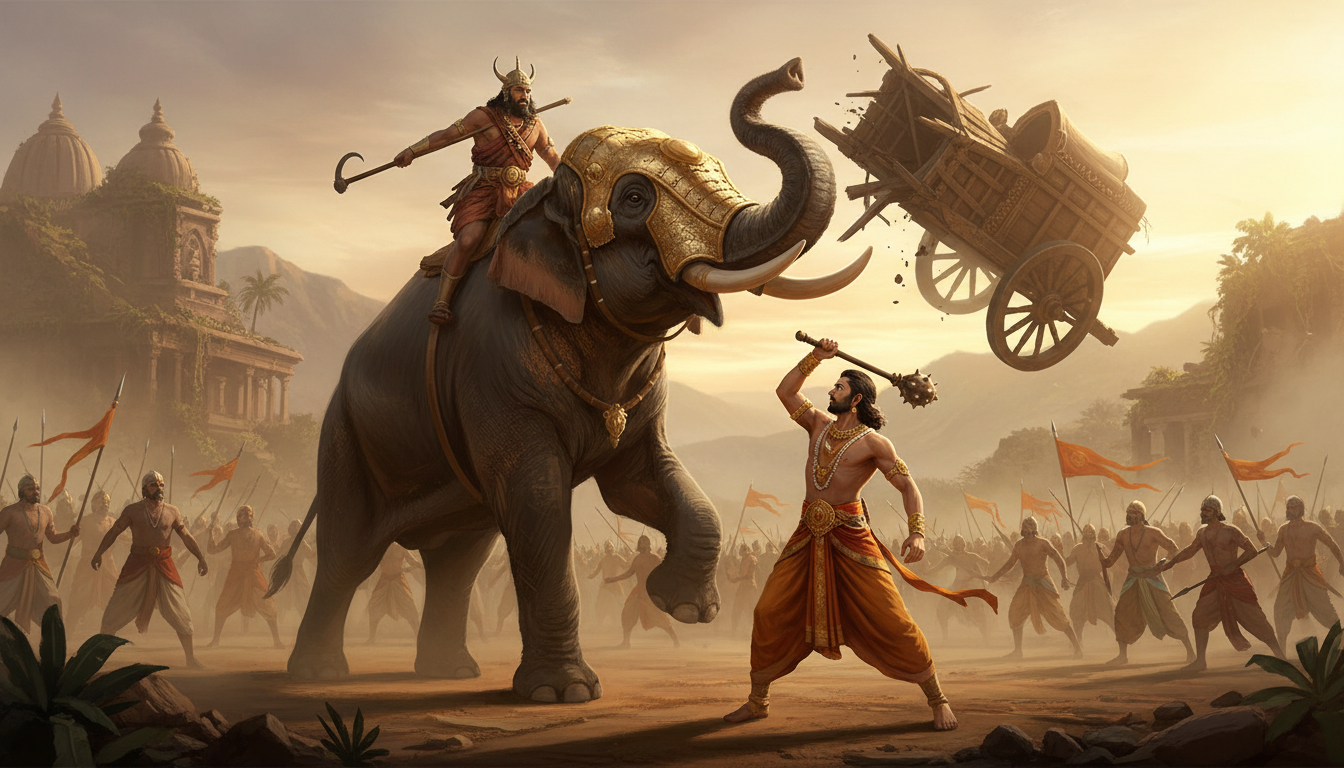
It took that gold-decked car with the horses and the driver still in it. It crushed the whole thing, and then it put its trunk under the wreck and raised it up into the air, high, in the sight of both armies, and dashed it down on the earth.
The driver of the Panchala king went up with it and came down with it. The men of the Srinjayas and the Panchalas and the Matsyas watching from the flanks cried out, and the account gives their cry as it was heard: 'Oh!' and 'Alas!'
And Dhrishtadyumna was standing on the ground under it with a mace in his hands.
Bhima, Shikhandi, and the Grandson of Sini
Three car-warriors came in at speed when they saw the driver crushed: Bhima, and Shikhandi, and the grandson of Sini.
They did not try to kill the animal. They shot to stop it, and between the three of them they checked the impetuosity of the advancing beast with their shafts, and it began to waver. Received like that and held, it stopped being a battering ram and became what it actually was, which was a very large animal with eight arrows in its head standing in the open with men on three sides of it.
But there was still a king on top of it, and he had a bow.
Shalva began to shoot from that height in every direction at once, and the man who described it reached for the sun: he shed his shafts on all sides the way the sun sheds its rays. Struck by them, the Pandava car-warriors began to fly. Even those three. Even then.
The Panchalas and the Srinjayas and the Matsyas cried out again at that feat of Shalva's, and this time they did not run. All those foremost of men, king, encompassed the animal on every side. They made a ring round it and stood there, which was all they could do, since going in meant the trunk and the feet and staying out meant the arrows.
And out of that ring, on foot, came the brave king of the Panchalas with his mace up.
The account pauses over that mace for one clause, and the clause is worth the pause: it resembled the lofty crest of a mountain. He had jumped down out of a wrecked chariot with it a minute before, and now he was walking with it toward the thing that had wrecked the chariot.
He Strikes the Frontal Globes
Fearlessly, that smiter of foes rushed at speed against the elephant.
The word the account uses about him at this point is activity: endued with great activity, the prince of the Panchalas approached. It is the correct word for a man on foot inside the reach of a war elephant, where the whole business is footwork, and one wrong step and there is nothing left of him to carry off the field.
It stood over him huge as a hill, shedding its secretions like a mass of pouring clouds, and he got in under the head and began to strike, with the mace, at the same two swellings he had put five arrows into a few minutes earlier from a chariot. He struck them again and he struck them again.
The frontal globes suddenly split open.
The animal uttered a loud cry, and vomited a profuse quantity of blood, and fell. Down the whole length of it, all at once, the way a mountain falls down during an earthquake.
Half a day's terror ended in that noise. The thing that a hundred archers could not stop and a whole army had run from was brought down by one man standing on the ground within arm's length of it, hitting it in the one place on its body that mattered, on foot, with a club.
Nothing new had to be discovered to do it. Dhrishtadyumna had found the frontal globes from his chariot with the very first volley, and the animal had turned and bolted. The arrows had been aimed correctly. There had simply not been enough of them, and Shalva with his hooks and his lances had been able to overrule what they said. A mace at that range cannot be overruled.
The whole difference between the shot that failed and the blow that worked was the distance the man was willing to close. An army had been standing on that field all afternoon with the means to do this. What was missing was not strength and it was not weapons. It was one person prepared to come down off the height, walk in under the trunk, and stay there long enough to hit the same place twice.
Your son's troops, king, began to wail at the sight while it was still coming down.
One Arrow While It Fell
And while that prince of elephants was still falling, and while the wailing was going up out of your lines, that foremost of warriors among the Sinis was already at full draw.
Satyaki had been waiting for it. A king on an elephant's neck is behind a wall of skull and tusk and trunk and cannot be reached, and there is one moment in which he can: the moment the animal beneath him goes over and he is carried down out of his own cover, still upright, still holding his bow, with nothing at all in front of him.
Satyaki took Shalva's head off with a single sharp broad-headed arrow.
His head cut off by the Satwata hero, Shalva fell down onto the earth alongside his prince of elephants, and the two of them lay there together, and the men who tried afterwards to say what it had looked like said this: a mountain summit suddenly riven by the thunderbolt hurled by the chief of the celestials.
"After the heroic Shalva was slain, king, that ornament of assemblies," Sanjaya said, "your army broke quickly, like a great tree broken by the force of a tempest. Kritavarma held them a little while, standing in that battle like a hill with arrows in it, and the Kuru heroes who had fled came back to him. Then Satyaki came to that spot, and sent king Kshemakirti to the abode of Yama with seven keen shafts, and the son of Hridika rushed at him, and they fought until Satyaki took the horses and the driver and the standard off Kritavarma's gold-decked car and put a broad-headed arrow into his chest, and Kripa had to take him up on his own car in the sight of all the bowmen and carry him out of the press."
The old king said nothing. Somewhere in the middle of all that, an animal his son had reared and honoured and prayed over in his own stables for years had lain down on the field and never got up, and the men who had blown their conchs for it an hour earlier were running again.
Dharma Lesson
Terror is a machine like any other, and it stops when someone gets close enough to strike it on foot. Dhrishtadyumna had already found the right target from his chariot and the arrows were simply too few to overrule the goad. The difference between the shot that failed and the blow that worked was only the distance one man was willing to close.