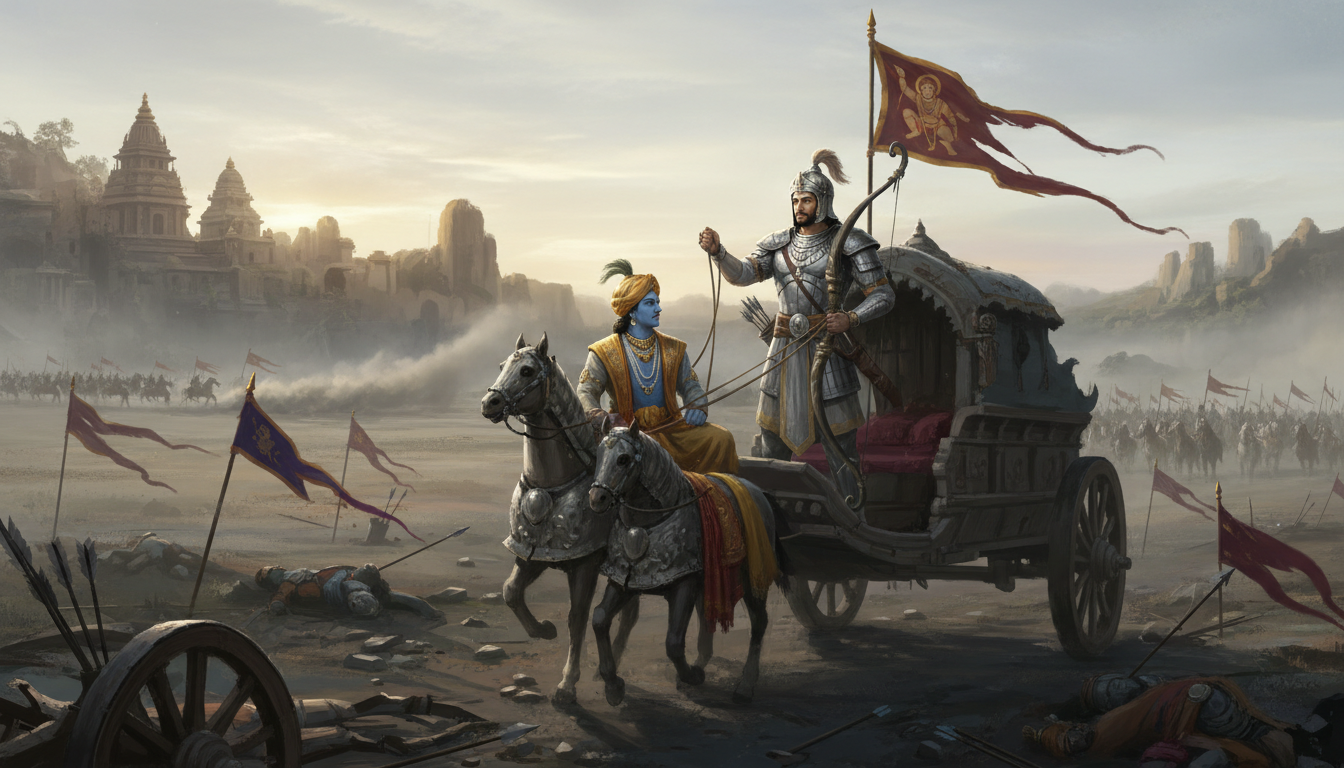
Where the Carnage Did Not Cease
Arjuna counts every point at which the war should have stopped
Where Is the King
"When the loud noise of battle had somewhat subsided," Sanjaya said, "and the Pandavas had slain large numbers of their foes, Subala's son came for fight once more, with the remnant of his horsemen. There were seven hundred of them left."
Dhritarashtra said nothing.
Shakuni rode along in front of what he had, and it did not take long to ride along in front of. He urged them to battle, and he said the same thing to them repeatedly, because there was nothing else to say at that hour of that day.
"You chastisers of foes, fight cheerfully."
Then he turned to the Kshatriyas nearest him and asked a question that tells you exactly what the eighteenth day looked like from inside the Kaurava line.
"Where is the king, that great car-warrior?"
He did not know. The uncle who had arranged this war over a board of dice, who had sat at Duryodhana's shoulder for eighteen years and eighteen days, had lost track of him in the dust and had to ask a stranger for directions.
And they answered him.
"Yonder stays that great car-warrior, the Kuru king. There, where that large umbrella of splendour equal to the full moon is visible. There, where those car-warriors clad in mail are standing. There, where that loud noise deep as the roar of clouds is being heard. Proceed quickly there, king, and you will see the Kuru monarch."
An umbrella still up, men in armour still standing under it, and enough noise around it to sound like weather. That was the whole address.
The Report of a Man Who Had Won
Shakuni went to that spot, where your son was staying, surrounded on all sides by unretreating heroes, and he came up among those car-warriors gladdening them as he came, and he spoke to Duryodhana in a manner which showed that he regarded all his purposes to have been already achieved.
"Slay the car-divisions, king. All their horses have been vanquished by me. Yudhishthira is incapable of being conquered in battle unless one is prepared to lay down his life. When that car-force protected by the son of Pandu has been destroyed, we shall then slay all those elephants and foot-soldiers and the rest of them."
All their horses have been vanquished by me. He said that with seven hundred riders behind him, on the last morning, at the end of an army that had been eleven divisions on the first day.
And your warriors believed it, because men at that stage of a war will believe anything offered to them in a confident voice. Inspired with the desire of victory, they rushed cheerfully towards the Pandava army. They had quivers on their backs and bows in their hands, and every one of them shook his bow, and they uttered leonine roars.
Once more the fierce twang of bowstrings was heard, and the slapping of palms against leather, and the whiz of arrows shot with force.
There is a kind of sentence that only gets spoken near the end of a lost war, and Shakuni had just produced the model of it. Every clause in it was about a difficulty that had been removed and none of it was about the field. His own contingent had been ground down from a division to seven hundred riders. Karna was dead, and Drona, and Bhishma was lying out beyond the lines on his arrows listening to the noise. And the report to the king was: all their horses have been vanquished by me, now let us finish the elephants.
The Indent of a Cow's Hoof
Across from them, Kunti's son Dhananjaya watched the Kuru combatants come on with their bows lifted, and spoke to the son of Devaki, who was holding his reins.
"Urge the steeds fearlessly and penetrate this sea of troops. With my keen shafts I shall today reach the end of these hostilities."
Then he did not give the order. He held it, with the enemy already moving, and said something else first.
"Today is the eighteenth day, Janardana, of this great battle that is raging between the two sides. The army of those high-souled heroes, which was literally numberless, has been nearly destroyed. Behold the course of Destiny. The army of Dhritarashtra's son, Madhava, which was vast as the ocean, has become, after encountering ourselves, even like the indent caused by a cow's hoof."
That is the figure he chose, and he was looking straight at it while he chose it. Eleven divisions of men, kings with their own countries and their own capitals and their own quarrels, brought here and reduced in seventeen days to the little dish of water that stands in a hoofprint in wet ground after the herd has gone by. You can step over it. You would not stoop to drink from it.
And having said that, Arjuna began to count backwards.
The First Door
"If peace had been made after Bhishma's fall, Madhava, everything would have been well."
That is where he starts, because that is where the first exit was. The grandsire went down on the tenth day and did not die. He lay on the arrows in the open ground between the two camps with his head unsupported and his body off the earth, and both armies could walk out and stand beside him, and both armies did.
"The words that were uttered by Bhishma were beneficial and worthy of adoption. Suyodhana, however, who had lost his understanding, did not act according to them. The foolish Duryodhana of weak understanding did not make peace."
Then Arjuna said the thing that he clearly had not been able to stop thinking about for eight days.
"After Bhishma had been struck and thrown down on the earth, I do not know the reason why the battle proceeded. I regard the Dhartarashtras to be foolish and of weak understanding in every way, since they continued the battle even after the fall of Santanu's son."
I do not know the reason why the battle proceeded. He had fought every day of it since. He had commanded on those days, and killed on them, and he is telling his charioteer, on the last morning, that he never understood why any of them happened.
Consider what the tenth night had offered. The commander of the Kaurava host was alive, conscious, out of the fight and beyond either camp's discipline, and speaking. Both sides had come to him and stood together around him without weapons. There was a man there whom every living Kuru obeyed by habit, in a position where nobody could pretend the war was going well, saying that it should be stopped. If the thing was ever going to be settled by talking, that was the ground it would have been settled on, and the armies went back to their tents and formed up again in the morning.
The Carnage Did Not Still Cease
"After that, when Drona, that foremost of all utterers of Brahma, fell, as also the son of Radha, and Vikarna, the carnage did not still cease."
He had a phrase and he used it like a beat on a drum. After every name, the same six words, so that the sentence never resolves and the killing never stops inside it.
"Alas, when a small remnant only of the army remained after the fall of that tiger among men, Karna, with his sons, the carnage did not still cease.
"After the fall of even the heroic Srutayush, of Jalasandha of Puru's race, and of king Srutayudha, the carnage did not still cease.
"After the fall of Bhurishrava, of Shalya, Janardana, and of the Avanti heroes, the carnage did not still cease.
"After the fall of Jayadratha, of the rakshasa Alayudha, of Bahlika, and of Somadatta, the carnage did not still cease.
"After the fall of the heroic Bhagadatta, of the Kamboja chief Sudakshina, and of Duhshasana, the carnage did not still cease.
"Beholding even diverse heroic and mighty kings, each owning extensive territories, slain in battle, the carnage, Krishna, did not still cease. Beholding even a full akshauhini of troops slain by Bhimasena in battle, the carnage did not still cease, in consequence of either the folly or the covetousness of the Dhartarashtras."
Sixteen names, and a whole division of men in a single clause at the end of them, and after each one there had been a night. Every one of those nights was a place where somebody could have said the word and did not.
They are not equal names, either, and Arjuna is not pretending they are. Drona had taught both armies. Karna had been the war's second half by himself. Vikarna was the one brother who stood up in the assembly and said the dicing was wrong, and Bhima had killed him and wept doing it. Jayadratha's death had cost a day and an oath and very nearly Arjuna's own life on a pyre. Bhurishrava had been cut down at his prayers with one arm gone. Shalya had commanded that very morning. Each of them was somebody's whole reason for being on that field, and in this speech each of them gets a half line and the same refrain, because from where Arjuna is standing the only fact any of them has in common is that the killing went on afterwards.
What Kind of King Does This
"What king born in a noble race, a race especially like that of Kuru, save of course the foolish Duryodhana, would thus fruitlessly wage such fierce hostilities?
"Who is there, possessed of reason and wisdom and capable of discriminating good from evil, that would thus wage war, knowing his foes to be superior to him in merit, strength, and courage?"
Arjuna is not boasting when he says that last part. He is stating the assessment every commander in both camps had made before the first day, and he is asking how a man goes to war anyway with that assessment on the table in front of him.
"How could he listen to the counsels of another, when, indeed, he could not make up his mind to make peace with the Pandavas in obedience to the words uttered by you?"
You went yourself, he means. Krishna had gone to that court as an envoy and stood in it and asked for five villages, and had been answered with an attempt to tie his hands.
"What medicine can be acceptable to that person today, who disregarded Bhishma the son of Santanu, and Drona, and Vidura, while they urged him to make peace? How can he accept good counsels, who from folly, Janardana, insolently disregarded his own aged sire, as also his own well-meaning mother, while they spoke beneficial words to him? That person of wicked understanding who, having listened to the beneficial and proper words of Jamadagni's son, disregarded them, should certainly be held as standing in the face of destruction."
Bhishma. Drona. Vidura. His father. His mother. Parashurama. Six people who told him not to, and he is dead by evening and every one of them told him.
What Vidura Kept Saying
"It is evident, Janardana, that Duryodhana took his birth for exterminating his race. His conduct and his policy, it is seen, point to that line. He will not give us our kingdom yet. This is my opinion, Achyuta."
Then he brought in the man who had been saying it longest.
"The high-souled Vidura, sire, told me many a time that as long as life remained in Dhritarashtra's son, he would never give us our share of the kingdom. Vidura further told me, 'As long also as Dhritarashtra will live, giver of honours, even that sinful wight will act sinfully towards you. You will never succeed in vanquishing Duryodhana without battle.'
"Even thus, Madhava, did Vidura of true foresight often speak to me. All the acts of that wicked-souled wight I now find to be exactly as the high-souled Vidura had said."
Often, he says. Not once, as a prophecy at a solemn moment. Often, in the ordinary way, across years, in rooms, to a young man who was probably tired of hearing it. There is no scene in which Vidura is believed. There is only this, on the last morning of the war, from a man standing in a chariot with the survivors of eleven divisions in front of him, saying that his uncle had been right the entire time.
"Many persons crowned with ascetic success said, as soon as Duryodhana was born, that the entire Kshatriya order would be exterminated in consequence of that wretch. Those words of the sages, Janardana, are now being realised, since the Kshatriyas are undergoing almost entire extermination in consequence of Duryodhana's acts."
They had said it in the birth chamber. The jackals had howled outside the house on that night and the brahmanas had told the father to put the child away, and the father had not been able to, and the count Arjuna has just recited is the itemised bill for that one decision.
The Last Door
"Exercising my reason, Madhava, and reflecting in my own mind, thinking of Vidura's words, and taking into account the acts of the wicked-souled Duryodhana himself, I have come to this conclusion."
The conclusion is not a wish for peace. Arjuna has just proved to his own satisfaction that there is no door left, and what he draws from it is arithmetic.
"I shall slay all the warriors today. After all the Kshatriyas will have been slain and the Kaurava camp made empty, Duryodhana will then desire battle with us for his own destruction. That will end these hostilities."
He has understood the man exactly. Duryodhana will not stop while he has an army, and he will not surrender when he loses one. He will come out himself, alone, and ask for a single combat, and be killed in it, and that is the only mechanism by which this ends. So the fastest road to the end of the war is to take away every last man standing between Duryodhana and the field, which means killing all of them today.
"Penetrate the Bharata army, hero, for I shall slay the wicked-souled Duryodhana and his army today with my keen shafts. Slaying this weak army in the very sight of Dhritarashtra's son, I shall today do what is for Yudhishthira's good."
Note what he does not say. He does not say that Duryodhana must be punished, or that the dead require it, or that the kingdom is owed to his brother. He says the man will not stop, and gives the reason, and names the only remaining machinery for stopping him, and then asks to be driven.
Thus addressed by Savyasaci, Sanjaya said, he of Dasarha's race, reins in hand, fearlessly penetrated that vast hostile force for battle.
The Forest They Entered
What they drove into is described as a wood, and the description is worth having whole, because Sanjaya gave it to a blind man who could not be shown anything.
It was a terrible forest of bows. Darts constituted its prickles. Maces and spiked bludgeons were its paths. Cars and elephants were its mighty trees. Cavalry and infantry were its creepers.
And the illustrious Keshava, as he entered that forest on that car decked with many banners and pennons, looked exceedingly resplendent. The white steeds bearing Arjuna were seen careering everywhere, urged by him of Dasarha's race, so that men in different parts of the field all reported the same horses at the same moment.
Then that scorcher of foes proceeded on his car, shooting hundreds of keen shafts like a cloud pouring showers of rain. Loud was the noise produced by those straight arrows, and by the men who were covered with them. Showers of shafts pierced through armour and fell down on the earth. Arrows impelled from Gandiva, whose touch resembled the touch of Indra's thunder, struck men and elephants and horses and fell with a noise like winged insects.
Everything was shrouded with those shafts. In that battle the points of the compass, cardinal and subsidiary, could not be distinguished. The whole world seemed to be filled with gold-winged arrows, steeped in oil, polished by the hands of the smith, and marked with Partha's name.
Not a Second Arrow
Struck with those keen shafts and burnt with them, as a herd of elephants is burnt with burning brands, the Kauravas became languid and lost their strength.
Armed with bow and arrows, resembling the blazing sun, Partha burnt the hostile combatants like a fire consuming a heap of dry grass. Sanjaya went further with it than that, because the fire he had in mind was a particular kind. Travellers cast away their embers on the confines of a forest when they break camp, and the thing that begins in the dry creepers afterwards is not aimed at anything and does not stop at the edge of what it was meant to take. That was the fire he compared Arjuna to on the eighteenth morning.
His gold-winged arrows, endued with fatal force and shot with care, could not be baffled by any armour. And he had not to shoot a second arrow at man, steed, or elephant of gigantic size.
That last sentence is the whole of the account. One shaft each. Like the thunder-wielding Indra striking down the Daityas, Arjuna alone entered that division of mighty car-warriors and destroyed it with shafts of diverse forms.
Somewhere on the far side of it Shakuni was still riding up and down in front of seven hundred horsemen, telling them to fight cheerfully. The umbrella was still up. And the man under it, who had been offered the door after Bhishma and after Drona and after Karna and after every name on the list Arjuna had just read out to Krishna, was waiting for the field to be emptied of everyone else so that he could go out onto it himself with a mace, which was the ending he had chosen at every one of those doors by walking past it.
Dharma Lesson
A war has many doors marked exit, and the guilt of the man who walks past all of them grows at every one. Duryodhana was told to stop by Bhishma, Drona, Vidura, his father, his mother and Parashurama, and the count of the dead is simply the itemised bill for those refusals. Arjuna does not draw comfort from being right; he concludes only that the last door left is the man's own death.