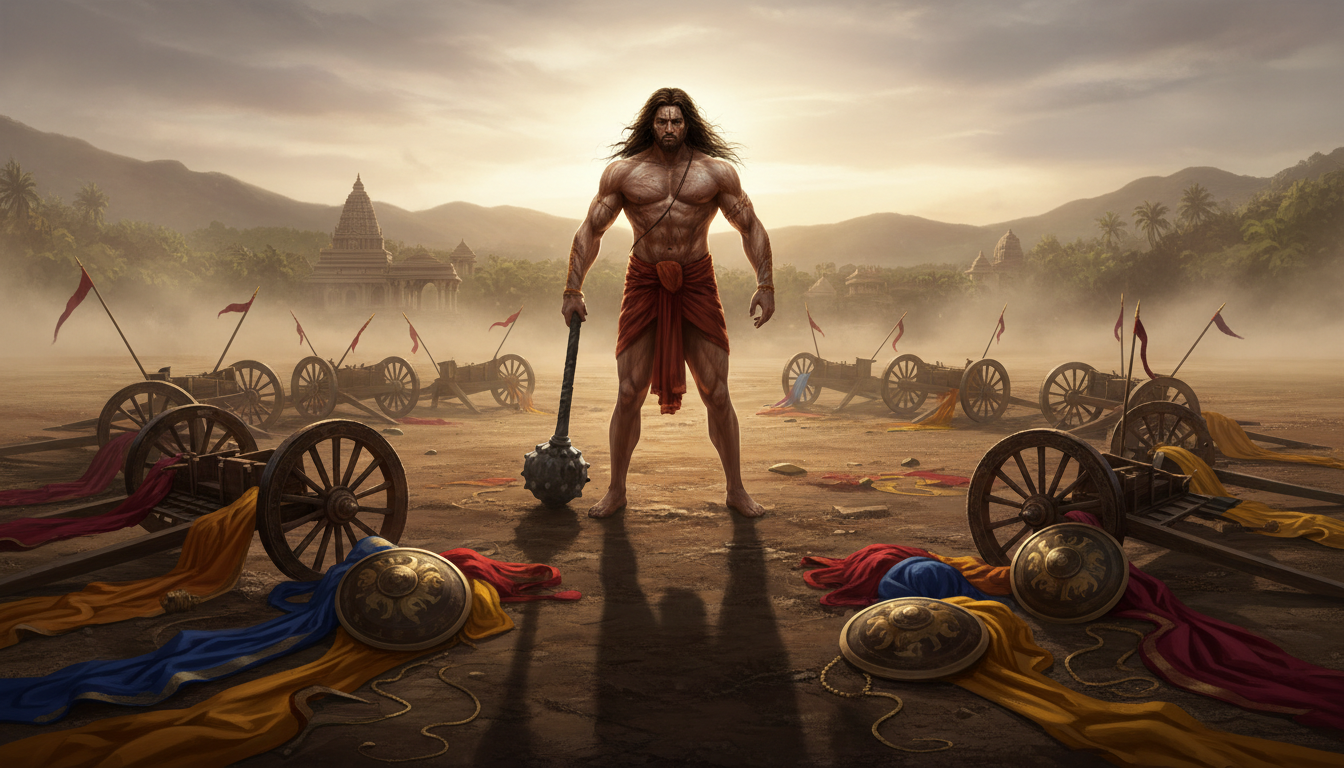
The Last of the Hundred
Bhima closes an eighteen-year account in a single afternoon
The Elephants Are Gone
"The elephant division is destroyed," Sanjaya said. "I say that first because you will want to know where the sound went. For seventeen days you have asked me every evening about the noise, and the noise was elephants. It is finished. He killed it."
Dhritarashtra sat with his hands on his knees.
"He is out there now with the club," Sanjaya said. "Careering. There is no other word for what he does with it. He goes through your men the way the Destroyer goes through a season, in a rage, armed, not hurrying."
It was the afternoon of the eighteenth day. Duryodhana had gone somewhere into the middle of the surviving cavalry with an umbrella over his head, and for the moment nobody on the Kaurava side could see him, and that absence was doing something to the men who were used to looking for him.
What was left of your sons, king, found each other in the wreck.
Eleven of them, uterine brothers all, born of the same womb as the man they could not find. They came together in one place, in the middle of a battle they were losing, and made a decision without anybody senior present to talk them out of it, and the decision was that all eleven of them would go at Bhimasena at once.
Sanjaya named them, because they were your sons and somebody should say the names out loud once. Durmarshana. Srutanta. Jaitra. Bhurivala. Ravi. Jayatsena. Sujata. Durvishaha. Durvimochana. Dushpradharsha. And the mighty-armed Srutarvan.
"All of them were accomplished in battle," he said. "I want that on the record too. They were not children and they were not fools. They were trained princes of the house of Kuru, and they had watched this man for eighteen days, and they went anyway."
Dragging an Elephant Off a Crossway
They shut him up on all sides. That was the plan and for a short while it worked.
Eleven chariots came in on him from eleven bearings and closed the circle, and Bhima was on the ground with the mace when they arrived, and a man on foot inside a ring of cars is a man about to die. So he went back up onto his own chariot, which had been standing empty behind him with the driver holding, and took the bow instead, and began shooting at the vital parts.
The eleven covered him with arrows. They kept on covering him. Sanjaya said they were dragging at him, the way men drag an elephant off a crossway when it has planted itself where four roads meet and will not move: ropes on it from every direction, everybody pulling, the animal shifting a foot and then standing again.
That is what eleven trained princes of the Kuru house were reduced to on the eighteenth afternoon. Not killing him. Pulling on him.
And then he began.
A razor-headed arrow took Durmarshana's head off cleanly and put it on the earth. That was the first. A broad-headed shaft, the kind made to go through any armour there is, killed Srutanta where he stood in his car, and he was a great car-warrior and it made no difference at all. Then a cloth-yard shaft went into Jayatsena with the greatest ease, and the prince came off his chariot and fell and expired at once, without a word, in front of ten of his brothers.
Three of them were dead and the fight was perhaps a minute old.
Kinsukas Cut in the Spring
Srutarvan, who was the strongest of them, went into a rage at that and put a hundred straight arrows into Bhima, every one of them winged with vulture feathers.
Bhima did not answer him. He turned instead and took three shafts and fitted them and let them go one after another at Jaitra and Ravi and Bhurivala, three arrows that Sanjaya said were like poison or like fire, and the three of them fell out of their cars together.
They came down, he said, the way kinsuka trees come down. In the spring the kinsuka is covered in red flowers from root to crown and looks like something on fire that is standing still, and when the axe-man puts it down it goes over whole, with all the colour still on it. That is how three of your sons went off their chariots, king. Variegated with flowers.
Then a broad-headed arrow of great keenness for Durvimochana, which despatched him to the abode of Yama, and he fell out of his car onto the ground like a tree that has grown up on a mountain summit and been broken off by the wind.
Dushpradharsha and Sujata were leading their own contingents at the head of the forces, and Bhima gave them a couple of arrows each, no more than that, and both of those foremost of car-warriors were pierced and fell.
Durvishaha saw it and rushed him. One broad-headed arrow. The prince came off his car in the plain sight of every bowman on that part of the field.
Ten. It is worth stopping on that number for a moment, because the reciters run over it. In the time it takes to describe the deaths, ten sons of Dhritarashtra had been killed by one man who was standing still.
Srutarvan
Srutarvan was the last one on his feet, and he had just watched ten of his brothers die inside a few minutes, and he went at Bhima.
He had a formidable bow decked with gold and he stretched it and shot a great many arrows that were like poison or fire in their energy, and he was good. That has to be said plainly. He cut the bow of the son of Pandu clean through in the middle of the dreadful battle and then put twenty arrows into a bowless Bhima while the man was reaching for the next weapon.
Bhima took up another bow, shrouded him in arrows, and called across to him.
"Wait," he said. "Wait."
Sanjaya said the fight that followed was beautiful, and he used the word without apologising for it, and he compared it to the encounter between Vasava and the Asura Jambha, which is the comparison the bards keep for a fight between two beings of a different order. The shafts they sent at each other were like the fatal rods of Yama. The earth was shrouded with them, and the sky, and all the points of the compass.
Then Srutarvan filled with rage, took up his bow again, and hit Bhimasena with many arrows in the arms and in the chest, deeply, so that the son of Pandu became agitated. Sanjaya's phrase for it is exact and worth hearing: he became agitated like the ocean at the full moon or the new. Which is to say he moved. Not that he broke. Something enormous was pulled at from a distance and it answered.
And then Bhima killed the four horses and the driver, and sent all five of them to Yama with arrows, and Srutarvan was standing on a chariot that was no longer a chariot.
The Shield with a Hundred Moons
Bhima did not shoot him at once. He covered him with winged arrows, showing off the lightness of his hands, keeping him pinned on the deck of the dead vehicle.
So Srutarvan took up a sword and a shield.
The shield was bright and it was decked with a hundred moons, which is the old way of describing the round bosses of polished metal that a good shield of that period carried in rows, and in the afternoon sun it would have been the most visible thing on that part of the field. He came down off the car with it and began to career, in the swordsman's way, low and moving, weaving the shield in front of him.
He was the last living son of Dhritarashtra in that fight and he had a sword and a shield and no chariot, and he was going forward.
Bhima put a razor-headed arrow through his neck and struck his head off his trunk and felled it on the earth.
The trunk stood a moment and then went down off the car, and Sanjaya said it filled the earth with a loud noise, which is a strange detail to keep and is probably the truest thing in the passage, because a man in armour falling on hard ground makes a sound that carries and everyone standing near hears it and knows what it is.
The Purpose of His Birth
Your troops rushed him after that. They were terrified and they came anyway, out of the unslain remnant of what had been an ocean of soldiers, and they surrounded him on all sides wanting to fight.
He afflicted all of them with keen shafts the way the god of a thousand eyes afflicts the Asuras. Sanjaya gave the numbers to the court because the court had asked for numbers all war. Five hundred great cars with their fences, destroyed. Seven hundred elephants after that. Ten thousand foot-soldiers with his mighty shafts. Eight hundred horses.
Then he stopped, and slapped his armpits.
It is a wrestler's gesture. It is what a man in a village yard does before a bout to tell the other man he is ready, and Bhima had been doing it since he was a boy in the exercise ground at Hastinapura where he used to hold your sons under the water for sport and shake the fruit trees with them still in the branches. He did it now, on the eighteenth afternoon, on an emptied field, and the sound of it went out across the plain and the surviving elephants shied at it.
"Having slain your sons in battle," Sanjaya said, "the son of Kunti regarded his object as achieved, and the purpose of his birth accomplished."
The purpose of his birth. Consider what a man has to have done to himself over thirteen years to be able to think that sentence and mean it. In the assembly hall he had made two promises out loud while a woman stood in one garment in the middle of the room and his eldest brother stared at the floor. He had kept the first one on the seventeenth day. He had now, with Srutarvan's head, kept the second.
There was nothing else he had ever agreed to be.
Your troops, at that time, did not dare even look at him.
Krishna Points Out the Cavalry
Two of your sons were still alive at that hour, king: Duryodhana, and Sudarsana. Both of them were inside the cavalry.
Krishna saw where they were and spoke to Arjuna from the driver's bench, quickly, the way a man speaks who is doing arithmetic out loud.
"A great many of our enemies, kinsmen who took our protection, have been killed. There is the bull of Sini's race coming back, and he has taken Sanjaya prisoner. Nakula and Sahadeva are fatigued, they have been fighting the wretched sons of Dhritarashtra and their followers all day. Kripa and Kritavarma and Ashvatthama have left Duryodhana's side and taken up a position somewhere else. The prince of the Pancalas is standing over there in the middle of the Prabhadrakas, and he is very beautiful, and he has just destroyed Duryodhana's troops.
"And there is Duryodhana, in the middle of his cavalry, with the umbrella over his head, throwing his glances all round. He has rearrayed what is left. Kill him with your keen shafts and everything you want is done. Do it now, while they can still see you in the middle of them and while they can still see that their elephants are gone. Send somebody for the Pancala prince and tell him to come here. Your enemies are all tired. The sinful Duryodhana will not get away. He has killed a great many of your men today and he looks proud, as though he thinks the Pandavas have been beaten. When he sees his own troops cut down he will come out and fight for his own destruction."
What Is Left of an Army
Arjuna answered him, and what he said was an inventory.
"Almost all the sons of Dhritarashtra have been killed by Bhima. Only these two are alive, and they will be destroyed today as well. Bhishma has been slain. Drona has been slain. Karna, who was called Vaikartana, has been slain. Shalya the king of the Madras has been slain, and Jayadratha has been slain.
"Of Shakuni's troops there are five hundred horse left. Of chariots, two hundred. Of elephants, a hundred that are still formidable. Of foot, three thousand. There remain Ashvatthama, and Kripa, and the ruler of the Trigartas, and Uluka, and Kritavarma of the Satwata race. That is the whole of Duryodhana's force.
"Truly there is no escape from death for anyone on earth. After a carnage like this one, look, Duryodhana is still alive.
"Today Yudhishthira will be free of all his enemies. Nobody will get past me. Today, killing the prince of Gandhara with my keen shafts, I will clear away the sleeplessness the king has suffered from for a long time, and I will win back every valuable thing that Subala's wicked son took from us at the gambling match in the assembly. Today all the ladies of the city called after the elephant will hear about their husbands and their sons and will wail aloud. Take him for dead, Krishna, if he does not run today. Those horses cannot stand the twang of my bow and the slapping of my palms. Drive."
And the one of Dasarha's race urged the horses toward Duryodhana's division.
The Ninety-Ninth
Three of them went at the cavalry together with leonine roars, wanting Duryodhana: Bhimasena, Arjuna, Sahadeva.
Shakuni came out to meet them. Susarman and Shakuni took Arjuna between them. Duryodhana himself, on horseback, went at Sahadeva, and struck him on the head with a lance so hard that the youngest son of Pandu sat down on the terrace of his own car with his limbs bathed in blood, sighing like a snake, before he came back to his senses and covered your son with arrows.
And your son Sudarsana rushed at Bhimasena.
There is nothing in the account about what he said, or whether he knew what he was riding at, or whether he had watched from somewhere what had happened to Srutarvan an hour earlier. He was the ninety-ninth son of Dhritarashtra and he had one brother left alive in the world.
Bhima made him invisible with arrows. That is the phrase: he covered the man so completely that from outside there was no longer a man there to see. And then, smiling, he cut his head off his trunk with a razor-headed arrow of great sharpness, and deprived of life the prince fell on the earth.
Sudarsana's followers closed round Bhima shooting whetted arrows and he covered the whole force with shafts whose touch was like the touch of Indra's thunder and killed all of them in a very short time. Then more of the Kaurava leaders came up to fight him and he covered them too.
"And that is ninety-nine," Sanjaya said. "I am telling you because you will be told a hundred by somebody who cannot count, and I would rather you had it right. Ninety-nine of your sons are lying on this field. Vikarna, who spoke for the queen in the hall, is among them. The eleven who went at him together this afternoon are among them. And one is alive, and he is in the cavalry with an umbrella held over his head."
The Man Who Kept It
By evening the two armies were only striking at each other because they had not been told to stop. Men of both sides fell down wailing aloud for kinsmen who were already dead, and there was no shape to it any more.
Dhritarashtra spoke at last, and what he asked was not about the war.
"How many did he name to me," he said. "Say the eleven again."
Sanjaya said them again. Durmarshana, Srutanta, Jaitra, Bhurivala, Ravi, Jayatsena, Sujata, Durvishaha, Durvimochana, Dushpradharsha, Srutarvan. And then, because the king did not tell him to stop, Sudarsana.
They are twelve names and none of them will be spoken again in this history. They have no stories of their own. They took no part in the dice game, they were not in the room when the queen was dragged into it, they did not counsel their brother and could not have changed him if they had. They are known for one thing, which is the manner in which they were removed, and they were removed in order to complete an arithmetic somebody had recited in a hall thirteen years before.
That was the thing Bhima had made of himself. He had taken a promise made in a rage and turned it into a life's work, and had carried it through the forest years and the year of hiding and eighteen days of this, and had finished it in an afternoon, and had felt, standing there afterwards with the field emptied around him, that the purpose of his birth was accomplished.
There is a question in that which the epic does not answer here and does not forget either. When the account is closed and the last name struck off, what is a man supposed to do the following morning?
Bhima had one brother of theirs left to find. So did the war.
Dharma Lesson
A vow kept to the letter can leave a man with nothing left to be except the man who kept it. Bhima turned one sentence spoken in rage into thirteen years of work and finished it in an afternoon, and the eleven brothers he finished it on had no stories of their own beyond the manner of their removal. The epic lets the count stand and quietly asks what a man does the morning after the ledger closes.