The Brothers Bhima Counted
Duryodhana's kin fall in handfuls on the seventeenth day
The Terrace of His Own Chariot
Shalya saw him coming before Karna did.
"Look at the son of Pandu," he said over his shoulder, holding the swan-white horses steady. "Look at him. He is filled with rage and without a doubt he means to vomit on you the whole of what he has been keeping down for years. I have never seen him take that form before. Not when Abhimanyu was killed. Not when the Rakshasa Ghatotkaca was killed. What he has on him now has the splendour of the fire that ends the yuga, and looking at him I would say he could stand against the three worlds put together."
Karna laughed at that, which was not bravery so much as habit.
"Everything you have said about Bhima is true, lord of the Madras. He is brave and he is a hero and he is full of wrath. He is reckless about his own body, and in the strength of his limbs he is above every man alive. When they were living hidden in the city of Virata he had nothing but his bare arms, and he used them to kill Kichaka and all his relatives in the dark, because it pleased Draupadi. And there he stands in his mail, at the head of the battle, out of his mind with anger, ready to engage the Destroyer himself with an uplifted mace."
He watched him come.
"But this is what I have wanted all my days: that either I kill Arjuna or Arjuna kills me. Perhaps this encounter serves it. If I kill Bhima or make him carless, Partha may come out against me, and that would be well for me. Settle it as you think suits the hour."
"Go against Bhimasena," Shalya said. "Check Bhimasena and you will get Phalguna. That purpose of yours, that desire you have carried in your heart for so many long years, will be accomplished today. I am telling you the truth."
"Either I kill Arjuna or he kills me," Karna said again, as if the sentence steadied him. "Set your heart on battle and drive to where Vrikodara is."
Struck Down in Front of the Whole Host
The trumpets went up and the drums came in when those two met, and it became fierce very quickly.
Karna struck first, in the centre of the chest, and then covered him in a shower of arrows. Bhima answered with winged shafts and then nine straight keen ones. Karna cut Bhima's bow in two at the handle and put a shaft through the middle of his chest that was made to go through any armour there is. Bhima took up another bow and shot him where a man is not made to be shot. Karna hit him with twenty-five arrows, the way a hunter goes at a proud rutting elephant in a forest with a fistful of blazing brands.
His limbs mangled, his eyes red with rage and the wanting of revenge, the son of Pandu set on his bow an excellent shaft of great impetuosity that would have gone through the mountains, and drew the string back to his ear, and held it.
Then he let it go.
It made a noise like thunder and it went through Karna the way the thunderbolt itself goes through a mountain. And Karna, the commander of your forces, sat down senseless on the terrace of his own chariot in front of both armies.
Shalya saw the state of him, turned the car, and bore him out of the fight, and Bhimasena went on into the leaderless host and began routing it the way Indra routs the danavas.
Go and Protect the Son of Radha
"That was exceedingly difficult of accomplishment," Dhritarashtra said. "What Bhima did. To make the mighty-armed Karna himself measure his length on the terrace of his car."
"It was," Sanjaya said.
"There is only one person, Karna, who will slay the Pandavas along with the Srinjayas. Duryodhana used to say that to me. Very often. He said it in this room." The old king's hands were open on his knees. "And now you tell me the son of Radha has been beaten out of the fight by Bhima. What did my son do next?"
"He called his brothers," Sanjaya said.
Duryodhana turned to the men of his own womb, the ones still on the field, and gave the order in the voice of a man who has been giving that order all his life and has never yet been refused.
"Go quickly, and blessed be you. Protect the son of Radha. He has been plunged into a fathomless ocean of calamity, and the ocean is the fear of Bhimasena."
And they went, and Sanjaya named them for the blind man, because they were his and nobody else was going to say the list aloud afterward: Srutarvan and Durddhara, Kratha and Vivitsu and Vikata, Soma, Nishangin, Kavashin, Pasin, Nanda and Upanandaka, Duspradharsha, Suvahu, Vatavega, Suvarchasas, Dhanurgraha, Durmada, Jalasandha, Sala and Saha. Twenty of them, with a large force of cars behind them, endued with great energy and great might, and they came round Bhimasena from every side and shot at him.
"They went at him like insects going at a fire that is already burning," Sanjaya said. "I am sorry, king. There is no other way to describe how it looked."
The Names Come Off One at a Time
Bhima, afflicted from every side at once, killed fifty of the foremost car-warriors in that press, and five hundred others with them, before he took a single brother.
Then he took Vivitsu. A broad-headed arrow, and the head came off, with the earrings still in it and the head-gear still on it and a face on it like the full moon, and the prince went down on the earth.
His brothers saw that and did not withdraw. They rushed Bhima from every side, all of them at once, and with two more broad-headed arrows he took the lives of two more of your sons in that dreadful battle. Vikata and Saha, who looked like a pair of celestial youths, fell together like two trees uprooted by a tempest.
Then, without losing a moment, he sent Kratha to the house of Yama with a long keen-pointed arrow, and Kratha came down deprived of life.
The crying began then, all along that part of the line, the sound men make when they understand that what is happening in front of them is not a battle but an accounting. And into that noise Bhima put two more shafts, and Nanda and Upananda went to Yama's abode together.
And then the rest of your sons broke, and ran, because Bhimasena in that battle was behaving like the Destroyer at the end of the yuga and there was nothing in any of them that could stand in the same field as it.
The Iron Bar Twined with Hemp
Karna had come back to himself by then and had watched his rescuers die on his behalf, and it made him cheerless. He urged the swan-hued horses back toward the son of Pandu, and Shalya drove them, and the two of them closed again, and the noise of it was loud enough that Sanjaya said he became very curious to see how it would end.
Bhima was boasting of his own prowess and covering Karna in showers of winged shafts in full view of Duryodhana. Karna, who knew the highest weapons, pierced him with nine broad-headed iron arrows. Bhima drew to his ear and gave back seven. Karna, sighing like a snake of virulent poison, shrouded him in a thick shower, and Bhima shrouded him back in front of the whole Kaurava host and shouted.
Then Karna gripped his strong bow and put ten stone-whetted arrows fledged with kanka feathers into him, and cut his bow with a broad-headed shaft.
So Bhima picked up the parigha.
It was a spiked iron bar twined round with hempen cords and decked with gold, and Sanjaya, describing it to a man who could not see it, called it a second bludgeon of Death. Bhima hurled it at Karna with a roar and it came across the ground between them with a peal like thunder, and Karna cut it into many fragments in the air with arrows like snakes of virulent poison, and it fell in pieces.
A Snake Going Into an Ant-Hill
Bhima took hold of his bow with greater strength and covered Karna in keen shafts, and for a moment it was like two huge lions each of whom means to kill the other and knows the other means it too.
Karna drew to his ear and put three arrows into him.
Deeply pierced, that foremost of all men endued with might took up a terrible shaft made to go through a body and not stop, and it went through Karna's armour, and through Karna, and out the other side, and into the earth like a snake going into an ant-hill.
Karna felt great pain from it and became exceedingly agitated, and Sanjaya said he trembled where he stood on his car like a mountain in an earthquake.
Then he retaliated, because he always did. Twenty-five shafts into Bhima, and then a great many more. One arrow to cut down Bhima's standard. One broad-headed arrow to send Bhima's driver to Yama. One winged arrow to cut the bow. And that was the car finished, and Bhima was standing on a wrecked platform behind dead horses with nothing in his hands.
So he took up his mace and jumped down.
Seven Hundred Elephants, on Foot
What happened next Sanjaya reported in numbers, because there is no other way to report it.
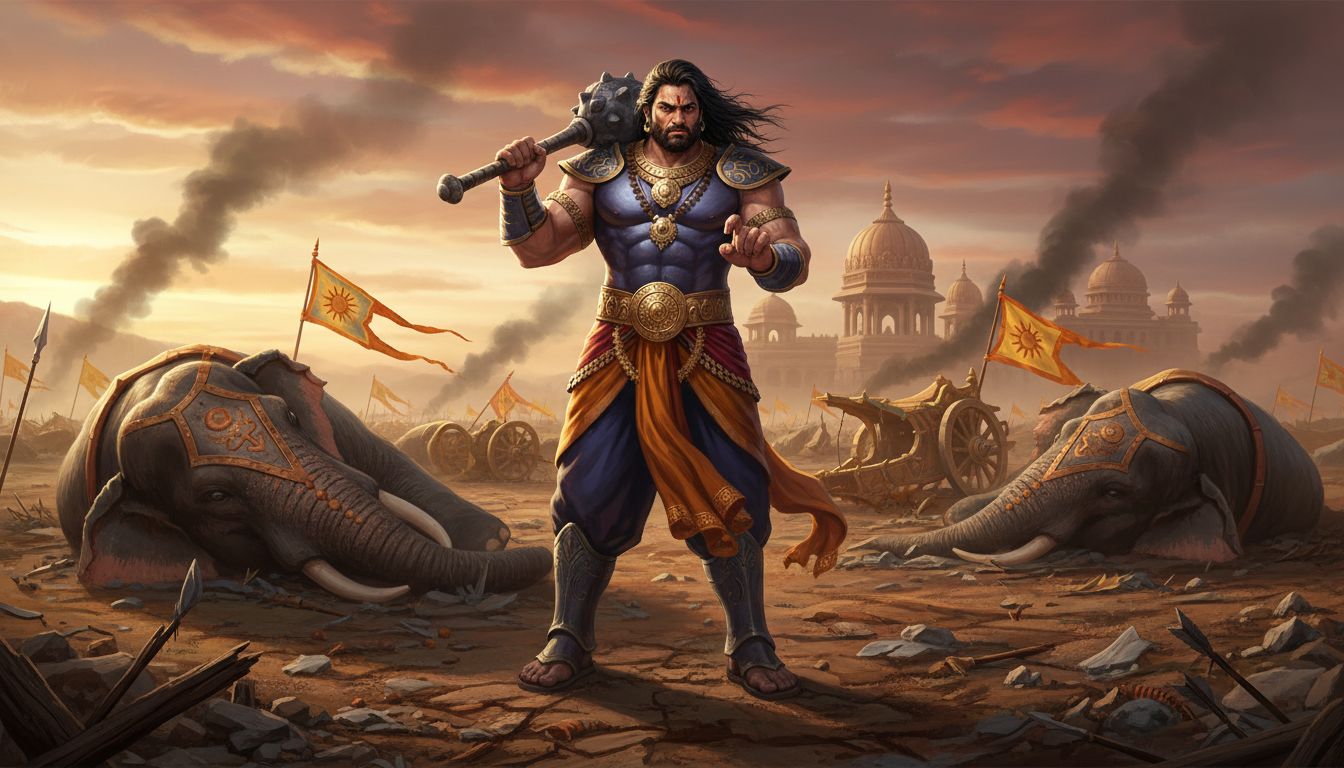
Bhima came off that chariot in a fury and began destroying your troops the way the wind destroys the clouds of autumn. Seven hundred elephants came at him, beasts with tusks as long as plough-shafts, all of them trained to break formations. He knew where the vital parts of an elephant are. He struck them on the temples, on the frontal globes, on the eyes, on the place above the gums, and they turned in terror and ran.
Their drivers turned them and brought them back and put them round him again like clouds covering the sun. Then Bhima, with his mace, felled all seven hundred, with the riders on their necks and the weapons in their hands and the standards over them, the way Indra fells mountains with the thunder.
Then fifty-two more elephants, great ones, belonging to the son of Subala, pressed down on the earth.
Then a hundred of the foremost cars, and several hundred foot-soldiers.
Scorched by the sun overhead and by Bhima on the ground, your army began to shrink like a piece of leather laid over a fire. Men who were still capable of fighting avoided the place where he was and went elsewhere.
Five hundred car-warriors in excellent mail came at him shouting and shooting from every side, and he destroyed all of them with the mace, with their drivers and their cars and their banners and their standards and their weapons, the way Vishnu destroys Asuras.
Then three thousand horsemen, sent by Shakuni, respected by every brave man, armed with darts and swords and lances, rode at him.
He went into them, coursing in every direction at once, and killed all three thousand with the mace, and the noise that came out of them while he did it was the noise a herd of elephants makes when large pieces of rock are thrown down on it.
Then he got up onto another car and went looking for the son of Radha again.
Every Man's Father Said Out Loud
Karna in the meantime had covered Yudhishthira with thick showers of arrows and felled his driver, and when the king went, he pursued him, shooting kanka-feathered shafts that ran straight.
Bhima came up behind him, covered the whole sky over the pursuit with shafts, and shrouded Karna from the rear until he had to turn round and deal with it. Then Satyaki brought his car up alongside Bhima's and began afflicting Karna from the flank, and Karna, badly afflicted, still kept coming at Bhima.
They shot at each other so long and so thickly that neither we nor the enemy could make out the rays of the sun or any point of the compass, cardinal or subsidiary. The blaze of the midday sun was put out by the arrows of those two men. In the air the flights of them looked, Sanjaya said, like the backs of cranes.
And behind that, seeing Subala's son and Kritavarma and Drona's son and Adhiratha's son and Kripa all engaged, the Kauravas rallied and came back, and the two hosts ran together like several oceans mingling, and the din was past describing.
Then came the part Sanjaya said he would remember longest, and it was not the killing.
The men were shouting at one another by name. A perfect Babel of it, up and down the field. And if a man had anything about him that could be made ridiculous, on his father's side or his mother's side, in his acts or in his conduct, then his antagonist found it and said it to his face while they fought.
"I watched brave men rebuking one another like that," Sanjaya said, "and I thought, these are men whose periods of life have been run out. Looking at their bodies, at all that immeasurable energy, a great fear came into my heart about what was going to follow from it."
Ten More, and Ten Arrows
Later, after Duhshasana had been thrown down at a distance of ten bow-lengths and opened on the ground and drunk from, ten more of your sons came at Bhima.
They were heroes who had never retreated from a battle, great car-warriors, filled with the poison of wrath, and they were afflicted past bearing by the death of their brother. Nishangin, Kavachin, Pasin, Dundadhara, Dhanurgraha, Alolupa, Saha, Shanda, Vatavega, Suvarchasas. They came together and they checked the mighty-armed Bhimasena with their shafts, all ten of them, from every side, and Bhima with his eyes red as fire stood in the middle of it looking like the Destroyer in a rage.
He did not have to kill them.
Partha, on the next car, took ten broad-headed shafts of great impetuosity, equipped with wings of gold, and sent all ten of those Bharata princes to Yama's abode. They were wearing golden bracelets when they fell.
And upon the fall of those ten, your army ran, in the very sight of the Suta's son, overwhelmed with the fear of the Pandavas.
Shalya Talks Him Back
And then, said Sanjaya, a great fear entered the heart of Karna.
It was Bhima that did it. Bhima's prowess, which by that hour resembled the Destroyer's toward living creatures, and Karna looked at it and something went out of him, and Shalya, who had been reading the back of his head all day, read his face this time and knew exactly what he was seeing.
"Do not be grieved, son of Radha. This does not become you. These kings are all running because they are afflicted with the fear of Bhimasena, and that is their business, not yours. Duryodhana is stupefied. He is sitting down with the calamity of his brother on him, Duhshasana, whose blood the high-souled Bhima has quaffed. Kripa and the others and those of the king's brothers who are still alive are sitting around him with afflicted hearts, tending him, their rage all quenched by sorrow. That is what is left behind you."
He kept the horses walking.
"And in front of you the Pandavas of sure aim are advancing, headed by Dhananjaya. So for these reasons, tiger among men, muster all your prowess, and keep the duties of a Kshatriya in front of your eyes, and go against Dhananjaya. The son of Dhritarashtra placed the entire burden of this on you. Carry it to the best of your power and might. If you win there is great fame in it. If you lose, heaven is certain. And look there, son of Radha. Your own son, Vrishasena, has seen the stupefaction that came over you, and he has taken it as an insult on your behalf, and he is already going out at them."
Karna heard all of it and reflected on it, and concluded, unalterably, that fighting had become unavoidable.
Vrishasena went at Bhima, who was still on foot with the mace. Nakula came across at him instead, joyously, the way Maghavat went at the Asura Jambha, and cut the boy's gem-decked standard off with a razor-headed shaft, and cut his bow with the golden belt still attached to it. And Vrishasena took up another bow, out of regard for Duhshasana, who had lifted him onto his own car when he was disarmed the day before and was now lying dead on the field, and the fighting went on, and further down the line the diadem-decked Arjuna turned his ape-bannered chariot, with Keshava at the reins, toward Karna's son.
"Count it if you can, king," Sanjaya said. "I could not, after a while. Your sons went in twenties and in tens, and the man who swore it in the dice hall had to stand there and keep counting long after the anger that fed the vow had gone cold in him."
Dharma Lesson
An oath sworn in a hall of dice is paid off one body at a time, and the man paying it has to keep counting long after the anger that fed the vow has gone cold. Bhima did exactly what he promised and nothing he did was outside his right, and the doing of it still took a whole afternoon of naming boys before killing them. A just vow is not made lighter by being just.