The Vow Remembered
Dawn broke over Kurukshetra for the fourth time since the conches had first sounded, and the plain that should have been quiet with dead was instead alive again, ranks reforming, drums answering drums, as though three days of slaughter had only sharpened the two armies' hunger for the fourth. Bhima stood beside his chariot in the grey light, and he did not mount it at once. He turned his mace over in his hands, feeling its weight the way a man feels the weight of an old promise.
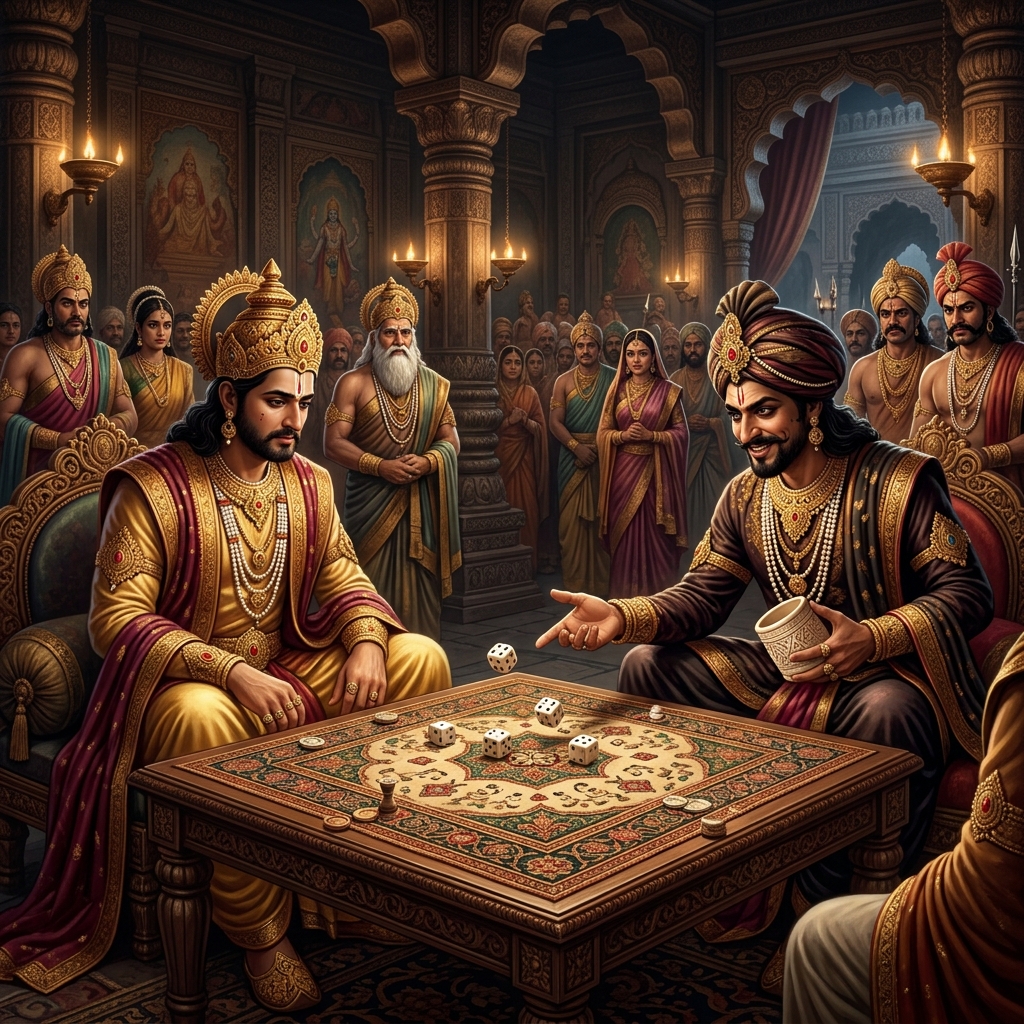
He was remembering a hall, not a battlefield. He was remembering Draupadi's hair wound in Duhshasana's fist, and her voice breaking as the sons of Dhritarashtra laughed around the dice, and his own voice rising over that laughter with an oath the whole court had heard: that he would tear open Duhshasana's chest and drink the blood from it, that he would break Duryodhana's thigh with this same mace, and that of the hundred brothers not one would live to see another season. Three days of war had let him keep none of it yet. Today he meant to begin.
'Today,' he told his charioteer, 'I stop counting how many days this war will take, and start counting how many of them are left.' The words were flat, without heat, which was somehow worse than fury would have been.
Across the field, Duryodhana watched the Pandava center shift and knew, before the first arrow flew, exactly where the day's weight would fall. He had a hundred brothers. He could not yet imagine losing eight of them before the sun reached its height, and so he did not try. He signaled his own line forward instead, and the two armies came together on the fourth morning the way a wave comes together with a wave, with no memory of the wreckage the last one had left.
Eight Sons of a Hundred
What happened next would be sung and wept over for generations, and no two singers would tell it quite the same way, but every version agreed on the number. Bhima left his chariot behind and went into the Kaurava center on foot, because a mace wants closeness the way an arrow wants distance, and because he had promised himself that these deaths would not be delivered from a safe remove.
He did not fight like a general. He fought like a debt collector. One Kaurava prince fell trying to hold a line that could not be held; another died charging him outright, thinking numbers might succeed where skill had failed; a third and fourth came at him together and left together, borne off by the same silence. By the time the sun stood at midmorning, eight sons of Dhritarashtra lay broken on the field, and the Kaurava center that had been a wall an hour before was a gap that kept widening.
Duryodhana watched from his chariot at the rear of the formation, and for once his famous composure did not hold. He had grown up counting his brothers the way other men count fingers, without needing to think about it, and now the count was wrong and would not come right again. Grief and rage arrived in him at the same moment and fused into something that looked, from a distance, like resolve.
He turned to the warrior beside him. 'Bhagadatta,' he said. 'Bring the elephant.'
Bhagadatta of Pragjyotisha needed no second summons. He was already moving his mount forward, the great tusker Supratika swaying beneath him like a hill deciding to walk, and the Kaurava soldiers who had begun to break saw that shadow fall across the field and found, for the first time that morning, a reason to stand their ground again.
Supratika's Shadow
Supratika had no equal on either side of the field. He stood taller than any war elephant either army had brought to Kurukshetra, and Bhagadatta rode him the way a king rides a fortress, secure and half-visible behind the beast's own bulk, his goad and his bow both finding their mark from a height no arrow shot in return could easily reach.
Bhima went to meet him on foot, as he had gone to meet everything that day, and for the first time since dawn he found something that would not simply break under his mace. Supratika's hide had been trained to war and hardened by it; his charge alone scattered chariots that stood in his path, and his trunk lashed out with a speed that seemed impossible in something so vast. Bhima dodged, circled, struck at the great legs and the trained flank, and for every blow he landed the beast answered with a rush that sent lesser warriors diving clear.
Bhagadatta fought well above the elephant's back, his arrows finding the gaps in Bhima's guard, his goad turning Supratika's fury with a precision that spoke of years spent learning this one animal's temper. Slowly, inch by contested inch, the ground that Bhima had won that morning began to hold rather than advance. The Kaurava soldiers who had scattered before his mace found their courage returning in Supratika's shadow, and the wall that eight dead princes had opened began, however raggedly, to close again.
It was not defeat. Bhima was not a man defeat came to easily, and he gave no ground he did not mean to give. But it was, for the first time that day, a check, and both armies felt it as one. The morning's slaughter had a rhythm that any single warrior could break; Bhagadatta and his elephant had found where that rhythm lived, and for now, at least, they held it.
The Twilight-Born
The sun was low and red over the western hills when the field changed a second time. A figure entered the battle that neither army's captains had planned for, tall beyond the measure of ordinary men, dark as a monsoon cloud, moving with a hunger that seemed to grow rather than tire as the light failed. This was Ghatotkacha, son of Bhima and the rakshasa Hidimbi, born in the forest years before the war had a name, and this was the first day he had ever set foot on this field.
He fought as his mother's people fought, which was to say he did not fight as a man at all. Where Bhima's strength was plain and total, Ghatotkacha's was uncanny, layered with illusion that thickened as twilight thickened, so that a single warrior seemed to become ten, and ten seemed to fill the darkening sky with shapes that had no fixed number and no fixed place. Arrows passed through forms that were not truly there. Spears found air where a moment before there had been a throat. The Kaurava line that Bhagadatta and Supratika had spent the whole afternoon rebuilding did not merely bend under this; it lost, for long minutes, any sense of where the enemy actually stood.
Duryodhana's soldiers, exhausted by a day that had already cost them dearly, broke a second time, and this breaking was worse than the first because it came with fear rather than mere pressure. Men who had held their ground against Bhima's mace could not hold it against something that multiplied in the dusk and struck from every direction their eyes reported at once.
On the Kaurava side, only the coolest heads did not run. Bhishma watched from his position at the center of the army, unmoved by the illusions filling the sky, and began already to calculate what the falling darkness would cost his side if the fighting continued much longer into it.
What You Chose
Bhishma had commanded armies since before most of the men now dying had been born, and he knew a truth that neither excitement nor grief could argue him out of: rakshasas fight best in darkness, and grow stronger, not weaker, the longer the night runs. Ghatotkacha's illusions would only multiply as the last light failed. To hold the field against him now would cost more than any gain was worth.
He gave the order himself, without waiting for Duryodhana to ask it of him. The Kaurava conches sounded retreat, ragged and unfamiliar after three days in which that particular call had not been needed, and the army pulled back from a field it had, for most of the day, been losing anyway. It was the first time since the war began that the Kauravas ended a day in withdrawal rather than in a line that simply stopped fighting where it stood.
In the camp that night, Duryodhana went from tent to tent counting what the day had actually cost him, and when the count reached eight brothers he stopped being able to hold his face still. He wept where his generals could see him, which was not a thing he often allowed himself, and when Bhishma found him there was no comfort in what the old man offered.
'You wanted this war,' Bhishma said, not unkindly, but not gently either. 'You refused every peace Krishna carried to you, down to the last, when five villages would have ended it. This is what a war looks like when it is not refused a second time. Grieve for them if you must, but do not ask me to tell you it was unforeseen.'
Far away in Hastinapura, blind Dhritarashtra sat through Sanjaya's account of the day in a silence that had, by now, become its own kind of grief, hearing in the number eight the shape of a fear he had never once let himself say aloud.
Dharma Lesson
Bhima's fury on this day is not wild anger but a vow being paid, one brother at a time, precise and remembered from a dice hall years past. Even in withdrawal, Bhishma acts from a soldier's clear judgment rather than fear, refusing to let darkness and a rakshasa's illusions cost more lives than the ground would be worth. Grief and consequence are inseparable: Duryodhana weeps for brothers whose deaths were set in motion by his own refusal of peace, and Bhishma will not soften that truth for him.