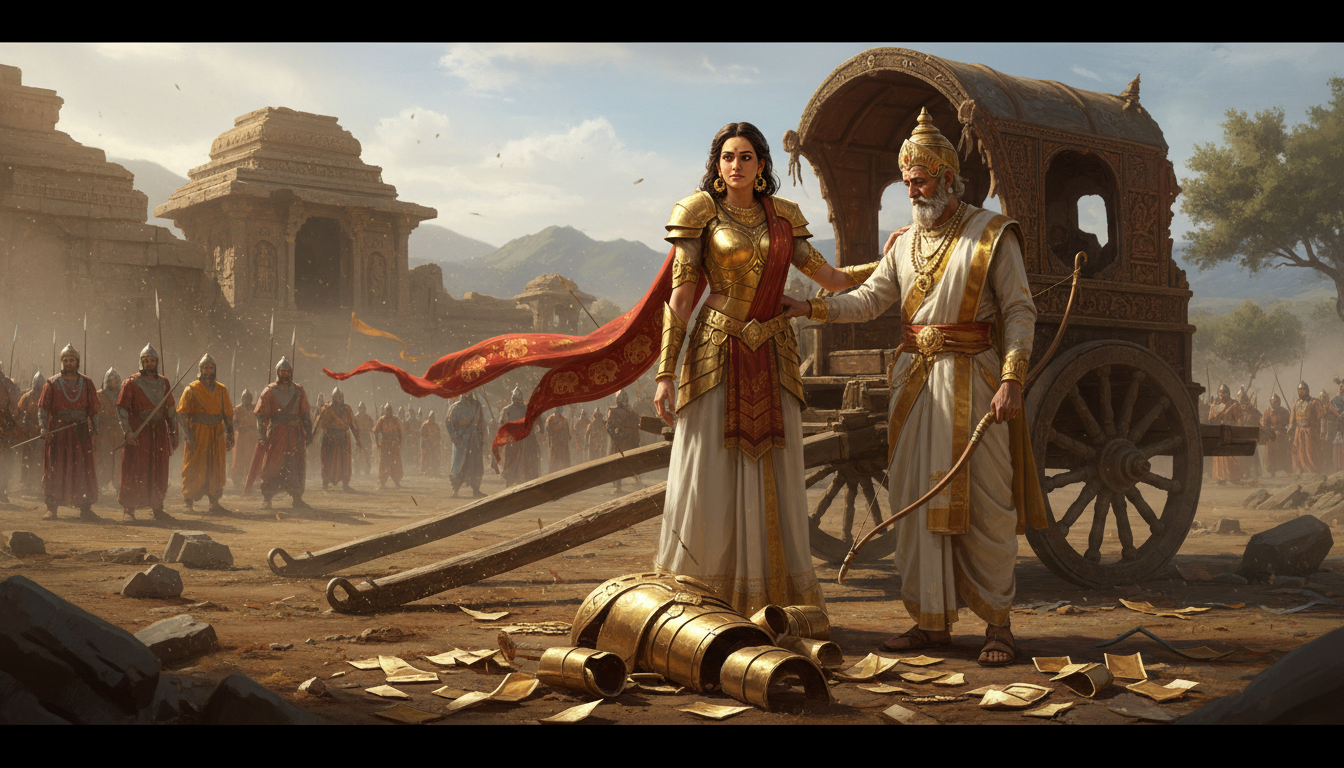
Karna Spares the King
The armour cut away, and a hand laid on Yudhishthira's shoulder
The Question the Blind King Asked
"Tell me how it was done," Dhritarashtra said. "Karna caused a great slaughter and then went into the middle of the Pandava troops and struck king Yudhishthira. I have heard that much. I want the rest of it. Who among the Parthas stood in front of him? Who were the ones he had to crush before he could get his hands on the king?"
"He began with the Pancalas," Sanjaya said.
Dhrishtadyumna had the Parthas drawn up and waiting. Karna saw the formation and did not go around it. He drove straight into it, and the Pancalas, who wanted the victory as badly as he did, came at him from the other direction, like swans going down a river to the sea.
Then the conchs went, thousands of them from both hosts at once, a noise so shrill it went into the chest and hurt. Under them the drums, thousands of those. Then the other instruments, and the elephants screaming, and the horses, and the wheels, and the lion-shouts of men who intended to be remembered. The whole earth with her mountains and trees and oceans seemed to shake with it. The sky shook. The sun and the moon and the stars in their places shook. Every creature there felt it that way, and among those creatures were some who did not have the strength for it, and they simply fell down where they stood and died of the sound.
"And then," Sanjaya said, "with great wrath, quickly invoking his weapons, the son of Radha began to smite your enemy's army the way Maghavat smites the army of the Asuras. King, I am going to give you numbers. They are what I have. It is the only honest way to tell you what one man did between noon and the middle of the afternoon."
Seventy-Seven, Then Twenty-Five, Then Five
He went into the host shooting, and the first thing he did inside it was kill seventy-seven of the foremost warriors among the Prabhadrakas.
Then twenty-five Pancalas, with twenty-five sharp shafts fitted with good wings, one each, and no shaft wasted. Then the Cedis, with long cloth-yard shafts winged with gold and made to go through any armour a man could afford, and the Cedis he did not kill by the score. He killed them by hundreds and by thousands.
While he was in the middle of that, the Pancala chariots came round him on all sides, a great press of them, and he aimed five irresistible arrows and five of their leaders died, and Sanjaya said their names to the blind king because their people would want them said: Bhanudeva. Citrasena. Senavindu. Tapana. Surasena.
A wail went up out of the Pancala host then, the cry that armies make when they realise the thing in among them cannot be stopped by more men. Ten more car-warriors closed on him. He killed the ten.
"He was not alone in there," Sanjaya said. "Two of his own sons were riding at his wheels, Sushena and Satyasena, and they fought as if their lives were not worth counting. His eldest, Vrishasena, kept himself behind his father the whole time, so that nothing came at Karna's back. That is a thing I saw and I will say it. Whatever else the man was, his sons chose to stand at his wheels."
The Whole Pandava Line Comes at One Man
So they all came for him together.
Dhrishtadyumna. Satyaki. The five sons of Draupadi. Vrikodara. The Pancala prince Janamejaya. Shikhandi. The foremost of the Prabhadrakas, and the Cedis, and the Kaikayas, and the Pancalas who were left, and the twins, and the Matsyas, all of them in mail, all of them riding at Radha's son at once because one at a time was not working. They poured every kind of weapon on him, and thick showers of arrows, the way clouds afflict the breast of a mountain in the rains.
Karna's sons put themselves in the way.
Sushena cut Bhima's bow with a broad-headed arrow and put seven cloth-yard shafts into his chest and roared. Bhima strung another bow, cut Sushena's, and, dancing on his car with rage, put ten arrows into Sushena and then seventy into Karna in the time it takes to blink. Then he found another of Karna's sons, Bhanusena, and felled him entire in front of his friends, horses and driver and weapons and standard together, and took the boy's head off with a razor-headed arrow, and the head with its moon-bright face went off the neck like a lotus plucked off its stalk while the father watched.
Bhima did not stop there. He cut the bows of Kripa and of Hridika's son and left them helpless. He put three arrows of solid iron into Duhshasana and six into Shakuni, and knocked Uluka and his brother Patatri out of their cars, and then reached for another arrow and told Sushena, "You are slain."
Karna cut that arrow out of the air, and put three shafts into Bhima, and when Bhima nocked a second one for the same target Karna cut that too. Then, wanting his son alive and wanting Bhima dead, he struck Bhima with seventy-three fierce arrows at once.
A Hundred Arrows for the King
Nakula came at Sushena and the two of them tore each other apart for a long while, bow after bow cut and replaced, Nakula killing the driver and splitting Sushena's great bow into three, Sushena rising each time and pouring sixty arrows back at him and seven more at Sahadeva.
Satyaki went for Vrishasena. He killed the driver with three arrows, cut the bow with a broad-headed shaft, struck the horses with seven, crushed the standard, and put three arrows into the young man's chest. Vrishasena went down senseless on the floor of his car and was standing again before anyone could count to three, and, having nothing left to shoot with, took up a sword and a shield and came at Satyaki on foot to kill him with his hands. Satyaki shot the sword and the shield out of his grip with ten arrows headed like a boar's ear. It was Duhshasana who came across, lifted him onto his own car, carried him out and put him into a fresh vehicle.
And Vrishasena, remounted, went back in and did this: seventy arrows into the five sons of Draupadi, five into Yuyudhana, sixty-four into Bhimasena, five into Sahadeva, thirty into Nakula, seven into Satanika, ten into Shikhandi, and one hundred into king Yudhishthira.
"Sini's grandson answered for it," Sanjaya said. "He made Duhshasana driverless and horseless and carless with nine times nine arrows of solid iron, and then put ten more into his forehead, and your son went and found a third chariot and came back and fought on from inside Karna's division. That is the kind of afternoon it was, king. Men were not being killed so much as dismounted and returned to the field."
Nobody Could See His Hands
They ground at him. Dhrishtadyumna with ten arrows. Draupadi's sons with seventy-three. Yuyudhana with seven. Bhimasena with sixty-four. Sahadeva with seven. Nakula with thirty. Satanika with seven. Shikhandi with ten. Yudhishthira with a hundred.
Karna turned his car through them, and pierced every single one of those men with ten arrows apiece, and then did it again.
"This is the part I cannot make you see," Sanjaya said, "and I was there and I could not see it either. Nobody could tell when he took up an arrow. Nobody could tell when he set it or when he loosed it. There was no moment in it that the eye could stop on. What people saw was his enemies dying quickly, one after another, and they worked backward from that to the wrath that must have been in him. The sky and the earth and every quarter of the compass were shut in with sharp arrows. The whole firmament looked as though it had gone over to red cloud."
Then he pierced each of his assailants with three times as many arrows as each had put into him, which was his way of answering a thing, and then once more, with ten arrows apiece for each man and his horses and his driver and his car and his standard, and he shouted.
And they gave him a way through.
That is the exact truth of it: the best warriors the Pandavas had opened and let him pass, because there was nothing else left to do. He came out the other side of them unresisted, into the middle of the division the Pandava king commanded in person. He destroyed thirty cars of the Cedis, who did not turn, and then he began to put sharp arrows into Yudhishthira.
The King Calls Him by His Father's Trade
They tried to build a wall in front of the king. Shikhandi and Satyaki brought men around him. The Dravidas and the Andhakas and the Nishadas, foot-soldiers, urged forward by Satyaki, went at Karna to kill him and came apart in front of him, heads and arms gone, dropping together like a stand of sala trees taken down with the axe. The Pandus and the Pancalas and the Kekayas held the line as men hold off a disease with charms and medicines, and for a little while it worked, and Karna could not get through.
And Yudhishthira, checked at a little distance from the man who had spent the day killing his army, went red in the eyes and spoke to him across it.
"Karna. Karna. You of the vain sight, you son of a Suta, listen to me. You are the one who is always challenging Phalguna. You are always looking for a way to oppose us, because Dhritarashtra's son tells you to. Muster your great prowess, then. Show me today all your might, all your energy, and every bit of the hatred you carry for the sons of Pandu. In this encounter, today, I will purge you of your appetite for battle."
And he shot: ten shafts of solid iron winged with gold.
Karna took the greatest care over his answer and gave him back exactly ten, headed like a calf's tooth. He did not say anything at all, and Sanjaya, who was watching the two of them, told the blind king that the silence was itself the contempt, and that Yudhishthira understood it as such and blazed up the way a fire does when butter is poured on it.
The Arrow in the Left Side
Then the eldest son of Pandu bent his formidable bow with the gold on it and set on the string a whetted arrow that would go through a hill.
He drew it to its fullest stretch. He was a better archer than men remember, because he stood next to a brother who was the best in the world, and on this one occasion the whole world watched him shoot.
The arrow went with a noise like thunder and took Karna in the left side.
The stroke was so violent that his limbs went out of his control. The greatest bowman on that field fell into a swoon on the floor of his own chariot and his bow dropped out of his hand and lay there.
"Your host cried out," Sanjaya said. "Oh, and alas, all along the line, and I watched the colour go out of the faces of men who had not been afraid at any point in seventeen days. And from the Pandava side, king, such a roar. Lion-shouts and confused shouting and men embracing each other in their cars. They believed for the length of about ten breaths that Yudhishthira the just had ended the war himself, in the open, in front of everyone."
Then the son of Radha came back to his senses, and there was nothing in his mind at all except the destruction of Yudhishthira.
Vijaya, and the Two Princes at the Wheels
He drew the great bow called Vijaya, the one decked with gold, and he began.
The first two things he did were not aimed at the king. Two Pancala princes guarded Yudhishthira's chariot wheels, Candradeva at one and Dandadhara at the other, and standing on either side of the king's car they had looked, all day, like the twin star Punarvasu standing on either side of the moon. Karna killed them with two razor-headed arrows, one apiece, and then the king had nobody at his wheels.
Yudhishthira put thirty arrows into him for it, and three each into Sushena and Satyasena, and three into every man protecting Karna's car. Karna laughed, shook his bow at him, opened a long cut across the king's body with a broad-headed arrow, put sixty more into him, and shouted.
That brought everyone. Satyaki and Chekitana and Yuyutsu, Shikhandi, the sons of Draupadi, the Prabhadrakas, the twins, Bhimasena, the Karushas and the Matsyas and the Suras and the Kaikayas, the men of Kasi and the men of Kosala, all of them rushing in wrath at one chariot to grind the man in it down with arrows. The Pancala prince Janamejaya put a great many into him.
And Karna, with every foremost warrior the Pandavas had assailing him from every side at once, called up the brahmastra and filled all the points of the compass with arrows. He went through that forest of troops the way fire goes through a forest, having shafts instead of flame for the scorching.
Ninety Shafts and the Armour Comes Off
Then, laughing, aiming some of the mighty weapons, he cut off Yudhishthira's bow.
And then he did the thing that was remembered, and it took him no longer than a blink: ninety straight arrows, and with those ninety he cut the armour off the king's body. It came away in pieces, gold-worked, set with gems, and it fell slowly, and Sanjaya said it looked like a wind-torn cloud with the sun's rays coming through it, and then lying on the ground with all its costly brilliants it looked like the night sky with the stars out.
Yudhishthira stood in his chariot with no armour on and blood coming out of him and threw an iron dart at Karna with everything he had. Karna cut it into pieces in the air with seven shafts and it fell.
So the king took four lances and struck him with them, in both arms and in the forehead and in the chest, and shouted every time one went home. The blood came out of Karna's wounds and ran down him, and he began to breathe like a snake, and then he cut down the king's standard, put three broad-headed arrows into him, cut away both his quivers, and broke his chariot into small pieces.
Yudhishthira got onto another car, behind those horses of his that were white as ivory with black hair in their tails, the ones that had carried him to every battle of the war. His second driver had already been killed. He was past being able to stand in front of Karna, and there was nothing cheerful left in him.
He turned his face away and fled.
The Open Palm
Karna went after him and caught him.
He put out his own fair hand and laid it flat on Yudhishthira's shoulder, and the palm of that hand carried the auspicious signs a man is born with and cannot earn: the thunderbolt, the umbrella, the hook, the fish, the tortoise, the conchshell. He was not striking. He had hold of him and he meant to take him alive.
And then he remembered the words of Kunti.
"Do not seize this best of kings," Shalya said quickly from the reins. "The instant you lay hold of him he will burn you and me both to ashes."
So Karna laughed in mockery, which was the only cover he had, and spoke down at the son of Pandu.
"Born in a noble race, and observant of the duties of a Kshatriya, and here you are leaving a battle in fear because you want to save your life. I do not think you are well acquainted with what a Kshatriya owes. You have Brahma-force in you. You are devoted to the study of the Vedas and the performance of the sacrifice. Do not fight again, son of Kunti. Do not go near brave warriors again. Do not use harsh language to heroes and do not come to great battles. Say those words you said to me to somebody else. Never to men like us. Speak that way to men like us and this is the sort of behaviour you will meet with, and worse. Go back to your quarters, son of Kunti, or go where those two are, Keshava and Arjuna. Karna will never kill one like you."
Then he took his hand off the king's shoulder and let him go, and turned back into the Pandava host and began slaughtering it like the wielder of the thunderbolt slaughtering Asuras.
Yudhishthira rode away fast. The Cedis went with him, and the Pandavas, and the Pancalas, and Satyaki, and the sons of Draupadi, and the two sons of Madri. He borrowed the car of Srutakirti and stood in it and watched Karna work.
And Bhima, seeing what had been done and to whom, called Satyaki and Dhrishtadyumna to him. "Go and protect king Yudhishthira. He got out of a very great danger just now with difficulty, in front of my own eyes. I saw the armour and the robes cut off the king, and torn, for Duryodhana's gratification, by Radha's son of wicked soul. Today I reach the end of that grief. Either I kill Karna in this battle or he kills me, and I am telling you the truth. I make the king over to you both as a sacred pledge. Be glad, and go and keep him alive."
Then Yudhishthira looked at his own retreating troops and found his voice and gave the only order he had left. "Slay these enemies. Why are you inactive?"
He had been let go in public. He had heard himself told, in front of two armies, to go home and read. Karna had put a hand on his shoulder as a man puts a hand on a boy, and the whole field had seen it, and the wound of it went in somewhere no arrow had reached that day. He carried it back to camp with him, and it stayed, and in a few hours it would come out of his mouth in a tent in front of the one brother who could not be spoken to that way.
Dharma Lesson
Contempt cuts deeper than a blade, and a man spared in public may carry the humiliation further than the wound would have carried him. Karna kept a promise to his mother by disguising mercy as scorn, and the disguise worked so well that it poisoned the man it saved. What we do for the sake of a private vow is still judged by everyone who has to watch it.